The Abatement Of Cruelty, Ctd

A reader makes an important point:

Your reader said: “And please, if we all became vegetarians/vegans … we would probably run out of arable land to feed everyone.” This could not be more wrong. Converting plants into meat is a very inefficient way to transmit the plants’ calories and nutrients to people. If we simply ate plants instead of meat, we’d need a lot LESS agricultural land. And the USA has one of the lowest population densities of any developed country, so we have plenty of arable land to spare. This is a complete red herring.

Another backs that up with a NYT piece:

[A]bout two to five times more grain is required to produce the same amount of calories through livestock as through direct grain consumption, according to Rosamond Naylor, an associate professor of economics at Stanford University. It is as much as 10 times more in the case of grain-fed beef in the United States.

The reader adds, “I gave up eating meat years ago not because I am morally opposed to the idea of killing animals, but because it was the one action I could take that would have the greatest impact on my carbon footprint.”

Greenwald’s New Gig

Earlier this week, Ebay founder Pierre Omidyar unveiled his new media venture headlined by Glenn. Jack Shafer deduces its goals:

Omidyar’s first-round hiring of Greenwald, Scahill, and Poitras — who hail from the rich tradition of partisan American journalism — speaks to his idealism. Where Bezos is banking on an institution and its brand value, Omidyar is making his first-round investment in individual journalists whose work he admires. Like Hearst, who preached in favor of the “journalism of action” that battled corruption and incompetence, and got things done, I assume Omidyar has world-changing on his mind.

Jay Rosen talked to Omidyar by phone about the specifics:

NewCo is a new venture— a company not a charity. It is not a project of Omidyar Network. It is separate from his philanthropy, he said. He said he will be putting a good deal of his time, as well as his capital, into it. I asked how large a commitment he was prepared to make in dollars. For starters: the $250 million it would have taken to buy the Washington Post. … the business model isn’t fully worked out yet, but this much is known: all proceeds from NewCo will be reinvested in the journalism. Also: there is no print product planned.

Henry Farrell believes the new venture will deeply affect the relationship between information technology and politics:

It will likely shape up as a serious journalistic enterprise. Capital of USD $250 million can hire some very good people. The venture has the potential to become the kind of news source that can turn information into knowledge. Yet it doesn’t sound as if it’ll be bound by the kinds of political relationships that most newspapers are embedded in. The Columbia Journalism Review gets this best when it describes the venture as I.F. Stone’s Weekly, if it had been lavishly funded by a friendly billionaire.

If this works, it is likely to change the relationship between information, knowledge and politics in some very interesting ways. Most obviously, it will make it even harder for the U.S. government to control the politics of leaks by pressuring newspapers not to publish stories that it thinks hurt the national interest.

Mark Coddington rounds up other responses to the news.

Dissents Of The Day

A reader writes:

One of the repeating themes in your commentary about the mess that is the GOP is that the region most responsible is the South. I’ve always thought you significantly overplayed that theme. My concern isn’t to defend the South, but to see the problem as it is, rather than through historical assumptions.

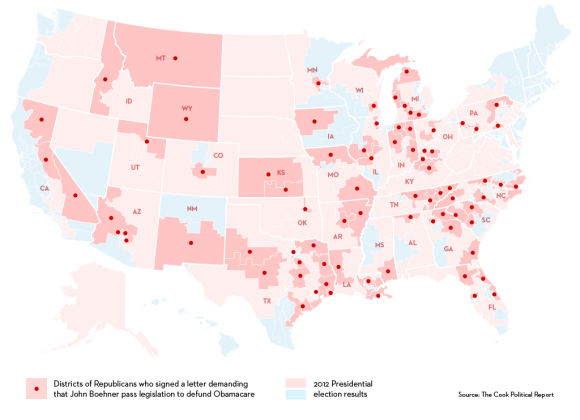
You posted this map a few weeks ago, showing the districts of the 80 Republican congressmen who signed a letter asking Boehner to defund Obamacare by threatening to shut down the government:

suicide-caucus

You can see that this nonsense isn’t just a regionalized phenomenon. It has hotbeds scattered all over the country, from Arizona to Pennsylvania, and Florida to Idaho, with more support in Michigan, Indiana, and western Ohio than in Alabama, Mississippi, and western Tennessee. Insofar as any region stands out at all, it’s Appalachia, not the former Confederacy. Even to say it’s Appalachian, though, is misleading. There’s more Tea Party support in Kansas than there is in West Virginia, for example. A more accurate description might be that Tea Party support generally tracks cultural Appalachia, but even that would have major exceptions.

On the whole, like racism, Tea Party support is ultimately much more age- and class-based than it is regional. Your emphasis on the old Confederacy confuses more than it clarifies.

I’d say it may confuse as well as clarify. I was too lazily reductionist and apologize for the confusion part. Nonetheless, even though the subculture may have spread beyond the South to much of rural, white America, you can still see the themes of nullification, secession, and states’ rights throughout the Obama opposition. They have a history.  Another reader is much more blunt:

I believe “The Tea Party As A Religion” is a very intemperate and inflammatory piece. If your goal is sensationalism to fire up your readership and improve your commercial success, then I believe it’s probably well done. If your goal is dialogue that tries to get at the truth of things and advance our common interest, then it is rather poorly done. You, for one, blast charges of racism against anyone that opposes Obama’s policies, with absolutely zero evidence for racism. It’s an incredible non-sequitur. Obama is black, I oppose Obama’s policies, therefore I am a racist. This is the worst kind of political arguing, gets us nowhere, and only leads to more enmity.

Indeed it is. But that is not what I wrote. The analysis in the post of the Tea Party deals with middle-class economic stagnation, bewildering changes in the culture (from a future majority-minority country to gay marriage), the decline of mainline Protestantism, the rise of modern fundamentalism, and the psychological need for total certainty in very unsettling times. It’s a very complex analysis, and it is elaborated at length in The Conservative Soul without any reference to race at all.

But to leave race out of it seems equally wrong to me.

Of course, opposition to Obama’s policies is not reducible to racism. But the fervor of the opposition, the personal contempt for and condescension toward the president, the rhetoric about his “otherness”, the refusal to believe he was born in America and is a Christian: these are all driven by some racial attitudes. They are part of the very complex mix. My goal is to try to capture reality – even if that might offend some of those I need to persuade. But for me, as a writer, I’ve long put understanding things as they are above any regard for my own influence. That doesn’t mean I haven’t gotten things very wrong. It just means that I’m trying to get things right. From the too-easy narrative about Matthew Shepard to the genetic aspects of race, from insisting on the fact of American torture to the reality of future crippling debt, I try to get things right.

Race in America still matters in complex ways. When Tea Party protestors wave the Confederate flag outside a White House occupied by an African-American, I’d be negligent for not addressing it.

Russia’s Race Wars

Julia Ioffe describes last weekend’s violence in Moscow:

[Russia is] second only to the U.S. in the number of illegal migrants, except that it is far worse at counting them and, unlike the U.S., does not even try to keep them out. They too live abysmal, perilous lives, and they too cause tensions with the local population. And, like in the U.S., the law of the land is far, far behind the reality. In fact, it doesn’t address it at all, leaving the more extreme elements in the country to take action themselves—kind of like in the U.S. (See: Arizona.)

But the problem in Russia is that, for the local population, the tension is not an economic one, but an overtly racial one. To wit: many of the migrants from the North Caucasus are Russian citizens because the North Caucasus is part of the Russian Federation. (They are  illegal because they don’t have the special permits required to live in Moscow.) The problem with people from the North Caucasus is that they are Muslim and have dark hair and dark complexions; that is, they stand out from the Christian Slavic part of the population. On good days, people from the North Caucasus or from former Soviet republics in Central Asia inspire derision and nasty, racist slurs. On bad days, it’s really, really bad.

The Tea Party Is The Enemy Of Small Government

Daniel McCarthy examines the self-delusion of the Republican base:

[A]nyone who is psychologically satisfied by actions that in fact cost taxpayers additional money, and that are counterproductive in the public arena, really an opponent of big government? A feeling of courageous satisfaction here is perverse: it subverts the principle it’s supposed to support.

Imagine what the Tea Party would accomplish if this incident became paradigmatic: government would grow, anti-government sentiment would be discredited, and the people responsible for both would continue to applaud themselves as the only true champions of limited-government principle.

The self-defeating emotionalism of Ted Cruz’s admirers won’t allow them to think through this problem. Instead they present themselves with a false dilemma between Cruz’s counterproductive incompetence and RINO liberalism. That there could be a more intelligent strategy for limited government than merely doing what feels good never occurs to them—it’s too painful to contemplate.

Larison chimes in:

Because small-government conservatism is a harder sell than many of the alternatives, it is especially important for its advocates to make good judgments about what is possible and to make sound decisions that prove that they are capable of running a government of reduced and limited powers. Neither of these has been on display in the last few weeks, everyone can see it, and it would be senseless for anyone to offer up spin to the contrary.

The Republican Crisis And The Bush Legacy

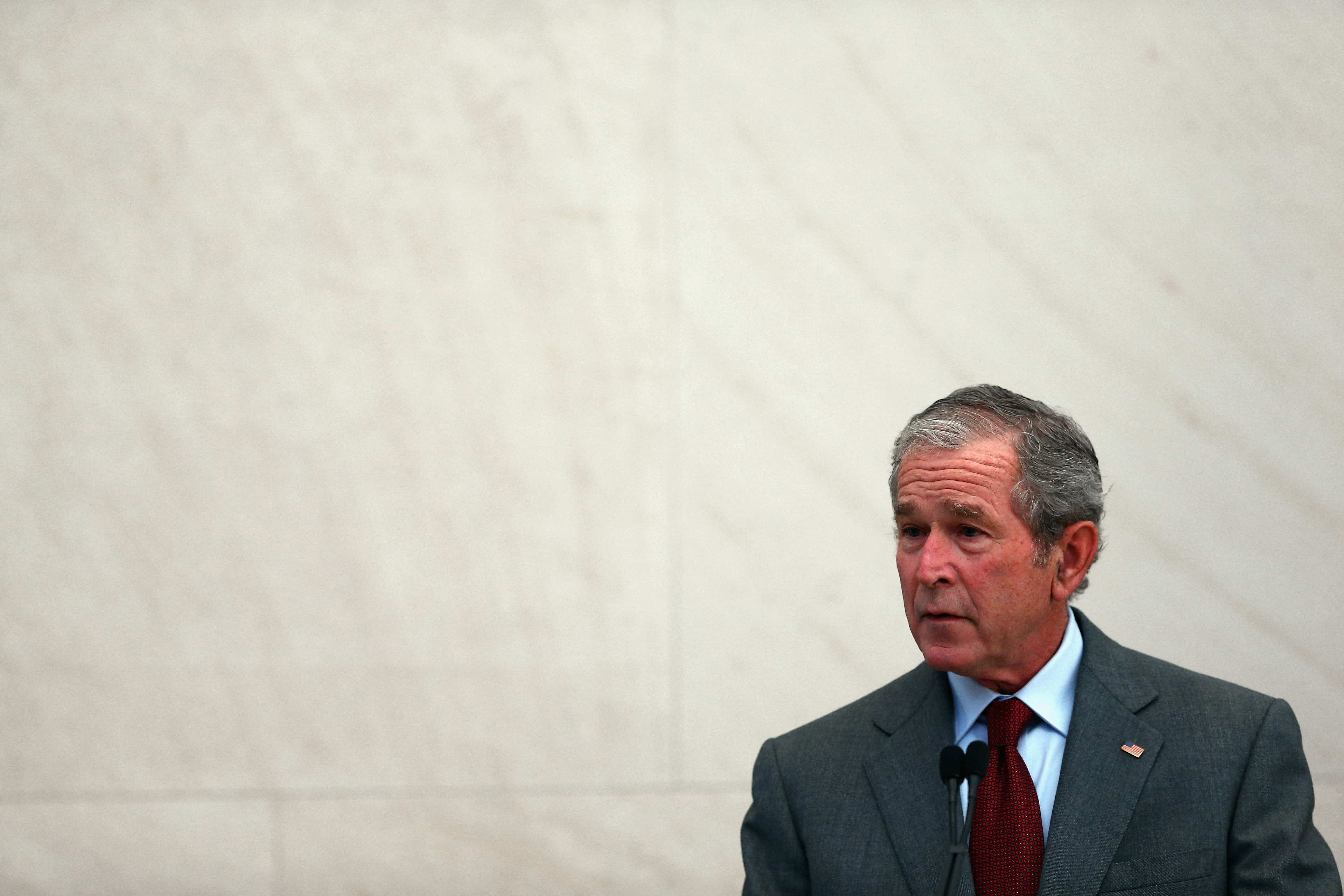
George W. Bush Speaks At Naturalization Ceremony At Bush Presidential Center

Erick Erickson announced this week his intention to primary the GOP Senators who didn’t vote to destroy the US and global economy. Even Mitch McConnell. And sure enough, McConnell’s primary opponent now has new backing – from the Senate Conservatives Fund. Larison shoots the stupid-fish in the barrel:

Having a larger number of uncompromising Republicans in the Senate probably wouldn’t have prevented yesterday’s deal, since nearly two-thirds of the Senate GOP voted for it anyway. That’s a lot of “charlatans” to defeat. Nonetheless, if a deal had been prevented thanks to Senate Republican opposition, Republicans would just as surely have “owned” the consequences of breaching the debt ceiling as they “owned” the shutdown. Those consequences would have been significantly worse for the country, and Republicans would have to start worrying about a net loss of seats in the Senate and the House. In case Erickson missed it, this would be the opposite of advancing. In other words, he wants to punish the Republicans that averted even greater disaster for the party than the failed strategy he urged them to follow.

And yet I am unsurprised. Friedersdorf focuses on the Republicans’ allergy to compromise:

Pretending that compromise is what went wrong during the Bush years helps conservatives evade responsibility for supporting an agenda many parts of which they find indefensible in hindsight.

It permits them to blame Democrats and establishment Republicans for events they themselves only rebelled against after the fact, and to delude themselves into thinking that everything will get better if only they vehemently insist on getting their way, sans compromise, all of the time.

Who wouldn’t want to believe that’s all success takes? It’s a pretty lie that talk radio hosts find it easy to tell over and over again, despite contrary evidence, because conservatives want to believe that it’s true. Reality is much harder to face. In order to mount a comeback and wield influence in American politics, conservatives need to face their own flaws, negotiate savvy compromises with President Obama and Democrats, build credibility and momentum with small gains in the short term, persuade people of their ideas and governing vision in the medium term, and implement their agenda by winning elections rather than brinkmanship. But hard truths don’t attract a large enough audience to sustain a talk radio show.

I do think the refusal to pore over the Bush-Cheney fiasco honestly remains a major block to reform on the right. The rational ones must know that Bush’s Medicare D was far more expensive than the Affordable Care Act, and, unlike the ACA, was never budgeted. They must know that domestic spending exploded under Bush, even as he refused, unlike Reagan before him, to budge on his ruinous tax cuts. They know they cannot attack Obama’s allegedly imperial presidency without confronting the much more expansive claims for executive power made by Cheney et al. They also must know somewhere in their heads that the debt we now have was not created by Obama. he just had to manage it in the depths of the worst recession since the 1930s. The debt is a function of tax cuts we couldn’t afford, wars we couldn’t afford, a new entitlement we couldn’t afford and a recession caused by an unregulated Wall Street run amok.

And on current spending, they must know that Obama’s record – partly thanks to them – is of serious deficit reduction, year after year, from over 10 percent of GDP to just over 3 percent predicted in 2016. Because acknowledging this reality means self-criticism, they cannot do it (and I don’t mean criticism of other Republicans, but of your own responsibility for the mess). But until they engage in self-criticism, especially of the Bush-Cheney administration, they cannot get to a place where they don’t need rigid adherence to purist ideology to keep their own worldview afloat. And that’s the only place – a pragmatic, sane, constructive, reality-based place – where they can rebuild their party and their message. The longer the suppression of the truth about Bush the longer the dysfunction will last.

(Photo: Former U.S. President George W. Bush speaks during a immigration naturalization ceremony held at the George W. Bush Presidential Center on July 10, 2013 in Dallas, Texas. By Tom Pennington/Getty Images.)

Why Is Obama Preventing The Release Of The Senate Torture Report?

abughraibleash.jpg

It is becoming clearer and clearer that one major power-broker in Washington is resisting the release of the Senate Intelligence Committee’s allegedly devastating report on the torture program run by the Bush-Cheney CIA. That major power-broker is the Obama administration.

You might be surprised by this, given the president’s opposition to torture and abolition of it. But the evidence is at this point irrefutable – and given extra punch by the invaluable Jane Mayer, who caught a fascinating document related to the Senate confirmation this week of Stephen W. Preston, the top lawyer at the CIA., for a new post as the top lawyer for the Pentagon. Senator Mark Udall wanted to get Preston on record about his views on the CIA’s past torture program and the reasons the CIA has given to prevent the public release of the Senate report. And he did in a series of questions you can read here.

Here’s what I got from the document and Jane’s reporting. The CIA’s own current chief counsel believes the CIA lied to and misled the Congress repeatedly about its torture program:

The C.I.A. has defended its record on keeping Congress informed. In contrast, Preston, in his answers to Udall, concedes that, during the Bush years, the C.I.A. “fell well short” of current standards for keeping the congressional oversight committees informed of covert actions, as is required under the 1947 National Security Act.

In fact, Preston admits outright that, contrary to the C.I.A.’s insistence that it did not actively impede congressional oversight of its detention and interrogation program, “briefings to the Committees included inaccurate information related to aspects of the program of express interest to Members.”

More to the point, Preston flatly disagreed with the CIA’s contention that it’s impossible to know whether intelligence procured through torture could have been achieved through civilized and legal methods. He says, in fact, that it’s perfectly possible to know this – and, indeed, the Senate Report documents the counter-factuals in excruciating, specific detail – the report is over 6,000 pages long. Since the entire legal defense of torture was premised on the idea that traditional, legal methods could not have been proven as equally effective, this point is important. It could show that the entire legal rationale for torturing prisoners was based on something even the CIA’s legal counsel believes is untrue.

Check out Katherine Hawkins’ read of the same just-released document. But for me, the obvious conclusion is that the CIA is stonewalling to prevent the full extent of its responsibility for war crimes from being known. At the head of the CIA is John Brennan, whose fervent opposition to releasing the full report is well known. But Brennan answers to the president, who has urged the release of the report.

So why the hold-up? That is the question.

Why is Obama allowing Brennan to undermine Obama’s own position? Why is the president allowing the CIA to prevent the very transparency he once pledged to uphold? I don’t know. But what I do know is that it is now Obama who is the main obstacle to releasing the Senate Report on Torture. He needs to tell his CIA director to give up his struggle to keep us all in the dark. He needs to stop dithering and tell Brennan to get out of the way of the report’s release – so we can all see, digest and understand what was done, in secret, in our name.

(Photo: Lynndie England demonstrating one of the CIA-approved torture techniques for breaking down the psyches of terror suspects, in US-run Abu Ghraib prison.)

A Note Of Thanks

After these several high-drama political weeks, I just wanted to offer some thanks to all the new Dish subscribers who signed up in October. We have had a surge of new subs that eclipses any since March, after the tsunami of initial support in January and February. We have no howler beaglemarketing department except for the Dish itself, and it’s incredibly rewarding to see simple content bringing us new readers and thereby a viable future.

I also want to thank the Dish team, whose salaries and healthcare you’re paying for, who have, despite their tender years, managed to produce well over 200 posts a week, round the clock, during frantic news cycles. Chris, Patrick, Jessie, Alice, Matt, Tracy, Chas, Brian and Brendan have no more job security than I have in this new experiment in reader-supported new media. But they work with an intensity and passion and integrity you have to see to believe. They make this look easy. It isn’t. I’m just immensely grateful so many of you seem to appreciate it, and have rewarded their hard work by actually paying for it.

If you’re still reading the Dish by bypassing our leaky meter and want to subscribe along with all these new, paying Dish readers, [tinypass_offer text=”please do”]. It takes two minutes and can cost [tinypass_offer text=”less than $2 a month”]. And thanks again to all of you who have – especially our Founding Members who helped get this whole show on the road in the first place. You rock. But you knew that already.

Update from a new subscriber:

Beats me why I waited so long to get out my credit card. Perhaps it’s because of the contrarian in me that led me to your site in the first place. I recognized in you (and those who write with you) an inability to accept the status quo wisdom as the best, last word. I just didn’t want to believe I had to be like all the others who immediately plunked down their cash to read all you offered. To me, maybe they were the lemmings. And I could get the best of the Dish by picking and skimming and finagling without bumping the meter limit. I was King of the Internets.

But I was wrong. Today, after the shutdown, after the GOP refused to pay for the things we all use – and they fucking liked it – well, I realized I wasn’t being the groovy iconoclast. I was being the winger-nut getting my stuff for free. So I gave up the ghost and paid. Glad I did. Sorry it took so long to realize that all the best misfits are inside the tent – agreeing and disagreeing with your wonderful and maddening posts.

The Tea Party As A Religion, Ctd

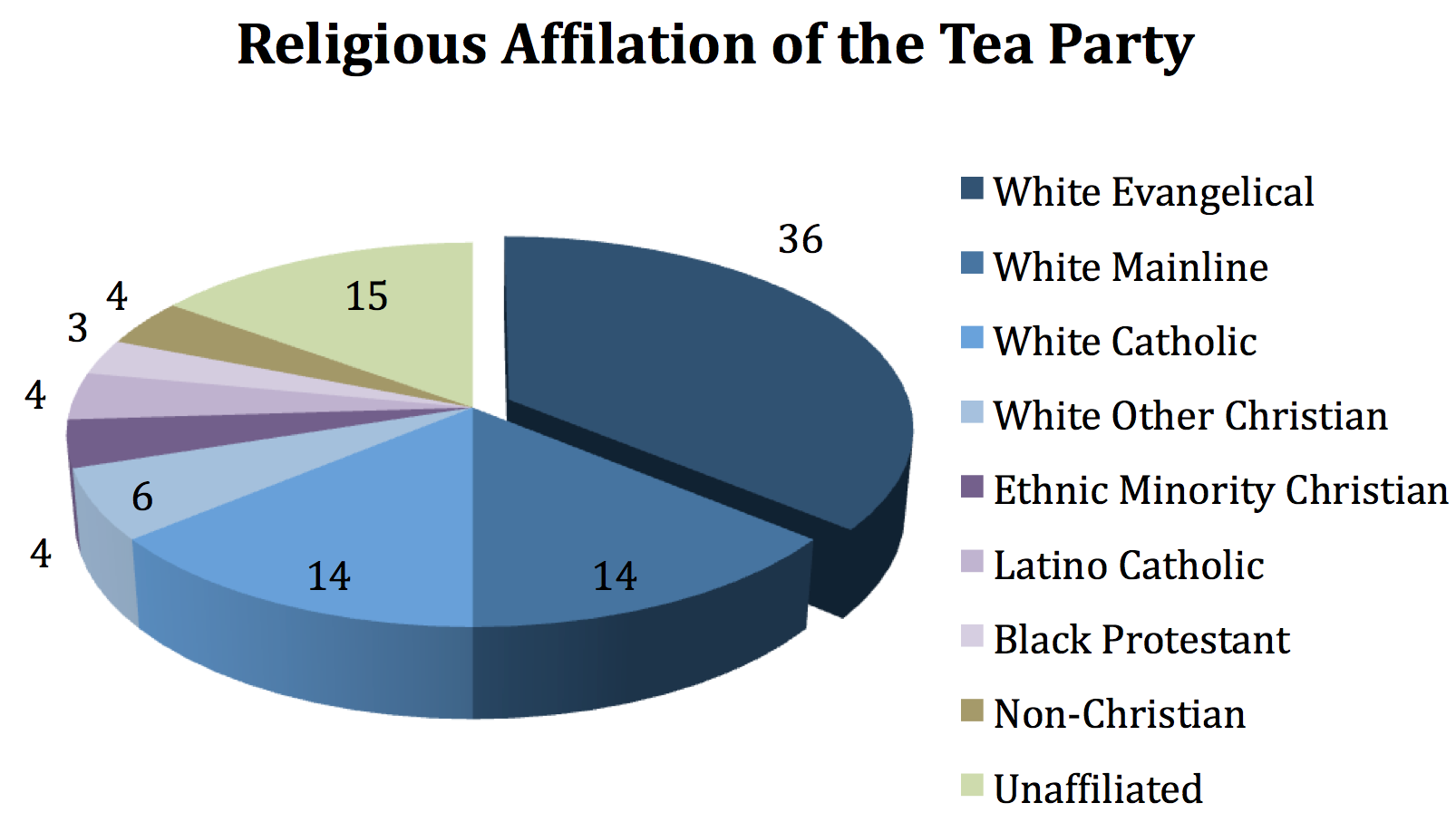
Tea Party Religion

Ed Kilgore responds to my take:

I think Andrew’s on the right track, but I’d add a complicating qualifier. It’s not just that these culturally threatened folk embrace their politics like it’s a religion. The actual religious outlook many of them espouse—whether they are conservative fundamentalist Protestants or neo-ultramontane Catholics—has imported secular political perspectives into their faith. They’ve managed to identify obedience to God with the restoration of pre-mid-twentieth-century culture and economics, and consequently, tend to look at themselves as the contemporary equivalents of the Old Testament prophets calling a wicked society to account before all hell literally breaks loose. So their politics reinforces their religion and vice-versa, and yes, the Republican Party, like the squishy mainline Protestant Churches and lenient do-gooder Catholic priests, are generally within crisis-distance of being viewed as objectively belonging to enemy ranks.

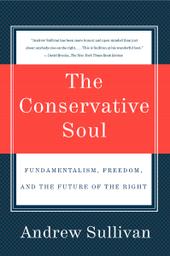
I’m grateful for Ed’s refinement of the thesis – and to Rod Dreher’s. My basic point is that underlying far right politics and religion is the fundamentalist psyche, which is, in modernity, a reaction to bewildering social change and economic stagnation. But the eddies here are manifold and mutually reinforcing. If your religious faith demands total assent to an inerrant set of doctrines, how likely are you to engage in conservativesoulpbc.jpgpolitical dialogue as if you don’t know all the answers and need input from others? If deviation from inerrant truth means damnation, then how easy is it to transition to a politics aimed at compromise? And by erasing the distinction between the religious sphere and the political – indeed insisting that it must never be erased – you can see how this entire syndrome reinforces itself and is very hard to counter with the usual democratic methods.

This is a complicated argument and if you want to absorb it at length, it’s the central critique of contemporary American “conservatism” in my book, The Conservative Soul. I think – but then I would, wouldn’t I? – that the book’s argument has held up almost too well in the years since it was published. But judge for yourself – it’s instantly available for your Kindle or iPad here. It both deconstructs today’s pseudo-conservatism and tries to reconstruct a conservatism of an older, deeper, wiser variety. To do that, it attempts to tackle religion as well as politics, to ponder the deep forces behind the current Republic crisis rather than the superficial ones.

Its main conclusion is that I do not believe we can have a political resolution in this country without first reforming Christianity, and distinguishing it from Christianist ideology. This is not easy, but the struggle to achieve this is winning some key reinforcements: Pope Francis and the next generation of evangelicals key among them. If some political Dishheads disdain our coverage of religion as gobbledygook – which is your right – then I hope you’ll see that the effort to reform Christianity is indirectly also a political project. It’s about saving conservatism from itself and making it humane again.

(Chart: The religious affiliations of Tea Partiers from “Religion and the Tea Party in the 2010 Election”(pdf))