China Invokes US Torture

Without quotation marks. It was bound to happen at some point, when the frenemies or allies or rivals of the US note that the world’s superpower has grotesquely violated the Geneva Conventions and held no one accountable:

In its commentary, Xinhua embellished its call for a new reserve currency with a scathing indictment of the United States’ broader role in the world, saying that the Obama administration claimed “the moral high ground” while covertly “torturing prisoners of war, slaying civilians in drone attacks and spying on world leaders.”

I don’t want an authoritarian police state to be able to use that accusation against the US. But which part of that sentence is untrue?

The Vitter End

Congressional Showdown As Government Shutdown Looms

So in a battle to save the country from the alleged “catastrophe” of Obamacare, the GOP has decided to risk pushing the country to the unpredictable brink of a real catastrophe, a default, and, in return, get … a punt on the debt ceiling and c0ntinuing funding the government at current levels. But wait! There’s something vital left for them to save face!

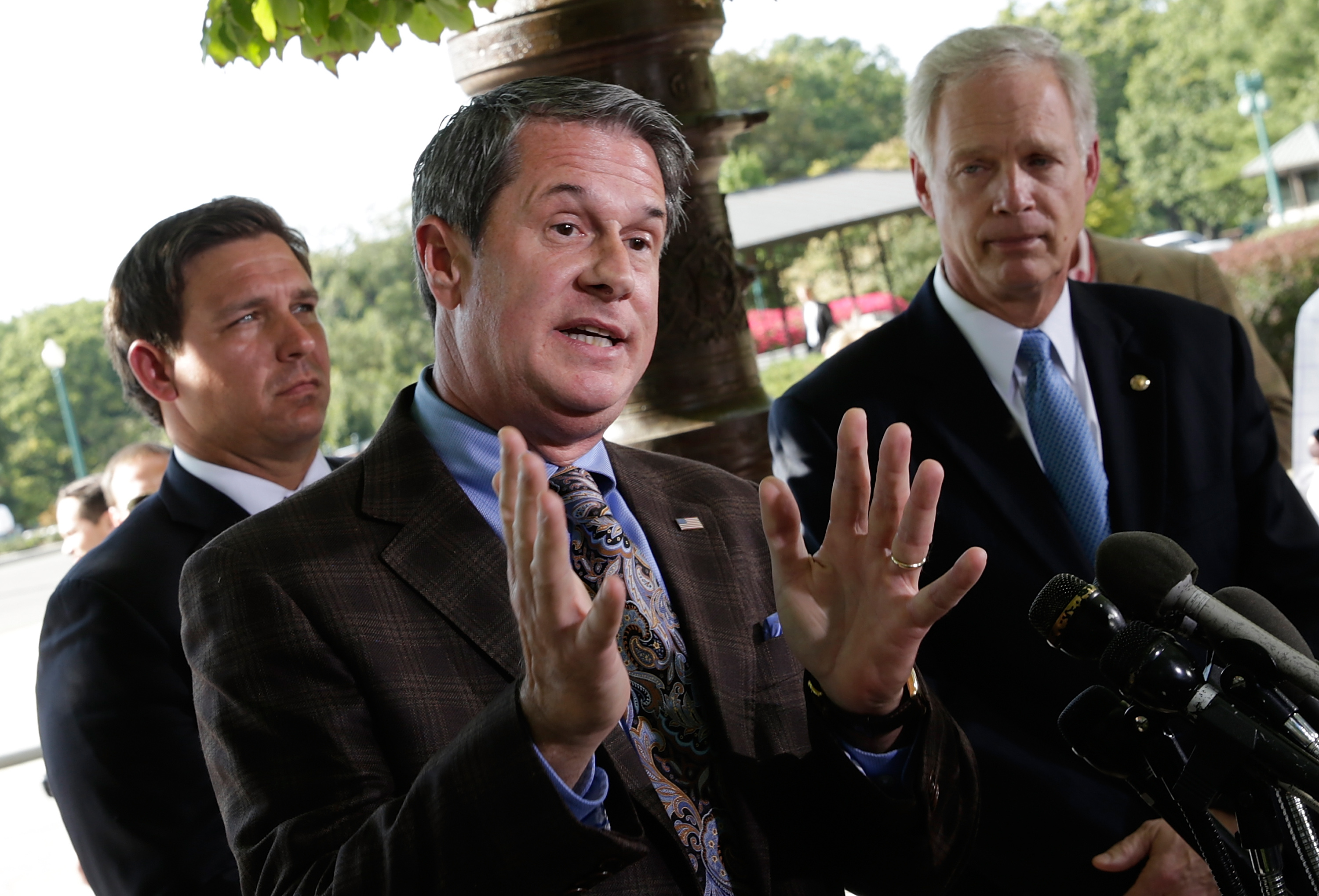
What many seek is a provision that would eliminate government contributions to the health plans for members of Congress and their staff members — as well as for the president, vice president and members of the cabinet — who would obtain their insurance through the exchanges established by the Affordable Care Act. The sticking point for many conservatives is the exception for Congressional staff members, as a plan endorsed earlier by House leadership contained. That idea was borrowed from Senator David Vitter, Republican of Louisiana, and it passed in the House but was later stripped by the Senate…

Under a wrinkle that dates back to enactment of the law, members of Congress and thousands of their aides are required to get their coverage through the insurance exchanges. The proposal floated by Republicans would eliminate the federal government’s share of the premiums for coverage.

A wrinkle in the healthcare law that affects an infinitesimal number of people, in the grand scheme of things, is apparently a must-have for the GOP. It would make their Democratic colleagues and their aides pay more in premiums under Obamacare.

Or to put it in more explicable terms: “Nyah. Nyah.”

Seriously, this is the level of pettiness involved here, even as the hours tick by before a potentially crippling default on the country’s debt. Plus: we all have to go through another government shutdown just before Christmas, if they don’t let more from this adolescent hostage taking.

Hats off to Robert Costa who seems to have a channel to the GOP deliberations. But, Jesus, check out this quote he just got:

“The leaders are giving us one more chance to get something passed out of the House before the Senate does its thing,” says a veteran House Republican. “I think we’ll get it through, at least that’s my sense of things now. We want to do something that marks our position, so we don’t end up swallowing whatever terrible bait the Senate casts our way. Now, I know, and the majority of us know, that this is futile. But believe me, even getting to 218 on this plan will be an achievement.”

“I know, and the majority of us know, that this is futile …” Just think about what that says about how this “veteran” of the House views the crazies now holding the country and the world hostage; and what it says about the coherence of the GOP House majority. This is why the world is watching the US right now with a mixture of terror and resignation. This is the way a great power dies, isn’t it?

(Photo: Sen. David Vitter (R-LA) joins other Republican members of Congress while they hold a press conference on the Vitter Amendment as the U.S. legislative body remains gridlocked over legislation to continue funding the federal government on September 30, 2013. By Win McNamee/Getty Images.)
CEO Pay Has Spiked

Surowiecki reveals why:

As the corporate-governance experts Charles Elson and Craig Ferrere write in a recent paper, boards at most companies use what’s called “peer benchmarking.” They look at the C.E.O. salaries at peer-group firms, and then peg their C.E.O.’s pay to the fiftieth, seventy-fifth, or ninetieth percentile of the peer group—never lower. This leads to the so-called Lake Wobegon effect: every C.E.O. gets treated as above average. With all the other companies following the same process, salaries ratchet inexorably higher. “Relying on peer-group comparisons, the way boards do, mathematically guarantees that pay is going to go up,” Elson told me. “Higher pay becomes a kind of self-fulfilling prophecy.”

If The Tea Party Packs Its Bags And Goes Home

There are reports that the House is thinking of “voting on their bill and, if it passes, leaving town — a bid to try to force the Senate’s hand.” Bernstein schemes:

1. Get reluctant House Republicans to vote for a debt limit/CR bill as part of the “leave town” strategy. Bill passes.

2. Head to airports.

3. Wait until the 30-60 or so crazy caucus boards planes.

4. Sneak back to Capitol, pass whatever the Senate sends over — with any luck, unanimously, now that voting that way won’t separate them from the not-present radicals.

That’s a pleasant fantasy. Back in the real world, Costa reports on Boehner’s continued efforts:

According to his allies, he’s still hoping to bring the House’s plan to the floor tonight, and he thinks it can pass, as long as a few elements of the proposal are adjusted. The 218 votes he needs, though, aren’t there yet, and he and his team are spending the afternoon informally whipping skeptical Republicans.

Is The Republicans’ Loss The Democrats’ Gain?

Ezra parses recent polling on the shutdown:

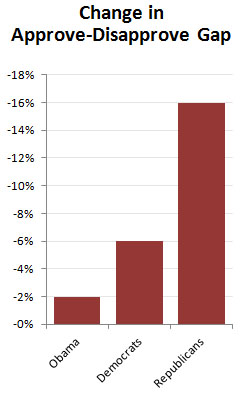
No one involved in this mess is particularly popular. But a two-party political system with first-past-the-post elections is a zero-sum affair. And Republicans are not only less popular than Democrats, their popularity isfalling faster than Democrats’. They are, in other words, losing, and badly.

Sides counters:

Disapproval Change[T]he Post’s numbers suggest this: if Republicans and Republican-leaning independents in the electorate approved of congressional Republicans as much as Democrats approve of Obama (71% do), congressional Republicans would be no less popular than congressional Democrats are.

Why does this matter? Because the politics of these approval numbers do not suggest that the GOP’s disadvantage would redound to the Democrat’s advantage in the midterm election in any clear zero-sum fashion.  As Lynn Vavreck and I noted in our piece for CNN, party identification predicts the vote in congressional elections very well.  The Republicans who don’t approve of the GOP’s handling of the budget negotiations aren’t likely to go vote for a Democrat.

How Masket understands the political impact of the shutdown:

If you want to do something with a bit lower profile, like changing logging rules or greenhouse gas regulations in order to satisfy some of your activist base, go for it. Most voters will never hear about it, and the people who do already have their mind made up about you anyway. But start a war, try to create or kill a piece of the social safety net, raise taxes, or shut down the government and its major services, and people will definitely notice, and they may punish you for it. That’s way outside of the blind spot, and if you operate there, you’re courting a reprisal. (Another way to operate outside the blind spot is to shrink it by drawing attention to what you’re doing, as Senator Ted Cruz did during his marathon Senate speech.)

But another thing to keep in mind is that voters are notoriously myopic. To the extent that they punish officeholders for their behavior, it’s usually for things that happened very recently. Sam Wang draws upon recent public opinion polls to find that the Democrats’ chances of taking back the U.S. House next year have gone from 13 percent to 50 percent, but that election is still more than a year away. (It’s not a coincidence that this standoff is happening now, and the last debt ceiling standoff occurred in 2011—both off-years for elections.) Lots of other things that voters may care about will happen between now and then. Congressional elections will also be affected somewhat by the economy, but voters will be evaluating an economy that doesn’t yet exist. Basically, they’ll be looking at economic growth in early 2014.

What Broke Washington?

Frum zooms out:

Why are American politicians playing so rough? We have moved into an era of scarcity. Once it seemed possible to have the spending Democrats wanted, financed at the tax rates the Republicans wanted, while paying for sufficient national security and running bearable deficits. That sense of expansiveness is gone. The trade-offs between Obamacare and Medicare, between spending and taxes, suddenly seem acute, imminent, and zero sum.

These disputes are not merely economic. As the United States becomes more ethnically diverse, debates over fiscal priorities inescapably become conflicts between ethnicities and cultures.

The Medicare population is more than 80 percent white. On the eve of the 2008 recession, the uninsured were 27 percent foreign born. Similar group dynamics are at work in debates over fiscal and monetary stimulus: inflation is a lot more frightening to a retiree who lost a great part of his or her savings in a stock-market crash than to a young family struggling with student loans and a mortgage. And again, America’s retirees are much more likely to be white and native-born than are America’s struggling young families. They are visible again in debates over taxes, where people who earn relatively more feel suddenly intensely vulnerable to the demands and resentment of those who earn less. Those were the feelings Mitt Romney channeled in his notorious crack about the 47 percent.

You don’t have to endorse any of these fears to recognize how they constrain even the best politicians. And not all politicians are best. There will always be people in political life who regard one man’s fear as another man’s opportunity. Such people have enjoyed a very prosperous half-decade.

The Political Price Of Epistemic Closure

A reader writes:

Speaking of Ted Cruz and the possibility of a “one-man default,” you ask, “One wonders what kind of demented ego lies behind this reckless, phony demagogue?” It’s not “ego” in the normal sense of the word. It’s paranoia – as in Richard Hofstadter’s The Paranoid Style in American Politics. For example, here’s a commenter on Krugman’s NYTimes column headlined “The Dixiecrat Solution:”

The Republicans are trying desperately to save America from the self appointed Czar and his Democrat henchman desperate to save their jobs. Your dire prediction is only shared by those of you in the Socialist media that also drank the Koolaid. Too bad you cannot be voted out of office too.

Screen Shot 2013-10-15 at 12.00.10 PMThat’s what’s really behind this recklessness. They don’t believe default will have any real consequences; they do believe the repeated warnings – “dire predictions” – are nothing but left-wing “socialist” propaganda, meant to squelch their movement and perpetuate the currently ascendant sociopolitical regime.

So there’s every reason to believe they will deliberately push the nation into default for no other reason than to call this “socialist” bluff, explode the “dire prediction” for the empty propaganda it is, validate their vision of the world, and completely reset the terms of any future debate. In other words, they want default. They want a showdown. And they may deliberately sabotage any attempt to avoid it: “Bring it on!”

Cruz may be reckless, and a demagogue, but I suspect he shares this commenter’s worldview – all of which is much scarier than mere “ego.” Maybe this has to happen. Maybe one side or the other has to explode, has to be exposed for what it is. They’re convinced that it’s the “socialist” mainstream that will be exploded. We think otherwise.

The only problem is, a great deal more than an abstract political vision may be exploded during the test.

(Image from Twitter user darthredpandacare)