Gerrymandering ≠ Polarization

According to Trende:

[T]he point here isn’t that gerrymandering hasn’t had any effect on party polarization. It is just that the effects are likely very small. What’s really happened, more than anything else, is that conservative areas of the country have, at least for now, become extremely reluctant to elect conservative or moderate Democrats, while liberal areas have largely given up on liberal or moderate Republicans. This has resulted in party caucuses that are increasingly made up of ideologues, and has made political compromise difficult. If there’s anyone to point the finger at, it’s ourselves.

Enten adds:

The Senate shows … that the sharp upswing in polarization we see today is largely the product of natural voting patterns. And these manifest themselves on the state level without any gerrymandering. Texas put Ted Cruz in the Senate not because someone redrew Texas’ state lines, but because Texas voters became, on average, more conservative.

Map Of The Day

discoveries6

Historian Bill Rankin captions:

Every Columbus Day, we’re reminded of the difference between discovery and “discovery” – and rightly so. But let’s not sell Europe short; after all, European explorers found plenty of diminutive islands that no human had ever seen before, along with extravagant amounts of ice and snow. Just the islands alone add up to more than 0.14% of the world’s total land area, and today they’re home to more people than live in all of Connecticut!

All sarcasm aside, it’s worth remembering that almost everywhere Europeans went, they were met by existing inhabitants. Even in the vast Pacific and the barren Arctic, only a few isolated coasts were truly terra nullius. (Indeed, this map particularly underscores the maritime expertise of Pacific Islanders. Unlike the islands of the Atlantic and Indian Oceans, nearly all of the Pacific was settled by the 14th century.)

(Hat tip: Benjy Hansen-Bundy)

The GOP Must Know It Lost

Isaac Chotiner explains:

If Republicans get a win on the medical device tax but are generally considered to have been routed by the president, future hostage-taking becomes less likely. If the GOP is despondent and depressed, and the media coverage plays up their falling poll numbers, this disaster is unlikely to repeat itself. But if concessions are seen as a GOP win, then expect more hostage scenarios. Remember, Clinton went along with spending cuts as a way of ending the government shutdown in 1995. But the perception was that he had won a major victory over Republicans, and, consequently, we did not witness five more years of shutdowns. Of course a debt ceiling crisis is much more serious than a shutdown (we can be proud to currently face both). But the principle still holds. The medical device tax and cuts to entitlement programs are important on the merits. But in this case, and going forward, perception trumps reality.

Given the absurd expectations created by fanatics like Cruz and Lee, I cannot imagine how the Tea Party will envisage any deal that doesn’t replace the entire Democratic agenda with their own as capitulation. Drudge, I note, has dropped the negotiations as a leading topic in favor of a story of a food stamp stampede after a technical glitch in a couple of towns in Louisiana. Maybe the propaganda machine is adjusting expectations a little … Costa notes:

GOP enthusiasm for the showdown, from both conservatives and grandees, is waning. Members are spending considerable time calling one another to lament, and they’re worried about fading public support. “We can’t get lower in the polls. We’re down to blood relatives and paid staffers now,” said Senator John McCain on CBS’s Face the Nation. “But we’ve got to turn this around, and the Democrats had better help.”

The Abatement Of Cruelty, Ctd

Readers keep the thread going:

I have not eaten pork in several years, after I saw the “Pandora’s Box” episode of This American Life (the TV show). Half of the show is dedicated to pig farming and the science behind it.  They keep experimenting with how they house and treat the pigs, which is spurring unexpected side effects. That was galling enough but seeing how the pigs live, how they are shoved into small pens, how they don’t even procreate – they don’t even have a chance to fuck – it was too much for me. Based on all that, I decided I cannot eat any more pork.  Other people can choose to eat pork; that’s fine with me.  I know that I couldn’t.

Another sends the above video:

Two of your recent themes have merged; Banksy is now bringing attention to pig torture in the Meatpacking District.

Another shifts the discussion:

Matthew Scully asks, “Why is it right or fair to pamper dogs [ ] and torture pigs?” He goes on to describe the horrible treatment of dogs as food in Asia. Scully omits mistreatment right here in the United States of dogs for research and agriculture.

The USDA estimates that 65,000 dogs are used in animal testing in the United States. Pertinently for Dish readers, beagles are one of the most common breeds used in research because they are “friendly, docile, trusting, forgiving, and people-pleasing.” Invasive research on dogs commonly involves exposure to experimental chemicals like cosmetics, insecticides, and dog products like flea medicine to determine their toxicity. These experiments ultimately lead to suffering and death.

One of the most horrifying facts about research on dogs is that many animal shelters have arrangements to give abandoned dogs – who at one time were companion animals for a family – to research facilities. These people are infamously known as Class B Dealers in the animal rights community. Everything I just described for dogs in research is wholly permissible under the Animal Welfare Act as long as basic conditions are satisfied such as the provision of clean food and water.

Likewise, the Animal Welfare Act does surprisingly little to protect dogs used for breeding purposes in so-called puppy mills. That law imposes no limits whatsoever on the number of dogs that can be used for breeding at a facility. I am a practicing animal rights attorney and commonly encounter reports of facilities with upwards of three hundred dogs (breeding females and puppies). The space requirement for breeding dogs is sadly insufficient – cages must be a mere six inches longer and wider than the dog herself. Breeders must provide clean food and water, as well as proper veterinary care.

Facilities that meet these requirements can call themselves USDA licensed and are often certified by third party groups like the American Kennel Club that are normally but incorrectly viewed of as reputable. Compliance with the Animal Welfare Act is generally checked during annual USDA inspections, and non-compliance almost always results in a warning with no penalty. When penalties are imposed, they are so insubstantial that the last two Office of the Inspector General audits of the USDA’s Animal Care Program (2005 and 2010) have found that penalties are viewed merely as the cost of doing business rather than having actual deterrent value. (I would link to those reports, but they are offline due to the government shutdown.)

An Opening For A Third Party?

Last week, Gallup found record desire for a third party:

Third Party

Jamie Chandler contends that the “midterm elections represent a rare opportunity for independents to mount viable campaigns – capitalizing on voter disgust with Beltway politics.” Nate Cohn disagrees:

After decades of culture wars and self-sorting, today’s Republicans are largely unified on policy, even if they disagree on tactics. And even if the disagreements between the tea party and moderates were substantive, it still wouldn’t produce a wave of independent candidates. National intraparty divisions don’t tend to produce opportunities for independents at the district-level, since representatives tend to reflect their districts. For the most part, ultraconservative Republicans hail from ultraconservative districts; moderates represent relatively moderate districts. That helps explain the apparent unity of post-war congressional Democrats: Even while Strom Thurmond and George Wallace mounted third-party challenges against pro-civil rights Democrats in presidential contests, Dixiecrats and northern liberals represented their districts well.

Unless, that is, the end-result of this recent bout of recklessness on the right provokes the Cruz-Palin-Lee wing to go rogue with a Tea Party ticket. A lot of dissatisfaction toward the GOP is coming from the right, after all. I suspect that if a third party emerges temporarily, it would be from the far right, not the increasingly empty center.

Email Of The Day

A reader writes:

I have been a registered Republican for almost 20 years now and I have endured some horrendous candidates within my party because I truly believed Republicans were capable of rational discourse and realistic methods to reining in what I believe is an out-of-control government. I have endured Bush in 2004 with his disgusting gay baiting, Palin in 2008 and Tea Party of 2010/2012. I have taken serious abuse from friends who cannot fathom why in the hell I would belong to such a party.

I grew up during the Reagan years, where the promise of America was real for everyone. I believed in my country and its leaders. I “thought” Republicans stood FOR something … but the sad reality is that they only are AGAINST everything that does not square with their delusional idea of what America used to be … and actually never was.

I think it was Ted Cruz who led me to my breaking point with his phony filibuster and his propaganda machine to exacerbate the already gripping paranoia in the Republican party. Make no mistake, I think Obamacare is a disaster and the Democrats barely capable of doing anything to get our country on the right path. But I’d rather work to fix the mess than to support a party totally incapable of governing in a fact-based manner.

I am ashamed it took me this long to change. But I just filled out my voter registration document to change party affiliation. I will not associate myself with this destructive party any longer. And I bet I am not alone.

Invoking The 14th

Hertzberg hopes Obama will go there:

In the end, Obama could have no honorable choice but to invoke the Fourteenth. There is little doubt that he would prevail. The Supreme Court would be unlikely even to consider the matter, since no one would have standing to bring a successful suit: when the government pays its bills, who is damaged? The House Republicans might draw up articles of impeachment, adopt them, and send them to the Senate, where the probability of a conviction would be zero. This would not be a replay of Bill Clinton and the intern. President Clinton was not remotely guilty of high crimes and misdemeanors, but he was guilty of something, and that something was sordid. Yet impeachment was what put Clinton on a glide path to his present pinnacle as a wildly popular statesman. President Obama would be guilty only of saving the nation’s economy, and the world’s.

Emily Bazelon and Eric Posner argue along the same lines:

[L]awsuits that challenge the president’s authority to issue debt would almost certainly go nowhere. Most plaintiffs would not be able to show a personal injury from the issuing of new debt. Lacking legal standing, their cases would be dismissed. Those who got beyond this stage would be blocked by the political question doctrine: Courts would dismiss the suit on the grounds that the controversy over the debt is an inter-branch conflict between the president and Congress that is not for judges to resolve. So if some creditors sell off Treasuries or refuse to buy new debt, the smartest investors—the hedge funds and the sovereign wealth funds—would sweep in to make a killing. …

If Obama jumps the gun and lifts the debt ceiling before the public has a sense of crisis, he risks being accused of imperialism (and of being impeached). But in the end, he has plausible arguments that he has the power to save us from default. He should use that power. The country, the markets, and future presidents will thank him.

The History Of The Radical Right

Gopnik traces it:

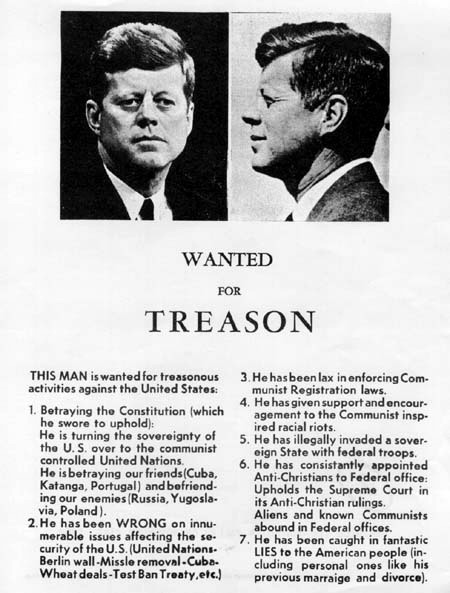
I’ve been doing some reading about John Kennedy, and what I find startling, and even surprising, is how absolutely Wanted_for_treasonconsistent and unchanged the ideology of the extreme American right has been over the past fifty years, from father to son and now, presumably, on to son from father again. The real analogue to today’s unhinged right wing in America is yesterday’s unhinged right wing in America. This really is your grandfather’s right, if not, to be sure, your grandfather’s Republican Party. …

Reading through the literature on the hysterias of 1963, the continuity of beliefs is plain: Now, as then, there is said to be a conspiracy in the highest places to end American Constitutional rule and replace it with a Marxist dictatorship, evidenced by a plan in which your family doctor will be replaced by a federal bureaucrat—mostly for unnamable purposes, but somehow involving the gleeful killing off of the aged. There is also the conviction, in both eras, that only a handful of Congressmen and polemicists (then mostly in newspapers; now on TV) stand between honest Americans and the apocalypse, and that the man presiding over that plan is not just a dupe but personally depraved, an active collaborator with our enemies, a secret something or other, and any necessary means to bring about the end of his reign are justified and appropriate. And fifty years ago, as today, groups with these beliefs, far from being banished to the fringe of political life, were closely entangled and intertwined with Senators and Congressmen and right-wing multi-millionaires.

(Image: A famous handbill circulated on November 21, 1963 In Dallas, Texas. One day before the assassination of John F. Kennedy. From Wikimedia Commons. I sure hope the secret service keep our president as safe as humanly possible.)

Is This What The Final Deal Will Look Like?

Government Shutdown Continues Into Its Second Weekend

Noam Scheiber’s best guess:

Setting aside the hourly thrust and parry between Democrats and Republicans, here’s how the shutdown is likely to end: Senate Majority Harry Reid is going to strike a deal with his Republican counterpart Mitch McConnell at some point in the next few days. The deal will reopen the government for a medium length of time—possibly till January 15, when the next round of sequester cuts kick in—giving the two sides time to replace the sequester with something more appealing. The deal will also raise the debt ceiling—maybe for as little as a few months, maybe until after the 2014 election. Reid will give up almost no concessions in return for any of this, with the exception of one or two symbolic items, and he’ll probably get some higher-than-sequester level of government funding (a top Democratic priority) for a month or two starting later this year. Pretty much every Democrat in the Senate will vote for the deal, along with at least five and maybe as many as 20 Republicans.

Here’s Reid’s actual proposal today, via Politico:

Senate Majority Leader Harry Reid has privately offered Senate Minority Leader Mitch McConnell a deal that would reopen the government until mid-to-late December while extending the U.S. debt ceiling until next year, according to several sources familiar with the talks.

The proposal would set up a framework for larger budget negotiations with the House over the automatic sequestration spending cuts and other major deficit issues, the sources said. Moreover, Senate Democrats are open to delaying Obamacare’s medical device tax and a requirement that those receiving Obamacare subsidies be subject to income verification — but they would have to get something from Republicans in return, sources said.

I’d press for a debt ceiling raise beyond the next Congressional elections as a key element of a deal. Beutler notes McConnell’s new role:

Mitch McConnell has suddenly become the lead Republican negotiator and all the action has shifted to the Senate. If McConnell had any confidence that Boehner could pull this off, Boehner would still be at the center of the story. McConnell has a primary challenger. He wants to oppose deals, not cut them. If there were any way for Boehner to get out of the mess on his own, McConnell would have let him try. His return to relevance demonstrates a complete loss of faith in his counterpart.

(Photo: U.S. President Barack Obama meets with Senate Democratic leadership, including Senate Majority Leader Sen. Harry Reid, to discuss the government shutdown and the nation’s debt ceiling in the Oval Office of the White House October 12, 2013 in Washington, DC. The U.S. Government is on its 12th day of a shutdown. By Alex Wong/Getty Images.)