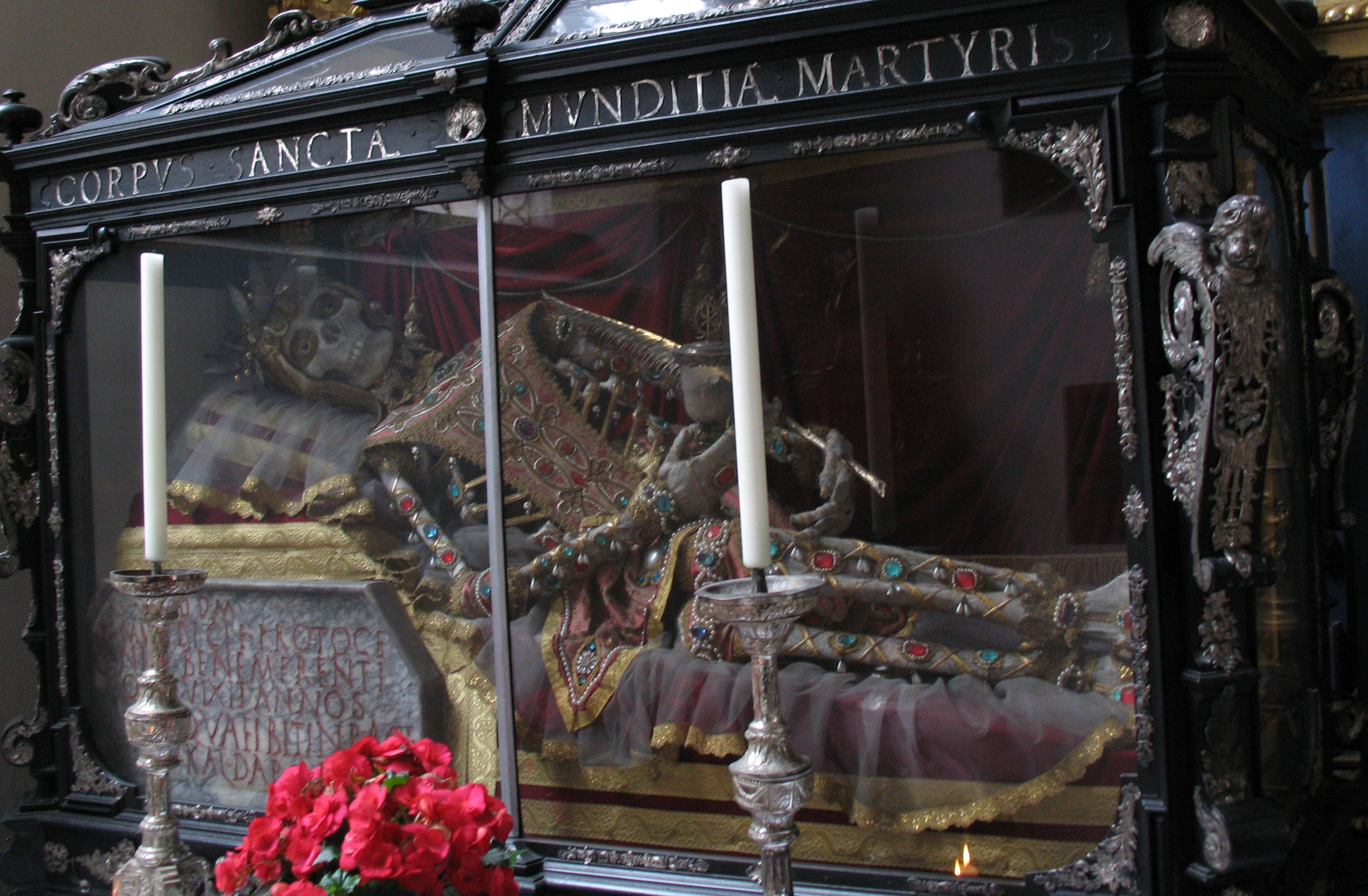
The Road To Becoming A Relic

München

Rachel Nuwer describes the work of art historian Paul Koudounaris, whose book, Heavenly Bodies, documents how the bones of Christian martyrs in Roman catacombs were transformed into bejeweled relics, which were displayed in churches throughout Europe. How Vatican investigators determined which remains belonged to a departed saint:

[T]he process of ascertaining which of the thousands of skeletons belonged to a martyr was a nebulous one. If they found “M.” engraved next to a corpse, they took it to stand for “martyr,” ignoring the fact that the initial could also stand for “Marcus,” one of the most popular names in ancient Rome. If any vials of dehydrated sediment turned up with the bones, they assumed it must be a martyr’s blood rather than perfume, which the Romans often left on graves in the way we leave flowers today. The Church also believed that the bones of martyrs cast off a golden glow and a faintly sweet smell, and teams of psychics would journey through the corporeal tunnels, slip into a trance and point out skeletons from which they perceived a telling aura. After identifying a skeleton as holy, the Vatican then decided who was who and issued the title of martyr.

Once a skeleton was selected, highly-skilled monks and nuns would prepare it for presentation to a congregation, a process that could take up to three years:

Each convent would develop its own flair for enshrouding the bones in gold, gems and fine fabrics. The women and men who decorated the skeletons did so anonymously, for the most part. But as Koudounaris studied more and more bodies, he began recognizing the handiwork of particular convents or individuals. “Even if I couldn’t come up with the name of a specific decorator, I could look at certain relics and tie them stylistically to her handiwork,” he says.

Nuns were often renowned for their achievements in clothmaking. They spun fine mesh gauze, which they used to delicately wrap each bone. This prevented dust from settling on the fragile material and created a medium for attaching decorations. Local nobles often donated personal garments, which the nuns would lovingly slip onto the corpse and then cut out peepholes so people could see the bones beneath. Likewise, jewels and gold were often donated or paid for by a private enterprise. To add a personal touch, some sisters slipped their own rings onto a skeleton’s fingers.

Read the recent Dish thread on relics, “Saints on Display,” here.

(Photo of Saint Munditia’s relics, found in St. Peter’s Church in Munich, Germany, via Wikimedia Commons)

The Oskar Schindler Of Argentina?

John L. Allen, Jr. details a new Italian book that claims that title for the man who became Pope Francis:

In reply to persistent charges that the young Fr. Jorge Mario Bergoglio was complicit in Argentina’s infamous “dirty war” from 1976 to 1983, when roughly 30,000 people disappeared, Scavo asserts that Bergoglio was actually a Jesuit version of Oskar Schindler – quietly saving lives rather than engaging in noisy public protest.

The future pope, Scavo writes, saved as many as a thousand targets of the military dictatorship by providing shelter in a Jesuit college, passing them off as seminarians or laity on retreat, then helping them move out of Argentina.

In one case, according to Scavo, Bergoglio gave a man who bore him a passing resemblance his own passport and priest’s clothing to make his escape.

A Poem For Sunday

eddyeyes.jpg

“How It Is With Us, And How It Is With Them” by Mary Oliver:

We become religious,
then we turn from it,
then we are in need and maybe we turn back.
We turn to making money,
then we turn to the moral life,
then we think about making money again.
We meet wonderful people, but lose them
in our busyness.
We’re, as the saying goes, all over the place.
Steadfastness, it seems,
is more about dogs than about us.
One of the reasons we love them so much.

(From Dog Songs by Mary Oliver. Reprinted by arrangement of Penguin Press, a member of Penguin Random House LLC. © 2013 by Mary Oliver.)

Jefferson’s Outreach To Islam

Denise Spellberg finds that the Founding Fathers anticipated and advocated tolerance and equality for Muslim Americans:

Muslims, for most American Protestants, remained beyond the outer limit of those possessing acceptable beliefs, but they nevertheless became emblems of two competing conceptions of the nation’s identity: one essentially preserving the Protestant status quo, and the other fully realizing the pluralism implied in the Revolutionary rhetoric of inalienable and universal rights. Thus while some fought to exclude a group whose inclusion they feared would ultimately portend the undoing of the nation’s Protestant character, a pivotal minority, also Protestant, perceiving the ultimate benefit and justice of a religiously plural America, set about defending the rights of future Muslim citizens.

They did so, however, not for the sake of actual Muslims, because none were known at the time to live in America. Instead, Jefferson and others defended Muslim rights for the sake of “imagined Muslims,” the promotion of whose theoretical citizenship would prove the true universality of American rights. Indeed, this defense of imagined Muslims would also create political room to consider the rights of other despised minorities whose numbers in America, though small, were quite real, namely Jews and Catholics. Although it was Muslims who embodied the ideal of inclusion, Jews and Catholics were often linked to them in early American debates, as Jefferson and others fought for the rights of all non-Protestants.

“The Promised Land For Christian Fundamentalism”

Andrew O’Hehir watched God Loves Uganda:

[Murdered Ugandan LGBT activist] David Kato and other victimized and persecuted LGBT people in Uganda and other heavily evangelized African nations seem to be paying the price for the fact that [preacher] Lou Engle and people like him are gradually losing the culture wars at home. Uganda is their biggest success so far, but the long-term vision involves a wave of Christian revival that will sweep out of Africa into the first world, driving back the apparently victorious forces of secularism. But even Engle and his movement, although they strongly oppose gay-rights legislation, did not propose the death penalty for homosexuals. Credit for that belongs in large part to Scott Lively, an unhinged American “ex-gay” leader whose extended rants about how gays had caused the Nazi holocaust (exactly how I do not know) and now sought the destruction of traditional African family life found an enormous audience among Ugandan officials, politicians and teachers.

In May, John G. Stackhouse, Jr. criticized this argument:

From first to last, the anti-homosexuality campaign in Uganda is attributed to the imposition of Western values. But anti-homosexuality is clearly not a distinctive Western value. It is rife in tribal cultures in Africa and already in the outlook of Ugandans when the recent wave of American evangelical extremists arrived. Only such facts can explain the receptivity given to such people as Scott Lively (who apparently spoke for five hours with the Ugandan Parliament) and the resulting widespread and violent anti-homosexuality in government and popular media. By comparison, when evangelicals did dominate North American societies in the nineteenth century, sodomy was illegal, but was not punished by anything approaching life imprisonment, let alone the death penalty. So the tired trope of imperialistic foreigners corrupting the noble savages rears its head again and must once again be dispatched by a little careful thought.

In an interview earlier this year with Queerty, Williams discussed what inspired him to make the film:

I have a strong religious background, and grew up singing in the choir of my family church.  I have always been interested in the power of religion as a force for both good and evil.  My last film [Music by Prudence] took place in Zimbabwe and, while I was shooting there, I was struck by how popular conservative Christianity is in sub-Saharan Africa. After I read about Uganda’s now famous “Kill the Gays” bill, I wanted to explore the religious forces behind it.  I’m not interested in films that preach to the converted— I always wanted to make a film that starts a dialogue within the religious community.

Previous Dish coverage of gay persecution in Uganda here, here and here.

Taking His Message To The Streets

Taking stock of Pope Francis’s three recent headline-grabbing interviews, William L. Portier argues that the new pontiff is pioneering “a new genre of papal pronouncement, minimally authoritative, but unprecedented in its reach”:

Long before his election, Pope Francis urged his people in Buenos Aires not to focus on the internal life of the church but to take the church out into the streets. In response to a journalist on the flight back from Brazil, he described himself as “a street priest” who feels somewhat “caged” in the Vatican. With the papal news media interview, Pope Francis has found a way to pop the bubble that seemed to isolate his predecessor during his last days in office. He has, in a real sense, made it back to the streets. This new genre of papal pronouncement dodges grasping handlers and bureaucrats who would brand the pope restrictively, frustrate his wishes, and control his access. Pope Francis is now an anticipated part of the news cycle. The papal news media interview takes him directly to the people, all the people.

How To Diagnose A Sex Deviant?

In an excerpt from his new book Perv, Jesse Bering illustrates the ongoing debate over sexual deviancy’s relation to mental illness:

[T]here was the tale of Armin Meiwes. That name might dimly light up in your frontal lobes as a distant headliner best forgotten, but to remind you—and apologies for doing so—Meiwes, a computer repairman by trade, was the German cannibalistic sexual sadist who, in the spring of 2001, found a willingly edible sexual masochist for himself named Bernd Jürgen Brandes. “Looking for a well-built 18- to 30-year-old to be slaughtered and then consumed,” read Meiwes’s personal ad on the Cannibal Café website (which, you’ll probably be glad to know, is a website no more). And Brandes, it seems, was looking to be thoroughly digested. That old psychopath Cupid couldn’t have arranged for a more tragic crossing of these lovers’ paths. … From the video footage—the whole awful thing was taped from start to finish—it’s apparent that Meiwes (the eater) didn’t coerce Brandes (the eatee) at all. If anything, the coercion was done by the masochist, not the sadist. Brandes even begged a hesitating Meiwes to bite off his penis. …

I’m by no means suggesting that both the S and the M parts of this equation weren’t disturbed men. You don’t need to be a mental health expert to see that. Yet when we try to apply the ”DSM- 5’s” criteria of pain and non-consent, there’s some tension here, since Meiwes had explicitly sought out a consenting adult partner. And when you combine consent with a masochist’s apparent death wish, well, you can see how a forensic psychiatrist’s job can be daunting.

Bering discusses what he learned from writing his book:

Over the 18 long months in which it was in production, Perv … evolved from being a light scientific treatment of weird sex to a book with an actual moral message. And that message turned out to be embarrassingly obvious, really. As a society, we’ve been dawdling over the irrelevant questions of what’s “normal” and “natural” for far too long. To make any real moral traction, we must abandon the rhetoric of righteousness and instead turn our efforts to clarifying, using science rather than scripture, laws, or even (and especially) our own gut feelings, how a sexual act or orientation is harmful to those involved. In my book, at least, doing harm is the only thing that makes a person a pervert.

Last year he answered a bunch of Ask Anything questions surrounding his previous book, Why is the Penis Shaped Like That? Meanwhile, on the video seen above:

Zoo is a 2007 documentary film based on the life and death of Kenneth Pinyan, an American man who died of peritonitis due to perforation of the colon after engaging in receptive anal sex with a horse. The film’s public debut was at the Sundance Film Festival in January 2007, where it was one of 16 winners out of 856 candidates. Following Sundance, it was selected as one of the top five American films to be presented at the prestigious Directors Fortnight sidebar at the 2007 Cannes Film Festival.

The film was made with co-operation of the two men who took Pinyan to the hospital, as well as other friends of his, in the attempt to explore the life and death of the man, as well as those who came to the farm near Enumclaw for similar reasons, beyond the public understanding of the media. It does contain explicit material of sexual activities, but only in the view of video footage shown on a small television screen.

Part one is above. The rest is here.

A Psychedelic Big Band

Seth Colter Walls tours the cosmic and eclectic music of jazz legend Sun Ra:

Sun Ra’s music became most abstract in the 1960s, when he and the Arkestra moved to New York and took up a residency at the East Village club, Slug’s. This is where Amiri Baraka (then LeRoi Jones) encountered the Arkestra. Though initially skeptical, he was won over as soon as he saw the group live. “Sun-Ra,” he wrote in 1966, “wants a music that will reflect a life-sense lost in the West, a music full of Africa.…On one piece the Arkestra moves, behind Sun-Ra, in a long line through the dark, chanting and playing…a totally different epoch is conjured.” Baraka described Ra’s new record for the ESP label, The Heliocentric Worlds of Sun Ra, as “one of the most beautiful albums I have ever heard,” the product of the “first big band of the New Black Music.” …

The prospect of getting to know this massive, erratically organized oeuvre may seem discouraging. But giving up on the ability to know everything doesn’t mean you have to resign yourself to total ignorance, either. That realization is a part of what is so welcome about Jazz at Lincoln Center’s embrace of the Sun Ra Arkestra this month. [John] Szwed’s biography, Space is the Place, makes mention of the fact that Lincoln Center’s then-“new jazz department” considered, but ultimately did not produce, a tribute concert to Ra not long before his death. Though by doing their part, now, to include his Arkestra in our understanding of American art music, the institution is helping to realize a mystic-sounding assertion from Ra’s later years: “A true birthday is the day of your death.”

When The Force Wasn’t So Strong

The original teaser trailer for Star Wars was recently rereleased:

But the groundbreaking film almost never saw theatrical release, “after it had gone considerably over budget ($13 million finally) and driven Lucas to the point of nervous collapse”. More from an excerpt from David Thompson’s new book, The Big Screen: The Story of the Movies:

Universal had given Lucas a two-picture contract, for American Graffiti and something called Star Wars. No matter the success of the first film, the bosses at Universal could not envisage what Star Wars would be, as Lucas struggled to write it and to work out the array of special effects that would be required. The project was hanging in the balance, even if it was about to reshape the art and the business. Universal faltered, but Twentieth Century–Fox said it would take on the venture. It was scared of science fiction and wary of Lucas and his taciturn demeanor, so it agreed only to a development deal, with step payments that exposed Lucas personally to his debts from THX 1138. …

Lucas had been dismayed in his deal with Fox to learn that the studio was closing down its special-effects department. Yet he envisaged countless scenes such as no one had ever seen before. He assigned John Dykstra (an assistant on 2001) to begin experimenting in Van Nuys, but this was only the prelude to a new culture in which photographic methods would be increasingly harnessed to the computer. In 1975, while working on the film, Lucasfilm founded a new operation, Industrial Light and Magic, which would soon move to Marin, north of San Francisco, at what would be called Skywalker Ranch, begun in 1978 at a cost of $100 million.

“Fear Of Sex Is Sexy”

From an interview with Allan Gurganus about his new novel, Local Souls:

To shy away from human extremes and human sensuality makes for bone-dry fiction. A world parched of our sexual releases and our tumultuous daily emotional lives is deeply impoverished. It is not lifelike, at least life as I remember living it. Far better to, like Updike or Nabokov, have entirely too much fun with the subject than to never chance describing this replenishing source of frisky joy. … Sometimes the books most restrained about sex, even deeply scandalized by it, can whisper to us with the greatest hidden force. I am a huge admirer of the recently deceased, always underranked Evan S. Connell. His novel “Mrs. Bridge” gives us India Bridge, the country-club wife of a Kansas insurance executive. She remains a person utterly baffled by sex. Scared, she watches her three children each come of age erotically; it’s as if she sees them turn slowly into slobbering zombies. And that, for me, registers as sexy! Fear of sex is sexy. Whip me if I’m wrong. Or right.