Is this a sign of major independent dissatisfaction with the loony right now running the GOP? Or a brief straw in the wind?
Month: October 2013
What’s The Endgame?

Ambers runs through various possibilities:
The most likely scenario is one where Boehner folds but pretends he didn’t, and Obama negotiates, but only in words. Privately, Boehner would prefer this solution because it would not actually concede any significant ground to the Tea Party, and if the optics are right, he could emerge from this fracas with roughly the same amount of power as before it started. What would this look like? A play, consisting of three acts. Act 1: Republicans promise to pass a clean CR and debt ceiling increase in exchange for specific words from Obama that he can be held to; Act 2: Obama proclaims publicly that he has said all along that he has been willing to negotiate with Republicans, and then says something like, “and I look forward to talking to them right after the the government opens on subjects ranging from tax reform to reducing the burden of entitlements.” Act 3: Boehner seizes on that sentence and tries to sell it to his conference. An unofficial whip count confirms this, but he says publicly that he will do the honorable thing and not allow the nation to go into default SO THAT Republicans can hold Obama accountable on his promise. Finale: the votes pass.
Waldman considers the situation from Boehner’s point of view:
[T]here is not a single factor that over time is making a GOP victory more likely. My guess is that Boehner knows this but is hoping that the fight itself will win him enough breathing space with the conservatives to keep his job when its over. He’ll lose, but he’ll show them that he was willing to inflict some harm on the country in the process, which will deplete their rage just enough.
Think about that for a moment. The only way the Speaker can keep his job is to inflict serious economic damage on the country. That’s the measure of his mettle. We can get lost in the tick-tock of this, and forget to step back and realize that this remains one of the most reckless, nihilist gambits by any political party in my adult lifetime – up there with impeaching Clinton, which, at least, wouldn’t have plunged the entire world into a second depression.
The more extremist they get, the more dangerous they become. If we can survive this self-induced fiasco, we have surely one overwhelming imperative – to get as much constructive things done in the next year and then launch a huge effort to rid the House of these fanatics in 2014. It won’t be easy, but it’s getting urgent.
(Photo: US Speaker of the House John Boehner leaves after speaking at the US Capitol in Washington, DC, October 8, 2013. By Saul Loeb/Getty.)
Will The GOP Take The Gun Away From Our Head?
Byron York passes along a new strategy the GOP is considering:
Many House Republicans, including some key leaders, have decided they can live with a government shutdown but not with the threat of default. In the hours ahead, look for the GOP to seek a deal with President Obama and Democrats on at least a short-term increase in the debt limit, while standing firm on their requirement that a continuing resolution to fund the government must contain some significant measure to limit Obamacare. The bottom line: Republicans have discovered the world did not end when shutdown became a reality — but they’re not willing to risk it with the debt ceiling.
Ponnuru tries to get inside Boehner’s head:
A “clean” CR — a budget bill that reopens the government without any anti-Obamacare conditions — could pass the House with mostly Democratic votes. I think he’s refusing to let it pass not because he’s afraid for his job, but because it would make it much harder for him to raise the debt limit — and he rightly thinks that’s more important.
Stay Classy, Erick
As the GOP begins to realize that destroying the American and the global economy to save millions of people from getting health insurance may not be quite the slam-dunk that Romney’s electoral triumph was going to be, the true believers keep digging in. Erickson wants secession – not from the union (that’s so last Friday), but from the confederacy:
I’m being told by several sources that Speaker Boehner and Majority Leader Eric Cantor are plotting to give up trying to either defund or delay Obamacare… John Boehner, Eric Cantor, Mitch McConnell, and John Cornyn will ensure that Obamacare is fully funded and give the American public no delay like businesses have.
In doing so, they will sow the seeds of a real third party movement that will fully divide the Republican Party.
Oh don’t tease us, Erick.
Print Is Dead, Long Live Books
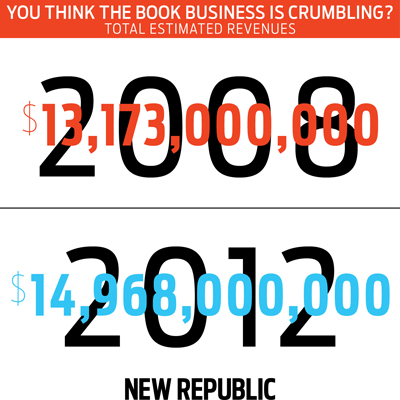
Evan Hughes presents evidence that the book business is relatively healthy:
Part of the problem for journalism, music, and television is that they are vulnerable to disaggregation. Their
products are made up of songs and articles and shows that have long been consumed in those individual units. Once the Internet made it possible to ignore the unwanted material, overall value slipped. Easy access to favorite singles opened those up to impulse buys—but also made purchasing the whole record feel almost indulgent, a splurge for audiophiles and diehard fans. Now the TV viewer wants “Breaking Bad” without bills from Comcast. The ability to score individual articles by the clicks and ad dollars they reap has exposed vital but embattled forms like international reporting and arts criticism to further pruning. ….
In publishing, meanwhile, the deal with the customer has always been dead simple, and the advent of digital has not changed it: You pay the asking price, and we give you the whole thing. It would make little sense to break novels or biographies into pieces, and they’re not dependent on the advertising that has kept journalism and television artificially inexpensive and that deceives the consumer into thinking the content is inexpensive to make.
Border Inequality
After more than 300 immigrants died less than a mile from the Italian coast, Max Fisher interviewed World Bank economist Branko Milanovic, author of The Haves and the Have-Nots:
[M]y book spends quite a lot of time discussing the income gaps between the countries. And of course these income gaps, historically, have risen tremendously, despite the fact that in the last 15 or 20 years, China and India have grown at very high rates. Still, the number of countries in Africa where income today is lower than in the 1960s [when they won independence] is large, I think about 15 countries.
So, clearly, the gap between Africa and Europe has increased. Even the gap between the United States and Mexico, for example in [gross domestic product at purchasing power parity], which is adjusted for price levels in each country, that gap has gone up. So the implication of that is that if the gap is significant, large, and in some cases rising, and the knowledge about the existence of such differences is more widespread, and the cost of transportation is less, then you will have huge pressure to migrate.
Where Digital Natives Come From
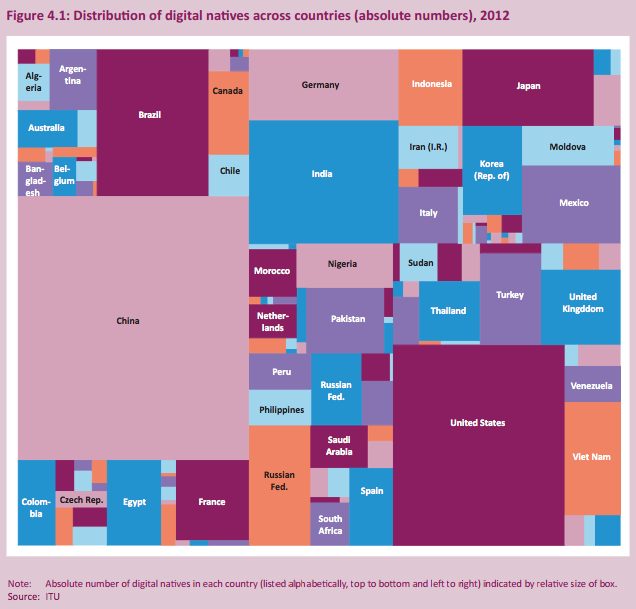
China leads in absolute numbers, according to the International Telecommunications Union (pdf), but South Korea has the greatest percentage of wired young people – 99.6 have been online for at least five years. Still, two-thirds of the world’s youth didn’t grow up with the Internet:
As you might expect, impoverished and war-torn nations have the lowest proportion of digital natives, a fact that could make the global economic playing field even less even going forward. Digital natives make up less than 5 percent of the youth in Afghanistan, Nepal, Iraq, Ethiopia, Bangladesh, and many other countries across south Asia, central Africa, and parts of the Middle East. “This is fundamental to a country’s economic and social development and their participation in an information network society,” [researcher Michael] Best said. “In these conflict-stressed and developing countries, the report suggests that further attention to Internet infrastructure and capacity are critical to their economic development.”
The Inevitability Of Ignorance
Pivoting off Ilya Somin’s new book on political ignorance, Jack Shafer argues that the advent of mass media has done little to cure it:
Our political ignorance is as enduring as it is pervasive. When the Pew Research Center study compared the political knowledge of 1989 respondents with those from 2007 it found the advent of multiple 24-hour news channels, the C-SPAN channels, and hundreds of news sites on the Web had not moved the political ignorance dial in any appreciable way. Nor have massive rises in education over the past half-century put a dent in political ignorance, Somin finds. “On an education-adjusted basis, political knowledge may actually have declined, with 1990s college graduates having knowledge levels comparable to those of high school graduates in the 1940s,” he writes, even though IQ scores have been rising.
Somin responds:
None of this suggests that media coverage of politics is useless. It does provide helpful information to the minority of voters who do follow political issues closely. And sometimes the media uncover a major scandal that penetrates the consciousness even of those members of the public who are usually oblivious to political news. Without the media, politicians bureaucrats, and interest groups would cause more harm than at present. But the media is unlikely to solve the problem of widespread political ignorance.
Kafka The Creeper
Richard Marshall reviews a new biography, Kafka: The Years Of Insight:
He was popular, smart, good looking enough to attract women, a joker and a writer with enough fame to feed the ego whilst not so much that would distract from the business. He was capable of acts of kindness but his erotic escapades were pretty dismal. Kafka was a creepy womanizer – at thirty he was stalking with the help of Max Brod some sixteen year old he saw one time at Goethe’s house and he built himself an impervious persona who was cruel, calculating and decisively self-serving when dealing with his never-ending erotic interests. …
Kafka writes letters and diaries that make clear that he has only one subject and that is himself as literature. ‘I have no literary interests; I am made of literature. I am nothing else and cannot be anything else.’ Decisive in this identity, Kafka frees himself from ties that bind those with merely an ‘artistic bent.’
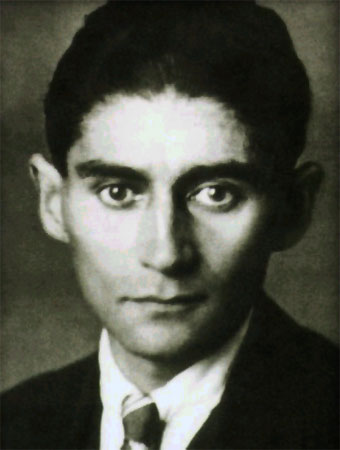
John Banville considers another new volume, Franz Kafka: The Poet of Shame and Guilt, and how the man’s enigmatic sexuality probably informed his fiction:
[Author Saul] Friedländer follows the Kafka scholar Mark Anderson in thinking it “highly improbable that Kafka ever considered the possibility of homosexual relations.” Nor does he for a moment seek to suggest that the “imagined sexual possibilities” Kafka may have entertained are a key to unlock the enigmas at the heart of the Kafka canon. All the same, once this particular genie is out of the bottle there is no forcing it back inside. Repressed homosexual yearnings certainly would account for some of the more striking of Kafka’s darker preoccupations, including the disgust toward women that he so frequently displays, his fascination with torture and evisceration, and most of all, perhaps, his lifelong obsession with his father, or better say, with the Father—the eternal masculine.
(Image via Wikimedia Commons)
Going Extinct On The Preserve
A 25-year study of “forest patches turned into islands by the filling of the Chiew Larn Reservoir in Thailand in 1986 and 1987” found that these islands, which were unpopulated by people, suffered major species extinction. What this tells us about conservation:
Small habitat patches may not be large enough to sustain a viable population. When ranges are compressed, populations face a number of hardships, from increased competition for resources to inbreeding and intrapopulation strife that can raise stress, increase conflict, and lower breeding rates.
This study isn’t just about isolated islands in a remote corner of Thailand. It’s also about the flecks of land we cordon off every time we fell a forest, plow a field, or plat a subdivision. We’re creating small islands of habitat surrounded by seas of human dominance. Certainly some animals and plants can move between those islands, but not all do and not all at rates needed to sustain remnant populations. … If we are to minimizing the impact we have on the environment—whether those be cities, farms, or even oil fields—we can’t just plan the land we’ll occupy, we have to plan the land we won’t.
 The Dish
