Why Hasn’t Big Business Stopped The Shutdown?

Josh Green examines the rift between the GOP and the U.S. Chamber of Commerce, a major GOP donor:

On Oct. 1, House Republicans ignored the Chamber’s pleas to keep the government running. The shutdown is costing the U.S. economy $300 million a day, according to IHS (IHS), a global market-research firm, and it’s only the latest sign suggesting that the old adage, “Republicans are the party of business,” no longer holds true. From the austerity imposed by sequestration to the refusal to reform immigration laws to the shutdown and now, as appears likely, another debt-ceiling showdown when U.S. borrowing authority expires on Oct. 17, the GOP’s actions have put a strain on one of its most valuable partners: the business community.

Drezner asks, “given the Chamber of Commerce’s tilt, why aren’t GOP representatives listening more closely?” Larison’s answer:

Because the Chamber of Commerce leans so heavily towards the GOP, Republican politicians may conclude that they can ignore some of its complaints without provoking the group to shift more of its support to the other party. Consistently and overwhelmingly favoring one party over another signals to party leaders that your group’s concerns can be dismissed more easily when the leaders have other priorities. The Chamber’s support for Republicans is being taken for granted because that support is so lopsided in the GOP’s favor, and as a result it sometimes has much less influence with what the party does in Congress than one would expect.


Street View Goes Off-Roading

Street view

And into CERN, the international physics laboratory:

Putting together a Street View tour of one of the largest and most expensive science projects in history wasn’t a particularly easy task; the mammoth detectors and tunnels of the collider took two full weeks to photograph. “Every three meters, they took a six-sided panorama of the tunnel,” CERN photographer Max Brice told Symmetry Breaking. “Then we had to figure out the coordinates of every image. It came out to 6000 points for us to track.” This was in 2011; stitching everything together into the finished product took an additional two years.

Luke Westaway takes in the views:

The ATLAS particle detector experiment can be explored, as well as the tunnel that makes up the Large Hadron Collider, plus CERN’s ALICE, CMS, and LHCb experiments. Virtually traversing the dense labs is an atmospheric experience – cramped Half Life-esque tunnels and metal walkways abound, as well as ominous signs that warn of radiation and dangerous magnetic fields.

(Photo: The Compact Muon Solenoid (CMS), a general-purpose detector designed to investigate a wide range of physics. Via Google.)

Obamacare Is Still Experiencing Technical Difficulties, Ctd

A reader writes:

There are a couple of counterpoints to your post you should mention.

First, this is now the fourth day of 180 during which people will be able to enroll. No one will even get coverage until January 1 of next year. Yes, the technical difficulties exist, but a relentless focus on them makes it seem like health reform isn’t working.

Second — and probably more important — the federal exchange was never intended to be anywhere near as large as it is. The ACA was designed so that states would run the exchanges, and they were given massive flexibility to make that happen. The intent was that the federal exchange would be a back up for a few states that could not, or would not take advantage of their state prerogatives.

Instead, a full 34 states decided they hated the federal government so much that they opted to let the feds run a health care exchange inside their borders.

This was clearly one of the choices they had, but no one anticipated that the sheer hysteria of health care reform would drive so many states to act so deeply against their own state interest.

So the federal exchange went from being a backstop to being the primary new program the federal government was required to operate. And the technical challenges of operating an exchange in 34 states with 34 hugely varying markets, populations, and state laws that needed to be accommodated proved to be enormous.

That is a very large part of the landscape HHS has had to deal with. Yes, the problems are real. But they are not immediately affecting anyone’s coverage, and they arise out of a political perversity it would have been hard for any rational person to predict.

Has Netflix Fixed The Water Cooler?

Nolan Feeney suggests that the era of binge-viewing has revived casual conversations among coworkers:

“Binge viewing is more about staying current and getting caught up so you can have those water-cooler conversations, and less about stockpiling episodes,” [VP of Comcast Matt] Strauss says. “As they get more caught up, we’re finding viewers are more like to stay caught up.”

Comcast also found that pre-linear premieres—offering the first episode of a season online weeks ahead of its live airing—hasn’t seemed to cannibalize viewership or splinter interested audiences into pieces. Rather, for a majority of shows, the practice appears to be growing and developing audiences: After Comcast offered the first episode of A&E’s Bates Motel ahead of schedule, the regular premiere saw a 35-percent boost in viewers in Comcast markets as opposed to non-Comcast markets.

Lindsay Abrams studies how the Netflix factor has lured millennials back to watching episodes live on TV, rather than streaming online:

After inviting myself over to a friend’s cable-equipped apartment to watch “Breaking Bad’s” premiere, I started showing up, instead, to a bar in Park Slope. They also have cable, along with “Schraderbrau” on tap and, for the past several weeks, have been packed to capacity. That’s right — people have actually been standing through the entire hour, commercials and all.

Hewitt Award Nominee

“President Obama will negotiate with the Syrian butcher Assad and erase his red line, will capitulate to Vladimir Putin, and he will negotiate with the happy face of the killer regime in Iran, President Rouhani, but not with Republicans over issues all presidents have always negotiated over,” – Hugh Hewitt. (Award glossary here.)

It’s worth noting Hewitt’s constant lies. What president has ever “negotiated” repealing a duly enacted law because one faction in one House has decided that it will shut down the government and destroy the US and global economy if he doesn’t? When has such a thing ever happened before? What are the Republicans offering in return? Nothing but the maintenance of basic government functions. As Ponnuru has noted:

Many [House Republicans] want to force President Barack Obama to make major changes to his health-care law, and in return give him nothing but the debt-limit increase. There is no precedent for the satisfaction of such demands.

In contrast, Hewitt baldly states that all presidents have always done this. Hewitt is not a fool, just one of the most shame-free liars and propagandists in the public arena. And he intends to keep lying, to keep calling this the Democrats‘ shutdown, to keep repeating lies until they can gain some patina of truth among his followers.

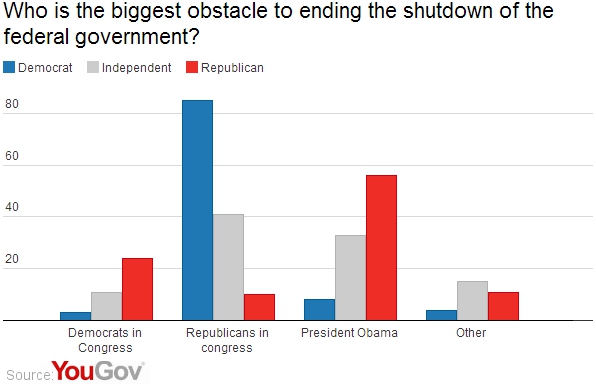
Who’s Blamin’ Who?

Shutdown Obstacle

YouGov’s latest:

The latest research from YouGov, conducted in the first two days of the shutdown, shows that half (50%) of Americans blame Republicans in Congress for the continuing shutdown. 11% blame Democrats in Congress while 29% blame President Obama for not ending the shutdown. This divides along partisan lines, with Democrats tending to blame Republicans and Republicans tending to blame the President or Democrats. Independents, however, are largely split, with 41% blaming Republicans in Congress and 33% blaming the President.

I’d find the narrow split among Independents unnerving, if I were the president. 33 percent blame the president for the shutdown and impasse? Given that he has already conceded sequester-level spending, and has cut the deficit in the last three years by the swiftest amount since the end of the Second World War, what else do they want him to do? If he were to abandon his signature domestic achievement after re-election, because of blackmail, we might as well give up on elections and representative government altogether. All round, this does not seem to me as a battle either side will “win” as such. Right now, as Harry Enten notes in a review of the polls, “no side is winning, one side is just losing by less”:

More Americans disapprove than approve of the job being done by all three actors in the dispute over the federal budget. President Obama comes out “ahead” in the ABC News/Washington Post poll with a -9pt approval rating. Both parties in Congress are much lower. Democrats in Congress manage to maintain a net approval of -22pt, while Republicans in Congress fall to a -37pt approval rating. These are all awful. …

A new CNN/ORC poll puts the net favorability rating of the Democratic party at -9pt: its lowest since CNN started asking the question in 2006. Republicans, too, are at their lowest level since 2006 as well, with -30pt favorability. A large portion of the difference between the parties’ favorability is that Tea Party supporters are less likely to hold a favorable view of Republicans than Tea Party opponents are of Democrats.

Meanwhile, Weigel highlights a Fox News poll with some bad numbers for Republicans. This one – compared with the last Fox News poll – stood out to me:

A tumble in the GOP’s favorable rating to 35–59, with 59 percent unfavorable marking the highest level in the history of the poll.

Of course that just might be the Tea Partiers frustrated that the GOP isn’t being radical enough in bringing the government and the economy into collapse.

Can You Get Axed For Loving A Kids Show? Ctd

A reader writes:

Excellent post that raises a really interesting issue – one on which I am torn. It really sucks that someone lost their job for such a trivial reason, but is the problem that employers can fire at will, or that we have created a labor market where losing a job with a shitty employer is so traumatic?

I am a total corporate guy who is a huge fan of universal healthcare because it could materially increase labor mobility and reduce the risk of leaving (or being asked to leave) a job.  I really think that the free market could be a much better mechanism to punish shitty employers than any regulation.  Want to fire people for their tastes in art and literature?  Fine, but good luck maintaining a workforce that will actually make you more profitable.  Employee, want to leave that draconian employer?  No big deal: you can find a new job and not worry about your health care.  Raise the cost of turnover and reduce the employee’s risk of job loss and employers will lose the incentive to fire capriciously and employees will be able to say “fuck you” and move on to greener pastures.

And hopefully make more “I quit!” videos like the awesome one above.

Who Knew Airline Safety Videos Could Be So Entertaining?

Based on yesterday’s MHB, which featured a parody of a safety video and then an update from a reader with a hilarious video from Delta, another writes:

My favorite airline safety video is this one from Air New Zealand [seen above]. It’s called The Bear Essentials of Safety.

Another reader:

I think Virgin America has one of the cutest and funniest in-flight safety videos – especially the part about how to operate the seat belts.

Another points to an “extremely cute” one from First Choice in the UK. And another:

This is my favorite cheeky airline video, from Mexico’s discount Volaris airlines.

Update from a reader:

The new Delta video you showed is cheeky, but a lot of us frequent fliers have a place in our heart for the so-called “Deltalina” video from a few years back. (The star even has her own Wikipedia entry.) While the video hasn’t been shown in a while, she has a cameo in the new one you posted yesterday, with the famous finger wag after the admonition to not smoke.