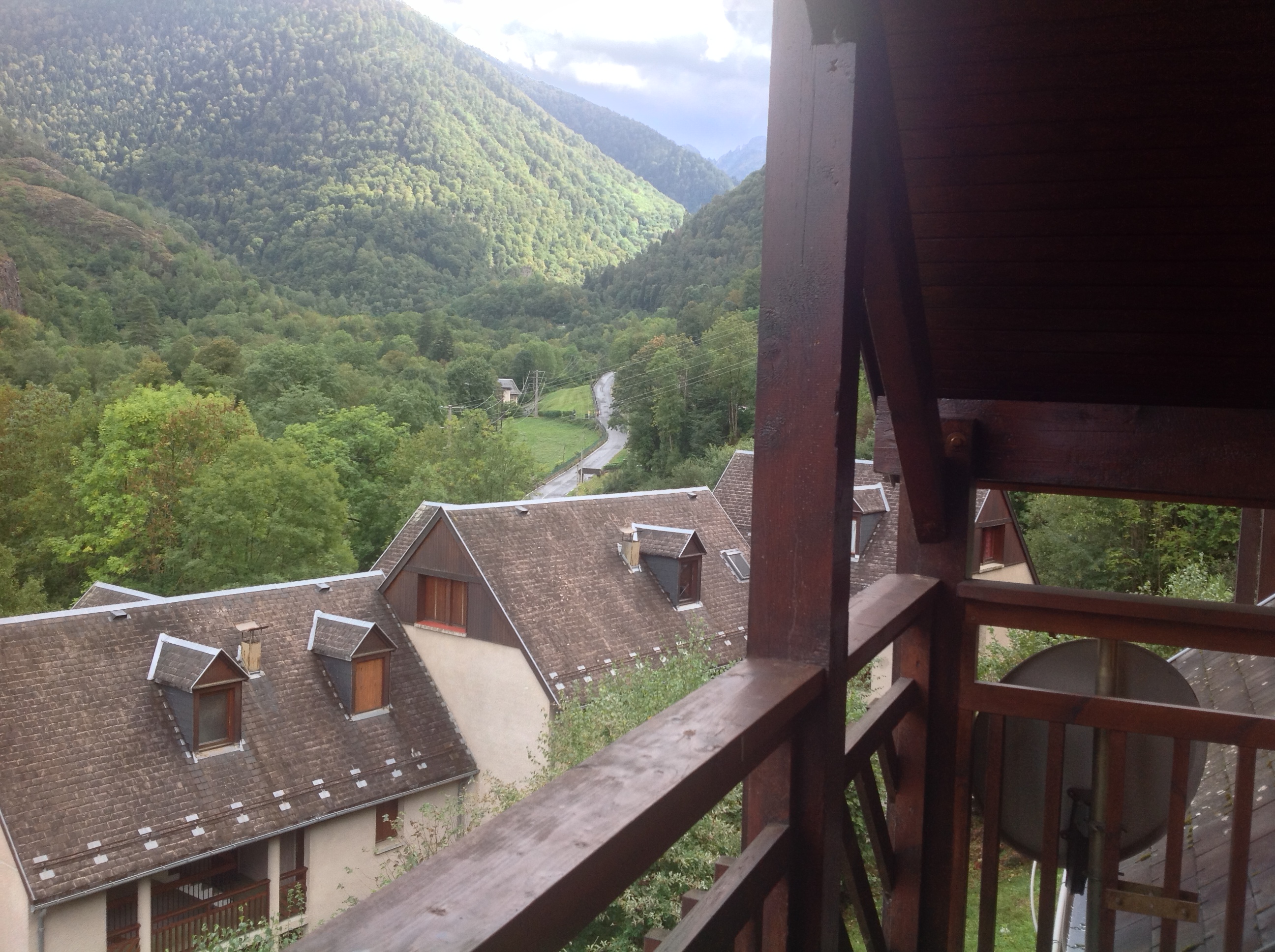
Bagnères de Luchon, France, 9.15 am
Bagnères de Luchon, France, 9.15 am
Beutler spells it out:
The whole point of Obama’s refusal to negotiate is that what Republicans are actually demanding is to fundamentally alter the power balance between the legislative and executive branches of government. If Obama caves and offers concessions to Republicans in exchange for a debt limit increase, it will clearly weaken the presidency. By contrast, if Republicans “cave” and increase the debt limit cleanly, Congress will lose none of its fundamental power.
Moreover, senior administration officials are confident that if Obama establishes the precedent that the president should yield concessions to the opposition on a threat of default, eventually the opposition will demand something so impossible that a default will happen anyhow. Taking a hard line now is the only way to prevent that.
A more concise description of Obama’s thinking:
[I]t would be a complete abdication, in [Obama’s] mind, to leave the next president vulnerable to the nullification of his or her election.
Yes, that is indeed where we are: nullification again.

Ezra advises the administration to get its shit together:
[T]he Obama administration did itself — and the millions of people who wanted to explore signing up — a terrible disservice by building a Web site that, four days into launch, is still unusable for most Americans. They knew that the only way to quiet the law’s critics was to implement it effectively. And building a working e-commerce Web site is not an impossible task, even with the added challenges of getting various government data services to talk to each other. Instead, the Obama administration gave critics arguing that the law isn’t ready for primetime more ammunition for their case.
There are signs the site is improving. The early word from insurers is that basically no one was able to sign up during the first two days, though successful applications began to “trickle” in on day three. HHS says that added capacity has cut wait times by a third, though wait times aren’t the only problem, as I found when I got through the queue only to have the site crash on me five or six screens in. The Obama administration need to get the marketplace working, and fast.
It is not as if the issues were not foreseen. Yes, the task is huge, but so are the stakes. The American people seem more than willing to participate but the federal government as well as state governments have given them an almost perfect example of why Americans are leery of government.
There’s time yet to fix many of the problems. But I’m tired of the lame excuses. This has always been the top priority for this administration in domestic policy in its second term. And yet, even with a one-year delay for corporations, they blew it. Most people’s first interactions with Obamacare have been frustration at a computer screen that won’t work. Inexcusable. The team that ran a brilliant technological re-election effort could not construct a system that worked on time for their most important test of government effectiveness. And do you think any heads will roll? Me neither.
In some ways, Obama is lucky that the GOP decided to commit political suicide by shutting down the government this week. If only the Republicans had had the restraint to let Obamacare’s disastrous early roll-out play out alone.
Not this administration’s finest hour.
Earlier Dish on the subject here. Screenshot above from a Reddit thread on the healthcare exchanges’ coding errors.
A reader writes:
My 80-year-old father-in-law is a Korean War vet and was 11 when we invaded Normandy. He has not been abroad since he returned from his tour in 1956. As part of his 80th birthday celebration, my wife asked that we find a way for me to take him to Europe to see all the WWII sights he’s been reading about since he was a young boy. For over a year now I’ve been planning and saving for this trip, and we leave one week from today.
But we might be forced to miss it because of GOP obstructionism. The American cemetery at Normandy and Patton’s grave at the US cemetery in Luxembourg, you see, are administered by the American Battlefield Monuments Commission, so they are essentially national parks overseas and closed due to lack of funding. Sixty-nine years of waiting to see one of our nations most sacred sights, and most likely his only opportunity, and this good and decent man may miss it because a congressional leader doesn’t have the will to stand up to his radical fringe.
Another reader:
I know this doesn’t qualify under the window rules, but I wanted to share it anyway regarding the
government antics. I’m out here in San Francisco on long vacation. Today, I hiked from the wharf out to the ocean. At my starting point, I saw confused and pissed-off tourists, locked out of Alcatraz, waiting in line to get refunds. One lady from Leeds, here with family on vacation, said, “Even our government isn’t this messed up.”
I ended my hike four hours later at my favorite bar, Louis’s at Land’s End. Despite its stellar view of the Pacific, it was deserted. A waitress told me that everyone was scared off because technically Louis’s, which leases its little aerie from the U.S. Parks Service, was supposed to be closed. “But the owner said screw ’em and opened anyway.” So thanks so the House Republicans, I had my Anchor Steam beer – and this view – all to myself.
Another:
I might just be one of the only federal employees who is saving money from being furloughed.
I’m an attorney with a very very long commute, and I’m not getting paid for my year-long fellowship. So I’m not concerned about how this impacts me personally. I am concerned, however, about the work that is getting put on hold. I spend my days enforcing and investigating violations of civil rights laws, primarily the Americans with Disabilities Act and Fair Housing Act. I’ve had to put a number of settlement negotiations on pause as the victims of discrimination wait patiently on the sidelines. It’s a very small group of us in our office doing this work, and we’re all sitting at home. And believe me, our district is in dire need of a vigorous enforcement of these laws.
Another:
I work for a company that does a significant amount of business with the federal government. Our client list includes the EPA, Department of Energy, Centers for Disease Control and Prevention, Housing and Urban Development, and the National Institutes for Health. These are the kind of agencies that many on the right would likely target as non-essential under any circumstance and that they are comfortable with shutting down now.
But here are some of the things that these agencies do, just from the perspective of our work with them: reduce pollution in our water system, lower energy usage in buildings in a cost-effective manner, prevent people – especially children and the aged – from being exposed to chemicals and other hazards that could jeopardize their health or kill them, and encourage builders to construct homes that are environmentally sound and energy efficient. Just to name a few things.
So, I laugh (sort of) when those who support the shutdown talk about how we can get by without most of this stuff. I guess they don’t breathe, drink water, live in homes, work in buildings or have any illnesses in their families. They’re pretty lucky, I guess.
I feel a general sense of low-level anxiety at our company. We’re keeping busy right now with internal tasks but how long that can last, I have no idea. I suspect the next step will be asking/encouraging people to use vacation time, if they can. Then, who knows?
It’s really nice that some of the Republican “leaders” decided to make sure the old vets could visit the World War II Memorial. Maybe they could do something a little more constructive that doesn’t also constitute a photo opp.
Another:
I’m an Aerospace Engineer who evaluates safety issues for the FAA. A couple of my coworkers and I have been excepted to keep up on the highest priority tasks, and evaluating new potential issues as they come in. But 90% of my coworkers (most of whom don’t work full time on operational safety) are furloughed. If this extends for much longer we’re going to have to bring back more people, because as lower priority issues sit for too long, they tend to bubble up the risk scale, and we don’t want to have to start grounding airplanes. Luckily, we have the flexibility to initiate call backs.
Three years ago, before becoming a civil servant, I would’ve shrugged off the folks who claim these absolute minimum staffing levels constitute the proper amount of government. I might have even conceded the principle. But having seen the sausage being made, it’s amazing how little these small-government fetishists know about what gets done day to day. Oftentimes, zilch.
One more:
I’ve been reading the various iterations of your blog since the Pleistocene era of the blogworld. I finally [tinypass_offer text=”subscribed”] today. I’ve been meaning to for a long time, but today I pulled the trigger. Your blog is the only place where I’ve seen all these stories of people actually affected by the shutdown brought on by the virulent clown-show that is the modern Republican Party. This is the bit from one of your readers that pulled me in: “While the Neo-Confederate toddlers stamp their feet and hold their breath, it is America that is turning blue.”
I’ve long since fallen under the spell of your writing. But today made it clear to me that I’ve also fallen under the spell of your readers’ writing as well. It is this extraordinary back and forth between writer and reader – which is not to be found anywhere else on the intertubez – which is ultimately irresistible to me.
And us as well. Read the whole series here, as well as unfiltered response from readers on our Facebook page. Our ever-growing archive of reader threads is here.
Brent Cunningham details the tradition of providing custom-made meals to death row inmates just before execution:
In America, where the death rows—like the prisons generally—are largely filled with men from the lower rungs of the socio-economic ladder, last-meal requests are dominated by the country’s mass-market comfort foods: fries, soda, fried chicken, pie. Sprinkled in this mix is a lot of what social scientists call “status foods”—steak, lobster, shrimp—the kinds of foods that in popular culture conjure up the image of affluence.
Every once in a while, though, a request harkens back to what, in the Judeo-Christian West, is the original last meal—the Last Supper, when Jesus Christ, foreseeing his death on the cross, dined one final time with his disciples. Jonathan Wayne Nobles, who was executed in Texas in 1998 for stabbing to death two young women, requested the Eucharist sacrament. Nobles had converted to Catholicism while incarcerated, becoming a lay member of the clergy, and made what was by all accounts a sincere and extended show of remorse while strapped to the gurney. He sang “Silent Night” as the chemicals were released into his veins.
We recently noted the sexual prowess of Walt Whitman, but what about his fellow 19th century writer, Henry David Thoreau? He wasn’t so lucky:
His close friend and fellow transcendentalist Ralph Waldo Emerson mentioned that Thoreau
lived alone and never married, but it’s the journal of author Nathaniel Hawthorne, a Concord, Massachusetts neighbor, that might explain why: “[Thoreau] is as ugly as sin, long-nosed, queer-mouthed….” Nathaniel’s son Julian is as kind in his own memoir, calling Thoreau a “short, dark, unbeautiful man.” Even nearly 20 years after Thoreau’s death, the Scottish writer Robert Louis Stevenson noted Thoreau’s “thin, penetrating, big-nosed face.” …
Despite his distaste for fashion, Thoreau did have some flair — if you could call it that. In the winter of 1855, Thoreau grew a neckbeard, which he claimed was for protection against “throat colds,” but also, he insisted, was quite popular with the ladies. Fellow author and Concord resident Louisa May Alcott reportedly pointed out the impossibility of this, mentioning to Emerson that Thoreau’s neckbeard “will most assuredly deflect amorous advances and preserve the man’s virtue in perpetuity.”
(Portrait of Thoreau in 1856, via Wikimedia Commons)
Reviewing Thomas Pynchon’s new thriller Bleeding Edge, Justin St. Clair is unnerved by the novel’s attention to “obscure particulars.” He gets the feeling that the author “must actually be reading us, and, in a way, he is”:
The trick amounts to the literary equivalent of a “cold reading,” a paranoid narrative inducing the same by offering readers a multitude of “relatable” (if meaningless) details. Primed for paranoia, we personally identify with the occasional particular, and the effect can be unsettling. My own frisson of familiarity, for what it’s worth, was triggered by a pair of gratuitous Midwestern references: Duck Creek Plaza in Bettendorf and the Hy-Vee commercial that [protagonist] Maxine’s kids can’t stop singing. Neither have anything to do with anything, but they’re creepily specific, especially if one was the turnaround for your high school cross country team, and the other, well, you appeared in one of those blasted commercials as a high school bagboy. Suddenly you’re wondering what the hell Pynchon was doing in the Quad Cities.
Noah Cruickshank praises the book for offering more than just Pynchon paranoia:
Like several Pynchon books, the heart of the conspiracy isn’t really uncovered, but that’s fitting in days like these. Maxi is a ballsy everywoman, buffeted about by forces she only slightly understands. And by placing the story before the NSA surveillance state became commonplace, Pynchon shows its genesis, which amounts to a bunch of very smart people making very stupid decisions. Bleeding Edge argues that everyone is culpable in these eventualities, but it also acknowledges that they may not have been preventable. That acknowledgement is an example of the empathy that runs through the novel (and is sometimes missing from Pynchon’s other work).
David Barrett is likewise caught off guard by the novel’s tenderness:
This relationship between the real world — which Pynchon dubs “meatspace” — and the internet is central to the novel. After September 11, more people find their way into [mysterious virtual world] DeepArcher. Maxine wonders if they’re in retreat from the real world. She picks up a “chill sense that some of the newer passengers [in DeepArcher] could be refugees from the event at the Trade Center”. Pynchon spends very few pages describing New York as the towers come down. He’s far more interested in how the atrocity distorts the public imagination, and over time DeepArcher begins to display the same levels of paranoia Pynchon sees everywhere offline. It’s in this context — amid the twin conspiracies of the internet and meatspace — that the novel considers what kind of future exists for boys like [songs] Ziggy and Otis in such a hostile world.
“There’s no innocence,” Maxine’s father Ernie says in the novel. “Anywhere. Never was.” Maybe so, but Pynchon’s preoccupation with family connections in Bleeding Edge shows that he wants there to be.
Recent Dish on the author and his new book here, here, and here.
This clever viral video had a lot of people fooled:
New Yorkers understand unconventional living situations, but this one is a little too crooked to be real. A documentary called Man in a Cube features a writer named “Dave” who claims to live inside the Astor Place Cube, an iconic New York City sculpture by artist Tony Rosenthal. … The video ends with a blatant plug for Whil, a self-proclaimed “brand about nothing.” The idea behind it is a 60-second technique during which one should meditate and power down from the chaos of the connected world.
Update from a reader:
There was a National Lampoon short story in the mid-1970s about a guy who lived in the Astor Place cube. If my memory serves me correctly (highly suspect for all the usual reasons), he had the gift of being able to poop a kind of super marijuana and supported himself by selling it around the neighborhood. “Hilarity” ensued.
A reader writes:
I’m trying to bring my fiancee, who currently lives in Mongolia, to the United States on a K-1 visa. We were both ecstatic when my K-1 visa application was recently approved by U.S. Citizenship and Immigration Services. The next step is for the approved visa application to be forwarded to the National Visa Center, and from there to the U.S. Consulate in Ulaanbaatar, Mongolia. As I watched the news about the attempt to pass a CR, I thought that it was unfortunate, but wouldn’t affect me directly.
Then suddenly it occurred to me that visa processing was almost certainly considered a “non-essential” government service, so I looked it up, and sure enough, immigration services is one of the things that will be severely curtailed or completely halted by the government shutdown. Which means that my reunion with my fiancee, which had looked to be on track to happen by the end of the year, is now being postponed indefinitely until the shutdown is resolved.
Update from a reader:
I work for USCIS and I can assure you that this is not true. Immigration services within DHS and DOS are entirely fee based. Immigration paperwork is being processed as normal. The only delay will be the normal processing delay that accompanies any application or petition.
Update from the first reader:
It may be true that will USCIS will continue to operate as normal, but as I stated, my visa application has already been approved, which means that USCIS is no longer involved. The visa application has already been moved to the National Visa Center, and from there to the State Department. Per this document, guidance from State in anticipation of the 2011 shutdown indicated that State would severely curtail non-emergency visa-related activities.
I appreciate your effort to put a human face on this political farce.
One more update:
I am a Foreign Service Officer currently serving abroad. In 2011, State Department guidance stated that visa services would be curtailed. This time around, we were given new guidance stating that all visa and citizenship services were fee based and would stay open (see Chapter 2, part C). I hope that your reader can be reunited with his fiancee soon, and thankfully the shutdown should not slow down their reunion.
Another reader:
I work for the Indian Health Service on the Navajo reservation. My rural hospital is “essential” and we are still open for business. We are continuing to get paid, although we cannot take sick leave or vacation. It was heartbreaking to see one of our medical records employees coming back into work on Tuesday less than two weeks after having a baby. Like most of our staff, she is Navajo. The unemployment rate on the reservation nears 50%, so anyone with even a low wage job supports many extended family members. She could not afford to take unpaid leave.
As much as the shutdown impacts our staff, it hurts our patients more.
On October 1st, we got an email stating that we do not have funds to pay for medical care outside of our system. We do not employ cardiologists, oncologists, neurosurgeons, etc. All pending appointments that are not urgently life or limb threatening are cancelled until further notice.
Today, October 3, we got another email stating that our pharmacy does not have funds to buy medicines. We are only ordering medications that are “of a life saving and sustaining nature.” We already work hard to keep medication costs low. But now, for just one example, we are no longer able to stock medications to treat rheumatoid arthritis, a disease with particularly high rates in our population.
The United States government is bound by treaty to provide health care for Native Americans. The lack of a budget is gravely impacting our ability to honor that that obligation.
Another:
I am a furloughed government employee. This government shutdown is so disheartening. I work in an office that deals with international issues and coordinates with the equivalent agencies in other countries. We send delegates frequently to conferences to coordinate cooperative pilot programs, capacity building exercises for developing countries, and the negotiation of international agreements. International meetings are on-going despite the shut-down, and the United States has lost its voice, investments, and subject matter experts for the time being.
It pains me that we have all be locked out of our offices and the missions we serve. However, it’s merely the final step in a long line of insults: no cost of living increases for four years, endless budget uncertainty due to a revolving door of continuing resolutions, hiring freezes, cuts, and the still-continuing sequester. My agency has not seen a Senate-confirmed leader in four years. We have endured audits of 15 years worth of travel and conferences because of the GSA Law Vegas Scandal, though we had nothing to do with it. We are cautioned to not do anything that could be perceived as partisan in the wake of the IRS non-scandal, and have to make unnecessary, inconvenient, expensive accommodations to ensure that our office’s activities ensure money/attention flowing towards the states of the chairmen and ranking members of the congressional committees that oversee us. We’re called leeches and ne’er-do-wells and told we “never created a single job.”
I hate the stereotypes that the Tea-Party has assigned government workers and greatly wish that Speaker Boehner and his party could come and meet us. My office is so diverse: we have grandparents, thirty and forty-somethings, and childless millennials. We have veterans from all five armed service branches, including those who saw active combat in Vietnam, Desert Storm, Kosovo, and the Iraq and Afghanistan wars. We come from almost every state, and numerous colleges, universities, and career paths.
We don’t always agree on everything, but everyone works hard to pursue our office’s mission as a group, and navigate the sometimes draconian regulations that reflect an inherent distrust of us. We all value public service, and there are several co-workers who cannot speak about 9/11 without getting emotional. This is a very painful time emotionally as well as financially/logistically. Some of my co-workers with decades of experience are actively looking for other work, which would be a huge loss to my agency’s institutional memory. I can only imagine how many more across the entire government workforce are now doing the same.
I know I’m probably just a chump, but I believe it’s an honor to serve the People of the United States, and I got teary-eyed when I took my oath to “support and defend the Constitution…” I wonder if the Republicans really believe they are upholding the Constitution as they strive to bring the U.S. to default to invalidate a legitimately passed and judicially-reviewed law?
Read the entire “View From Your Shutdown” series here.
Emily Yoshida explores the legacy of one of the first great computer games:
Twenty years ago, people talked about Myst the same way they talked about The Sopranos during its first season: as one of those rare works that irrevocably changed its medium. It certainly felt like nothing in gaming would or could be the same after it. If you remember the game, you remember that feeling of landing on Myst Island for the first time, staggeringly bereft of information in a way that felt like some kind of reverse epiphany, left with no option but to start exploring. This was a revolutionary feeling to have while staring at your PC screen.
And the word-of-mouth carried — people who had never gamed before in their lives bought new computers so they could play Myst. “It is the first artifact of CD-ROM technology that suggests that a new art form might very well be plausible, a kind of puzzle box inside a novel inside a painting, only with music,” came the impassioned, if grasping prophecy from Wired’s Jon Carroll. “Or something.” …
Myst required little more than your eyes, your ears, and a healthy sense of curiosity. And that’s the most important mark it made. Myst arrived before most home PCs had Internet connections; it was one of the first faraway worlds in which you could get lost from the comfort of your swivel chair. Without Myst there’s no Grand Theft Auto V or Assassin’s Creed — but I’d also argue that there’s no late-night bottomless Wikipedia rabbit hole. Maybe Myst didn’t change how we approached computer games, but rather how we approached computer lives.
Update from a reader:
I grew up with computer games in the ’80s and early nineties, and while Myst was revolutionary in its graphical content, it was not exactly revolutionary in the ways Emily Yoshida points out. She says “…left with no option but to start exploring. This was a revolutionary feeling to have while staring at your PC screen.”
I’m not sure how you can talk about Myst and write that quote seriously without mentioning the Zork series. Those amazing text based games were essentially a pre-cursor to Myst that created the exact same feeling, but with words instead of pictures. You could also mention any of the party based RPGs of the time (Wizardry, Bard’s Tale, Might and Magic) with the same feeling. They clearly required a more “nerdy” bent to play a game with characters and statistics and you know, names. However, they started you the same way. The game threw you into an unknown situation with minimal back-story and you had to adventure your way through and figure it out.
So yeah, Myst was graphically revolutionary, and may have pulled more people in to computer gaming, but the basic concept was not that novel.
Previous Dish on Myst‘s influence here.


 The Dish
