Cool Ad Watch

A simple but clever way to market a new book about a bunch of other books:

This embed is invalid

How A Reader’s Book of Days Was Made from WW Norton on Vimeo.

At once a love letter to literature and a charming guide to the books most worth reading, A Reader’s Book of Days by Tom Nissley is an addictively readable day-by-day literary companion. Every book you see here (and many more!) are all in A Reader’s Book of Days. It’s brimming with stories from the lives of authors and the books they created. Learn more here.

A Short Story For Saturday

This weekend’s tale is Jack London’s 1908 classic, “To Build a Fire“:

The man flung a look back along the way he had come. The Yukon lay a mile wide and hidden under three feet of ice. On top of this ice were as many feet of snow. It was all pure white, rolling in gentle undulations where the ice-jams of the freeze-up had formed. North and south, as far as his eye could see, it was unbroken white, save for a dark hair-line that curved and twisted from around the spruce- covered island to the south, and that curved and twisted away into the north, where it disappeared behind another spruce-covered island. This dark hair-line was the trail–the main trail–that led south five hundred miles to the Chilcoot Pass, Dyea, and salt water; and that led north seventy miles to Dawson, and still on to the north a thousand miles to Nulato, and finally to St. Michael on Bering Sea, a thousand miles and half a thousand more.

But all this–the mysterious, far-reaching hairline trail, the absence of sun from the sky, the tremendous cold, and the strangeness and weirdness of it all–made no impression on the man.

It was not because he was long used to it. He was a new-comer in the land, a chechaquo, and this was his first winter. The trouble with him was that he was without imagination. He was quick and alert in the things of life, but only in the things, and not in the significances. Fifty degrees below zero meant eighty odd degrees of frost. Such fact impressed him as being cold and uncomfortable, and that was all. It did not lead him to meditate upon his frailty as a creature of temperature, and upon man’s frailty in general, able only to live within certain narrow limits of heat and cold; and from there on it did not lead him to the conjectural field of immortality and man’s place in the universe. Fifty degrees below zero stood for a bite of frost that hurt and that must be guarded against by the use of mittens, ear-flaps, warm moccasins, and thick socks. Fifty degrees below zero was to him just precisely fifty degrees below zero. That there should be anything more to it than that was a thought that never entered his head.

Continue reading here.  The Dish recently featured other short stories here, here, and here.

The View From Your Window Contest

vfyw_11-30

You have until noon on Tuesday to guess it. City and/or state first, then country. Please put the location in the subject heading, along with any description within the email. If no one guesses the exact location, proximity counts.  Be sure to email entries to contest@andrewsullivan.com. Winner gets a free The View From Your Window book or two free gift subscriptions to the Dish. Have at it.

Dropping Out Of School Testing

Robert Kolker investigates New York’s “opt-outers” – kids who refuse to take a standardized test known to be so difficult that “fewer than one third of all third- through eighth-graders across the state passed” in 2012:

According to the [Department of Education], New York City had 320 opt-outers in 2013, nearly triple the number of the previous year—and all because of the city’s decision to roll out a test that was way too hard for most students. [In NYC,] Time Out From Testing and Change the Stakes worked together to show families how to opt out. Across the state, the movement was even bigger. Buffalo, Rochester, and Long Island all boasted support for their opt-out movements. Jeanette Deutermann, alarmed by her child’s panicked reaction to the tests, started a Facebook page called Long Island Opt-Out Info that now has nearly 13,000 members. “People got onboard so quickly,” Deutermann says. “Even if their kid got fours”—the highest scores—“every parent had a story about how the test had negatively affected them.” …

Should the movement continue to grow, there are a number of tangible (and chaotic) repercussions that [Mayor-elect Bill] De Blasio would have to face. A growing opt-out movement could hurt teachers, if refusals to take the tests bring down the overall average of the scores being used in teacher evaluations. A critical mass of opt-outers could even arguably work toward disqualifying a school from receiving federal funding (the money from No Child Left Behind is contingent upon 95 percent of a school’s students taking the annual standardized tests).

Who Are Superheroes Meant For?

Stuart Kelly discovers some surprising views from the legendary comic book writer Alan Moore:

When I mention that Geoff Johns has done a whole series of Green Lantern based on his story “Tygers”, he gets tetchy. “Now, see,” he says, “I haven’t read any superhero comics since I finished with Watchmen. I hate superheroes. I think they’re abominations. They don’t mean what they used to mean. They were originally in the hands of writers who would actively expand the imagination of their nine- to 13-year-old audience. That was completely what they were meant to do and they were doing it excellently. These days, superhero comics think the audience is certainly not nine to 13, it’s nothing to do with them. It’s an audience largely of 30-, 40-, 50-, 60-year old men, usually men. Someone came up with the term graphic novel. These readers latched on to it; they were simply interested in a way that could validate their continued love of Green Lantern or Spider-Man without appearing in some way emotionally subnormal. This is a significant rump of the superhero-addicted, mainstream-addicted audience. I don’t think the superhero stands for anything good. I think it’s a rather alarming sign if we’ve got audiences of adults going to see the Avengers movie and delighting in concepts and characters meant to entertain the 12-year-old boys of the 1950s.”

Update from a reader:

We all give thanks for the monster talent of this man, who almost single-handedly recaptured the attention of adults for comics, but who is also famously curmudgeonly to his legions of fans.  Like so many great creators, Moore is a misanthrope who seems ever confused about the motivations, loves and hopes of real people. God love him.

Oh and The Avengers is beneath him, now? Please. Even Kurt Cobain professed his love for the Beatles. Come on Alan!  Live a little!

A Poem For Saturday

poetrysocietyawards_9073

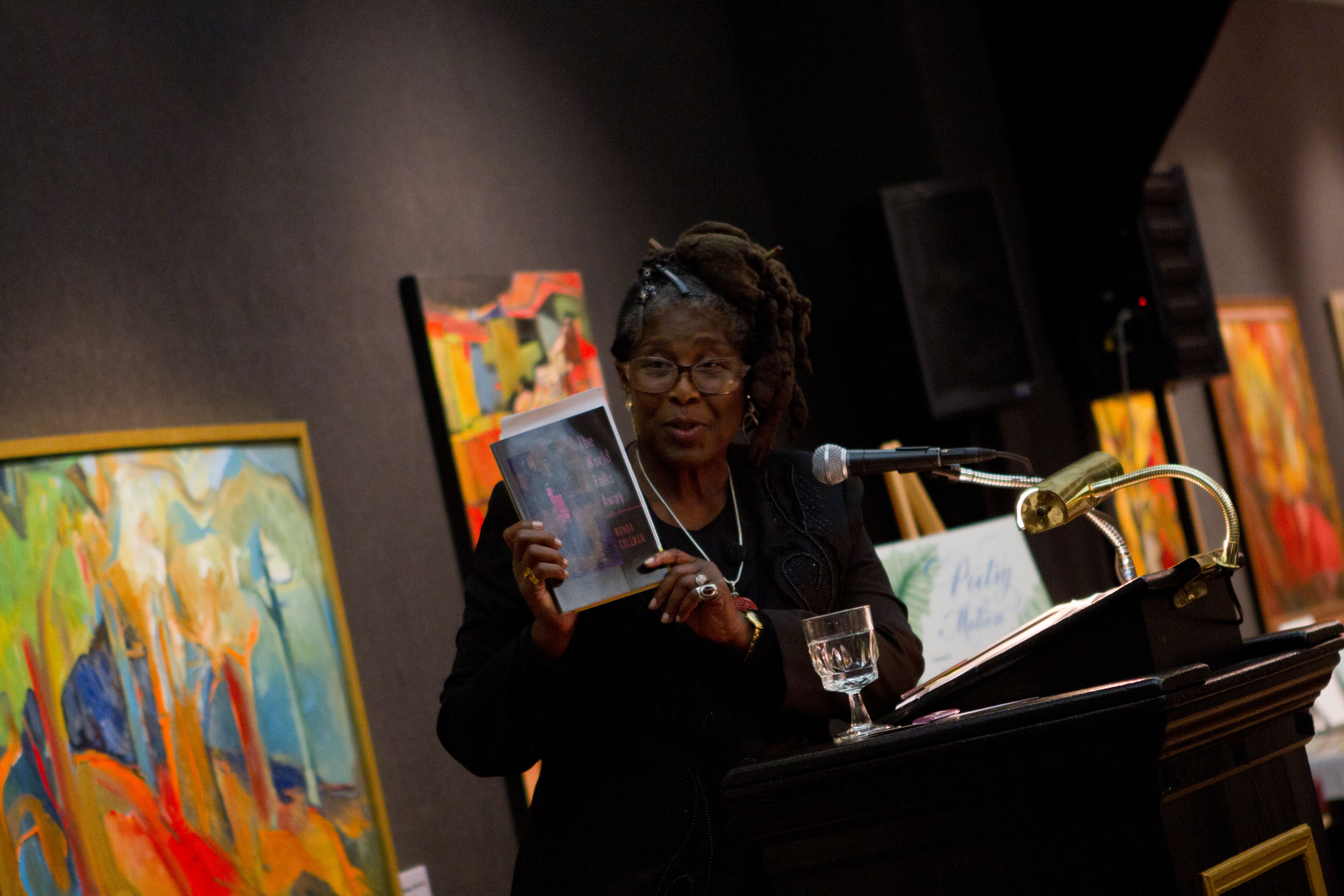
Last Friday, the poet Wanda Coleman died at Cedars-Sinai Medical Center in Los Angeles at the age of 67. David L. Ulin remembered her with these words:

Coleman was the conscience of the L.A. literary scene—a poet, essayist and fiction writer who helped transform the city’s literature when she emerged in the early 1970s….When she began to write, as a member of the Watts Writers Workshop that sprang up after the 1965 riots, L.A. literature was largely a literature of exile, produced primarily by those from elsewhere, who lingered briefly along the city’s glittering surfaces and did not invest the place with any depth. Working in the tradition of John Fante, Chester Himes and Charles Bukowski, Coleman invented a new way of thinking about the city: street-level, gritty, engaged with it not as a mythic landscape, but in the most fundamental sense as home.

On Thanksgiving Day, we posted a poem of Coleman’s, “Pigging Out,” dedicated to her husband. Today we’re featuring a poem about her daily life as an artist, and tomorrow we’ll run a self-portrait of this remarkable woman and poet, who received the Shelley Memorial Award from the Poetry Society of America in 2012, joining e.e.cummings (1945), Elizabeth Bishop (1953), Theodore Roethke (1962), and May Swenson (1968), among others. Here’s Coleman’s “Slave Driven”:

i barely niggle a living squirreling around
the home office. I work for myself as my own secretary.
it’s a shitty job, paperwork ceiling to floor. the
technology changes every few months. i’m on call
weekends and holidays. no benefits or perks.
there’s no vacation or overtime. the pay is less
than minimum wage.
it’s like every job I’ve ever had except I don’t drive
rush-hour traffic and can wear nightclothes if I want.
there are no racist vibes, no gender or sex preference
or intergenerational discrimination, quitting time
is determined by level of exhaustion.
i get no breaks. i sit all day.
i grab a bite while on duty
the boss never has anything
good to say

(From Ostinato Vamps © 2003 by Wanda Coleman. Reprinted by kind permission of the University of Pittsburgh Press. Photo of Coleman courtesy of the Poetry Society of America)

Always Tell Kids The Truth?

The above video shows children reacting to the “news” that their parents ate all their Halloween candy – a prank. Sam Harris takes offense, insisting that “anyone who takes pleasure in all this exploited cuteness is morally confused”:

My daughter is nearly five, and I can recall lying to her only once. We were looking for nursery rhymes on the Internet and landed on a page that showed a 16th-century woodcut of a person being decapitated. As I was hurriedly scrolling elsewhere, she demanded to know what we had just seen. I said something silly like “That was an old and very impractical form of surgery.” This left her suitably perplexed, and she remains unaware of man’s inhumanity to man to this day. However, I doubt that even this lie was necessary. I just wasn’t thinking very fast on my feet.

As parents, we must maintain our children’s trust—and the easiest way to lose it is by lying to them. Of course, we should communicate the truth in ways they can handle—and this often demands that we suppress details that would be confusing or needlessly disturbing. An important difference between children and (normal) adults is that children are not fully capable of conceiving of (much less looking out for) their real interests. Consequently, it might be necessary in some situations to pacify or motivate them with a lie. In my experience, however, such circumstances almost never arise.

Face Of The Day

dish_1stselfiefotd

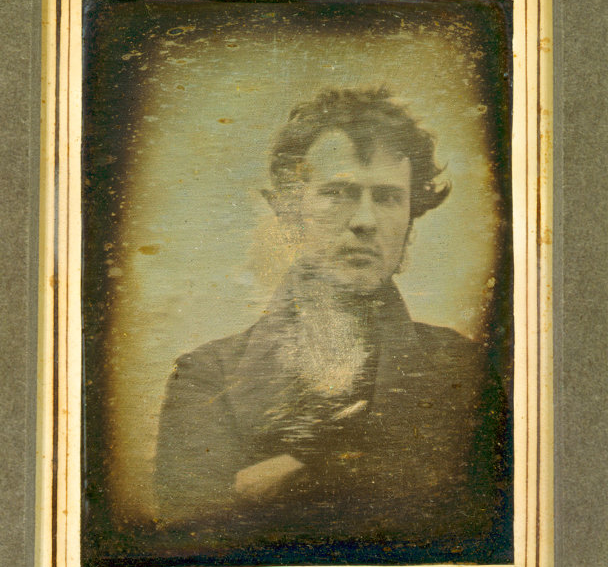
Joe Berkowitz captions the earliest known selfie:

According to the Library of Congress, chemist and metallurgist Robert Cornelius is believed to be the first person to ever stare into the unblinking iris of a machine, beseeching it to capture his ephemeral essence forever. His self-shot daguerreotype from 1839 is the earliest known American portrait photo. It was taken in the yard of his family’s lighting store, back when long exposure times rendered the idea of photographing people just a wonderful dream. We’ve already seen what some historical photos might look like as selfies, but now we have the real deal to measure against.

When Thinking Trips You Up

A new study from sports psychologist James Bell suggests that neurotic people are more likely to make more accurate judgments the faster they respond:

One hundred and ninety-six teenage male cricketers, all members of regional academies, took part in the study. They watched six clips of footage recorded from behind bowlers during the Twenty20 World Cup in England in 2009. Just as the bowler released the ball, each clip was frozen and remained visible for half a second – the approximate amount of time that a batsman has to decide how to react to a delivery. After the freeze-frame disappeared, the participants pressed one of two keyboard keys as fast as possible to indicate whether they judged it was better to attempt to hit a single run, or to go for a “six” (a boundary shot similar to a home run in baseball). Four qualified cricket coaches agreed on the optimum response for each clip. The participants also completed a neuroticism scale, measured by their agreement with statements like “I worry about things” and “I get stressed out easily.”

The key finding is that for low scorers on neuroticism, the more quickly they responded on average, the poorer their judgments tended to be, yet for high scorers on neuroticism the opposite was true. “The most parsimonious explanation,” the researchers said, “… is that individuals with high levels of neuroticism tend to have a stimulus-driven attentional orientation, which means they are likely to react automatically to environmental stimuli (particularly if it is threat related) resulting in faster and more accurate responses in the context of the current task.”