The Power Of Touch

Christian Jarrett considers a new study suggesting that human touch, and possibly stuffed animals, can reduce existential angst for people with low self-esteem:

For an initial study, a female experimenter passed a pair of questionnaires measuring death angst and self-esteem to each of 61 participants (35 men) who took part. If she CSC_0277 touched a participant gently on the back for one second as she passed them the papers, then afterwards they tended to report having less fear of death, as compared with if no physical contact was made. But crucially, this was only the case for participants with low self-esteem. …
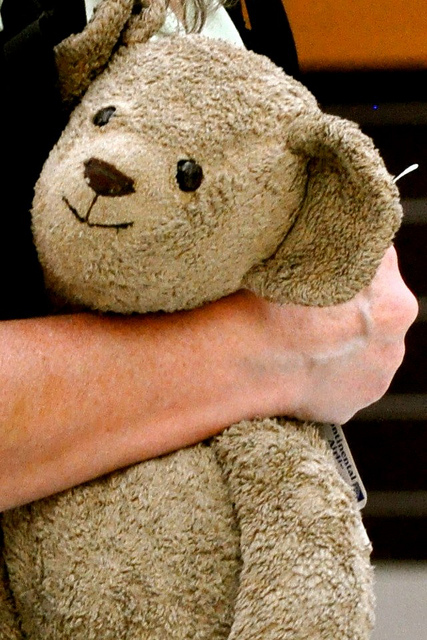

Next, 50 participants were asked to estimate the value of a metre-high teddy bear enclosed in a box and viewed through a plexiglass panel. Those who’d first been reminded of death and who had low self-esteem put a price on the bear of €23. In contrast, participants with high self-esteem who were reminded of death, and all participants not reminded of death, valued the teddy at just €13. This shows that thoughts of death “increased the desire for touch among individuals with low self-esteem,” the researchers said.

Unfortunately we can’t be confident this is true. Because there were no control conditions in which participants rated the value of other objects, we can’t know if low self-esteem individuals reminded of death wouldn’t have placed a higher value on any product.

(Photo by Flickr user christopher frier brown)

The Conspiracy Theory Narrative

Benjamin Wallace-Wells runs through the past 50 years of conspiracy theories:

The seduction of conspiracy is the way it orders chaos. In the summer of 1964, the English philosopher and logician Bertrand Russell—past 90 years old then and possibly the most famously rational person on the planet—read the early accounts of the Warren Commission Report with mounting alarm. None of the important questions, he thought, were being answered. There was the matter of the parade route being changed without explanation at the last minute, so that the motorcade passed Lee Harvey Oswald’s workplace; the geometrically confounding arrangement of entry and exit wounds; the curious fact that an alibi witness who helped get an alternate suspect released from custody turned out to be a stripper at Jack Ruby’s club.

The logician went to work. Meticulously, Russell documented the discrepancies between each first-person account and the divergences between each report in the media. He gave his document a modest, scientific-sounding title (“16 Questions on the Assassination”) and a just-the-facts tone. This strange hybrid method, through which a literary genre convinces itself it is a science, has become not just a template for ornate conspiracies but a defining way in which American stories are told. In the English tradition of mysteries, the screen­writing guru Robert McKee explained a few years ago, “a murder is committed and the investigation drives inward: You know, you’ve got six possible murderers. In the American tradition, a murder is committed, we start to investigate, and it turns out to encompass all of society.”

William Saletan reviews a variety of polls regarding belief in conspiracies. Among them:

In 1996, near the 50th anniversary of the supposed UFO crash in Roswell, N.M., Gallup asked Americans whether UFOs had “ever visited earth in some form.” Forty-five percent said yes. But when Gallup asked, in the same questionnaire, “Does the US government know more about UFOs than they are telling us,” 71 percent said yes. Surveys of registered voters by Fox News found a similar gap between belief in the legend and general distrust of the feds.

His takeaway:

[C]onspiracists aren’t completely isolated. They’re surrounded by a substantial number of deep skeptics—people who aren’t drinking the Kool-Aid but don’t trust the government to tell the whole story. On average, these people seem to represent about a quarter of the population. In many cases, when combined with the conspiracy believers, they add up to a majority. We need to understand more about these skeptics. We need to keep them from falling into the arms of the conspiracy-theory peddlers. If they’re suspicious by nature, earning their trust may be difficult. But the best way to win them over is simple. Tell the truth.

Recent Dish tackling the “magic bullet” theory here. Update from a reader:

Check out the official Johnny Carson YouTube channel. Today they released portions of Johnny’s interview with Jim Garrison, a District Attorney from Louisiana who may be the biggest reason the conspiracy theories have lasted so long. Part 1 here and Part 2 here. Carson’s skepticism, even at that time, is really interesting given how long these theories have lasted.  And while Carson lets Garrison lay out his case, he doesn’t pull any punches when he disagrees with Garrison either.

The Risk Of Leaving Your Bed

This embed is invalid


Noah Davis considers his chances of dying today:

First, some of the obvious risks. I have to take the subway to Harlem later tonight. In 2012, 55 people died on the tracks (up from eight in 2011), but there were 1,654,582,265 total riders. That’s about one death for every 30 million riders and about one death per week. I might take a taxi back from Harlem. Seventy-three people lost their lives in traffic accidents in New York City in 2012, which, while tragic, is a low number considering there are more than 27 million taxi rides alone in a single year. That doesn’t include the number of regular cars, livery cabs, buses, etc. Odds of dying in a traffic fatality today are well into the millions to one. It’s actually considerably more dangerous to walk, as 148 pedestrians died in 2012, but that is still extremely unlikely. Biking would be another risk, with 18 cyclists dying in 2012, but biking is actually getting safer as awareness grows. …

Odds of dying in a given year from choking on food are one in 370,035. Multiple that by 365 and I have a roughly one in 135 million chance of dying today from choking on food. But, again, I’m kind of dumb that way and have a history of choking, so let’s bump it up to one in 100 million. Still not likely.

Earlier this year his colleagues interviewed the authors of The Norm Chronicles, a book calculating the risk of everyday scenarios:

What people mean when they say something’s risky is also often packed with other values and preferences for things like a feeling of control (at the wheel of a car rather than as a passenger in a plane, for example). On top of which, their own behavior can make, say, crossing the road, more or less risky than the current average probabilities of being run over. So risk is also contingent. For these and other reasons, a large part of people’s sense of risk has to be subjective. In fact, we’d go so far as to say that objective risk for an individual, thought of as an independent property of the world out there, doesn’t exist. We prefer to think of risk as typically more like an uncertain bet on a horse using scraps of imperfect information mixed with your own judgment: the horse might come in, or it might not….

Beating The Clock

Lucas Reilly explains why regular sleepers tend to wake up before their alarms:

Your sleep-wake cycle is regulated by a protein called PER. The protein level rises and falls each day, peaking in the evening and plummeting at night. When PER levels are low, your blood pressure drops, heart rate slows, and thinking becomes foggier. You get sleepy.

If you follow a diligent sleep routine – waking up the same time every day – your body learns to increase your PER levels in time for your alarm. About an hour before you’re supposed to wake up, PER levels rise (along with your body temperature and blood pressure). To prepare for the stress of waking, your body releases a cocktail of stress hormones, like cortisol. Gradually, your sleep becomes lighter and lighter.

And that’s why you wake up before your alarm. Your body hates your alarm clock. It’s jarring. It’s stressful. And it ruins all that hard work. It defeats the purpose of gradually waking up. So, to avoid being interrupted, your body does something amazing: It starts increasing PER and stress hormones earlier in the night. Your body gets a head start so the waking process isn’t cut short. It’s so precise that your eyelids open minutes – maybe even seconds – before the alarm goes off.

I’m in the opposite camp right now – got up before dawn to get a flight to London. My brain hurts. It wants its normal wake-up time.

The Best Of The Dish Today

Reid finally whipped out the nuke today – and here’s a classic Dish reax post on the fallout. Mike Allen was still busted for egregious Washingtonitis combined with all the ethical quandaries of “sponsored content.” The Scottish parliament heard a sterling conservative case for marriage equality – by the openly lesbian leader of the Scottish Tories. Yep, you read that right, Liz Cheney. Teenage boys are discovering their vulnerable side on Facebook; and we asked why no one eats their pets.

I tried to connect recent events with the thesis that soaring inequality is testing our political and social fabric, and called on conservatives to address the two nations Disraeli once bemoaned.

And did you know that Republicans favor a deal with Iran by 57 – 38 percent? You do now.

The most popular post was “Mike Allen, Busted.” Runner up: “The Political Threat Of Soaring Inequality.”

Are you excited as I am about the 5oth Anniversary episode of Doctor Who?

Didn’t think so.

See you in the morning.

The Misery Of Miscarriage, Ctd

800px-Karlsruhe_Hauptfriedhof_Kleinstkinder

Gracy Olmstead has been following our thread:

When the Dish picked up [Ariel Levy’s story of miscarriage, readers] responded with an outpouring of comments describing the grief and pain of miscarriage. This bursting forth has opened a door, shedding new light on a previously unseen grief. Melissa Lafsky Wall explained the reaction Monday in her piece “Giving Voice to the Silent Sorrow”:

The grieving that follows a miscarriage is similar to other types of loss, but different too. You’re mourning a life that could have been, the decades of lost possibility. In a weepy attempt to explain it to my husband, I said the following: It’s like a close member of your family just died and you had a major medical problem all at the same time. And you’re not supposed to tell anyone.

I never heard of the “silent sorrow” until a few months later. Learning that a phrase existed for women who’ve miscarried made me even sadder. Its presence means that there are untold armies of women marching grimly through life, carrying their silent sorrow like a wound patched up with duct tape, and no one even knows what they’re suffering. Pain will always accompany losing a pregnancy. But silence — that part is optional.

Olmstead goes on to share the story of a mother she interviewed who lost three children to miscarriage.

(Photo from Wiki: “Babies’ graves on Karlsruhe main cemetery. In the foreground a common burial field for miscarried children, in the background graves of children who were stillborn or have died soon after their birth.”)

The Inevitability In Beauty

Theoretical physicist Nima Arkani-Hamed and novelist Ian McEwan recently discussed the relationship between art and science, often agreeing that what might unite them is beauty. Here’s how Arkani-Hamed thinks about the aesthetics of his work:

We often talk of the idea of beauty in theories. And I think if this is interpreted loosely you won’t get really a sense of what we mean. We have to be a little more specific. Ideas that we find beautiful are not a capricious aesthetic judgment. It’s not fashion, it’s not sociology. It’s not something that you might find beautiful today but won’t find beautiful 10 years from now. The things that we find beautiful today we suspect would be beautiful for all eternity. And the reason is, what we mean by beauty is really a shorthand for something else. The laws that we find describe nature somehow have a sense of inevitability about them. There are very few principles and there’s no possible other way they could work once you understand them deeply enough. So that’s what we mean when we say ideas are beautiful.

A year ago I ran into this great lecture on YouTube by Leonard Bernstein about the first movement of Beethoven’s Fifth. And Bernstein used precisely this language – not approximately this language – exactly this language of inevitability, perfect accordance to its internal logical structure and how difficult and tortuous it was for Beethoven to figure out. He used precisely the same language we use in mathematics and theoretical physics to describe our sense of aesthetics and beauty.

And here’s how McEwan describes his writing’s debt to science:

I would like to feel that we could think about science as just one more aspect of organised human curiosity rather than as a special compartment. And it has, as has been very clear from this discussion, a powerful aesthetic. I think we need to generalise it. We need to absorb it into our sense that we can love the music of Beethoven without being composers and we could love science as a celebration of human ingenuity without being scientists.

Science has had a huge effect on my own sense of the world. It certainly has helped me along the way to a general global scepticism about religion. The world of faith is inimical to the world of science and in that sense science has helped me want to write books every now and then that celebrate a full-blooded rationalism. It’s one of our delightful aspects and it informs what we try to do with our laws and social policy.

We don’t succeed a lot of the time. And we despair of human relationships at the most private level when they’re irregular or contradictory. We demand even of our lovers a degree of coherence and behind that lies a notion of consistency and rationality. Enduring Love was actually a novel wishing to oppose the romantic notion that abstraction and logic and rationality and science in particular was a cold-hearted thing, a myth I think which began with Mary Shelley’s Frankenstein. We need to reclaim our own sense of the full-bloodedness, the warmth of what’s rational.

You can watch the whole interaction between McEwan and Arkani-Hamed here.

The Calm After The Storm

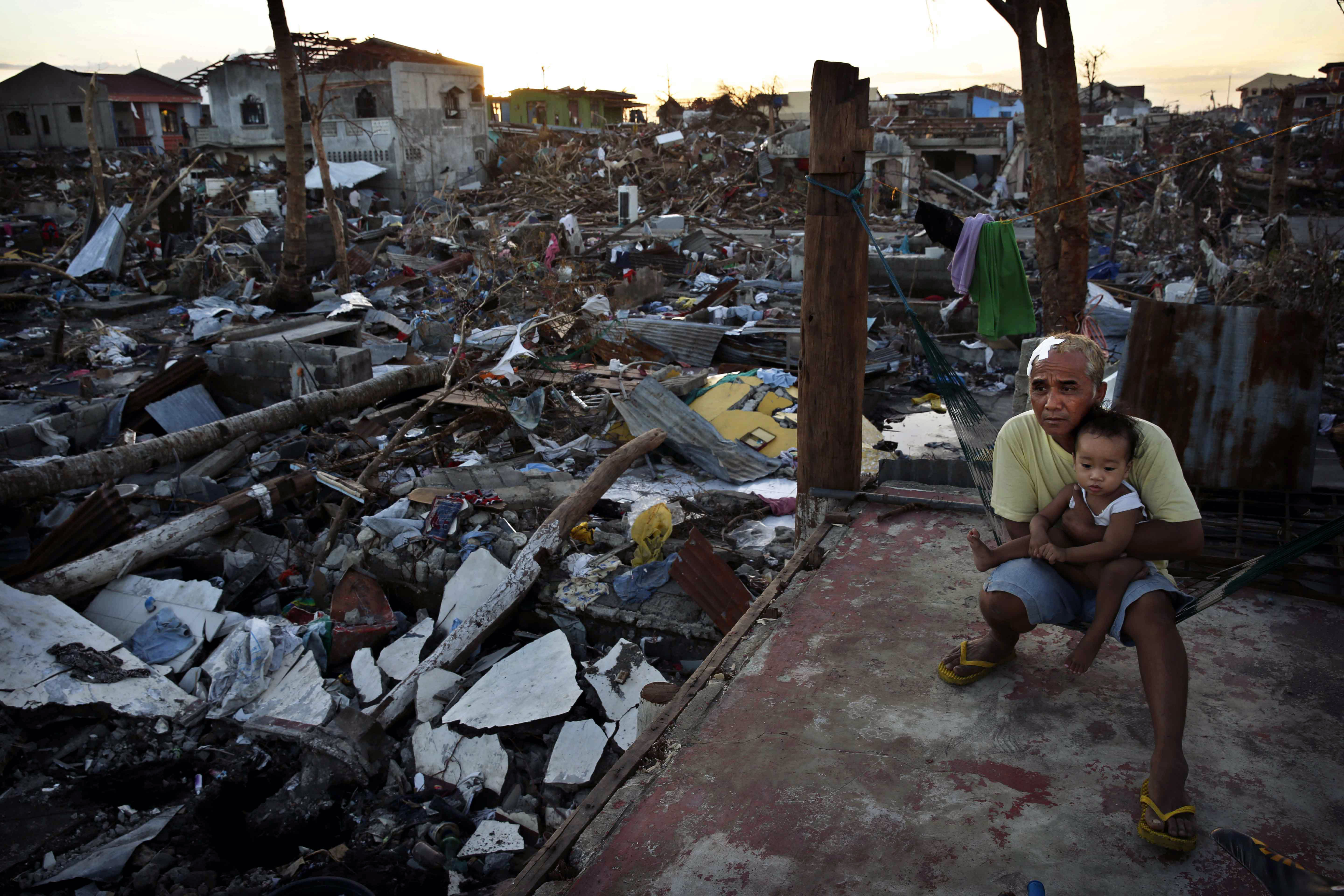
Humanitarian Efforts Continue Following Devastating Super Typhoon

Natural disasters aren’t as politically destabilizing as you might expect:

[In democracies, citizens] hold governments accountable for their preparations for and responses to disasters. Incumbent governments know this, and their responses are typically geared toward shoring up political support among key constituencies. In functioning democracies, this tends to result in more effective post-disaster emergency response. Michael Bechtel and Jens Hainmueller found that effective emergency response to the 2002 Elbe River flood in Germany immediately increased incumbent vote shares in disaster-affected areas, and that the effect carried over to elections three years later. Andrew Reeves found that in the United States, “swing” states receive presidential disaster declarations – which can move billions of dollars – about twice as frequently as non-competitive states.

In non-democratic systems, disaster response policies generally cater to the more narrow interests of urbanites in important political and economic centers … These more targeted responses (or non-responses) to disasters make for bad humanitarian outcomes but good politics: Alastair Smith and Alejandro Quiroz Flores found that while democratic governments are often ousted from office following major earthquakes, the rate at which autocratic governments are deposed is not significantly different following similar disasters.

(Photo of the aftermath of Typhoon Haiyan from Getty)

The Social Psychology Of Memes

Annalee Newitz offers a theory of virality:

To share a story is in part to take ownership of it, especially because you are often able to comment on a story that you are sharing on social media. If you can share a piece of information that’s an absolute truth – whether that’s how to uninstall apps on your phone, or what the NSA is really doing – you too become a truth teller. And that feels good. Just as good as it does to be the person who has the cutest cat picture on the Internet.

So that leaves us with the stories that don’t make it. These are the articles and essays that have fallen into the valley of ambiguity – reports on important scientific findings with difficult-to-interpret results, political news with a long and tangled back story attached, and opinion essays that require us to account for points of view that may be unfamiliar or strange.

We just want to share stories that make us seem like we know something. Most of all, we don’t want to say something that we didn’t intend.

And that is the danger with any story that falls into the valley of ambiguity. We can’t be sure how people will take it. We don’t want to risk our reputations on a story that can be taken more than one way.

More than anything, the fear of a smeared reputation is what creates that dip in virality. Sharing a story means that in some sense we stake our reputation on it. That’s why sharing a story is not the same thing as enjoying a story, reading a story, or even learning from a story. I know for certain that there are plenty of stories that get read, but not shared. I have seen the statistics on io9’s back end. But when we measure a story’s success by virality, which is what we must do in the age of social media, the content of our popular culture changes. We measure success by what people aren’t afraid to share with their neighbors, rather than what people will read on their own.

A good recent example of a Dish post that was read a lot but not relatively shared a lot was the controversial debate between Max Blumenthal and Eric Alterman over the former’s new book, Goliath: Life and Loathing in Greater Israel. Many posts that day that were less polarizing – about gays in the South, Ted Cruz’s nutty Christianist dad, and sizing up Election Day, for example – garnered many more Facebook likes than the Blumenthal-Alterman showdown, which was the most popular post of the day by traffic. Evidently many readers don’t want others to know they “like” a post criticizing Greater Israel.