Or why we need gay Republicans more than ever: because marriage will increasingly be a battle ground in the red states (so gays need ’em), and the wedge issue will come back to haunt the GOP if they don’t change (so Republicans need ’em).
Month: November 2013
A Way Forward For The ACA?
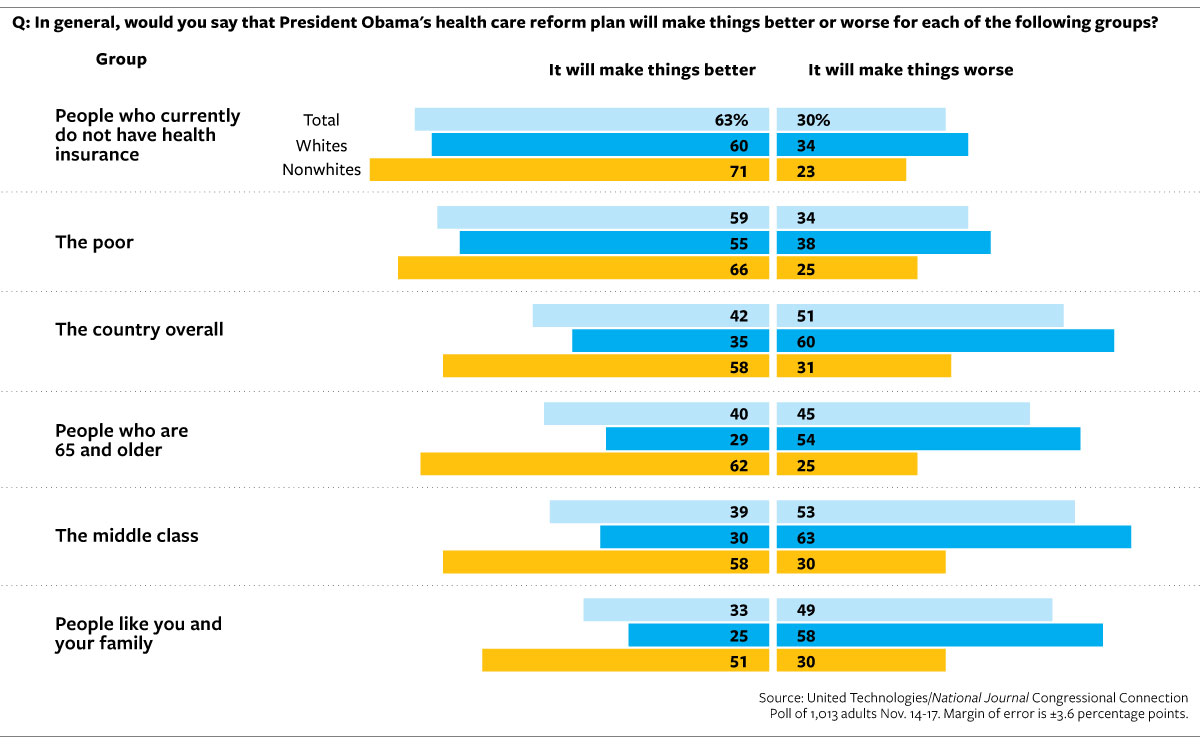
The good news for the president is that support for the law has not collapsed, especially given the massive – and largely deserved – shellacking of the wobbly website. A new United Technologies/National Journal poll makes for fascinating reading:
Amid all of the turmoil surrounding the law, solid majorities of Americans continue to say they believe it will “make things better” for people who do not have health insurance (63 percent) and the poor (59 percent). Only about one-third thought the law would “make things … worse” for each group. In each case, that’s a slight improvement in the overall judgment since the July poll. Back then, 58 percent thought the law would help the uninsured and 55 percent believed it would benefit the poor.
My italics. And there’s a distinct racial imbalance here. 58 percent of non-whites say the law will benefit the country overall, while only 35 percent of whites believe that. The danger for the administration is that many whites therefore see this as a transfer of wealth to nonwhites and away from them. But given our shifting demographics, that’s also a danger for Republicans.
Just as striking to me is the finding that support for repeal of the law has not grown, even as frustration has mounted: in July support for repeal was at 36 percent and is now at 38 percent. Those preferring to “Wait and see how things go before making any changes” numbered 30 percent in July and now is at 35 percent. 23 percent backed a third option: “providing more money so the law is implemented effectively.” That amounts to a 58 percent majority for keeping the law and trying to make it work. That strikes me as an important corrective to some of the hysteria in the Beltway.
I think all this comes from the realization that the status quo ante was a nightmare, and that it’s still early days for the ACA. Which is, again, a warning to the GOP: repeal is not going to win any converts unless you have a viable alternative that tackles some of the core problems, i.e. the millions of uninsured, the grotesque inefficiency of the American private healthcare sector, and the bar on getting insurance for people with pre-existing conditions and the maddening unreliability of any private insurance plan.
Add to this the tantalizing possibility that the federal website may soon be obsolete. Why? Because you can already get a lot of critical info from other sites like eHealth and the administration is now prepared to delegate the subsidy application process to insurers and online brokers. Andrew Sprung makes the case:
As of now, eHealth will give you price quotes incorporating your estimated subsidy, based simply on the single number you provide for your household income. It will also hold information for any plan you select and notify you when enrollment is available on eHealth — that is, when the site can initiate the subsidy application.
If you want to eliminate the middleman, once the government allows third parties to process the subsidy application, you can use a non-transactional comparison site like ValuePenguin and apply directly through the insurer offering the plan you choose. Many (I suspect most) insurers on the exchanges provide plan summaries online and enable online applications.
Once the government does outsource the subsidy application process — if eHealth and other online brokers can handle the traffic — someone please tell me: who needs HealthCare.gov? Its front end, that is, which always should have been easy. All that really matters is the back end: whether an application can be processed accurately in reasonable time. Perhaps the insurers and brokers will be able to expedite the process on behalf of their prospective customers. If insurers and brokers can take the complete application, all the government needs to do is refer users to functioning online brokers and the informational sites.
This seems to me to be a very pragmatic way to get around much of the site’s (and the ACA’s) start-up problems. But maybe I’m being too optimistic here. What am I missing?
Quote For The Day II
“I wonder how long we can maintain our miraculous survival story. One more generation? Two? Three? Eventually the hand holding the sword must loosen its grip. Eventually the sword itself will rust. No nation can face the world surrounding it for over a hundred years with a jutting spear,” – Ari Shavit, from his new book, “My Promised Land: The Triumph and Tragedy of Israel.”
Map Of The Day
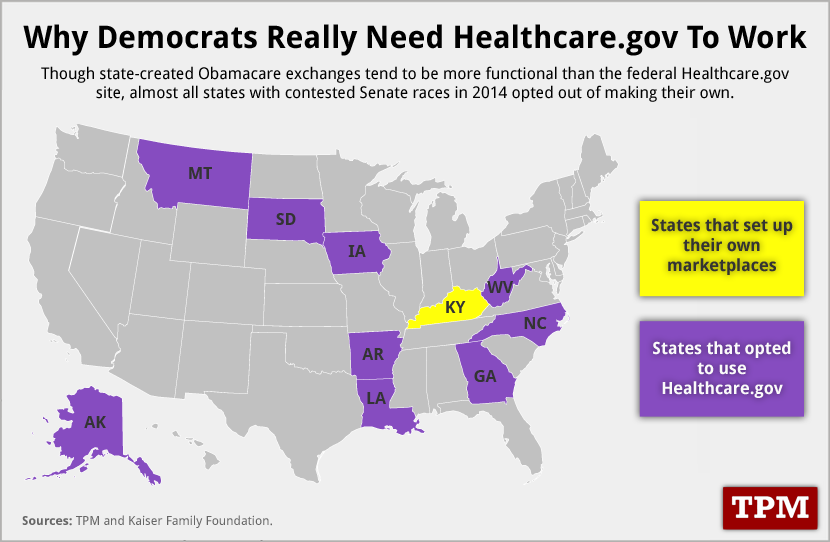
The performance of Healthcare.gov could have a major impact on the Senate races:
Of the top ten most contested seats in 2014, nine of them are in states where people must sign up for Obamacare through Healthcare.gov thanks to those states’ refusal to open up their own state healthcare marketplace. That means that voters in those states will be forced to use Healthcare.gov to sign up for health insurance, making it all the more important that the website is functioning in time for upcoming signup deadlines.
Alex Roarty looks at red-state polling on Obamacare:
An imposing plurality of adults in states that backed Mitt Romney last year say they are more likely to oppose than support a lawmaker who backs the health care law, according to an ABC News/Washington Post survey. Forty-six percent of red-state citizens said they’d be less inclined to support the candidate; only 15 percent said they’d be more inclined.
Overall, the law’s unpopularity has dipped far lower since its disastrous rollout, with disapproval of the Affordable Care Act among all adults spiking considerably since last month.
Those numbers draw a bull’s-eye on the back of the four red-state Democratic incumbents who voted for the health care reform in 2010 and are up for reelection in 2014: Mary Landrieu in Louisiana, Mark Begich in Alaska, Mark Pryor in Arkansas, and Kay Hagan in North Carolina.
Sean Sullivan also analyzes the latest numbers:
In addition to using the law to go after Democrats, there’s another reason that Republicans are expected to harden their criticism of Obamacare: GOP primaries, where there will be little appetite for anything less than robust opposition to Obamacare.
Seventy-one percent of Republican voters say they are more likely to oppose a candidate if that candidate supports the law, the highest level in Post-ABC polls. Intensity runs high for GOP voters, with 56 percent who would be much more likely to oppose the candidate. Just 8 percent of Republican voters say they would be more likely to support a candidate if that candidate supports the law.
Quote For The Day
“The vision of ‘technology’ as something you can buy according to a plan, then have delivered as if it were coming off a truck, flatters and relieves managers who have no idea and no interest in how this stuff works, but it’s also a breeding ground for disaster. The mismatch between technical competence and executive authority is at least as bad in government now as it was in media companies in the 1990s, but with much more at stake,” – Clay Shirky.
I loved this other insight:
Given examples of technological success from commercial firms, a common response is that the government has special constraints, and thus cannot develop projects piecemeal, test with citizens, or learn from its mistakes in public. I was up at the Kennedy School a month after the launch, talking about technical leadership and Healthcare.gov, when one of the audience members made just this point, proposing that the difficult launch was unavoidable, because the government simply couldn’t have tested bits of the project over time.
That observation illustrates the gulf between planning and reality in political circles. It is hard for policy people to imagine that Healthcare.gov could have had a phased rollout, even while it is having one.
The Rise Of Gay-Friendly Churches
Gabriel Arana investigates the grassroots efforts of Christians:
Except for the Episcopal Church, which recognized same-sex unions in 2009 and ordains openly gay and lesbian priests, the leadership of the country’s major Christian denominations has presented a solid front against the spread of same-sex marriage across
the country. Further down the totem pole, churches are moving on without their leadership. According to a forthcoming report from the National Congregations Study at Duke University, the number of congregations allowing openly gay and lesbian members has increased from 38 to 48 percent since 2006. Twenty-seven percent of churches gave gay and lesbian congregants leadership roles in the same timeframe—an 8 percent jump.
“Things don’t change that much in religion—there’s a lot of stability,” says Mark Chaves, a sociologist at Duke and one of the researchers behind the study. “This is one of the biggest jumps on a specific subject we’ve seen since we first started collecting data in 1998.” Indeed, while public support for same-sex marriage shot up in the last ten years—in 2003, only 33 percent of the public supported gay unions; today, 55 percent do—polls have generally shown attitudes among religious folk trending upward more languorously. But those who study religious opinion say the trend line among the faithful began to shoot up between 2008 and 2009. “The sea change has hit among religious organizations,” says Robert Jones, CEO of the Public Religion Research Institute (PRRI), a think tank in Washington, D.C. “Overall, what we’re seeing are the changes in American culture broadly reflected in attitudes of religious Americans as well.”

And the Pope is conducting a survey of Catholics in the pews …
Updates from a few readers:
Please don’t forget the United Church of Christ, which has been on the right side of this issue even longer than the Episcopalians (God bless ’em).
The New York Times called the UCC “the first mainline Christian denomination” to support same-sex marriage officially, in 2005. As the Times notes, “the denomination says it and its predecessors were among the first churches to take a stand against slavery, in 1700, the first to ordain a woman, in 1853, and the first to publish an inclusive-language hymnal, in 1995.” The UCC is one of the oldest and proudest Protestant churches in America. Many of the Pilgrims were Congregationalists (one of the denominations that joined to become the UCC in 1957). It was a Congregational church that supported the African victims of the Amistad. And President Obama was a UCC church member in Chicago before the Rev. Wright imbroglio. It’s frustrating that the UCC is often left off the list of significant Protestant denominations in America. This is a truly historic American church that has been fighting the good fight for centuries.
Another:
I hope others will be emailing you also, but Arana needs to do a bit more homework. Yes, he forgot the UCC, but he also forgot the Evangelical Lutheran Church in America, which is home to nearly 4 million Lutherans in more than 10,000 congregations (which makes it about four times larger than the Episcopal Church and the UCC). In 2009, the ELCA – which has, for its 25 years, always allowed gay and lesbian persons to be ordained – voted to allow churches to call partnered clergy and to allow congregations to recognize and support the LGBT people and relationships in their midst. The Southern California Synod also recently elected Guy Irwin, an openly (and now engaged to be married) gay man, with very little notice.
The UCC and the Episcopal Church deserve their praise, no doubt. But we ELCA Lutherans have been quietly fighting the good fight for some time now. For many in the ELCA, this isn’t part of a political movement, but simply part of our ongoing response to God’s call of love and grace for we vulnerable humans.
(Photo from Getty)
Taking Guns Away From The Mentally Ill
The case against doing so:
Mayo Clinic psychiatrist J. Michael Bostwick recently addressed this subject (pdf):
Just because the general public wants to believe the tautology that heinous crimes must be the province of the mentally ill (because no one in his right mind would perpetrate such acts) does not make it so.
In a nationwide Swedish study of 13 years of violent crimes such as homicide, aggravated assault, and robbery, individuals discharged from psychiatric hospitals with severe psychotic or affective diagnoses did have 3.8 times the odds of committing such crimes than did their none mentally ill countrymen. However, their number relative to the general populace was so low that only 1 in 20 violent crimes could be attributed to them. These findings are consistent with earlier American studies, which estimated a 2- to 4-fold increase in the risk of violence by individuals with schizophrenia but only a 3% to 5% population-attributable risk.
Calling the epidemiology of mass murder “counterintuitive,” Friedman and Michels write that “we must explain an epidemiologic fact that the public likely finds counterintuitive in the wake of a mass killing: Although mass murderers probably have more psychopathology than other killers, the mentally ill as a group pose little risk of violence.” Moreover, Appelbaum warns that increased violence may not actually be a result of the mental illness itself but of comorbid substance abuse and sociopathic personality traits. Given these statistics, the American Psychiatric Association has questioned both the “fundamental fairness” of re-stricting firearm access for the mentally ill and the possibility that such restrictions could further stigmatize an already marginalized group.
Authors Anonymous
Maria Bustillos explores why a writer might be “immune to the lure of fame” and prefer anonymity:
Anonymous is more than a pseudonym. It is a stark declaration of intent: a wall explicitly thrown up, not only between writer and reader, but between the writer’s work and his life. His book is one thing and his “real” life another, and the latter is entirely off limits, not only to you, the reader, but presumably to almost everybody. Sometimes he has written about something too intimate, too scary, too real, for him to bear public scrutiny. Once the connection is known, what he has written will mark his ordinary life ineradicably. …
No book is dangerous in and of itself. A book is only a collection of words in a certain order, pages, screens, a sequence of ideas. Ideas alone can never hurt us. People only make ideas dangerous by fearing and hating them, and by vilifying and persecuting those who disagree with them. In this way, the association of a writer with his ideas can be very dangerous, even deadly. You stand a reasonably good chance of denying ever having read a book, but it’s a great deal harder to hide from having written one. Beyond this, though, lies the deeper problem for those who imagine that they can write, and yet escape a reckoning. Writers are generally fated to commit the truest parts of themselves to the page, whether they choose to own their work in public or not. That is the ultimate vulnerability, and it is inescapable.
Self-described “hack writer” Nicole Dieker offers a different logic for writing anonymously – making a living:
I am one of the unsung, invisible hacks of the internet generation. I help fill blogs and news sites and online stores with the new text those sites need every day. Within an hour I can give you the ten best celebrity wedding dresses, or a thousand words on how to get your kids to eat healthy snacks. I can ghostwrite to match your blog’s tone and style, if you need a post in a hurry. I write approximately 5,000 words per day, at various rates that average out to about $20/hour.
I can’t tell you who my clients are. Yes, in part because of the NDAs, but also because my writing, at its best, is supposed to be invisible. Take, for example, the copy you see when you log on to your bank’s website. 500 words on the importance of compound interest or CD laddering. No byline, of course. That’s the type of stuff I write. More functional than memorable. I’ve done work for dictionaries and catalogs and multiple-choice test questions. I’ve described how to French braid hair, how to reverse French braid hair, how to French twist hair, how to make a sock bun. I’ve written the introductions to probably a hundred recipes…. My goal is to continue to increase the number of words out there with my name on them, although I’m not foolish enough to think that means I’ll never have to write another hair-braiding article again. Nor, honestly, would I want to give up that type of copy work. How-to articles and byline-free content seems to be where the money is, these days.
A Peace Song Beating The War Drums
Irving Berlin’s “God Bless America” underwent major changes in meaning; it was “originally written as a peace song for Armistice Day in 1938, but by 1940 [it] had become an anthem for intervention”:
[J]ust four months after its debut in the fall of 1938, “God Bless America” was no longer a peace song. In fact, later articles and interviews about the song made no mention of the peace message that was present at the song’s origins. There are a few reasons behind this shift. One important factor is that the premiere of “God Bless America” happened to occur the day after Kristallnacht, the Nazi Party’s calculated attacks on Jewish communities in Germany and its annexed territories. According to many scholars of World War II, the brutality of these attacks signaled a turning point for a growing American condemnation of Nazi Germany, and a consequent move away from staunch isolationism.
Irving Berlin’s removal of the line “grateful that we’re far from there” was a reflection of his own changing views as much as to shifts in public opinion. As a Jewish immigrant, Berlin showed growing concern about the Nazi Party’s rise in Europe and began to give large donations to Jewish relief work during this period. In her memoir, Berlin’s daughter Mary Ellin Barrett wrote that by 1940, “isolationists in our interventionist family became the enemy, or at best, if close friends, the misguided ones.” A “peace song” was no longer called for, and Irving Berlin himself began to lead the song at rallies in support of American involvement in the escalating conflict in Europe.
(Video: Kate Smith introduces “God Bless America”)
Driving Towards Political Apathy
Long commutes hinder political engagement:
That is an implication of new research by political scientists Benjamin Newman, Joshua Johnson, and Patrick Lown. They show that Americans who report longer commutes say they are less involved in politics. … Notably, Newman and colleagues show that the potential impact of commuting on our political involvement doesn’t arise just because more hours in the car means fewer hours to watch the news, write letters to members of Congress, or vote. If it were just a question of time, then we might expect people who work long hours to be less involved in politics too. But that isn’t true: people who report working more hours are no more or less likely to participate in politics. Instead, the authors argue that commuting depletes our psychological resources in unique ways. In short, commuting makes us feel bad, and this leaves us with less energy for pursuits like politics.
 The Dish