Do Antibiotics Make Us Fat?

AntibioticsObesity Rate

Kiera Butler and Jaeah Lee review research on the question:

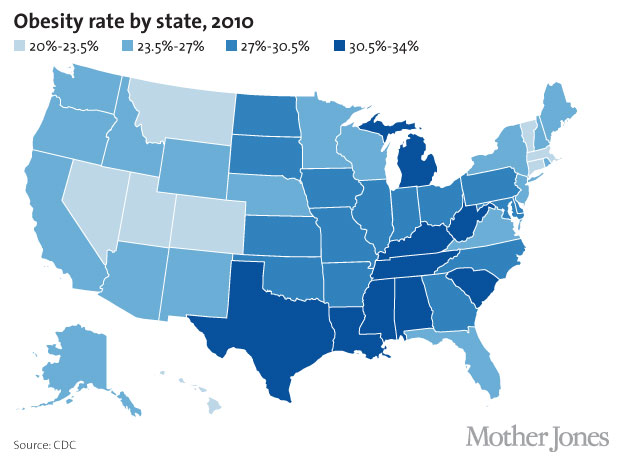
[A] growing body of evidence suggests that antibiotics might be linked to weight gain. A 2012 New York University study found that antibiotic use in the first six months of life was linked with obesity later on. Another 2012 NYU study found that mice given antibiotics gained more weight than their drug-free counterparts. As my colleague Tom Philpott has noted repeatedly, livestock operations routinely dose animals with low levels of antibiotics to promote growth.

No one knows exactly how antibiotics help animals (and possibly humans) pack on the pounds, but there are some theories. One is that antibiotics change the composition of the microbiome, the community of microorganisms in your body that scientists are just beginning to understand. (For a more in-depth look at the connection between bacteria and weight loss, read Moises Velasquez-Manoff’s piece on the topic.)

Grease Thieves

John Colapino reports that used commercial cooking oil has quickly gone from being a cheap additive for animal feed to a sought-after component of biofuels – and thieves are taking notice:

A decade ago, used grease traded on the Chicago commodities exchange for less than eight cents a pound. Now it can go for more than four times that price, providing criminals with a potent incentive to get at spent oil before renderers do. Thieves use bolt cutters to remove locks on container lids or cut through vacuum hoses to suck grease into tanker trucks. A thief driving down a strip-mall alleyway can collect four thousand dollars’ worth in half an hour.

Like other big renderers, Dar Pro has turned to security firms to protect its grease. In 2012, [C.E.O. Randall] Stuewe hired Total Compliance Associates, a Manhattan-based firm headed by Stuart GraBois, a former US assistant district attorney, and Mike Ferrandino, a former F.B.I. supervisor. When I visited the firm’s offices, in a Times Square high-rise, GraBois, elegantly dressed, white-haired man, admitted that he was nonplussed when he got the call from Dar Pro. “I thought, ‘Grease?’” he said laughing. “I didn’t want to say ‘Who cares?’ – but grease? Then you find out what a huge business it is, and how much they’re losing.”

In the past two years, GraBois and Ferrandino have pursued more than a hundred grease cases, using classic crime-busting techniques: surveillance and stakeouts, undercover operations, stings, hidden camera. They still struggle to persuade law enforcement officials to take grease theft seriously, but GraBois insisted that they’re making headway. “You speak to a prosecutor a year ago,” he said, “and it’s like, ‘What are you calling me about?’” Now I think it’s reached a point where they’re believing that it’s real.”

Syria’s Deadly Food Fight

Colum Lynch looks at how Assad is winning it, with the support of the West and the United Nations:

The distribution of humanitarian aid has emerged as a central front of the Syrian government’s Screen Shot 2013-11-19 at 5.50.57 PMmilitary campaign to starve out pockets of potential support for the armed resistance. By restricting deliveries to pro-government areas, the Syrian government has gained a political advantage by ensuring that food and assistance is channeled disproportionately to those who support it.

“Both sides want to be the food-giver, but Assad has made it very clear he’s not going to let anybody else but him feed Syrians,” said Joshua Landis, an expert on Syria at the University of Oklahoma. Assad’s hope: that “people will crawl back to him” for bread, salaries, and other subsidies. “And that’s what’s happening.”

While the United States and European powers have publicly denounced the Syrian government’s curtailing of assistance to opposition territory, one of their chief objectives in Syria — saving lives and stopping the wholesale flight of refugees — has perversely aligned with Assad’s aims, according to Landis. “If you want to stop refugee flow and cauterize Syria, which is [the West’s] major objective, the way to do it is to pump more calories into Syria, and the best way to pump calories into Syria is to work through Assad,” Landis said. “He owns the Syrians, and he will facilitate that food distribution if it relegitimizes him.

(Photo from Assad’s propagandist Instagram account, covered by the Dish here and here. Caption: “The First Lady joins a Damascus-based youth volunteer group in preparing food to be distributed to needy families during the Holy month of Ramadan, 4 August 2013 #Syria #Asma #Assad #سورية #الأسد #الاسد #أسماء)

What To Do With Illegal Ivory?

U.S. Fish And Wildfire Service Destroy Six Tons Of Confiscated Ivory

Until last week, the US government had a little-known cache of ivory carvings, jewelry, and other products – all illegal. On Thursday, the Fish and Wildlife Service publicly pulverized all six tons of it:

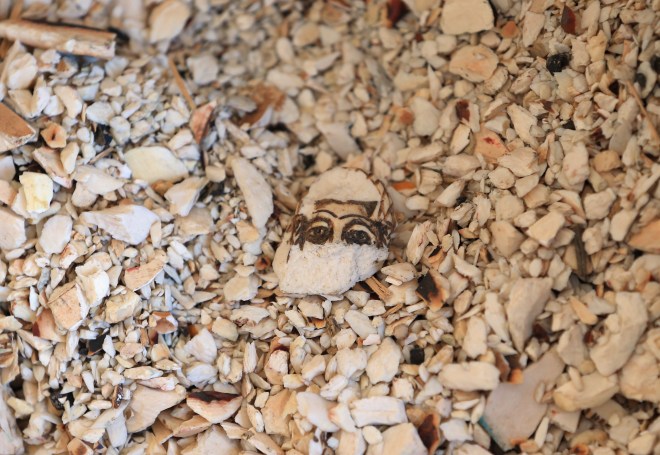
The so-called “ivory crush” is a first for the agency, which has previously stored all seized contraband at various government facilities. … [It] is only one part of a broader federal initiative to thwart poaching and illegal trafficking. First announced by President Obama in July, the $10 million campaign will also train park rangers and local officials in African poaching hubs, and work towards mandating stiffer penalties for anyone caught smuggling ivory into the United States. Yet another effort, this one launched by the Convention on International Trade in Endangered Species, is performing DNA analysis on seized ivory in an effort to track its origins and zero in on where poaching is most ubiquitous.

These efforts come at a time when elephant poaching is making a devastating comeback: an international ban on ivory sales in 1989 has recently been undermined by increased demand for illicit ivory, and the FWS now estimates that some 30,000 elephants are killed each year.

Bryan Christie calls the crush a largely symbolic act, but adds that “symbolism counts”:

Ivory destruction ceremonies have been a litmus test for where a country stands on the ivory trade ever since Kenyan President Daniel Arap Moi torched 13 tons of ivory in 1989, setting the stage for a vote to ban international trade in ivory by parties to the Convention on International Trade in Endangered Species (CITES). That ban went into effect in 1990. Six months later, the U.S. ivory market collapsed.

With no international market, it might have been reasonable for all CITES parties to destroy their ivory stocks after the 1990 international ivory ban took effect. But the ban did not last. In 1999 and again in 2008 parties to CITES voted to allow ivory sales. The first sale was of 55 tons to Japan and the second, of 115 tons to Japan and China.  In the wake of the China sale, elephant poaching and ivory trafficking have boomed. So has the need for international action.

But Yglesias thinks the destroying the ivory is a mistake:

By destroying the ivory, you create even more ivory scarcity and increase the incentives for future poaching. It seems like the more reasonable approach would be to arrest and punish human beings who are committing crimes, and then sell the seized ivory and use the proceeds to finance more anti-poaching efforts. … Via Tyler Cowen, a 2000 paper by Michael Kremer and Charles Morcom offers a hybrid solution. They say don’t sell the ivory and don’t destroy it either. Instead stockpile the ivory and say it’ll be dumped on the market if the elephant population falls below some critical threshold value.

Meanwhile, Derek Mead worries about parallels with the Drug War:

If this [ivory crush] sounds something like the massively-publicized busts and marijuana burning events that have remained in vogue in the drug war, it’s because they’re indeed quite similar. In both cases, the market has become so large and widespread that catching every vendor simply isn’t feasible. And in both cases, quelling demand and shrinking the market is the most stable long-term solution. By publicizing high-profile busts – or crushing tons of ivory with a steamroller in front of cameras – authorities get the dual benefit of showing potential customers that this is not okay, while also hopefully scaring off some vendors here and there. … The US is making strides this week to fight against wildlife crime, which it is undoubtedly interested in because of the national security angle. But the US crushing ivory, educating citizens, and putting out bounties isn’t enough, just as policing narcotics in some place and turning a blind eye in others has left the drug war stuck in a state of perpetuity.

Update from a reader:

I appreciate your efforts to raise awareness of the global crisis in wildlife poaching and trafficking.  I work for the U.S. Fish and Wildlife Service and was at the event, and I think it’s important to put the crush in its proper perspective. Some have argued that this stock and other illegal ivory stockpiles held by foreign governments should be sold, in an effort to alleviate the demand for ivory. But they are by far in the minority, and don’t represent the consensus of the wildlife community, international law enforcement, and even economists who have studied this issue. Decades of experience shows that allowing ivory to enter legal trade only makes enforcement harder, by giving traffickers additional ways to disguise sources of poached ivory. And past sales have only fueled demand, maintaining the perception among consumers that ivory is a status symbol, rather than an emblem of greed and callous indifference to life.

The ivory we crushed last week is a fraction of the stocks held by foreign governments, and would have no impact on the global market. Tanzania alone holds more than 120 tons, 20 times what the United States has seized. Even if every government sold their ivory stocks, there’s little chance it would alleviate demand. And if by some miracle prices did happen to drop, it would simply open up the market to a vast new segment of consumers in Asia and other parts of the world.

In this sense, critics are partially right. We cannot solve this problem by cracking down on the supply of illegal ivory alone. Unless the demand side of this terrible equation is addressed, poaching will continue at some level commensurate with the risks. But the solution lies in stigmatizing the sale and possession of ivory, not facilitating it. As long as it’s socially acceptable to own ivory, people will attempt to supply it.

Selling our ivory would have sent a terrible message to the world. Judging by the outpouring of support we’ve received from around the world, we’ve sent a far better one by destroying it.

Previous Dish on poaching here.

(Photo: Six tons of crushed ivory is displayed during the U.S. Ivory Crush event at the Rocky Mountain Arsenal Wildlife Refuge in Commerce City, Colorado. By Doug Pensinger/Getty Images)

The Best Of The Dish Today

I want to revisit the posts on Ponnuru’s and Levin’s critique of the Affordable Care Act – including my citing the obvious comparisons with other Western countries. Why is socialism so damn more efficient than capitalism when it comes to healthcare? I think the answer is a relatively simple one, and it was elegantly made by a commenter on Yuval’s piece at NRO. Money quote:

The root of “conservative” thinking on healthcare, at least as it is articulated in this space, appears not to have anything to do with centralization versus decentralization of decision making, but with dedication to the proposition that the healthcare market is just like all other markets; that a decision about healthcare follows the same logic and has the same degrees of freedom as do decisions such as whether to buy a new TV, or broccoli. Unless that catastrophically mistaken idea is abandoned, I don’t see how the local variety of “conservative” thinking can address reality and thereby improve.

The reason that the breadth of options that insurers can offer must be constrained is that if it is not constrained, then that variable, and not efficiency, is the lever that will preferentially be used as the profit generating mechanism. What that means in the real world is that the poor will be poorly insured and the rich richly insured, with the same problems of free ridership and poor long term outcomes due to avoidance of preventive care that we have now …  In other words, healthcare really is a different beast in that it cannot be effectively treated as though it were a completely free market at the policy level because it can never, in fact, behave like one. That is not an ideological framing but a hard, cold fact. Healthcare is not a market like other markets and it is not even remotely anti free-market to point that out.

That‘s what I’m grappling with. The reason for my support for the ACA is that the crisis of costs and accessibility is urgent and only Obama had the balls to propose a possible solution. The ACA, it seems to me, is a good faith attempt at integrating the existing structures of American healthcare into a better system that can expand coverage and also control costs. In that sense, once again, I think Obama is the conservative in this – and many ideological liberals will not disagree. It may be that this conservative compromise won’t work; but a more bare bones insurance regime which does not have to include the basic needs of most lives, and skimps on preventative care, is a false economy.

There are cost control ideas embedded in the ACA. But I’d add some more conservative ingredients to the mix. I’d make co-pays a fixed percentage of the actual costs, not a flat fee, so that patients are brought closer to the actual price of what they want, and can adjust. I’d insist that all those about to get Medicare or care on the ACA exchanges also make a choice: whether to seek unlimited care at the very end of their lives or give someone else a power of attorney if they are incapacitated. Personally, I’d gladly make the choice not to survive for another few days if it would make it much more fiscally feasible for a child to get vaccinated. I consider that personally a moral imperative. But I’d still insist this remain a choice. And I’d face down the moronic denialism of “death panels”. Sane cost-controls in the most expensive time of our lives is not totalitarianism. It’s fiscal sanity and moral prudence. I’m used to facing down Sarah Palin and she knows it. I’d also be more stringent about tort reform than the ACA, though I have no illusions this is a panacea for the cost problem.

If you want a free market in healthcare, you have to let people die on the streets or in agony at home rather than seeking mandatory help in an emergency room, if they have not been able to buy insurance. Anything else is socialized medicine, which we’ve had in America since 1986. The question is simply whether we want to have the most fucked-up, inefficient and inhumane socialized system on the planet or whether we have the political courage to tackle this. Decry Obama all you like, but he has tackled this. And the pile-on is a form of denial that we have a problem. But boy, do we have a problem.

Anyway, four faves from the day: the origin of the word “selfie“; readers’ responses to our new eBook, I Was Wrong; why gay life is better in DC than New York City; and a window view of autumnal gorgeousness.

The most popular post of the day was I Was Wrong (paywalled on Deep Dish); followed by The Cheneys and the Republicans.

I posted the music video above because it just gives me joy.

See you in the morning.

Four Score And Seventy Years Ago

On November 19, 1863, Lincoln delivered a speech at the dedication of the Soldiers’ National Cemetery in Gettysburg, Pennsylvania. Ilia Blinderman flags the above video of various figures reading those famous words:

Lincoln’s Gettysburg address (whose five versions can be found here) has shown little wear since its delivery on November 19, exactly 150 years ago. While there is some evidence to suggest that the audience was initially nonplussed by the speech’s simple language and striking brevity, today Lincoln’s words are considered to be among the most finely wrought rhetoric in the Western canon: they remain accessible to all, yet seamlessly entwine the thread of equality that ran so clearly through the Declaration of Independence with the idea of the war being essential to the preservation of the Union.

I was ready to gag at some of these celebrities, but found myself unable to. The words carry them. Garry Wills’ 1992 essay, adapted from his book on the Gettysburg address, is well worth re-reading today:

Up to the Civil War “the United States” was invariably a plural noun: “The United States are a free country.” After Gettysburg it became a singular: “The United States is a free country.” This was a result of the whole mode of thinking that Lincoln expressed in his acts as well as his words, making union not a mystical hope but a constitutional reality.

When, at the end of the address, he referred to government “of the people, by the people, for the people,” he was not, like Theodore Parker, just praising popular government as a Transcendentalist’s ideal. Rather, like Webster, he was saying that America was a people accepting as its great assignment what was addressed in the Declaration. This people was “conceived” in 1776, was “brought forth” as an entity whose birth was datable (“four score and seven years” before) and placeable (“on this continent”), and was capable of receiving a “new birth of freedom.”

Thus Abraham Lincoln changed the way people thought about the Constitution … The Gettysburg Address has become an authoritative expression of the American spirit—as authoritative as the Declaration itself, and perhaps even more influential, since it determines how we read the Declaration. For most people now, the Declaration means what Lincoln told us it means, as he did to correct the Constitution without overthrowing it

In a 2009 essay, the historian Sean Wilentz noted a neglected 1852 speech in which Lincoln defended the Fugitive Slave Law, thus reminding us that Lincoln was foremost a politician – something that shouldn’t detract from his greatness, however:

In 1854, when Lincoln began shifting his loyalties to the anti-slavery Republican Party, the tone as well as the substance of his speeches became grander, and the casual racism receded. Lincoln evolved and grew as the Republican Party and anti-slavery public opinion in the North grew. But it is important to understand that those later pronouncements of Lincoln’s were no less political that his earlier ones, no less geared to achieving a particular political goal or set of political goals. Given the enlarged stakes of the sectional crisis and then the Civil War, Lincoln’s goals were actually more political than ever. He was a shrewd and calculating creature of politics; and he achieved historical greatness in his later years because of, and not despite, his political skills. It was the only way that anyone could have completed the momentous tasks that history, as well as his personal ambition, had handed to him. It was the only way he knew how to do anything of public importance, and the only way he cared to know.

Recent Dish on the Gettysburg Address here. For more, Google’s Cultural Institute has assembled a series of commemorative online exhibits.

Disaster Relief Done Right

Humanitarian Efforts Continue Following Devastating Super Typhoon

Charles Kenny’s advice on how best to help the Philippines:

Donor agencies and humanitarian organizations should tell individuals who want to help that they should send cash—not food, clothes, or other supplies. Wherever possible, those organizations should give cash, too. As quickly as possible, donors should move away from a model based on financing nonprofit and contractor provision of services and instead deliver aid through local government authorities.

Victims are far better placed than foreign aid bureaucrats to decide how best to spend resources to recover from the impact of the typhoon. Cash-transfer programs were tried in Haiti and became a significant part of the relief effort after Pakistan’s 2010 floods. Thanks to advances in biometric identification and electronic payments, it’s cheap and easy to ensure that cash transfers reach victims, and the risk of fraud or misallocation is low. Cash transfers are faster and more effective, and they require less overhead than large-scale relief projects—which should be limited to restoring infrastructure and public services.

Aid worker Jessica Alexander, who echoes Kenny on the importance of cash charity, describes the debacles that come from donating clothes and other random items:

I was there after the [2004 South Asian] tsunami and saw what happened to these clothes: Heaps of them were left lying on the side of the road. Cattle began picking at them and getting sick. Civil servants had to divert their limited time to eliminating the unwanted clothes. Sri Lankans and Indonesians found it degrading to be shipped people’s hand-me-downs. I remember a local colleague sighed as we passed the heaps of clothing on the sides of the road and said “I know people mean well, but we’re not beggars.” Boxes filled with Santa costumes, 4-inch high heels, and cocktail dresses landed in tsunami-affected areas. In some places, open tubes of Neosporin, Preparation H, and Viagra showed up. The aid community has coined a term for these items that get shipped from people’s closets and medicine cabinets as SWEDOW: Stuff We Don’t Want.

(Photo: People queue for aid in Tananau, Leyte, Philippines on November 19, 2013. Typhoon Haiyan, which ripped through Philippines over a week ago, has left thousands dead and hundreds of thousands homeless. Countries all over the world have pledged relief aid to help support those affected by the typhoon however damage to the airport and roads have made moving the aid into the most affected areas very difficult. By Dan Kitwood/Getty Images)

Face Of The Day

George Zimmerman Appears Before Judge On Recent Aggravated Assault Charges

George Zimmerman, the acquitted shooter in the death of Trayvon Martin, listens to defense counsel Daniel Megaro (L) during a first-appearance hearing on charges including aggravated assault stemming from a fight with his girlfriend on November 19, 2013. Zimmerman, 30, was arrested after police responded to a domestic disturbance call at a house. By Joe Burbank-Pool/Getty Images.

The Wrong Way To Fund Schools?

Peter Marber says it’s time to stop relying on property taxes:

This is hugely controversial, but it has clearly shaped much of the American experience for a century. Property taxes have largely financed American public education, with very little federal funding. As wealthy zip codes can spend more on education, the overall system becomes uneven and reinforces skill gaps and socio-economic divides.

If we could start with a blank slate and look around the world, we would probably institute state and federal funding in public education like virtually every other country, and not fund education largely through property taxes. This would create a far more even system. For those who want to opt out of the public system, there will always be private alternatives. A political impossibility? Maybe, but not insurmountable if implemented over a 30-year period, for example, with re-balancing over time from real estate taxes towards state and local income taxes.