This time … in a Miami Dolphins speedo getting thrown out of the stadium for excessive abtitude. Extra social media photos here.
Month: November 2013
Losing Lessing
Nobel Prize-winning author Doris Lessing died last Sunday at the age of 94. Her life, like her work, was varied:
A generous, open minded character, she was, at various stages of her life, a communist, socialist, feminist, atheist, Laingian and finally a Sufi. To each of these beliefs, she brought a tireless enthusiasm that sometimes obscured judgment. She fell for ideas, digested then, outgrew them and then moved on. While she still believed, she wrote novels out of the experience. Her interests were varied but her ability to make fascinating fiction out of life was constant.
If she had written nothing else, The Golden Notebook (1962) would have secured Doris Lessing a place in the hall of fame. With it, she wrote about “new women” in a new kind of novel, one that stretched the boundaries of realist fiction.
Kim Murphy elaborates on The Golden Notebook:
In her work, Lessing raised but didn’t necessarily answer the existential questions of women’s lives in the 1960s and beyond: Is it better to be married or single? How do you raise children and have a professional life? Is a woman denying her intellect if she longs for a man to love her? Why do older women still feel passion, and what is acceptable for them to do about it? If my life is so perfect, why do I feel as though I’m losing my mind? …
“The Golden Notebook” suggested that humanity, male and female, is driven by a common yearning: “Everybody in the world is thinking: I wish there was just one other person I could really talk to, who would really understand me, who’d be kind to me,” one of the characters said. “That’s what people really want, if they’re telling the truth.”
The above video from 2007 captures Lessing’s reaction to the news that she won the Nobel Prize. Her first words? “Oh, Christ!” When she was offered the title of “Dame” in 1992, she was similarly dismissive, rejecting the honor by writing, “There is something ruritannical about honours given in the name of a non-existent Empire.” David Ulin praises her as someone who believed “that literature should recognize no boundaries, that the best work moves us by challenging our preconceptions, whether they have to do with content or with form”:
This, in some ways, could be read as Lessing’s legacy: Don’t stand on ceremony, question your beliefs and prejudices and always, always be prepared to change your mind.
Justin Cartwright remembers a woman “truly unique in her views and in her take on life.” Sophia Barnes argues that “[t]he diversity of Lessing’s oeuvre goes hand in hand with the impossibility – and I would argue the futility – of trying to categorise her”:
A recent collection of scholarly essays on her work was titled Border Crossings, in reference to her seemingly endless capacity for moving between spaces, genres, forms and modes of thinking. What is important to emphasise is that in crossing borders Lessing did not leave what she had experienced or thought behind; rather, she constantly moved back and forth across borders, displaying an adaptive historical consciousness which was vital to the whole body of her fiction.. … She was a postmodernist before postmodernism, a post-communist before the fall of the Iron Curtain, and perhaps both more and less of a feminist than she has often been seen to be. She was without doubt a radical, in the truest sense: intellectually uncompromising, absolutely individual, always striving with the boundaries of her form and the intellectual climate of her age.
From her 2007 Nobel lecture:
We are a jaded lot, we in our threatened world. We are good for irony and even cynicism. Some words and ideas we hardly use, so worn out have they become. But we may want to restore some words that have lost their potency.
We have a treasure-house of literature, going back to the Egyptians, the Greeks, the Romans. It is all there, this wealth of literature, to be discovered again and again by whoever is lucky enough to come upon it. A treasure. Suppose it did not exist. How impoverished, how empty we would be. We own a legacy of languages, poems, histories, and it is not one that will ever be exhausted. It is there, always.
The New Yorker has assembled a collection of her pieces here. The New Statesman has republished her first piece for the magazine, from 1956, on being refused entry into South Africa. Her 1988 interview with the Paris Review is here.
Israel’s Warmongering
Drezner considers it unwise, to say the least:
Israeli jaw-jawing about a military strike puts it into a corner with no good exit option. Netanyahu’s definition of a bad nuclear deal seems to include… any nuclear deal. So say that one is negotiated. What can Israel do then? Netanyahu could follow through on his rhetoric and launch a unilateral strike. Maybe that would set Iran back a few years. It would also rupture any deal, accelerate Iran’s nuclear ambitions, invite unconventional retaliation from Iran and its proxies, and isolate Israel even further. If Netanyahu doesn’t follow through on his rhetoric, then every disparaging Israeli quote about Obama’s volte-face on Syria will be thrown back at the Israeli security establishment. Times a hundred.
Larison piles on:
Attacking Iran’s nuclear facilities would make the Iranian government more interested in acquiring a nuclear weapon, so an Israeli strike couldn’t ever truly “prevent” that outcome in any case. Once a deal is negotiated, I suspect that Netanyahu will accept it as a fait accompli, because there is nothing else he plausibly could do that wouldn’t risk a huge breach between the U.S. and Israel.
Robert Merry chimes in:
Netanyahu believes, based on past experience, that he can set in motion pressures and forces within the American polity that will ensure the demise of Obama’s delicate reach-out to Iran. And he is willing to risk a rupture with this administration in order to do so because he doesn’t think the risk is very great.
In response to Merry, Larison bets that “the administration will press ahead with negotiations despite Israeli and Congressional complaints”:
I suspect that Obama correctly assumes that his handling of Iran has broader international and domestic support than the critics of the negotiations realize. Netanyahu may think that most Americans will sympathize with his position, but if so he is very likely misreading the public mood and potentially inviting a backlash against himself.
Drum joins the conversation:
Netanyahu obviously has good reason to think that Republicans will support him in this unreservedly, but he better be careful. Even Obama-hating tea party types can start to get a little antsy when a foreign leader is so obviously contemptuous of American interests and the American president.
The Press’s Obamacare Pile On
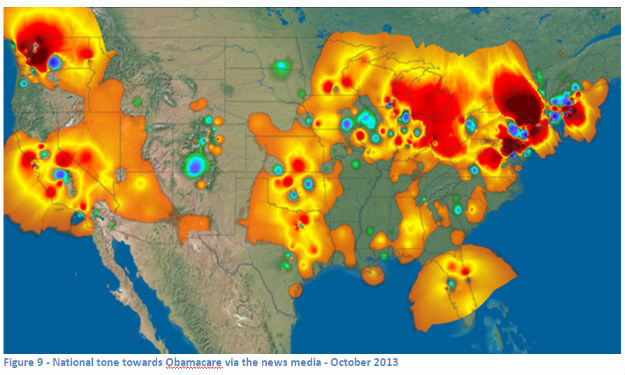
Kalev Leetaru maps it:
[W]hat we are able to see in the crisp mathematical precision of the computerized graphs and maps above is just how vast and intense the negative coverage really is. As a result, we can move beyond anecdotes like “It’s getting a lot of coverage” to precise statements like “More than 80 percent of all television news shows are talking about it.”
We can also gaze through the eyes of the news media and literally map the deep pessimism towards the law as it spreads across the nation. This by itself is a key finding: just how much the media has been covering Obamacare and, in particular, how key the GOP’s tying of Obamacare to the government shutdown was in bringing it to the forefront.
Chait tries to calm the media down:
Lost in the Keep Your Plan imbroglio, it appears that healthcare.gov has already reached a point of functionality. It can currently handle 20–25,000 simultaneous users. That may or may not qualify as a full Hanukkah Miracle fixed website by the end of the month, but it’s probably enough, at the very least, to let the law muddle through.
All sorts of things will happen to Obamacare in the next few months. At least some of those things will be bad, because any large enough enterprise, public or private, has bad things happen. One thing that can be predicted is that more and more people will start signing up for Obamacare between now and the end of March, which means the constituency for the law will steadily grow. There will still be a constituency against the law, and possibly future failures will enlarge it, too.
But at some point, having state exchanges where people buy private insurance, with rules preventing abusive practices, will simply be part of the backdrop of health insurance.
Waldman adds:
I realize that there’s an impulse as a reporter or a pundit to cast everything in the most dramatic terms possible. “Things are neither perfect nor disastrous” is a much less interesting assertion to make than “Everything has changed! Earth-shattering developments are afoot!” But that happens to be the truth.
Earlier Dish on media coverage of Obamacare here.
The Democrats’ Shutdown Bump Fades
Nate Cohn parses recent polling:
Several new surveys show that the Democratic advantage on the generic congressional ballot—the one that emerged during the shutdown—has faded or even evaporated. The three live interview surveys conducted more than two weeks after the shutdown show a dead heat, with the Republicans gaining an average of a net-5 points over the previous survey. Fox News, the newest poll, even shows the Republicans ahead by three points among registered voters.
A “dead heat” among registered voters all but ends Democratic hopes of retaking the House, notwithstanding another political earthquake. They might not even gain seats, since Democrats hold more vulnerable districts than Republicans.
He cautions against reading too much into these numbers:
[I]t would be foolish to assume that the environment will remain this bad for Democrats, just as it was wrong to assume that the GOP was doomed by the shutdown. Frustration will probably subside if and when Obamacare gets up and running. Frustration could even turn into a bit of renewed support if the president benefits from lowered expectations. In the end, the public has a short memory. So, apparently, do most commentators, who have forgotten that they were frothing about the end of the Republican Party as recently as three weeks ago.
Waldman made related points late last week:
Over the next year, the rest of the law will be implemented. There may be problems here and there, but overall it will probably go reasonably well. There will be plenty of things Democrats can point to in order to convince people that it was a good idea, like the fact that now nobody can be denied coverage because of a pre-existing condition, or the fact that millions of people who couldn’t afford coverage or were denied before now have it. There will also be things Republicans will say to try to convince people it was a terrible idea, like the fact that premiums didn’t plummet, and health care is still expensive, and Obamacare didn’t give every little girl a pony.
And what else will happen in the next year? Other things. The economy may get worse, or it may get better. There may be a foreign crisis. Controversies we can’t yet anticipate will emerge, explode, then disappear. A young singer may move her posterior about in a suggestive manner, causing a nation to drop everything and talk about nothing else for a week. We might start talking about immigration reform again. There’s going to be another budget battle. In other words, all sorts of things could affect the next election, and the election after that.
The View From Your Window Contest: Winner #180
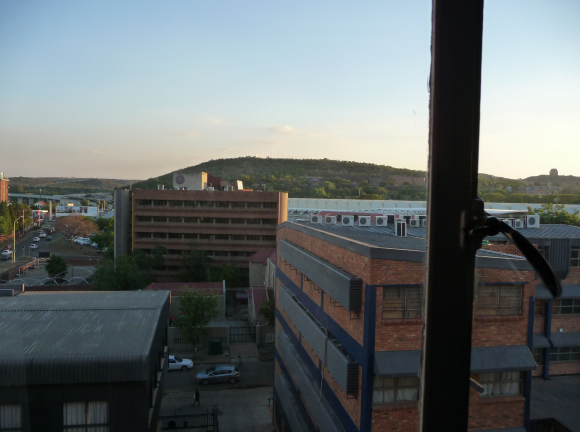
A reader writes:
You’re killing me … lots of clues, but I’m still clueless. Left-hand driving, which is mostly in tropical countries, except for UK and Japan, and this doesn’t look like either to me. I can’t read the signs, but they seem to be in a different script. Maybe Thai, but vegetation doesn’t look Thai. I thought about New Zealand, but the train in the background doesn’t look like any of the images I found for “New Zealand Trains.” There’s a KFC, but where isn’t there a KFC? I tried to figure out who made the air conditioners on the roof. Looked like an “O” logo. There is a company called O General that sells AC units in India, but couldn’t find any units that looked like those. White is the most popular car color worldwide, so that’s no help. But cars look relatively new, which says prosperous country.
I’m going with Japan. Let’s say Matsumoto, because I like the way it sounds.
Another:
Charleston, West Virginia? I don’t even know why I’m bothering. It just looks like Charleston, but I have no idea what building the picture was taken from. But, then again, those look not unlike windmills on the mountain. Massachusetts, maybe? No, that’s definitely Charleston. The building in the foreground looks like the kind of federal office building that Robert C. Byrd so fought for.
Another:
I think it’s somewhere in Tasmania. The cars drive on the left, so it’s a former British place, and it looks like it’s just rained in an otherwise dryish region, and the light looks like it’s in the Southern Hemisphere.
Another:
Ok, the photo indicates that this was taken 2013-11-04 at 10-13-38 PM. I would think that only the Northern European countries are in play – Sweden, Finland, Norway as they would have sunlight at 10pm at night in November or so I think. I also think the tip off is the fir trees. I searched Google images for bridges in all three and the closest I came was the Vousaari Bridge in Vousaari, a suburb of Helsinki. So I searched, and boy does Helsinki have a lot of bridges and waterways, but I can’t locate the spot of the photo. I’m just fishing for closeness points.
I’m also think that this could be Canada as well. There’s an American style pickup in traffic heading towards the water, but given a lapse in any other clues, I’m sticking with Helsinki.
Actually, “2013-11-04 at 10-13-38 PM” is just the timestamp of the screenshot of the original image, something we do to bypass the meta data that would reveal the exact geographical coordinates. Another reader:
You people are ruining my weekends.
I get a few right and think, OK, I’ve got this figured out now. Last week’s was bad enough, but this week is awful. There are so many clues I thought I would find it in five minutes flat. Instead we can’t even agree on what country it’s in and I am probably off by several thousand miles again.
We argued over hemisphere. I say the tree in the middle is starting to bloom and the white car in the alley in the foreground is parked on the left, so it must be the Southern Hemisphere – Australia or South Africa. The housemate says no; it’s a tree starting to shed its leaves and the two people you can see are fairly well bundled up, so it’s fall somewhere in the northern half of the world. The visible cars are sold pretty much everywhere in the developed countries. I said, well, there’s a KFC and an elevated railway, so how hard can it be? I booted up Google Earth – if you go into the “more” section on the menu and click Transportation, you see a zillion highway numbers and bus stops, but railroads are nice black lines. That’s a big help when there is a railroad track or three visible. I found if you do a search for “KFC near [name of any city, country], Google Earth will put pink dots on the map of the entire world, each of which
represents a KFC store. For the city you name, it gives you selections A-J on a page, with as many pages as necessary to name them all.
Unfortunately, Wikipedia says that “As of 2012, there were over 18,000 KFC outlets in 120 countries and territories around the world. There are 4,600 outlets in the United States, 4,400 in China, and 9,000 across the rest of the world.” That is a lot of pink dots to check. It turns out that lots and lots of them are near railways and hills. It’s an older sign they don’t use any more in the US and some countries, and you use four-year-old photos, so the store may have closed.
We looked for other clues – that weird white scalloped wall, the hills, possibly wind farm on top of one hill, the tower you can see past the top of another, elevated railways, weird traffic signals. We tried to figure out what those installations wall of the brick building in front are – they look like pipes for some kind of heating system? I have decided there is not nearly enough information on the web about rooftop air conditioners; I think those are made by LG, but they sell them all over the place. There are no satellite dishes visible, so I looked for places they might be banned. Nothing paid off.
I thought it was Australia, because they seem to use the bucket on a short pole the most, and those strange short traffic signals show up in a few towns. So my guess is Brisbane, because I fell in love with it looking at photos of the bays and beaches and rivers and birds.
My first job was at KFC in 1972 – I negotiated a salary of $1.60 an hour, way more than the other fast food place in town, Jack in the Box, would give me (only $1.35). We spent a lot of time seeing how far we could slide on the greased kitchen floor after closing, and I sliced off the end of my finger cleaning a machine. Good times. I wouldn’t eat chicken for several years after that, and now I hate them again. Your fault.
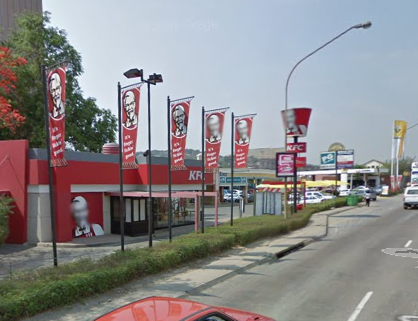
Another gets the right country:
While I can’t identify the exact location in the city, I’m sure it’s South Africa and have a pretty good idea it’s in Pietermaritzburg or somewhere else in KwaZulu-Natal. Firstly, the diagonal lines at the intersection on the left side of the picture and the left-hand drive on the car on the street in the bottom middle. Also, the deciduous trees on the hill mean it has to be somewhere that gets cold enough for them to lose their leaves. But you also see air conditioner condensers, therefore it’s a place that gets cold in the winter and warm in the summer. It’s also somewhere where you have security concerns (note the walls and gates on the edges of all the buildings. Based on the terrain I’m going to guess Pietermaritzburg.
Another gets the right city:
Boy, these things are hard. It looked a lot like the highveld on a winter afternoon, and then I spotted the Voortrekker Monument in the distance, making it Pretoria, South Africa or its surrounds. I think, based on the relative location of the sun, this must be near Unisa, close to an on-ramp to the highway, but my Google Street View skills aren’t hot enough to pinpoint it exactly.
Pretoria it is. An aerial view:

Another gets the right building:
Having lived in South Africa, I immediately recognized the purple jacaranda tree in the background, which Johannesburg and Pretoria are famous for. The “robots” (traffic signals) also had a distinct South African appearance. When I zoomed in, I also saw the modern-looking passenger train in the background – which I assumed must be the Gautrain. These clues made zeroing in on the location fairly easy. The picture was taken from the Manhattan Hotel in Pretoria, South Africa (or Tshwane, the official name for the municipality). The hotel is located at the corner of Scheiding Street and Thabo Sehume Streets in the Pretoria CBD. The picture was taken from a window on the backside (southside) of the hotel. I would guess it was from the 5th floor (6th floor in US numbering).
Another visual entry:
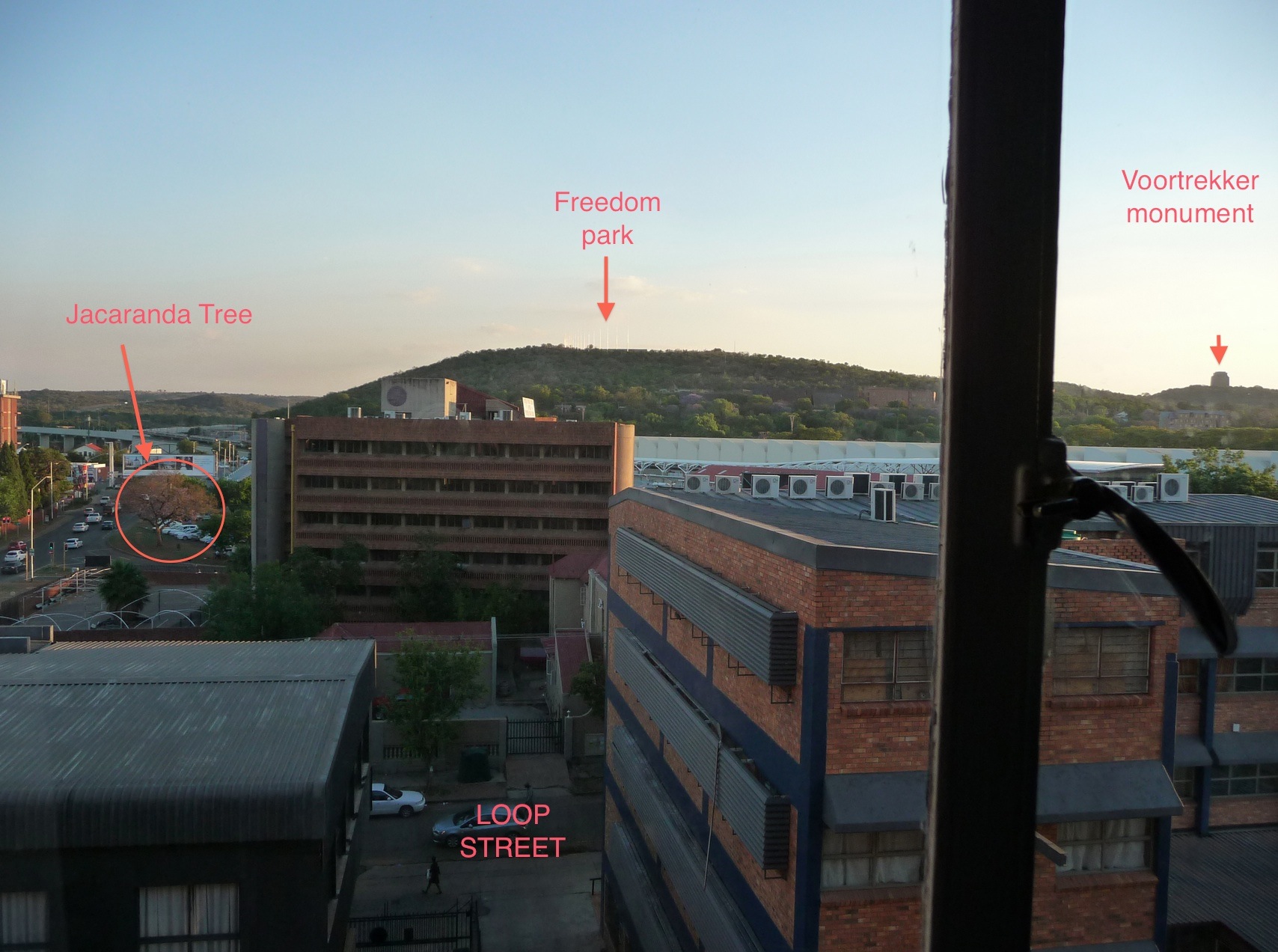
Another reader:
The poles (or “reeds”) of Freedom Park helped orient me. Freedom Park, by the way, honors people who died during South African various conflicts, going back centuries, including people who died in the struggle against apartheid. It’s the Rainbow Nation’s answer to the nearby apartheid-era Voortrekker Monument, which used to monopolize the view (and still kind of does).
Another adds, “I’m a historian, and I found a crazy archive of sorts in the Voortrekker museum’s vaults.” Another looks to the nearby rail station:
The elevated platform on the left side of the photo, which appears too slim to be a highway, immediately indicated to me that this is a view of the Gautrain track (a mass rapid transit system that was completed in 2012 and connects Jo’burg and Pretoria). I searched Gautrain stations on Google, and the one in Pretoria, with that unique wave-style roof, immediately stood out and told me that I was on the right path. A little playing around on Google Earth helped me to find the specific building, which is the Manhattan Hotel located on Scheiding Street.
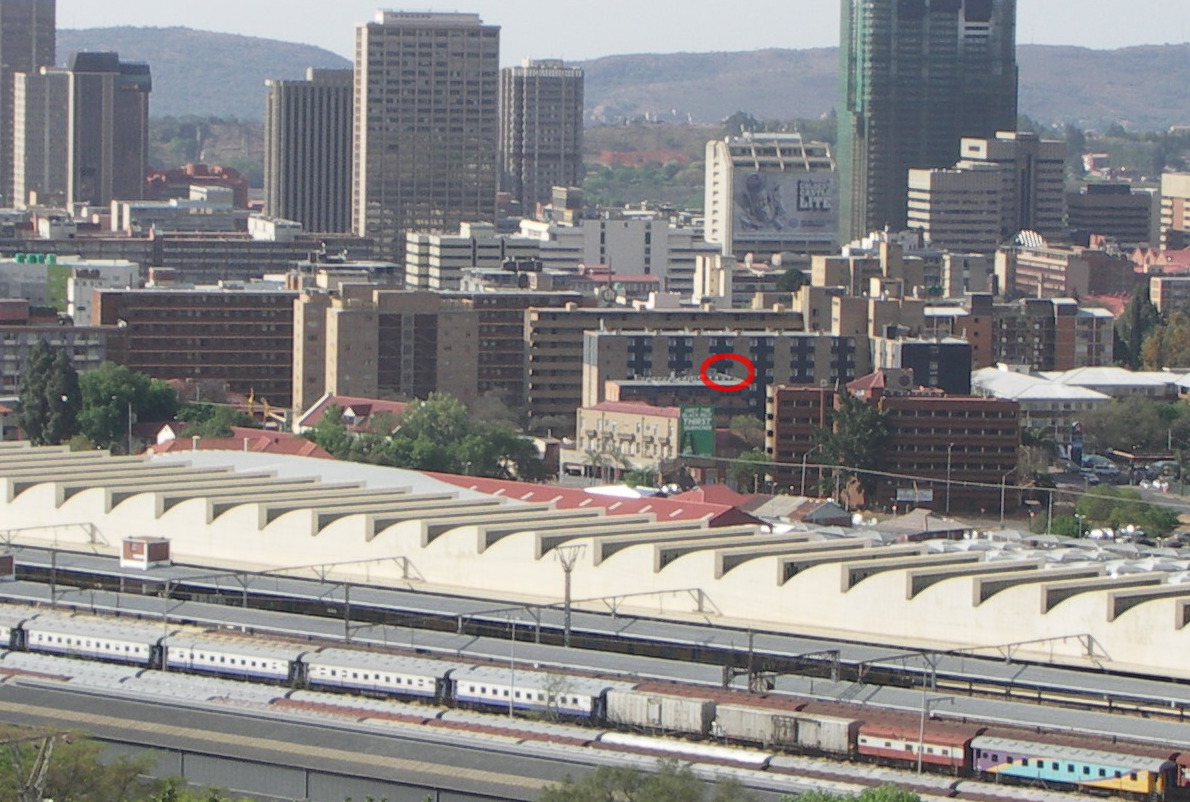
Another zooms in on the hotel:
I have a suspicion that the scalloped roof of the railway station will be immediately recognizable to residents and visitors of the city, but I did do this the old-fashioned way and hopefully that will count for something! I started out noticing the left-hand traffic, limiting this to a few likely candidate countries. Too spread out to be the UK, and the brick made it seem unlikely to be India. Australia? South Africa? Japan? Realizing the two people walking at the bottom of the picture were black, my attention immediately turned to South Africa. Googling “South Africa traffic lights” revealed the same shape seen on the road on the left as confirmation. The rail station with its unique-looking roof seemed to be the best clue, so looking up images of different rail stations in South Africa led to a perfect match with Pretoria. A bit of orienting from there and we have the Karos Manhattan Hotel, 247 Scheiding Street, Pretoria, South Africa. I would guess the 6th floor, from the window highlighted in the attached picture:
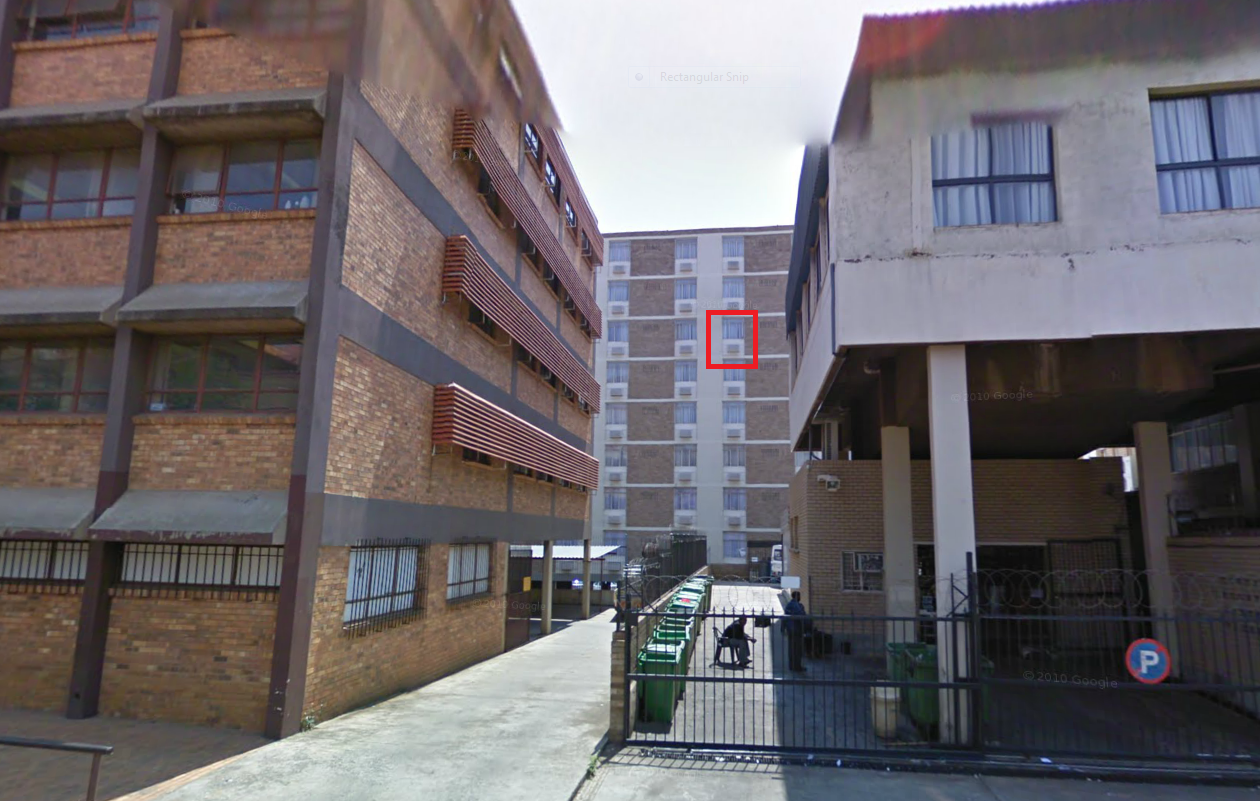
The correct floor is actually the 7th, which about a half-dozen readers guessed. Of them, two readers have previously gotten a difficult window view (“difficult” defined by having 10 or less correct guesses) without yet winning. To break that razor-thin tie, we counted the total contests each of the two readers have participated in. The following reader has 8 contests under his belt. Money quote from his highly-detailed entry this week:
I should note that I have tried, hard, in MANY of these contests. I occasionally get the right country and I once got the right city (mostly by luck). But this time I KNEW I was close, really close. At this point, I literally heard angelic music and noticed a bright glow in my bedroom. I found this distracting, so I turned down the volume and brightness on my laptop and carried on.
But the following reader ekes out a win this week with a total of 10 contests. Money quote from his extensive entry:
Worthy of note is the presence of 40 to 70 thousand jacaranda trees, which had led me to consider the southern hemisphere for my search. Pretoria in South Africa is popularly known as The Jacaranda City due to the thousands of jacaranda trees. Interestingly, the jacaranda are considered an invasive species, as they were imported from South America, and are no longer allowed to be planted.
I have previous correct submissions of Depoe Bay, Waterton, Sierra Vista, Finca Magdalena, Hiangyin, North Ballachulish, Fayetteville, and Lima, Peru.
And now Pretoria. For the record, here are the exact details from the photo’s submitter:
Monday, 4 Nov, 2013, at 6 p.m. Room 707 (facing south), Manhattan Hotel, 247 Scheiding St., Pretoria, South Africa. The jacaranda trees are blooming in town, but I don’t think you can see any in this pic. The global “access programs” groups of the Clinton Health Access Initiative are here for an annualish meeting. An inspiring bunch of people, and generally a lot of fun. We’ve been to Jo’burg and Dar es Salaam before (as well as Goa, India and stateside in Boston, NYC, Chicago).
I know Andrew doesn’t have much love for the Clintons, but I hope he realizes what a huge impact the Clinton Health Access Initiative has had on getting anti-retrovirals to the people of Africa and SE Asia. As we move on from ARVs, we discussed some exciting new initiatives in our meetings in Pretoria.
(Archive)
Obama Agonistes
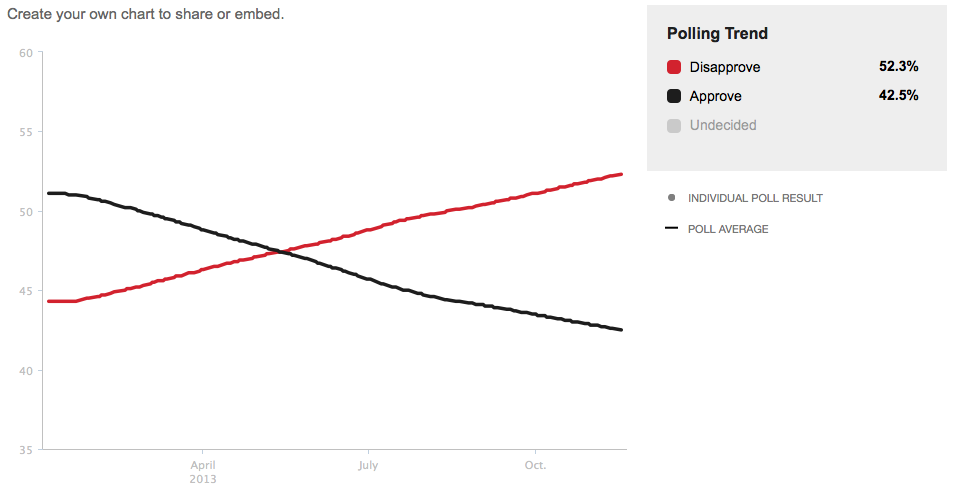
The major clusterfuck of the website, the breaking of an unequivocal promise, and a media eager to prove it’s not a lapdog to the president have all combined to bring the president down. The latest polling is grim. Here’s the poll of polls on Obama’s approval, since January:
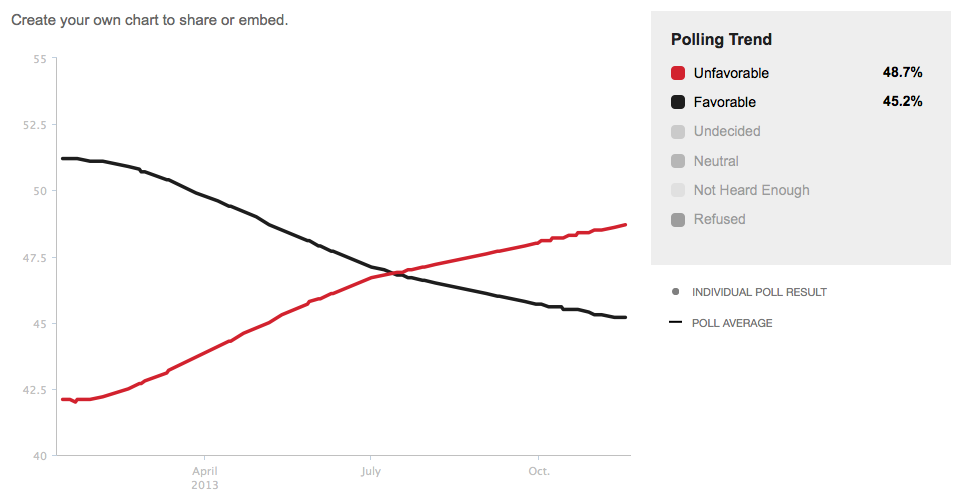
Here’s the favorability chart for the same period:
The question is: what does this mean and what does it portend? I don’t know, but I can express how this has changed my view of the president. On the core question of whether I believe the president deliberately lied to us, I’m inclined to believe he didn’t. His explanation of his broken promise last week was depressing but convincing to me. And I’m not alone: “By 52 percent to 44 percent, Americans say they think he told people what he thought was correct at the time.”
As for the website debacle: Canada and the UK had similar disasters when they attempted something on this scale. And the refusal of many states to set up their own exchanges made the burden on the federal website far greater than might have been imagined. The relative success of many of the states’ own sites is more proof that federalism works, and more proof of the sabotage of the law of the land that Republicans have engaged in.
But what I cannot get past is the management failure. Walter Russell Mead made a strong case on this yesterday:
Obamacare is the single most important initiative of his presidency. The website rollout was, as the President himself has repeatedly stated, the most important element of the law’s debut. Domestically speaking there was no higher priority for the President and his staff than getting this right. And the President is telling the world that a week before the disaster he had no idea how that website was doing.
I’d cavil about the ACA being the single most important initiative of his presidency (pulling the world out of an incipient second depression and carefully unwinding the Bush-Cheney catastrophe in foreign policy beat it, in my view). But it sure is a key element in his domestic agenda for his second term. It was going to require a real focus to get the federal government to work on this core matter. And yet the president was somehow blindsided by this fiasco. One wonders: what on earth was he doing this past year? He clearly understood the importance of the website’s functionality, and yet he didn’t get into the innards of the government to avoid a debacle.
Substantively, I think the ACA may well have the last laugh. We are certainly primed by the press for comeback stories. But I can’t predict the future, except that the core issues that the ACA deals with are not going away and even the nihilist GOP will have to offer something at some point to address them. What I do know is that the president was inexcusably AWOL on this for the past nine months. And that matters.
Protected by too-loyal staffers, let down by contractors, sabotaged and distracted by the Republican war on him, he lost his grip on his own agenda. That is now embedded in my consciousness, and that of many others. For a candidate who insisted that a president should be able to walk and chew gum at the same time, there’s no escaping the failure.
But, to revisit a theme, what matters in a president is not that he is flawless. It is how he responds to the flaws, once exposed. Obama always said he would not be a perfect president, and, unlike others, I found his presser last week to be consistent with much of what he has said and done in the past. He’s also president for the next three years. What we should observe is how he now reacts; how he shuffles staff; how he re-applies himself to the nuts and bolts of the federal government in the months ahead. Unlike Bush, we know he’s capable of this. We’ve just seen him coasting incompetently on healthcare in his second term thus far. To suddenly extrapolate from that a failed presidency is absurdly overblown, especially given the huge achievements already under is belt, the remaining potential for the ACA to work, and the enormous prize of ending the Cold War with Iran that is now within his reach.
He has been humbled and chastened. That’s a good thing. But reveling in that, rather than acutely watching how he adjusts in response, is a function of obsession with the man rather than concern for the country. He’s under probation now. His potential success will matter just as much as his obvious and glaring current failure. And unlike some, I want him to succeed in this. Because I want this country to succeed as well, and its current healthcare system is so profoundly inefficient and ineffective for so many that the status quo is simply not an option.
Finally, Some Good News For The ACA
In states with functioning websites, enrollments are picking up:
A number of states that use their own systems, including California, are on track to hit enrollment targets for 2014 because of a sharp increase in November, according to state officials.
“What we are seeing is incredible momentum,” said Peter Lee, director of Covered California, the nation’s largest state insurance marketplace, which accounted for a third of all enrollments nationally in October. California — which enrolled about 31,000 people in health plans last month — nearly doubled that in the first two weeks of this month.
Several other states, including Connecticut and Kentucky, are outpacing their enrollment estimates, even as states that depend on the federal website lag far behind.
Yglesias states the obvious:
[W]here the IT is on track, the enrollments are on track. If they can get the federal exchanges in decent shape, the rest should fall into place. If they can’t, they won’t.
Reliving The Iraq War
A reader writes:
It’s less than a hour since your email alert and I’m already reading I Was Wrong. The first entries
are scathing. It’s one thing for you to maintain an archive of your Iraq posts on the blog itself; it’s another to compile them for everyone to see. Given how raw and enraged your initial reaction was, it’s a typically ballsy thing for you to do. (For the record, I’m one of the liberal “fifth columnists” you line up in your sights in the early going.) I think your readers are as loyal to you as they are because you do this sort of thing all of the time, only not on this heroic scale. I wrote you once to push back a little on your regard for Hitch by reminding you that he did no such public penance for Iraq, and that his last, loud outburst against religion may have been fairly regarded on some level as a diversionary tactic to regain some street cred on the left. (It worked.) You did not duck when he did, and now you’re doing more than anyone could have been reasonably expected to do.
We now live in a world where what is said by both politicians and politicians is expected to be forgotten by the next news cycle. To jigger the old saying about the Bourbons, you learned everything and have forgotten nothing.
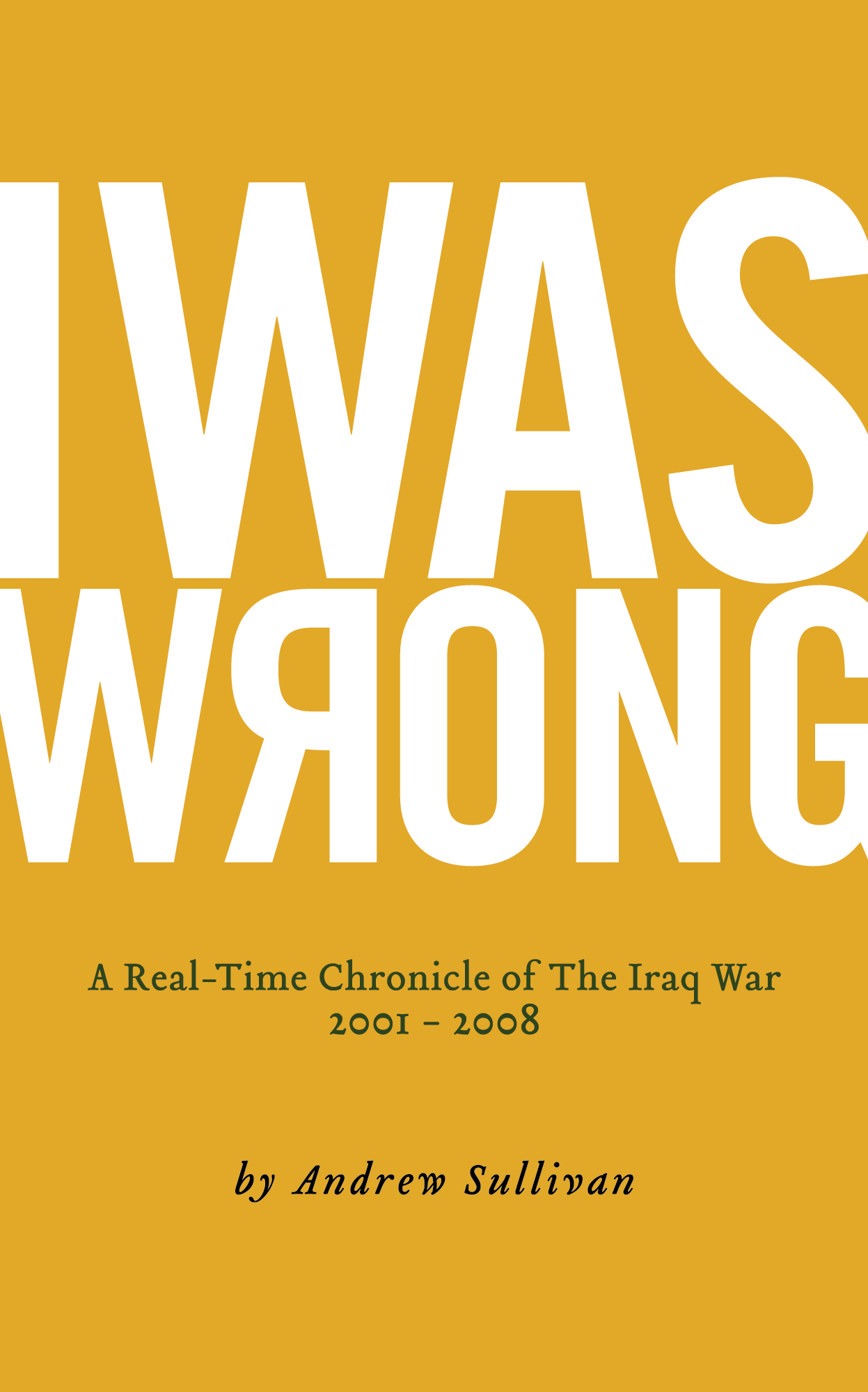
I want to say I’m not doing this to evince professions of admiration for my “courage.” I’m doing it because I severely regret – and in some cases, am ashamed of – many things that I wrote. Since it led to the actual deaths of tens of thousands of people, and the traumatization of countless more on both sides, it’s not courageous to revisit these more excruciating moments. It’s just basic accountability. That’s also why we accompanied this eBook with a podcast with a commander actually tasked with carrying this war out. I wanted to look the man in the eyes and listen.
And, look, I know my deep underlying flaw as a blogger – my passion, for good and, in this case, ill. I can’t help that, but I can learn to restrain it. The Dish has evolved out of this process. It’s because of these failures that I began regularly publishing prominent dissents; that I built a blog that had many checks and balances, not least from its readers, but also from new colleagues, who could push back and rein me in. The book’s initial and final edits were not mine. Chris and Patrick had that authority, and that does not simply apply to the book. Every day on the Dish, they correct for my impulses, and make the Dish something biased but balanced. I learned that separation of powers is not just a good idea in politics.
Another reader isn’t nearly as forgiving:
At first I was pleased at your running parts of your pieces to show how you’d changed your thinking. Though it was sort of late last night when I received your email, I clicked on it and started to read. You know, I found it profoundly disturbing, even depressing, to read your posts written during the run-up to the Iraq war. I don’t remember if I was a regular reader of your blog then, but to scan them for 20 minutes made me feel physically ill, at least a little bit. I remember the kind of rage and hysteria that were in the air from the pro-war people, and they were all – to a man/woman – appalling in almost every way.
So cut to today, and I find myself, overall, less inclined to resubscribe next year than I was yesterday. I find many things about you admirable, but the single most off-putting trait you have as a journalist and a man is your zealotry, your near-hysteria in putting forth your viewpoints. It’s great that you are admitting in depth that you were wrong. It’s upsetting to me, though, to deal with it in detail. I mean, if one doesn’t get going to war right, then what else matters? On what subject, then, are you trustworthy? In your job as a journalist (and as a man), my advice to you would be to create “more light, less heat.”
I understand my reader’s point. I respect his decision not to re-subscribe, but would simply argue that that is throwing the baby out with the bathwater. No writer is always right. What matters is how he or she grapples with being wrong.
And that is what I have tried to do in grappling with these errors. Seeing them exposed again so baldly in a daily, hourly blog, is another unsentimental education in my own blind spots. And they were many: acceptance of a neoconservative consensus that I had been marinated in for years and never questioned enough; betrayal of my own conservative principles in neglecting the vital importance of culture and history in reforming the world; impossibly good intentions, fueled by overpowering grief at what had been done to my beloved country, the US; and hubris – because of such a long period of time in which military might had been more successful than not – from the end of the Cold War to Bosnia.
The silver lining is that I learned on the spot, and you can trace, with painful dramatic irony, the scales slowly falling from my eyes. And the point is not just personal. I was not alone. This process of learning from history is a core obligation of any writer who wants to be true to his calling. But it’s also something we need to do as a country as well. Too often, these lessons are buried in partisanship or “moving on” or are inchoately felt without ever being directly expressed. One more reaction:
I’m a subscriber and long-time reader, but not long enough to have read your blog during the run up to the war in Iraq. I have to commend you for the ambitious project of the Deep Dish and your humility in creating the I Was Wrong piece in particular. Who is this person, Andrew? I recognize so little of you in these words, so much rage and vitriol. As soon as you learned of the torture and abuse of detainees, you shook the cobwebs from your eyes and never looked back. It’s incredible to me how much you’ve changed. There is grace and mercy tempering you now, and it pains me to imagine you any other way.
Heading Back To The Gay Future
I vented a little – well more than a little – in my Sunday Times column last week. It was about the amazement that many New Yorkers have that anyone could even think of moving back to DC once they’ve gotten a taste of the Big Apple. That a gay man would pick DC over NYC seems to strike a particularly raw and incredulous nerve. But, of course, one of the things I miss is the community I grew up in as an adult, the friendships over the decades, and the particular way of gay life that has evolved in DC more potently than in many cities with much stronger gay reputations.
And now it’s not just me saying it … but even the New York Times. Jeremy Peters’ piece is a little over-stated but its core argument is indisputably true. Washington has always been a very gay city, and still is:
Gary J. Gates, who studies census data for the Williams Institute at the University of California, Los Angeles, reports that Washington has 18.1 same-sex couples per 1,000 households. That places it eighth among cities with populations larger than 250,000. Sorry, New York, but you have only 8.75 same-sex couples per 1,000 households. In Manhattan alone, it’s higher, at 16.7, but still not higher than D.C. The top three are San Francisco (30.3 per 1,000), Seattle (23) and Oakland (21). The numbers capture only those who acknowledge being in a same-sex relationship.
What Peters observes – after living in New York for six years – is the gay sophistication of the place. He argues that the stunning success of the civil rights movement, which reached its tipping point under Obama, has eroded the closet to the point of irrelevance, and thereby transformed the place. That’s certainly true, but I knew gay Washington before the Obama era, and it wasn’t ever as uptight as some would have you believe.
There was always a thriving nightlife – from the great old discos, Tracks and Lost and Found to one of the cradles of House music, the Clubhouse. The DC Eagle is as venerable as the New York version. The community’s response to the AIDS crisis was deep and wide. And the military and Congress brought gays from all over the country to the capital – and not simply because they were gay. So there was always a deep bench of gay cultural diversity in DC that was more like the rest of the country than the flypaper destinations like New York or San Francisco or Miami. And if you’ve never two-stepped at a gay country bar, then Remingtons will be a revelation. For me, a little English kid, it was quite simply overwhelmingly wonderful.
In that way, I think DC was ahead of its time as well as behind it. It had the kernel of a really thriving, large, and diverse gay community, but inside a hard shell of fear and the closet. I don’t want to minimize the fear.
When I was openly gay in the late 1980s and early 1990s, it was a real novelty. I could almost feel the tension in some gay social circles as I entered: Would I expose them? Why did I think I could get away with being open in a city whose homosexual presence had always been defined by maximal discretion? When I came out as HIV-positive in the mid-90s, the was another collective dropping of jaws. But over the years, as the gay and (to a much lesser extent) HIV closets eroded, something that had always been there began to breathe and grow into something more mature and more integrated than the beachheads of gay visibility and power. So much so, in fact, that New York today seems a little dated in comparison, even a little stereotypical with its huge fashion and theater scenes.
Then the little things: the gay press in DC is vastly superior to NYC. The infrastructure – from booming 14th Street to Columbia Heights as well as Adams Morgan and Tacoma Park – is often newer and fresher and more modern than New York. A gym like Vida can be a little much – but it no longer has any inferiority complex toward New York. Yes, the white men are, to my mind, simply way hotter in NYC than DC. The DC gays are perfectly formed, but also a little too squeaky clean. A little less deoderant and a little more body and facial hair would be a blessing. But then what does New York have that compares with Bear Happy Hour at Town or a gay sports bar legend called “Nellie’s” that has plastered on its exterior: “Are you Nellie enough?” That kind of edge – integrating mainstream with the subculture and finding a new cultural fusion of the two is something really coming into its own in the nation’s capital. New York, in contrast, seems – dare I say it? – a little played out.
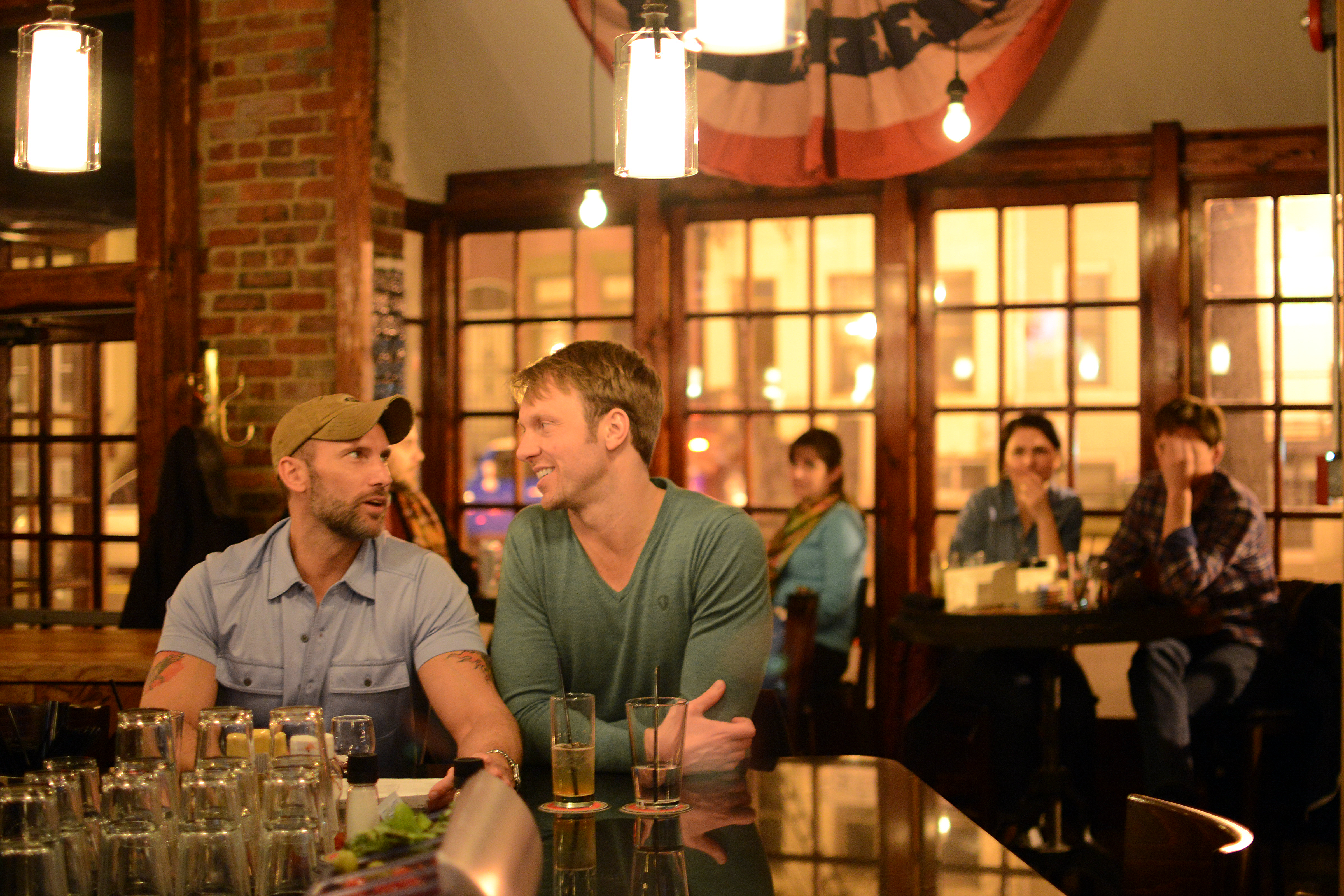
(Photo: Craig Hollander, left, and his partner Gary Unger enjoy the Oscars at Shaw’s Tavern, a DC gastropub managed by a largely gay staff which attracts straight and gay patrons alike. Both men enjoy living openly gay in the district. ‘DC is very much gay-friendly,’ says Gary. ‘You don’t have to look over your shoulders anymore’. By Astrid Riecken/Washington Post/Getty.)
 The Dish