Introducing Deep Dish

andrew-sullivan-i-was-wrong-cover

From the beginning of this experiment in the new media economy, we’ve said that one day, we’d like to add a monthly magazine to the Dish. Today, we’re launching a prototype, and we’re calling it Deep Dish. It’s a skeletal first issue, but we hope it sketches the kind of things we want to publish in the months and years ahead.

What we’re trying to do – to put it bluntly – is to reinvent the idea of a magazine through a blog.

I love magazines – but the web has not been kind to them. The web tends to favor the quick hit and the rapid fire of blogging; and long-form journalism, magazines’ previous specialty, has taken a hit as a result. Online, no one wants to read a long piece, as they sit at their desks or check their iPhone on the bus. The tablet has changed that a huge amount, but it’s still a struggle. Our idea is to do something relatively simple: connect an already vibrant and subscriber-based blog community (that would be you) to monthly long-form pieces in all the variety that the web can support. We know we have the kind of committed readership that the best long-form writers love to reach. And we think we have the ability to find those writers. We want to connect the two.

It’s monthly because you already have too much to read; and it’s called Deep Dish because we want to use it to provide substantive but compelling depth to online journalism. Plus, I like puns.

The first issue is bare-bones, compared with our eventual hopes. With a handful of staff, and a commitment first and foremost to creating and innovating the Dish every day, it’s frankly the most we can accomplish right now. Since we haven’t yet reached our annual goal of $900K for just putting out the Dish, it’s an act of faith as well as an act of entrepreneurship.

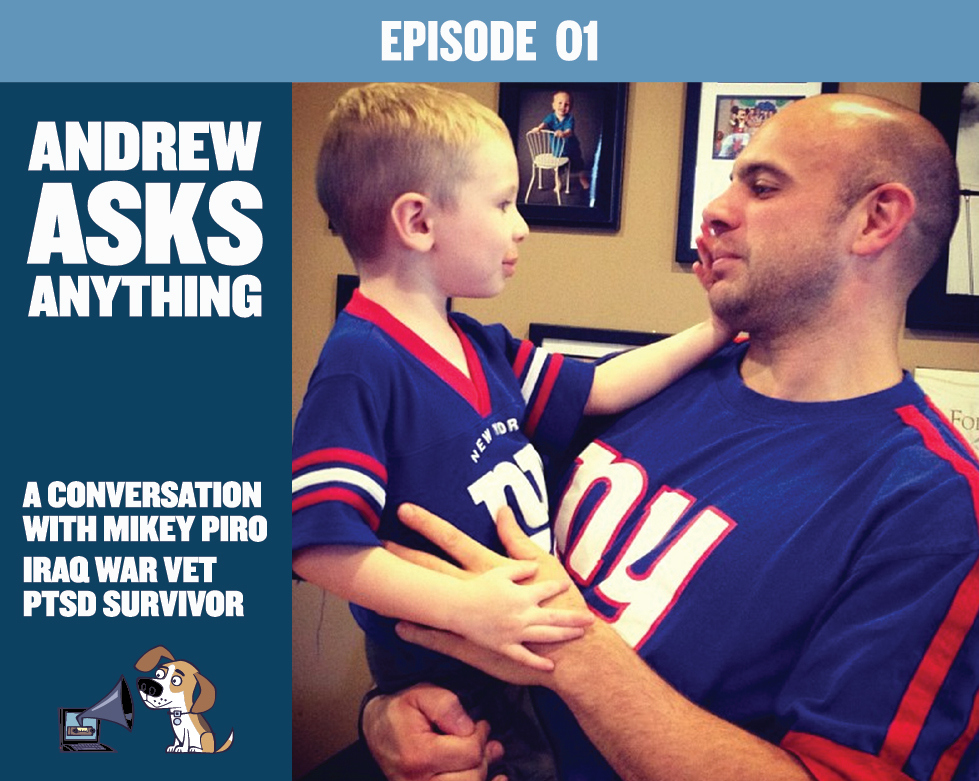
But it’s a start. Our first issue has two long-form pieces: an eBook, I Was Wrong, which is an edited diary-like chronicle of my blogging of the Deep Dish LogoIraq war from 2001 – 2008; and a 100-minute conversation with a remarkable former Iraq war commander, Mikey Piro, who now deals with PTSD, and in our conversation, tells the story of his war – on the ground and in the front-lines. Together, we hope they provide a deeper look at the narrative of the core event of the first decade of the 21st century.

We intend to follow up each month with long-form journalism that is close to the polar opposite of our daily blogging, yet fueled by its thriving community of readers. We’ve already begun taping a series of audio conversations called “Andrew Asks Anything” of which Mikey Piro is our first. I wanted to create something deeper, more intimate and less constrained than a television or radio interview. I didn’t want to interview anyone so much as enter into a conversation with another person, in which both of us have something to say and learn. It grew out of my one early experiment with such a sprawling, recorded after-dinner chat with Hitch.

I’ll also be writing long-form essays of the kind I used to produce for the Atlantic, the New York Times Magazine, Newsweek and Time. We’ll also use Deep Dish to create edited eBooks of some of the Dish’s best reader threads – from the death of pets to the cannabis closet. Soon, we  hope to have the resources to pay outside writers for the kind of long-form journalism that is increasingly under threat of extinction: lengthy piro-banner1investigative reports, New York Review of Books-style reviews, and sustained arguments and essays that require more than a column’s length. I have ambitions for long-form video as well; adventures in photography (an eBook of the best window views around the world, for example); and a continuing commitment to the publishing of poetry. In other words, we want to begin creating the kind of content we often link to.
Think of it as the Dish – but deeper, longer and uncut. You can check out our inaugural issue here. But Deep Dish is not as accessible to the world as the Dish. It’s behind a real paywall, which means it is for subscribers only. We wanted to offer the 32,000 or so subscribers  a token of gratitude for their amazing support this year, but also to show everyone else (a million monthly readers) what subscribing to the Dish could help spawn: a new business model for long-form magazine journalism.

There are signs that our own model of subscriber-based online journalism is beginning to bear fruit. Here’s a piece by Mathew Ingram on Beacon, a new media start-up he summarizes thus:

Beacon wants to give journalists who may not have the ability — or the desire — to run their own site a way to connect with readers who might want to subscribe.

It’s a collective version of the Dish model – for those who have not had thirteen years to build an online readership. We deeply hope it works. As long-form struggles to survive, and as “sponsored content” or page-view trolling gain more and more traction in the media, we want to pull in the very opposite direction – toward more reader-writer interaction and support, toward subscription-based journalism that can focus on the quality of content, rather than on the need to placate corporate advertisers with unprecedented leverage over struggling news sites or to rack up pageviews.

So here’s our first prototype. As always, we welcome feedback of all kinds, including your ideas of what we could do with Deep Dish in the months and years ahead. Our regular in-box is always open, and we read it carefully.

If you’re a subscriber,  just click here to read and listen to the first issue. (If you can’t access Deep Dish, you probably need to sign in with your username and password. If you need help signing in, check out this help page. If you’re still having trouble, email us at support@andrewsullivan.com.)

If you haven’t yet subscribed but want to read the eBook – the kind of journalistic accountability for error Paul Krugman called for today – or listen to the podcast (perhaps the most intense and humbling public conversation I have ever had), you can get immediate access to Deep Dish and unlimited access to the Dish by subscribing [tinypass_offer text=”here”]. If you’ve been hemming and hawing, this is an opportunity not just to help us, but to help others pioneer a new business model for long-form quality magazine journalism. Subscribe [tinypass_offer text=”here”]. It takes two minutes and it’s just $1.99 a month or [tinypass_offer text=”$19.99 a year”]. Or more, if you really want to help us turn this prototype into a more sustainable reality.

Only you can make it happen. But welcome to the beginning of what could be our future.

Obama’s Executive Power Grab

Jonathan Adler questions the legality of the Obamacare fix that the president announced last week:

It’s nice that regulators may forbear enforcing the relevant regulatory requirements, but this is not the only source of potential legal jeopardy. So, for instance, what happens when there’s a legal dispute under one of these policies? Say, for instance, an insurance company denies payment for something that is not covered under the policy but that would have been covered under the PPACA and the insured sues? Would an insurance company really want to have to defend this decision in court? After all, this would place the insurance company in the position of seeking judicial enforcement of an illegal insurance policy.

Nicholas Bagley also has concerns:

I’m uncomfortable with the “enforcement discretion” justification. Because I haven’t yet seen a complete legal defense, I remain open to persuasion. As it stands, however, the administrative fix looks awfully vulnerable to legal attack.

McArdle adds:

President Obama, who used to be so sharply critical of George W. Bush’s use of executive power, is now pioneering his own expansive views of what the president may do. The White House seems to believe that they are allowed to shinny around any rule, as long as they wrote it. I’d argue that this is exactly backward: They have an especial duty to uphold the laws that they themselves constructed, because if they don’t, why should the rest of us go along?

The Cheneys And The Republicans

Dick Cheney Poses For A Family Photo

For quite a while now, the GOP has lived with a rather spectacular contradiction over homosexuality. It was perhaps best summed up by the split between George W Bush and Dick Cheney in 2004 over the federal marriage amendment. Bush backed the amendment – you can read my real-time response that day here – and Cheney didn’t. So on a major issue of social policy – one on which the 2004 election was waged in Ohio – the ticket was split. Well: not so split. Bush – we were led to believe – was not exactly energized on this subject. His wife and daughters all backed marriage equality. In his personal life, Bush wasn’t a hater or a man lacking in empathy. Far from it. But Rove knew the base, and knew what could deliver it. So, with the aid of his then-closeted campaign honcho, Ken Mehlman, Rove won Ohio. With Ohio, he won Bush’s re-election.

Ask yourself: on what ticket in living memory did a president and vice-president publicly disagree on an issue that was critical to winning the election? And there you see the clash. Republican elites had gay friends, offspring and key aides. Yet the Republican base continued to view gays as some kind of threat to the family. The electoral math won. I remember – those were the days – when I was invited to meet Rove in the White House early in the first Bush term, and pressed the case against the FMA, or any variant thereof. Rove simply told me that there were many more Christianists than homos, and that mathematical reality dwarfed any arguments, however meritorious. It wasn’t the first time I had seen utter cynicism on this issue in high places – it was hard to beat the Clintons for that. But the baldness of the cynicism – the reflexive refusal even to address the actual rights and wrongs of the matter – was never better expressed than by Rove.

Cheney got a pass – but he shouldn’t have. He boldly came out for marriage equality explicitly … in 2009. In the vice-presidential debate of 2004, he bristled – as did the public – at being confronted by the fact that he was hurting his own family on this issue. But at some point, the contradictions – and their deep moral consequences – had to emerge. And now they have in full bloom. Liz Cheney, not a homophobe in my personal memory, is nonetheless opposing her sister’s right to marry – anywhere. Actually, she is in favor of her sister and her wife being stripped of all legal protections the moment they come into their family’s home state. Let me put this more clearly: Liz Cheney is attacking her sister’s dignity and civil equality, in order to advance her political career. In a word, it’s disgusting.

It’s not made any better by Liz Cheney’s response:

I love my sister and her family and have always tried to be compassionate towards them. I believe that is the Christian way to behave.

To which I would like to respond on behalf of Mary and Heather and the rest of us: fuck your compassion. Just give your sister the basic equality and security for her own family that you have for yours.

At some point, even the most cynical of politicians has to understand that this issue is not abstract. It affects your own sons and daughters, brothers and sisters. You cannot publicly attack your own sister’s family and say you love her as well. It does not compute. And Liz Cheney does not even have the excuse of being of a different generation. She’s my generation. She knows better. She has seen her sister’s life up-close. So major props to Heather Poe, Liz’s sister-in-law, for calling her out:

Liz has been a guest in our home, has spent time and shared holidays with our children, and when Mary and I got married in 2012 — she didn’t hesitate to tell us how happy she was for us. To have her say she doesn’t support our right to marry is offensive to say the least.

Of course, principled differences of opinion are compatible with family values. Some members of my own extended family don’t agree with marriage equality. I live with that, but I’d be lying if I said it doesn’t sting. But they’re not actively campaigning on the issue and even trying to use it for political gain.

What you’re seeing here is the Republican elite’s hypocrisy finally being called out – in the most public way possible. By refusing to stay silent while their sister and sister-in-law acts as if it’s still 1996, Mary Cheney and Heather Poe are standing up for their own integrity. They are therefore now leaders of the gay rights cause – even though many on the gay left will doubtless give them no credit. Because this cause is not just a public and political one; it is a personal and moral one. And the ability to pretend that you can do one thing in public and another in private is becoming more attenuated by the day.

(Photo: Congressman Dick Cheney and wife Lynne pose for a photo with their two children Liz (L) and Mary and Basset Hound Cyrano at their home in Casper, Wyoming in March 1978. By David Hume Kennerly/Getty Images.)

Quote For The Day

“If you write about current affairs and you’re never wrong, you just aren’t sticking your neck out enough. Stuff happens, and sometimes it’s not the stuff you thought would happen. So what do you do then? Do you claim that you never said what you said? Do you lash out at your critics and play victim? Or do you try to figure out what you got wrong and why, and revise your thinking accordingly?” – Paul Krugman.

A New Evil Face

Nicholas Schmidle acquaints readers with Maulana Fazlullah, the new head of the Pakistani Taliban:

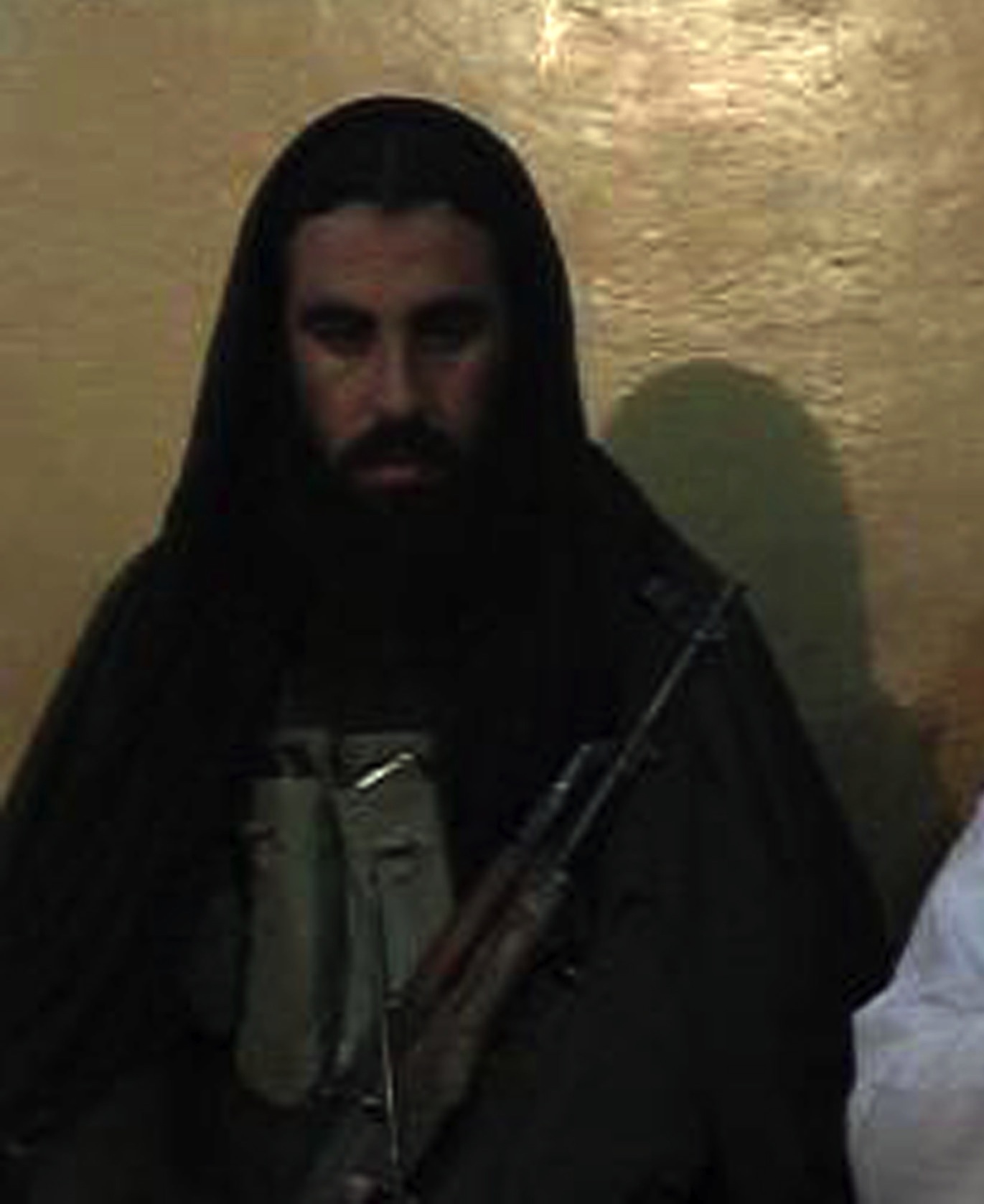
Fazlullah was an inspired choice, by the Taliban’s warped standards. He is young and ruthless, and has taken responsibility for a panoply of barbaric acts over the years: floggings, suicide PAKISTAN-UNREST-TALIBANbombings, even the attempted assassination of Malala Yousafzai, a teen-age girl who survived gunshots to the head and neck, and who has become an even more driven advocate for girls’ education. (She recently addressed the United Nations and appeared on “The Daily Show.”) Last summer, his men kidnapped and beheaded seventeen Pakistani soldiers.

But what distinguishes Fazlullah from his predecessors is his evangelism. He is as much a rebel and a crusader—bent on imposing his harsh interpretation of sharia on others – as he is a terrorist. He was perhaps the first militant leader to declare jihad against the Pakistani government. When the Pakistani Taliban announced their existence a month later, they turned their guns on the state, toppling a long-standing relationship between elements inside the Pakistani government and jihadists in Pakistan and Afghanistan. Compared to their Afghan counterparts, the Pakistani Taliban have turned into a sophisticated group with global reach—they planned the failed attack on Times Square, in 2010 – as a result of their alliance with Al Qaeda. Still, some members are reportedly amenable to peace talks with officials in Islamabad. Fazlullah is not one of them.

He has not received a wholly warm welcome from the group; “several furious commanders from a rival clan stood up and left” when he was named the new leader. Colin Freeman considers the implications:

Fazlullah, despite his reputation as a hardliner’s hardliner, is considered a relative outsider within the ranks, as he hails from the Swat Valley rather than the Taliban’s traditional strongholds in Pakistan’s tribally-administered region. … “There are reports of serious infighting among them that might come to the fore in the near future,” said Saifullah Mahsud, director of the FATA Research Centre, a Pakistani think tank. While a failure to agree on a new leader could compromise the group’s operation effectiveness, it could equally lead to even more bloodshed as different commanders and factions embark on their own rampages. The group already stands accused accused of killing thousands of Pakistani civilians in recent years, as well as trying to impose sharia law in places like Swat.

Meanwhile, Karachi-based novelist Mohammed Hanif argues that Pakistan “seems to have lost the will to fight its old foe, Fazlullah, and his followers”:

When [Fazlullah’s predecessor Hakimullah] Mehsud was killed, instead of celebrating or letting out quiet sighs of relief, politicians and journalists reacted as if they had lost a favorite son. He had killed many of us, but we weren’t craving vengeance; we were ready to make up and cuddle. Why does Pakistan’s political and military élite celebrate the very people it is fighting? The logic – or its absence – goes like this: Hakimullah Mehsud was our enemy. But the United States is also our enemy. So how dare the Americans kill him? And how dare they kill him when we had made up our minds to talk to him?

The popular narrative in Pakistan holds that the Taliban’s fight is simply a reaction to American drone strikes: it’s a war between American kids sitting in front of LCD screens eating their TV dinners and our own men in the north, who are better Muslims than we are. The Pakistani logic seems to be that if America stops killing them, they’ll stop killing us. But the truth is that the Taliban leadership has made no such promises. They have only said that if the government stops drone strikes, and stops coöperating with America’s war in Afghanistan, they would be willing to talk. But what would they talk about? The little problem they have with Pakistan is that it’s an infidel state – almost as bad as America, but with some potential; they believe that they can somehow make us all better Muslims. Our Taliban are simply saying, “Save us from the U.S. drones, so we can continue to kill you infidels in peace.”

Pakistan’s rulers have developed a strange fetish for lionizing its tormenters. Watching the proceedings in Pakistan’s parliament last week, after Mehsud’s murder, you could have mistaken it all for a Taliban meeting. “This is not just the killing of one person,” Pakistan’s interior minister, Chaudhry Nisar Ali Khan, said. “It’s the death of all peace efforts.” It was mentioned, but only in passing, that since Pakistan had proposed talks with Mehsud in September, the peacemaker and his allies had killed an Army generalblown up a church filled with worshippers, and killed hundreds of other civilians. … In their collective hankering for one true Sharia, the leaders of Pakistan’s political and security establishment – and their American backers – have long since lost their bearings.

(Photo by Thir Khan/AFP/Getty Images)

“A Reef Of Dead Metaphor”

That’s how linguist Guy Deutscher characterizes all language. Prospero’s R.L.G. elaborates:

Most of the time we do not realise that nearly every word that comes out of our mouths has made some kind of jump from older, concrete meanings to the ones we use today. This process is simple language change. Yesterday’s metaphors become so common that today we don’t process them as metaphors at all. Primal man, in inventing language, would have only used concrete terms he could stub his toe on, like tree and rock. So tree is not a metaphor, and rock is not a metaphor. As far back as the OED can tell us, they (in their physical meanings) are not metaphorical extensions of some other word.

But if “tree” and “rock” aren’t metaphors, nearly everything else in our vocabulary seems to be.

For example, you cannot use “independent” without metaphor, unless you mean “not hanging from”. You can’t use “transpire” unless you mean “to breathe through”. The first English meaning of a book was “a written document”. If we want to avoid all metaphorised language (If we want to be “literal”), we must constantly rush to a historical dictionary and frantically check that there is no concrete meaning historically antecedent to the one we hope to use. In every language, pretty much everything is metaphor—even good old “literally”, the battle-axe of those who think that words can always be pinned down precisely.

Previous Dish on the uses and misuses of “literally” here, here, and here.

Our Vivid Planet

dish_Edmaier

Megan Gambino talked to photographer and geologist-by-training Bernhard Edmaier about how he captures his aerial shots of Earth, such as the above photo of Landeyarsandur, Iceland:

“I do a lot of internet research, including Google Earth [searches], study satellite images of planned destinations, maintain close contact with local scientists and commercial pilots, deal with various authorities and negotiate flight permits,” says Edmaier. “It can take months of research until the moment of shooting has arrived.”

Then, on that long-awaited day, the German photographer boards a small plane or helicopter and instructs the pilot to position him in just the right spot over the landform. He often has that perfect shot in mind, thanks to his planning, and he captures it out of the side of the side of the aircraft with his 60-megapixel digital Hasselblad camera.

From a logistical standpoint, Edmaier explains, “As my favorite motifs, geological structures, are mostly very large, I need to shoot my images from a greater distance. Only from a bird’s eye view can I manage to capture these phenomena and to visualize them in a certain ‘ideal’ composition.”

(Photo by Bernhard Edmaier. More of his work is available in his new book, EarthART, published by Phaidon.)

Brevity Is The Soul Of Twitter

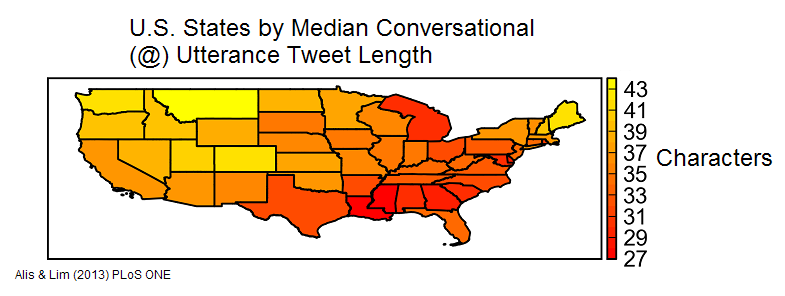
Neuroskeptic comments on new study findings that suggest “conversational” tweets (tweets that begin with “@”) are getting shorter:

The difference is mainly due to people using fewer words. The length of the most-used words didn’t change very much, but the number of words per tweet fell… So tweeters are dish_state_tweets becoming less verbose (within any given tweet), which the authors suggest might represent the development of more economical linguistic conventions adapted to Twitter. But is this true of everyone?

Broadly speaking, yes – at least in terms of English-language tweets. The slope of the decline was similar in the USA and in tweets originating from the rest of the world. However within the US, [researchers Christian M.] Alis and [May T.] Lim found a remarkable state-by-state variability (Bear in mind however that few tweets have geolocatable info, so the sample sizes,and representativeness, of these data here are lower)… The average @ utterence from Louisiana is just 27 characters, compared to 43 in Montana.

Why? State average income and educational attainment were weak predictors of length, but Alis and Lim say that the biggest factor they found was… race. States with more African-Americans produced shorter tweets.

Remembering Moms Mabley

Lisa Derrick recommends the new HBO documentary “Whoopi Goldberg Presents Moms Mabley,” about the first female comedian to make a living in stand-up:

Born Loretta Mary Aitken, Mabley began working as a stand-up in the late 1920s, and made a living on the Chitlin’ Circuit—the vaudeville clubs, speakeasies and theaters throughout the eastern, southern, and upper mid-west areas of the United States where African-American performers were able to perform during segregation. In the early days of her performances, Mabley wore androgynous clothes on stage and worked blue, performing XXX-rated routines. As she developed her act, Mabley took on the persona of granny or great auntie, wearing a floral house dress and a drooping hat. She took out her dentures for her stand-up routine—at the time dentures were common—and riffed on her character’s desire for young men and her distaste of old ones, addressing the imbalance of sexual power, as well as hitting on politics, race, war, and other social issues.

Neil Drumming explains that Mabley’s “broke-down hat, old housedress, and ill-fitting shoes” were “more than a visual gag”:

[T]his entire “Moms” persona was Mabley’s method of making herself non-threatening — a tactic that even the most successful female comedians utilize in order to deliver their unique message in a male-dominated field. “People don’t want to hear the truth,” [Joan] Rivers elaborates. “And if you are going to hear the truth, it’s got to come from a homely lady, a lady that’s no competition, a lady that ain’t gonna take your husband, a lady that is okay, that you can trust because she’s harmless.” This insight strikes home as soon as you hear Mabley’s subtle, irreverent commentary on Civil Rights and the political climate of the ’60s.

Diana Anderson-Minshall says that “Mabley’s stage persona reflected her core political values, but did little to suggest she was a lesbian”:

According to Keith Stern’s Queers in History, Mabley came out as a lesbian in her act when she was 79, and worked the lesbian club circuit until her death a couple of years later. … “I had always heard rumors and had never seen any proof,” Goldberg says. “People said, ‘Well, I saw her at [a lesbian club] or I saw her here and I saw her there.’ But there was never anything where you could say, ‘Look, here you go.’” That is, until Goldberg stumbled onto a card picturing Mabley decked out in a man’s suit. It was signed “Mr. Moms.” “Baby, when we found that,” Goldberg recalls, “I was like, Hey, I can say it now!”

Previous Dish on female comedians here and here.