
West Jefferson, Ohio, 8.30 am
West Jefferson, Ohio, 8.30 am
The thread continues:
Excess skin is also a reality for most women after pregnancy – even if you didn’t experience excessive weight gain. I am trim and fit otherwise, but my stomach and breasts are saggy and loose and covered in stretch marks. It definitely affects intimacy. My husband says he doesn’t care; that he doesn’t even notice, but I care and I notice. I have a hard time relaxing during sex and I find myself contracting away when my husband touches my belly. My youngest child is almost 15 years old and I still feel shame and embarrassment about my post-pregnancy body. The feelings haven’t gotten any less intense, even after all this time.
Mariah Blake chronicles the collapse of the Unification Church:
[I]n recent years, [Rev. Sun Myung] Moon’s plans to remake America and salvage humanity had run into trouble. Followers had drifted away; his political influence had ebbed. With his ninetieth birthday approaching, he increasingly looked to his children to preserve his life’s work.
In Jin, Moon and his wife’s fourth child, seemed suited for the task. She had a modern American upbringing and a master’s degree from Harvard. In 2009, she took over the Unification Church of America and introduced a bold modernization program. Her aim, she said, was to transform the church into one that people – especially young people – were “dying to join.” She renamed the church Lovin’ Life Ministries, shelved the old hymn books, and launched a rock band, an offshoot of which played New York clubs under the moniker Sonic Cult. She also discarded the old Korean-inspired traditions: bows and chanting gave way to “Guitar Hero” parties, open mics, concerts, and ping-pong tournaments.
And then, early last year, she disappeared:
After several months passed with no sign of her, some parishioners began pressing for information on her whereabouts. They were blocked at every turn. Even the highest circles of church leadership couldn’t – or wouldn’t – say what had happened to In Jin Moon. Before long, it became clear that the House of Moon was crumbling and In Jin had become caught up in its downfall. But her disappearance was only one part of a much more complicated saga – one that involved illegitimate children, secret sex rituals, foreign spy agencies, and the family of Vice President Joseph Biden. Even by Moon’s famously eccentric standards, the collapse of his American project would turn out to be spectacular and deeply strange.
Previous Dish on the Moonies here and here.
(Video: From the Washington Times’ 15th anniversary dinner, in 1997)
Prescription painkillers now kill more Americans than heroin and cocaine combined, according to the CDC. Physician Celine Gouder confesses that she, like other doctors, often struggles to make the right call when patients request painkillers:
Doctors have a duty to relieve suffering, and many of us became doctors to help people. But giving that help isn’t straightforward, especially when it comes to chronic pain. Try explaining the downsides of narcotics to a patient while declining to give him the medication he wants. He might accuse you of not understanding because you’re not the one in pain; he might question why you won’t give him what another doctor prescribed; he might give you a bad rating on a doctor-grading Web site. He might even accuse you of malpractice. None of this is rewarding for doctors: we’re frustrated that we can’t cure the pain, and that our patients end up upset with us. …
I sometimes think of the patient who asked me for OxyContin early in my career; I continued to prescribe the drug. But I also referred him for physical therapy and helped him get bariatric surgery to lose the weight that was putting extra stress on his spine and joints. Unfortunately, even after he lost about a hundred pounds, he wasn’t able to stop using narcotics or go back to work.
Justin Gregg considers whether there’s reason to believe in a special dolphin-human bond. On the plus side:
The phenomenon of lone sociable dolphins — for whom human contact appears to substitute for the company of their own kind — is documented extensively in the scientific literature. Among the better-known examples are Pita from Belize, Davina from England, Filippo from Italy, Tião from Brazil, and JoJo from Turks and Caicos. One report from 2003 described 29 lone sociable dolphins that were regularly observed by scientists, and a number of scientific articles have been published since then on new ones. There is no doubt that these animals are exhibiting inquisitive behaviour, which lends weight to the idea that dolphins do in fact seek out human contact with some regularity.
On the other hand:
The marine mammal researcher Toni Frohoff, director of TerraMar Research in California, reported an incident in which dolphins suddenly fled the scene as soon as a shark was spotted, leaving her to fend for herself. There’s even a news report from 2007 of an intoxicated man who was attacked by a group of bottlenose dolphins after falling into the Black Sea in Ukraine. The animals allegedly tried to drown him, prompting the Russian news agency Interfax to declare that they ‘lack the reputation of friendliness and love of humans enjoyed by dolphins in wealthy nations’. Perhaps the homicidal-dolphin phenomenon is more prevalent than we know. As Kathleen Dudzinski, my research supervisor at the Dolphin Communication Project, used to say: ‘You never hear from the people that the dolphins didn’t save.’
Tim Murphy examines the growing market for political intelligence:
As Wall Street has pursued ever more complex ways to make a buck, the political intelligence industry has boomed, bringing in $402 million in 2009, according to Integrity Research Associates, which tracks the PI sector. That’s still small potatoes compared to the $3.3 billion lobbying industry, but it has caught the eye of critics who worry that it amounts to selling special access to the public’s business.
The political intelligence industry began to take shape in the early 1980s.
As federal regulatory power expanded, big business wanted to know what happened in obscure subcommittee hearings—and didn’t want to wait for the next day’s papers to read about it. In 1984, investment banker Ivan Boesky hired lobbyists to attend committee hearings about a big oil merger and report back to him. It paid off: Boesky made a cool $65 million just by finding out first and buying low. “Investors started to realize that there was money to be made by knowing what was going on in Washington and knowing it as quickly as possible,” says Michael Mayhew, the founder of Integrity Research Associates.
As Wall Street put an ever-greater premium on speed, investing in supercomputers to place orders milliseconds before the competition, the industry took off. The biggest known score came in 2005, when Congress was weighing approval of a $140 billion trust fund for asbestos liability claims. … A few days before then-Senate Majority Leader Bill Frist (R-Tenn.) announced a vote on the plan, hedge funds snapped up stock in companies that would be shielded from lawsuits if the fund were set up. The Securities and Exchange Commission suspected that advance notice of the vote had leaked from the senator’s office to lobbyists who then tipped off their political-intelligence clients. That the asbestos fund ultimately never came to be was beside the point; the hedge funds had already made their money.
A map showing “where is childhood homelessness getting worse”:
While overall homelessness rates have fallen, more and more of kids are unhoused:
[T]he National Center for Homeless Education (NCHE) released an annual survey that found that since 2007, the beginning of the global recession, the number of homeless youth enrolled in K-to-12 public schools has increased by a whopping 72 percent. Between 2010 and 2011 alone the number increased by 10 percent. The largest concentration of homeless youth in school are in California, which has about 35 percent of the national homeless youth population, followed by Florida, Texas and New York.
Some 1.2 million public school students were homeless in the first half of 2012, according to the most recent DOE count. That’s out of a total of 50 million.
Recent Dish on homelessness here.
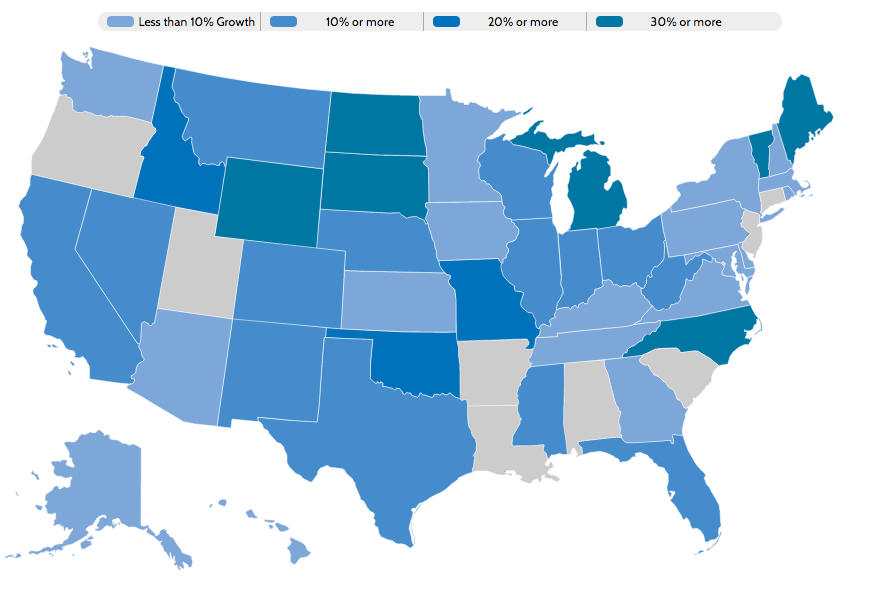
Kasia Klimasinska reports that fertility rates are creeping back up in states such as South Dakota, where the unemployment rate is just 3.8 percent:
Besides South Dakota, 18 other states, including Idaho, Kansas, North Dakota, Texas and Ohio had 2012 fertility rates higher than recession lows, according to an analysis by Daniel Schneider, a scholar in health policy research at the University of California at Berkeley. The jobless rate in those 19 states averaged 6.1 percent in August compared with a national level more than a percentage point higher. …
Economists say there’s a link between fertility and economic well-being. North Dakota, where an oil boom has helped deliver the nation’s lowest unemployment rate, is a case in point: its fertility rate rose 4.1 percentage points between 2010 and 2012, the largest recovery in the nation, according to Schneider. States that fared better during the recession, including North Dakota, had no or little fertility declines, while hardest-hit states, such as Arizona, Nevada, California, Florida, and Georgia, posted some of the biggest drops.
I’m still reeling from a screening of Errol Morris’s new documentary on Donald Rumsfeld, The Unknown Known. I’m going to try and see it one more time before I write about it. But for me, it was a bit of a breakthrough in understanding a man whose company I once enjoyed and who became responsible for such catastrophic error and evil. It’s a brilliant exposition – more impressive in my mind than The Fog Of War, Morris’s account of Robert McNamara – but so powerful and devastating a portrait I need to sit with it some more.
Meanwhile, it was D-Day for the president on the Affordable Care Act, and he responded in familiar fashion. His presser revealed the preternaturally imperturbable president explaining why he hadn’t meant to lie, why the ACA is doing far more good than harm, and why an administrative fix could temporarily help those who feel cheated by losing their plans.
I compared his mea culpa to Reagan’s over the much more serious criminal matter of Iran-Contra. I also compared Obama’s popularity drop to Reagan’s in 1987. (Reagan’s implosion was far worse). Others chimed in on his stiffing of the insurance companies, and whether it’s wise in the long run. We aired a Republican alternative to the ACA, which does not even begin to achieve what Obama hopes for.
We revisited the agony of miscarriage; the red state drug epidemic; the integrity of Lilly Allen; and the continued violent and homophobic bigotry of Alec Baldwin, liberal MSNBC’s star. What a bunch of hypocrites and phonies on that propaganda network. They’re almost as bad as GLAAD, which has finally – finally – criticized the bigot. But, of course, they haven’t called on MSNBC to fire him. Baldwin, for his part, actually tried to claim he said “fathead” instead of “fag”! And then – no, I’m not making it up – insisted that he had no idea that the word “cocksucker” had a gay connotation. For a litany of his deranged tweets, check this page.
There will be no consequences. With liberal homophobes, there never are. If you’re a conservative and are caught yelling these slurs at random people, you’d be fired pronto or buried in an avalanche of gay protest. If you’re a self-entitled liberal, you’re fine. What, I wonder, will MSNBC’s Rachel Maddow, Thomas Roberts and Jonathan Capehart say about this? Nothing, I’ll bet you.
The most popular post of the day was Obama’s Iran-Contra Moment; second up was Alec Baldwin Is A Homophobic Bigot. Or maybe I should call him a cock-sucking fag. It’s not homophobic, I swear!
See you in the morning.


Shaunacy Ferro points to a new study that shows that since 1999, “the rise in drug deaths hasn’t been evenly spread out across the country, but has gone up most dramatically in rural areas”:
In 1999, only 3 percent of U.S. counties had an annual drug death rate of more than ten people per 100,000. By 2008, 54 percent of counties did. However, the increase has been most dramatic for rural populations, which according to the CDC have some of the highest rates of prescription drug abuse and overdose. Rural counties saw higher increases in age-adjusted death rates between 1999 and 2009. As you can see, the maps show about the same death rates for rural and urban populations in 2008-2009, but most rural areas started out with significantly lower drug deaths than urban areas back in 1999.
Jason Koebler looks at the data and sees more than just a “rural” problem:
The CDC and law enforcement groups say that much of that increase has been driven by the availability of prescription opioids such oxycodone and anti-anxiety drugs. The abuse of prescription painkillers are often seen as a “rural” problem, but data broken up by county suggests that cities have almost as much to worry about.
Between 1999 and 2009, drug poisoning deaths grew by 394 percent in rural areas and 279 percent for large metropolitan areas, according to the CDC’s county-level look at the data. The highest death rates from overdoses occurred in heavily populated areas, according to the study, published Tuesday in the American Journal of Preventative Medicine.
 The Dish