A Poem For Thanksgiving

“Pigging Out” by Wanda Coleman:

–for Austin

at the restaurant we sit down to wine
we are so hungry
the crisp appetizers/early loves
and lightly seasoned salad
we’ve developed appetites for the garlic & onion of life
gorging on a main course of dissatisfaction
over frustrated creativity in
economic plight
he chews over his brooklyn childhood
i pick at the tedium of youthful watts summers

we eat away the lousy jobs stunting our talent
we eat away the hot smog-filled day
we eat away the war in the headlines
we eat away the threat of nuclear holocaust
we eat away love-threatening pressures
we eat away the human pain we see/feel/
are stymied by

[pride is such thin dessert]

we eat until our smiles return
until fat and happy

(From Imagoes © 1983 by Wanda Coleman. Reprinted by kind permission of Black Sparrow Books and David R. Godine, Publisher.)

Happy Thanksgivukkah

Thanksgiving and the first day of Hanukkah overlap this year:

Back in 1888—the only other time Hanukkah and Thanksgiving converged—the weekly Jewish American newspaper, The American Hebrew, “encouraged readers to enthusiastically embrace both holidays, because Hanukkah is itself a holiday of Thanksgiving,” says Dianne Ashton, author of the recently published book, Hanukkah in America: A History. The message was, “when it’s Thanksgiving, you can completely join in with American society” to celebrate this ecumenical holiday, she says. “But not with Christmas, because it is a Christian holiday.”

Ultimately, “Thanksgiving is a civic holiday with spiritual overtones,” says Rabbi Julie Schonfeld, executive vice president of the Rabbinical Assembly, the international association of Conservative rabbis. Regardless of your religion or lack of faith, the holiday “speaks to gratitude, to forces greater than ourselves, and calls upon us to help others,” she points out.

Allison Benedikt is not a fan:

Because my favorite thing about Thanksgiving is that it’s secular.

I know, I know, we’re supposed to be giving thanks to “our beneficent Father who dwelleth in the Heavens,” as Abe Lincoln’s 1863 proclamation establishing the holiday put it. But for most Americans, Thanksgiving is not a religious holiday. It is a food and football holiday. We eat, drink, watch parades, argue about politics, and give thanks. In my family, at least, the gratitude is secular—we give thanks to each other. The most common choked-up toast at the table: “I’m just so lucky to have all of you.” I don’t want my religion or anyone else’s pulling up a seat.

Some of this is because I am intermarried. I cannot tell you what a relief it is to have this one major holiday—the best one!—that isn’t in some part about what I am and my husband is not (Jewish), or what he is and I’m not (Christmas-celebrating). Given the latest survey of American Jews—58 percent of whom are intermarried—I suspect we are not alone in those feelings. Thanksgiving, for all its colonialist origin-story problems, is the one great holiday where you don’t have to explain to your kids why Mom believes this and Dad believes that. One great holiday that all of your neighbors celebrate, regardless of background.

Which brings to mind a classic passage from Philip Roth’s American Pastoral:

[I]t was never but once a year that they were brought together anyway, and that was on the neutral, dereligionized ground of Thanksgiving, when everybody gets to eat the same thing, nobody sneaking off to eat funny stuff–no kugel, no gefilte fish, no bitter herbs, just one colossal turkey for two hundred and fifty million people–one colossal turkey feeds all.  A moratorium on funny foods and funny ways and religious exclusivity, a moratorium on the three-thousand-year-old nostalgia of the Jews, a moratorium on Christ and the cross and the crucifixion for the Christians, where everyone in New Jersey and elsewhere can be more passive about their irrationalities than they are the rest of the year.  A moratorium on all the grievances and resentments, and not only for the Dwyers and the Levovs but for everyone in America who is suspicious of everyone else.  It is the American pastoral par excellence and it lasts twenty-four hours.
The Sad Fate Of The Pardoned Turkey

US-POLITICS-OBAMA-TURKEY PARDON-POPCORN

Only one turkey pardoned by the president has lived to see a second Thanksgiving:

So, what’s wrong with our political turkey class? A 2010 report for the Human Society detailed the burdens Turkey eugenics have wrought on the birds. Simply put, they are not bred for living, but for eating. “Farming interests have transformed Ben Franklin’s tree-perching ‘Bird of Courage’ into a flightless gargantua bred to grow so fast that today’s commercially raised turkeys [are on the verge of structural collapse],” [said] the report’s section on turkey obesity. The added weight causes degenerative hip failure and other joint deformities.

In fact, they are so fat, that without human intervention, the domesticated turkey would go extinct. That’s because “Turkeys have been bred for such heavy body weight that they are physically incapable of mating, necessitating artificial insemination via tube or syringe.” And like overweight humans, these obese turkeys suffer and die from heart disease. “Sudden death associated with acute heart failure and perirenal hemorrhage bleeding around the kidneys is a significant cause of mortality for rapidly growing turkey toms,” the report states.

Nikki Schwab passes along a grim update:

Cobbler, 2012’s official pardoned turkey, lived through the summer and was euthanized on Aug. 22. (The turkeys always come to Washington in pairs, and while one attends the pardoning ceremony, both get to live.) Liberty, a turkey from 2011, had the longest lifespan of the crop, living to the ripe old age of 2, before being euthanized on April 26, due to heart failure.

Alexis Madrigal zooms out:

Turkey Weight

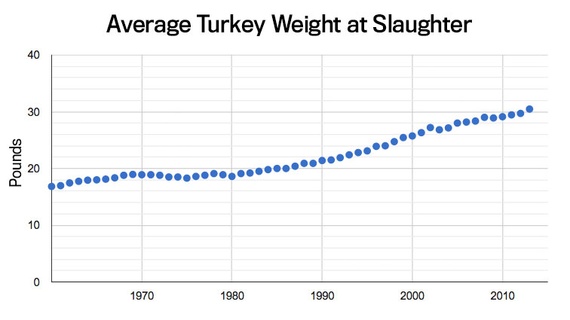
[I]n 2013, the average weight for American produced turkey crossed 30 pounds for the first time. At least based on the January to October numbers for this year, we’re talking about an average weight of 30.47 pounds. That’s a remarkable increase in average size. Go back a little further, like I did in 2008, and you see that we didn’t hit 15 pounds until the 1930s. In 1960, the average weight of a turkey was just 16.83 pounds. Even in 1985, it was only 20 pounds, and we didn’t hit 25 pounds until 1999. And we owe it all to artificial insemination. …

In 2007, poultry scientists conducted a remarkable study. They took a line of turkeys housed at Ohio State that had not been selectively bred over the last 40 years. That is to say, the turkeys had the genetics of commercial turkeys from 1966. Then they fed the old-genetics turkeys and modern breeds the same diet, one often used in 1966. The old-line turkeys reached 21 pounds. The modern turkeys grew to an average of 39 pounds, and did it quickly. A faster growing bird that converts feed more efficiently into breast meat helps drive down costs for farmers. Their DNA, transformed over decades, is doing the work.

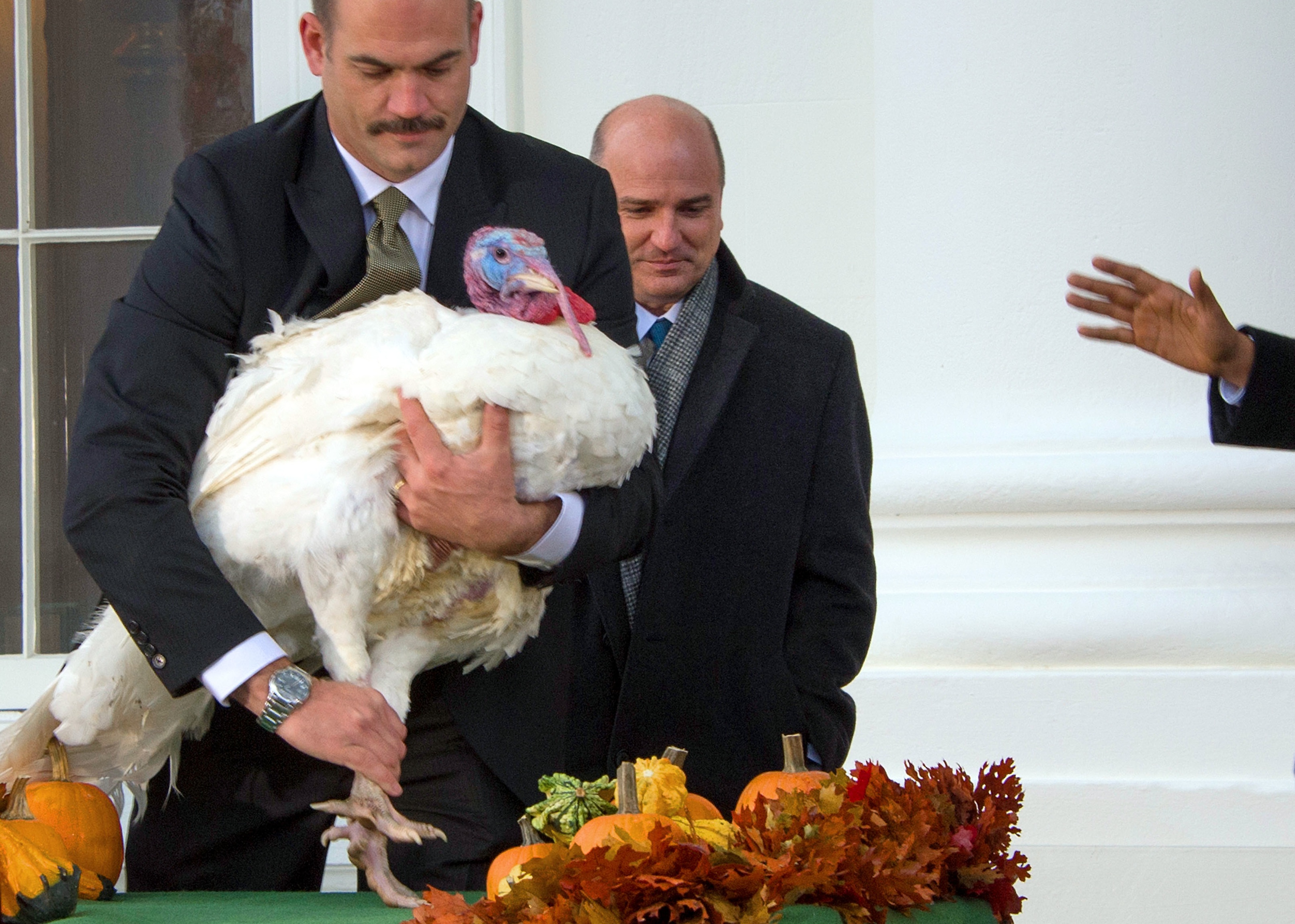
(Photo: US President Barack Obama pardons the 2013 National Thanksgiving Turkey ‘Popcorn’ with Chairman of the National Turkey Federation John Burkel (2nd L) during an event at the White House on November 27, 2013. By Jim Watson/AFP/Getty Images)

Take A Holiday From Consumerism?

Ellen Galinsky, president and co-founder of the Families and Work Institute, is against shopping on Thanksgiving Day:

As a society, we’ve agreed that most of America’s workforce should have key holidays — in this case just one day — to be with family and friends, or just to take a breather from work. Holidays are also up there with vacation days as critical to keeping employees healthy and productive, more so than ever. Our research at the Families and Work Institute shows that the nation’s workforce is more stressed than ever, increasing significantly in recent years. Nearly one-third (32%) of employees report that their work has a primarily negative impact on their lives off the job by draining energy, so they don’t have enough left over for their personal and family life. Our research also shows that those who take vacations and holidays return to work more energized and productive. That’s why so many leading employers are encouraging time off for holidays and vacations.

In a statement, Macy’s said the decision to open on Thanksgiving was “in response to interest from customers who prefer to start their shopping early.” And it’s also true that it’s what some employees want as well, especially when retailers offer to pay time and a half, or when labor agreements include provisions for premium pay. But what I want to do is encourage people to look at the bigger work-life picture. Giving up our holidays can negatively impact our well-being and our personal and family lives. Creating traditions with our children and continuing traditions with our elders can also suffer. More important, it further erodes the already faint distinction between our work and our personal lives, and it’s a trend that just may move from retail to white collar jobs. After all, 50 years ago no one would have thought that professionals would be working nights and weekends, and we all know how that turned out.

Yglesias differs:

[I]n a diverse nation with more than 300 million citizens, opinions are going to vary on the pros and cons of extended business hours. How strapped for cash are you? Where does your family live? What’s your relationship with them like? How sentimental are you about specific holiday rituals? People will differ. This Thanksgiving there are going to be people with jobs at the Gap who wish they weren’t working Thanksgiving but feel that they’d lose their jobs if they weren’t willing to take an extra shift. There are also going to be people with jobs at Radio Shack who wish they could earn some extra cash and get out from under that credit card debt. I’m not persuaded that there’s a first-order question of social justice here one way or the other.

Nick Gillespie is pro-shopping:

Those of us who are old enough to recall little-remembered and even less-loved “blue laws” can only cheer the growth in 24/7 shopping. Dating back to the colonial times and religious in origin, blue laws severely limited whether stores could open at all on certain days of the year and what sorts of goods they could offer. Growing up in 1970s New Jersey, for instance, supermarkets could sell milk, bread, cold cuts, and other “necessities” on Sundays but whole aisles were literally roped off because the Sabbath was no day for frivolous purchases (especially of the alcoholic variety). Picking up furniture or clothes would have to wait til Monday.

What Makes Us Human?

4621517777_a8f82d7426_o

Matthew Parris’s answer? “Playfulness”:

Doing pointless, purposeless things, just for fun. Doing things for the sheer devilment of it. Being silly for the sake of being silly. Larking around. Taking pleasure in activities that do not advantage us and have nothing to do with our survival. These are the highest signs of intelligence. It is when a creature, having met and surmounted all the practical needs that face him, decides to dance that we know we are in the presence of a human. It is when a creature, having successfully performed all necessary functions, starts to play the fool, just for the hell of it, that we know he is not a robot.

He recalls an vivid example from the time he and friends were looking at ancient cave art in the southeastern Sahara Desert. Amidst the usual buffaloes and gazelles, there was a series of five-dot clusters that confused them. Then a friend understood – “if he’d daubed them in paint, the fingers and thumb would have left five blobs just like the ones we had been puzzling over”:

All at once, it was clear. The bush people, lounging about after dark in their family shelter, perhaps around a fire – basically just hanging out – had been amusing themselves doing a bit of rock art. And perhaps with some leftover red paste, a few of the younger ones had had a competition to see who could jump highest and make their fingermarks highest up the overhang.

This was not even art. It called for no particular skill. It was just mucking about. And yet, for all the careful beauty of their pictures, for all the recognition of their lives from the vantage point of my life that was sparked in me by the appreciation of their artwork, it was not what was skilful that brought me closest to them. It was what was playful.

(Photo by D. Sharon Pruitt)

Should We Move Turkey Day?

“Moving Thanksgiving sounds nuts, but it’s not unprecedented,” says Steve Friess:

The first time the Pilgrims and Indians broke bread together back in 1621, they did so somewhere between Sept. 21 and Nov. 11, so we’re already way off the mark. Starting in 1863, Presidents issued annual declarations for the holiday and pegged it for the final Thursday of November, which meant it could fall even later than it does this year.

Then, in 1939, Thanksgiving was expected to fall on Nov. 30, leaving a scant 24 shopping days until Christmas Eve, and retailers begged for a reprieve amid a fragile but steady economic recovery. (Sound familiar?) FDR obliged, moving it to Nov. 23 that year and Nov. 24 in 1940. In a pre-TV era of more cumbersome communications, there was widespread confusion and pushback from some states, so Congress in 1941 officially slated Thanksgiving for the fourth Thursday of the month. The effort did produce a victory, though — the banishment of a fifth-Thursday holiday.

Brian Palmer wonders if holding Thanksgiving earlier (say, in October with Canadian Thanksgiving) would prove an economic boon:

There’s no indication that Canadians spend more on gifts because they hold their holiday parades early in the year. Despite a slightly higher per capita GDP, Canadians spend less on Christmas than people in the United States do. In 2011, for example, the average Canadian planned to spend $582.70 on Christmas gifts, compared with $646 for the average American. (The Canadian dollar was approximately even with the U.S. dollar that year.) The holiday shopping habits of the two countries are rapidly converging, though. In the last couple of years, Canadian malls, especially those near the border, have begun holding Black Friday sales and opening early on the day after U.S. Thanksgiving.

“We Are A Dark People”

David Hayden tours the literature of Ireland, from gothic fiction to Joyce, and notices “the persistent tendency of Irish writers to occupy the shadows of the mind, often pushing the English language out of shape in the process”:

Ireland’s history of colonisation, famine and flight, a collapsed revolution, a dominant church and the vitalising deformation of English by the Irish language have created conditions that occasioned writers to follow the twisting inward paths, and for the courageous, to look at the darkest of human behaviour and bring it to some form of light.

One might start in 1820 with Charles Maturin’s Melmoth the Wanderer. Within the billowing gothic excess of this madly-plotted tale of a fatal bargain with evil powers is a novel of great psychological acuity that explores the terrors of loneliness, failure and madness in ways that make it seem peculiarly contemporary. The denseness, strange colouration and wild febrility of the writing pre-figures much “experimental” writing, encompassing surrealism and modernism alongside work that doesn’t belong to any “-ism” at all. Melmoth haunts novels as different as Oscar Wilde‘s The Picture of Dorian Gray, Patrick McCabe’s brutal, sharp-etched The Butcher Boy and John Banville‘s laconic and unsettlingly funny Birchwood. Turning from the lost mind to a blighted society, William Carleton’s The Black Prophet of 1847, through a powerful melodrama of prophecy and murder, forced the gaze of its largely well-fed readers onto the terrible scenes of famine that were endemic in Ireland even before the Great Hunger. In the decade following the book’s publication the death or desperate flight of millions of people left a legacy of loss and silence that shaped the narrative landscape of Ireland.

(Video: An illustrated scene from The Pillowman, a play by Irish playwright Martin McDonagh)

Face Of The Day

Travelers Embark On Holiday Travel Day Before Thanksgiving

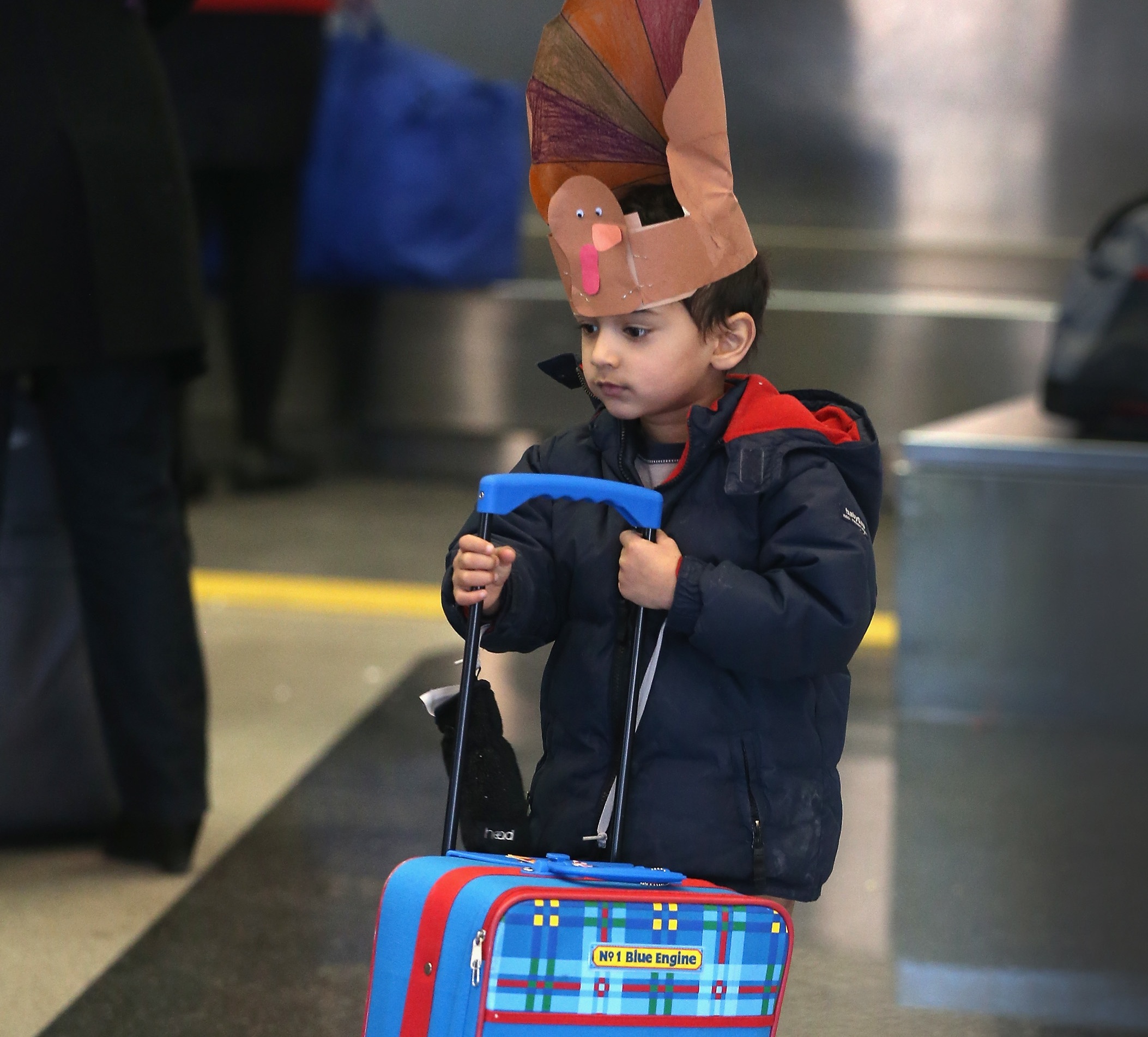
Rabi Chandra, 4, waits as his parents check in for a flight at O’Hare International Airport in Chicago, Illinois on November 27, 2013. Nearly 1.5 million travelers are expected to fly through O’Hare over an eight-day Thanksgiving holiday travel period that ends December 3, according to the city’s Department of Aviation. A wintry storm system covering much of the nation is threatening to wreak havoc on holiday travel, especially in the South and Northeast. By Scott Olson/Getty Images.

Native Americans’ European Heritage

Researchers who sequenced the genome of the 24,000-year-old remains of a boy from the Siberian village of Mal’ta were surprised to find indications of European ancestry:

The team found that DNA from the boy’s mitochondria — the energy-processing organelles of living cells — belonged to a lineage called haplogroup U, which is found in Europe and west Asia but not in east Asia, where his body was unearthed. The result was so bizarre that [palaeogeneticist Eske] Willerslev assumed that his sample had been contaminated with other genetic material, and put the project on hold for a year.

But the boy’s nuclear DNA — the bulk of his genome — told the same story. “Genetically, this individual had no east Asian resemblance but looked like Europeans and people from west Asia,” says Willerslev. “But the thing that was really mind-blowing was that there were signatures you only see in today’s Native Americans.” This signal is consistent among peoples from across the Americas, implying that it could not have come from European settlers who arrived after Christopher Columbus. Instead, it must reflect an ancient ancestry.

The Mal’ta boy’s genome showed that Native Americans can trace 14% to 38% of their ancestry back to western Eurasia, the authors conclude.