Drones In The Fog

Political scientist Frederik Rosén argues that “if military commanders have drones, then under international humanitarian law they are required to use them to the greatest possible extent” to prevent civilian casualties:

If a state possesses drone technology, and if the deployment of this technology may potentially reduce unnecessary harm from armed attacks, the state is obliged to employ the technology. This is not at all different from the obligation to pick up the binoculars before firing the shells. The obligation to use drones for precaution is logically not limited to drone attacks. It applies across all weapon systems. Even in the near future, ground attacks may no longer be lawful without engaging available drone technology for the purpose of precaution. … It is as if drone technology lifts the “fog of war” from critical aspects of the use of armed force. We therefore need to think through the application of the laws of war in armed conflicts characterized by total visibility. Because drone technology is not only a game changer, it also triggers obligations.

The Problem With Palm Oil

dish_oilpalm

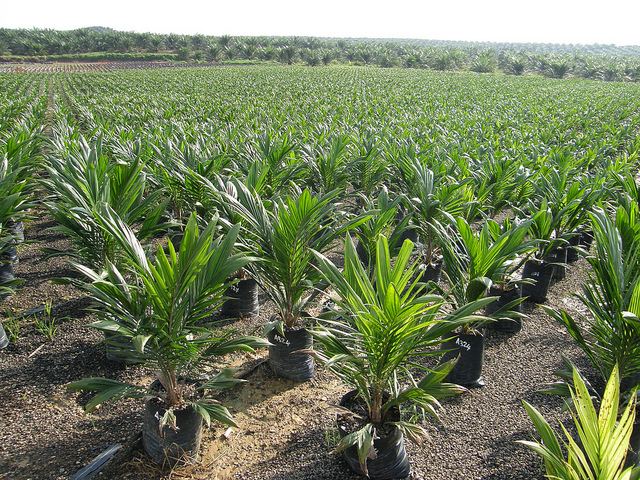
Hillary Rosner warns that “palm oil is one of the planet’s most destructive ingredients”:

It is largely responsible for the massive deforestation of Borneo. As companies slash, burn and bulldoze rain forest to plant uniform rows of oil palm trees, they’re decimating the island’s legendary biodiversity, driving up greenhouse gas emissions and destroying the livelihoods of local subsistence farmers. …

World markets are ravenous for palm oil, and demand shows no sign of waning.

Production doubled in the 2000s and is expected to double again by the end of this decade. In Asia, it’s used for cooking; in Europe, it’s feedstock for biofuel (a particularly egregious example of bad policy-making). In the U.S., it’s an ingredient not just in foods and health and beauty products, but in the ingredients that make up those products — vitamin A palmitate, sodium laurel sulfate, stearic acid. That means palm oil is often absent from the label, leaving consumers in the dark about what they’re actually buying and its impact. …

Today, most consumers remain unaware either that they’re eating palm oil or that there’s anything wrong with it. A recent campaign by talk show host Dr. Oz even encouraged consumers to buy more palm oil, touting its health benefits. Palm oil may be the ultimate icon of globalization — an ingredient directly responsible for some of the world’s most pressing environmental problems that has nonetheless permeated our lives so stealthily we barely noticed.

(Photo of oil palm nursery in Borneo by Flickr user DrLianPinKoh)

Prose In Prison

Andrea Jones provides a collection of interviews and letters from inmates who discovered writing skills once imprisoned.  Here is Seth Ferranti from Forrest City, Arkansas:

I started my sentence in 1993, and was into all types of things—drugs, violence, more crime—all while in prison. I was what they call “in the mix”: self-destructive, looking for drama, and courting chaos. Finally, around 1999, I got a clue and started to write. I took some classes on journalism and I found it was something that interested me very much: the idea of being published, the idea of people reading what I wrote and caring about what I said, the idea that I could make an impact from my prison cell with my words.  I started writing about the circumstances of my case and the injustices of the drug war in general. I then found a niche writing about prison basketball, which evolved from there into documenting prison gangs, life on the inside, hustling, and drug recovery.

When I am released, I plan on doing a documentary series about all the people and gangsters I’ve covered in my work, looking at the failed war on drugs and unnecessary incarceration rates. I plan on being involved in any hearings that take place on the state of incarceration and draconian sentencing in America, and hope that I can shed some light on what’s wrong with our system of justice so that legislators can enact change so others don’t have to endure what I have. I have been buried in prison for twenty years  and am resolute that my voice will be heard and changes will be made.

Previous Dish on prison writing here.

The Best Of The Dish Today

This embed is invalid

Visit NBCNews.com for breaking news, world news, and news about the economy

The president tonight did exactly the right thing. He should have done it sooner. But he did it – and it matters. He’s right to remind us how chaotic and disruptive the market was before the ACA, and right to offer a personal apology for the political obfuscation he repeated far too long. His credibility matters. He made up some ground tonight – in his usual unflappable way.

I argued today that in the long run, the current website fiasco may seem as minor in the backview mirror as it was with the Medicare D rollout. The ACA may work in the long run – both substantively and politically.

Four faves: joy in the face of a mastectomy; an argument against saying “I would argue …”; serious corporate event hathos; and dogs with balloons.

Two outrages: a drug war over-reach so grotesque it reached an innocent man’s upper colon; and a follow-up to our continuing coverage of the hideous torture of farm animals in industrial factory farming.

One essay: on the moral case for marijuana legalization.

The most popular post of the day was “Pope Francis As Saint Francis.”

More thanks for the surge in subscriptions and revenue to get us to make our annual $900K target. As I write this, we’re at $802K with two months to go. For all of you still on the fence, just ask yourselves if what we offer every day is worth $1.99 a month or $19.99 a year to you. If it is, help us out and subscribe. And make the house ads – and these posts asking for subs – go away. Or if you’ve already subscribed, you can give the gift of the Dish to someone you care about.

Thanks again, and see you in the morning. One more update from a new subscriber:

Multiple times a day reader since 2003, so I figured after 10 years it’s finally time to fork over a 20 spot. Keep up the good work, Andrew and company; you’re fighting the good fight and ensuring those within your ecosystem are aware of what’s important, daily.

Quote For The Day

“I have never seen an expression as full of wonder as Lou’s as he died. His hands were doing the water-flowing 21-form of tai chi. His eyes were wide open. I was holding in my arms the person I loved the most in the world, and talking to him as he died. His heart stopped. He wasn’t afraid. I had gotten to walk with him to the end of the world. Life – so beautiful, painful and dazzling – does not get better than that.

And death? I believe that the purpose of death is the release of love,” – Laurie Anderson, on her marriage to Lou Reed.

A Dangerous Mission

Christian evangelists are flocking to a special investment zone in North Korea:

For nearly two years, Kenneth Bae, an undercover missionary from Lynnwood, Wash., safely shuttled groups of Christians in and out of North Korea’s Rason Special Economic Zone. In November 2012, Bae’s crusade ended abruptly. The owner of Nations Tour, a China-based front company he formed as a cover to evangelize in the world’s last Stalinist state, Bae was arrested by North Korean agents as he passed through the Wonjong border crossing with a small group of European travelers. The 44-year-old Korean-American was charged with possession of “anti-DPRK literature,” convicted of encouraging foreigners to  “perpetrate hostile acts to bring down [the] government,” and sentenced to 15 years hard labor.

It is relatively rare that North Korea arrests a foreign national, even rarer when one considers that a company like Nations Tour is hardly unique.

The so-called “Business as Mission” movement, which instructs devout Christians to set up companies as vehicles for spiritual outreach, dates back to the 18th century but found new life at the beginning of the 21st. It’s a missionary model that, by definition, assumes a certain amount of risk for those setting out to reach the “unreached.”

But the risks haven’t dissuaded the faithful from taking up the cause. Today, there is an extensive, well-financed network of for-profit missions, using shadowy front companies to evangelize in North Korea. Though precise numbers are impossible to pin down, missionary-businesspeople have set up a staggering breadth of enterprises, including tour agencies, bakeries, factories, farms, even schools and orphanages, all in the name of spreading the Good Word.

Justin Rohrlich and Chad O’Carroll describe the 300-square-mile Rason Special Economic Zone as “ground zero for these modern apostles”:

Generations of central planning and Soviet-style inefficiencies have left North Korea in dire need of food, fuel, and just about everything else. The nation’s largest trading partner is neighboring China, from whom it buys much and sells little. With no rational person likely to accept Pyongyang’s terms for foreign direct investment, Kim Jong-un’s regime has few options. “The only people willing to do business in North Korea are ones who don’t really care if they make money or not, ones that have other reasons for being there,” says economist and investment strategist Patrick Chovanec, who has visited and analyzed North Korea extensively.

Consuming America’s Scraps

Adam Minter, in an excerpt from his book Junkyard Planet, covers China’s hunger for American scrap metal:

No surprise, China leads the world in the consumption of steel, copper, aluminum, lead, stainless steel, gold, silver, palladium, zinc, platinum, rare earth compounds, and pretty much anything else labeled “metal.” But China is desperately short of metal resources of its own. For example, in 2012 China produced 5.6 million tons of copper, of which 2.75 million tons was made from scrap. Of that scrap copper, 70 percent was imported, with most coming from the United States. In other words, just under half of China’s copper supply is imported as scrap metal. That’s not a trivial matter: Copper, more than any other metal, is essential to modern life. It is the means by which we transmit power and information.

So what would happen if that supply of copper were cut off ? What if Europe and the United States decided to embargo all recycling to China, India, and other developing countries? What if, instead of importing scrap paper, plastic, and metal, China had to find it somewhere else? Some Chinese industries would substitute other metals for the ones that it couldn’t obtain via recycling—that’s technically doable in many cases—but for some applications (like the copper used in sensitive electronics) substitutions are not possible. That leaves mining. To make up the loss of imported scrap metal, there’d need to be a lot of holes in the ground: even the best copper ore deposits require one hundred tons of ore to obtain one ton of the red metal. What would the environmental cost of all that digging be? Would it exceed the environmental cost of recycling the developed world’s throwaways? What’s worse?

Face Of The Day

Twitter Goes Public On The New York Stock Exchange

Twitter CEO Dick Costolo adjusts his tie while waiting to see what Twitter’s opening market price will be on the floor of the New York Stock Exchange (NYSE) on November 7, 2013. Twitter went public today, selling at a market price of $45.10, with the initial price being set at $26 on November 6. The IPO drove the seven-year-old company’s value to $25 billion. By Andrew Burton/Getty Images.

Shares of Dish were also strong today:

Screen Shot 2013-11-07 at 5.41.04 PM

Today we hit the $800K mark, with just under two months to reach our $900K goal. Subscribe [tinypass_offer text=”here”] to help us get there. If you’re already a subscriber, you can always buy a gift subscription to help spread the Dish. One of the roughly 200 new subscribers today writes:

This site has been a part of my daily routine for the last few years. Perhaps not my entire outfit, but a clean pair of socks at least. I had been meaning to subscribe before today, to show some appreciation for the amount of labor and love that goes into the creation of such a compelling site. I have felt a certain amount of guilt for not doing so, and from what I know about guilt, it has a way of persisting, eventually becoming its own obstacle. Of course, this guilt does not help anyone get paid, and the feeling lingers like so many neglected well-intentions do. So, I set up my annual subscription, and the dissonance in my mind subsided a bit.

Beyond this, however, I wanted you and the rest of the team to know that I deeply appreciate the mission of the Dish, and I hope to see this sort of business model thrive for scores of years to come.

Auden’s Approach To Nature

Robert Archambeau explores it:

When the wind, in an Auden poem, says “come,” we are not getting a representation of nature as something different from ourselves: we are getting a glimpse of human temptation and desire. When the water in “Streams” comes across as playful, we are not being told about the quality of nature so much as about certain human moods and capacities—Auden’s personification of water is much closer to a Greek naiad than to the streams above Wordsworth’s ruined abbey. When Auden gives us a landscape, he is less interested in it as a place or an ecosystem or as a physical reality—like Schiller’s Greeks, he rushes past its otherness and uses it as a way of describing human psychological states. …

The critic G.S. Fraser once remarked that Auden, unlike many of his contemporaries, was always interested in the moral rather than the sensuous element in his images, writing,

“Lay your sleeping head, my love, / Human on my faithless arm” where most poets would have written something more like, “Lay your golden head, my love / Heavy on my cradling arm.” There is truth in this—Auden’s is a world of psychology and morality rather than of creaturely sentimentality. And, despite his love of a particular kind of landscape, full of disused mines and scarred limestone cliffs, he is never a particularly visual poet, preferring to allegorize, personify, and psychologize where a more usual sort of modern poet would concentrate on physical detail and specificity. Even “In Praise of Limestone,” a poem whose title seems to promise an evocation of a specific natural landscape and its otherness, quickly turns back to the human: “examine this region / Of short distances and definite places,” he writes,
“What could be more like Mother?” You see the pattern: Auden turns to nature to find something specific to the human psychological drama.

Previous Dish on Auden here, here, and here.

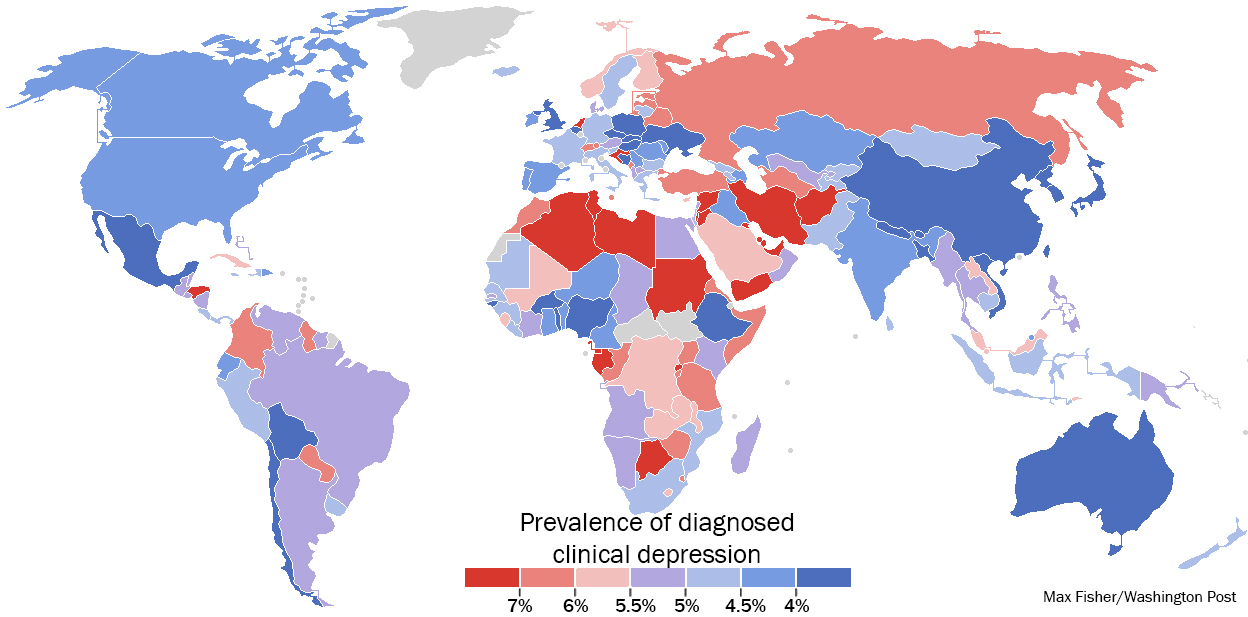
Depression Around The Globe

Global Depression

Caitlin Dewey maps the results of a new study:

Globally, they found, depression is the second-leading cause of disability, with slightly more than 4 percent of the world’s population diagnosed with it. The map at the top of this page shows how much of the population in each country has received a diagnosis of clinical depression.

Of course, researchers didn’t go out and test everyone for clinical depression; rather, they used preexisting data. That means we’re not looking at rates of clinical depression, exactly, so much as the rate at which people are diagnosed with clinical depression. People who live in countries with greater awareness of and easier access to mental health services, then, are naturally going to be diagnosed at a higher rate. That may help explain the unusually low rate in Iraq, for example, where public health services are poor.

Taboos against mental health disorders may also drive down diagnosis rates, for example in East Asia, artificially lowering the study’s measure of clinical depression’s prevalence in that region. The paper further cautions that reliable depression surveys don’t even exist for some low-income countries — a common issue with global studies — forcing the researchers to come up with their own estimates based on statistical regression models.