What Are Christie’s Chances In 2016?

New Jersey Governor Chris Christie Holds Election Night Party

Ambers weighs in on the question:

Chris Christie can win the presidency if he can win his party’s nomination. Forget the exit poll question showing that voters in New Jersey would have chosen Hillary Clinton over Christie for president. Christie would have done well enough in that scenario to win the presidency nationally. Can we meaningfully extrapolate? Well, sure. Is the 2016 Democratic nominee likely to win with the same “coalition of the ascendant” that drove Barack Obama’s engines? Probably not. But if the Republican nominee does better with Hispanics in the Intermountain West, slightly better with minorities and women in North Carolina and Virginia (or changes the composition of the electorate to include more white men), and turns out a higher proportion of Reagan Democrats in Wisconsin, Ohio, and Florida, then he can win. (The electorate in Pennsylvania is very much a testing ground.)

But Chait believes that shepherding Christie “through a competitive Republican primary will be vastly more difficult than anybody seems to be figuring at the moment”:

His ideological deviations are not fake. They’re real. Christie has openly endorsed gun control, called for a path to citizenship for illegal immigrants, and conceded the legitimacy of climate science (“But when you have over 90 percent of the world’s scientists who have studied this stating that climate change is occurring and that humans play a contributing role it’s time to defer to the experts.”)

The largest, and least appreciated, of Christie’s betrayals of party doctrine is his decision to participate in the expansion of Medicaid under Obamacare. Some other Republican governors have made the same decision, but they have all faced unrelenting and bitter opposition from legislators of their party and conservative activists. Unyielding hatred to every aspect of Obamacare, regardless of its practical impact, has become the main doctrinal tenet of conservative thought. That alone could potentially disqualify him.

Sides pushes back:

Chris Christie’s victory helps make him a more viable Republican presidential candidate.  Period.

Yes, he will face challenges if he chooses to run.  But there is no question that winning reelection so handily helps his cause, relative to a narrower victory.  And this should concern Democrats. There is some evidence that moderate candidates do better in presidential elections — and anything that makes it more likely that the GOP nominates someone like Christie as opposed to someone like Ted Cruz isn’t good for Democrats.  In short, last night made it more, not less, likely that Christie could be the nominee.  And, relative to someone like Cruz, having Christie as the nominee makes it more likely that the GOP can retake the White House in 2016.

Kornacki talks up Christie:

[T]here’s his trump card: Personality. Many people loath Christie, but plenty appreciate his swagger, especially in the Republican universe. The risk of Christie as a national candidate is that he’ll lose his temper at the wrong time, in the wrong way – an ugly explosion that becomes his identity and sinks his campaign. The flip side, though, is that he’s good at this game. He’s the rare politician who can talk to a room of people who disagree with them and win them over. They warm up to him, they laugh at his jokes, start to like him – then, without even realizing it, they’re working backward in their minds to tell themselves why, come to think of it, it actually wouldn’t be crazy to support him. I’ve seen him do this in rooms of skeptical Democrats. I’ve seen him do this in rooms of skeptical conservatives. And I can absolutely see him doing it in a room of skeptical Iowa Republicans two years from now.

Josh Marshall downplays Christie’s chances:

The ‘different kind of conservative’ who runs at least in part against his own party’s crazies on Capitol Hill after a big reelection victory is what took George W. Bush to the White House. But Bush had Texas, evangelical Christianity and the ambiguously powerful cachet of the Bush family name to make the whole thing work. On a national level he was running in part against DC conservatism. But the party’s base, for many reasons, always knew that he was one of them on tax policy, hot-button social issues and national security. That’s not the case for Christie. He’s a quintessential Northeasterner with a coarse version of the region’s regional edge in a party dominated by the South. I just don’t see that happening.

Lowry differs:

Christie is going to position himself as the outsider, the bipartisan uniter, the reformer, and the doer. All of these are naturals for a Republican winning reelection in a blue state and for a successful governor at a time of discontent with Washington — and potentially quite powerful. Let the race for New Hampshire begin.

(Photo: New Jersey Governor Chris Christie arrives to speak at his election night event after winning a second term at the Asbury Park Convention Hall on November 05, 2013 in Asbury Park, New Jersey. Incumbent Governor Chris Christie defeated his Democratic opponent Barbara Buono by a commanding margin. By Kena Betancur/Getty Images)

Finally, Accountability

A Dish reader who knows about these things wrote recently:

Is Sebelius culpable? I really don’t think so. This really is squarely in the hands of the CIO at CMS (and everyone downstream to the project manager).

Another reader got more specific:

Tony Trenkle is the Chief Information Officer (CIO) and the Director of the Office of Information Services (OIS) in the Centers for Medicare and Medicaid Services (CMS).

Today:

The chief information officer at the Centers for Medicare and Medicaid Services, whose office supervised creation of the troubled federal website for health insurance, is retiring, the Obama administration said Wednesday. The official, Tony Trenkle, will step down on Nov. 15 “to take a position in the private sector,” said an email message circulated among agency employees.

We all know Dish readers are among the smartest on the web. Even so, they sometimes take my breath away.

Stop Digging, Mr President

US-POLITICS-OBAMA-LGBT

Yesterday’s attempt by the president to try and argue that he didn’t give a blanket, sweeping promise that no one would have to change their insurance plan or doctor under the ACA was not the Obama I know. It was the kind of parsing that Bill Clinton would have tried. Here’s the money quote:

“Now, if you have or had one of these plans before the Affordable Care Act came into law and you really liked that plan, what we said was you can keep it if it hasn’t changed since the law passed.”

Oy. Look: I love this president, regard him as the sanest man in Washington, think his two terms still have the potential to be transformative, believe his foreign policy has been cool-eyed and under-appreciated, and know that he helped preside over a civil rights revolution not seen in decades. But he over-sold his well-intentioned, moderate plan for universal health insurance. He made a decision in a polarized climate to over-simplify to the point of near-deception. I don’t think it’s outright deception because the plan does indeed mean that large numbers of people will not be forced to switch plans so much as upgrade some. But he still said something that was untrue and he underlined it with a “period”, meaning there were no caveats.

It’s not an Iran-Contra or Iraq WMD or Lewinsky lie. But it’s a serious one. And he should stop trying to finesse it. The best advice for him was given by Chris Christie, believe it or not. To wit:

“Here’s what my advice would be to him — don’t be so cute. And, when you make a mistake, admit it. If he was mistaken in 2009 an 2010 on his understanding of how the law would operate, then just admit it to people. ‘You know what? I said it and I was wrong. I’m sorry, and we’re gonna try to fix this and make it better.’ I think people would give any leader in that circumstance a lot of credit for just owning up to it. Instead of now trying — don’t try to lawyer it. People don’t like lawyers. I’m a lawyer – they don’t like them. When I saw that this morning, I saw that for the first time, and I thought, ‘he’s lawyering it. That’s Barack Obama the lawyer.’”

Bring back Barack Obama, the truth-teller. I understand why he feels beleaguered right now, but this too will pass. The core of the law will help millions without insurance and reassure millions more who have it. Hang in – but be as candid as you possibly can. Get out of the defensive crouch and into the game. Everything is still to play for.

(Photo: Saul Loeb/AFP/Getty.)

Bridging The Gap

A reader writes:

My husband and I live in Houma, Louisiana, which is 60 southwest of New Orleans. Houma is staunch Republican territory. People have asked how we can live in such a very red state and in such a very red community. My reply is always, “Because of the people. I love them.”

I moved here when I was a teenager in junior high school back in 1977.  As a former Navy brat who grew up moving from state to state, moving to Cajun country was like moving to a foreign outpost. I’ve been enchanted ever since. I’ve lived here off and on for over 26 years. The times I’ve been away were when I was in the Army and when I attended seminary and was a Southern Baptist minister. I’ve always been drawn back and returned 16 years ago. I came out over ten years ago, divorced, and eventually remarried three years ago. This time I got it right.

How does an openly gay married couple survive in this bastion of conservatism?

Actually, it’s been easy. What we have determined is that as people get to know us, they discover that we’re very much like them. We love our families as much as they love theirs. We love our kids (my daughters from a previous marriage) as much as they love theirs. We love spending time with our granddaughter. We have an excellent friendship with my ex-wife and her husband (who I refer to as my step-husband). In fact, as strange as it may seem for some, our families get together for holidays and vacations.

My husband and I love attending football games in Death Valley and watching our beloved LSU Tigers play.  We were on Canal Street in New Orleans celebrating with the record crowd when the New Orleans Saints won the Super Bowl and had their victory parade. We know first-hand the impact that had not only on New Orleans, but on our region after Hurricane Katrina.

As an Army veteran, I’ve never had anybody question my loyalty to our country. As a public servant in our community and somebody involved in numerous nonprofit organizations, I’ve never had anybody question my love and loyalty to our community. As a former Southern Baptist minister, I’ve never been directly questioned about my faith, although I’ve been compelled to write numerous letters to the editor of our local newspaper respectfully and thoughtfully responding to anti-gay letters, relaying my views on spiritual matters and asking serious questions of those who hold different views concerning gays.

I’ve been fortunate to live in an area that has been influenced by a number of gays who have been successful in business or in the public sector. They stepped up to the plate long before I came out and made my transition as an out gay man much easier.

I think that’s the key not only in the South, but everywhere. As more gays come out and more people cannot help but be around gays, people discover that we’re not the ogres the Christian “Right” has portrayed. Yes, it takes longer down here and, yes, it can be frustrating when seeing how other areas of the country and other states have become more “gay friendly.” Yet, our roots are here and they run deep. It is home and I see it changing for the better. I know hope because I see changing perspectives in those I know and those I meet and get to know.  One person at a time. How else can you change a community? How else can you change a state? We’ve chosen to be a part of change.

Another reader:

I’m responding to this request from you:

If readers have their own stories to tell – not family but friend stories – we’d love to hear from you about bridging the gap. That goes for Republicans engaging Democrats as well, of course.

We live on the central coast of California, out in the country, on a private road with seven other homes.  When one of our neighbor families moved in about eight years ago, we were determined to welcome them, as we’d had a lot of problems with their predecessors, and wanted to ensure that we got off to a fresh and good start with this family, whom I’ll refer to as the Ds.

We liked them immediately. They’re younger than us by fifteen or so years, and at that time had a baby son.  The Ds had met and married in DC, where he had worked all his professional life for the government (including time in the Clinton White House), and she had worked at a couple of jobs, speaking bureaus, NGOs, and the like.  They are both bright, well-traveled, and he currently works for the government and travels a great deal for the Department of Defense (non-military).  She’s a stay-at-home mom with two children and has her own consulting marketing company, working from home.

At first we thought they were sort of like us: fairly sophisticated, politically interested, socially liberal, me a little more liberal, my husband a little more fiscally conservative, lapsed Episcopalians, and, as is commonly used these days, “spiritual, but not religious.”  But as we soon found out, they are Christians with a capital C. Upon moving here, they joined the local mega church (a former Baptist church that changed its name, I suspect, to attract more members since we live in a pretty liberal area).  We found this out when the local newspaper profiled them on the 10th anniversary of 9/11 – he had been at the Pentagon when it was struck, and described himself as having survived “by being in the arms of God.”  At first, when we read this, we were dumbfounded.  This was a neighbor of ours?  How could we possibly continue to be their friends?  How could he believe he had some special relationship with God, that ensured survival of 9/11, but not all the others who perished that day?  How could such an intelligent person (with a Stanford degree, no less) utter something so simplistic?

But we continued to see them, because they are utterly decent human beings.  We see them often, having dinner at each other’s homes, sharing wine and recipes, thoughts on the world, on DC, and laughing at just about everything, including our local politics.  Over the years, they have become increasingly disillusioned with the Republican Party because it is so mean.  But back in 2008, and again in 2012, they voted against Obama.  Again, it dumbfounds us.  But we continue to see them.  We’ve talked about everything we do not agree on, and it has been a real lesson for us, and for our two adult sons, both of whom are pretty cynical and don’t even pretend to have any religious affiliation.  But they love the Ds as do we.  I never would have thought I would have such close friends with whom I have such profound differences.  I think too it’s been an eye-opener for them, to have so many of their deep beliefs challenged.

A good example of this is a discussion we had about the age of the earth.  When challenged with the fact of carbon dating, Mrs. D. finally sort of threw up her hands, and said, “Well, I’m no scientist.”  So this I guess is an example of faith trumping reality, but still difficult to understand from our perspective.

Sometimes after a little too much wine, when the hour is late, we’ve come close to getting a little too personal, but we’ve never crossed the line, I think, because we all value our friendship so much.  In short, there’s more that holds us together than separates us.  But it has been a real education in “bridging the gap.”

Map Of The Day

dish_electoralmap1880

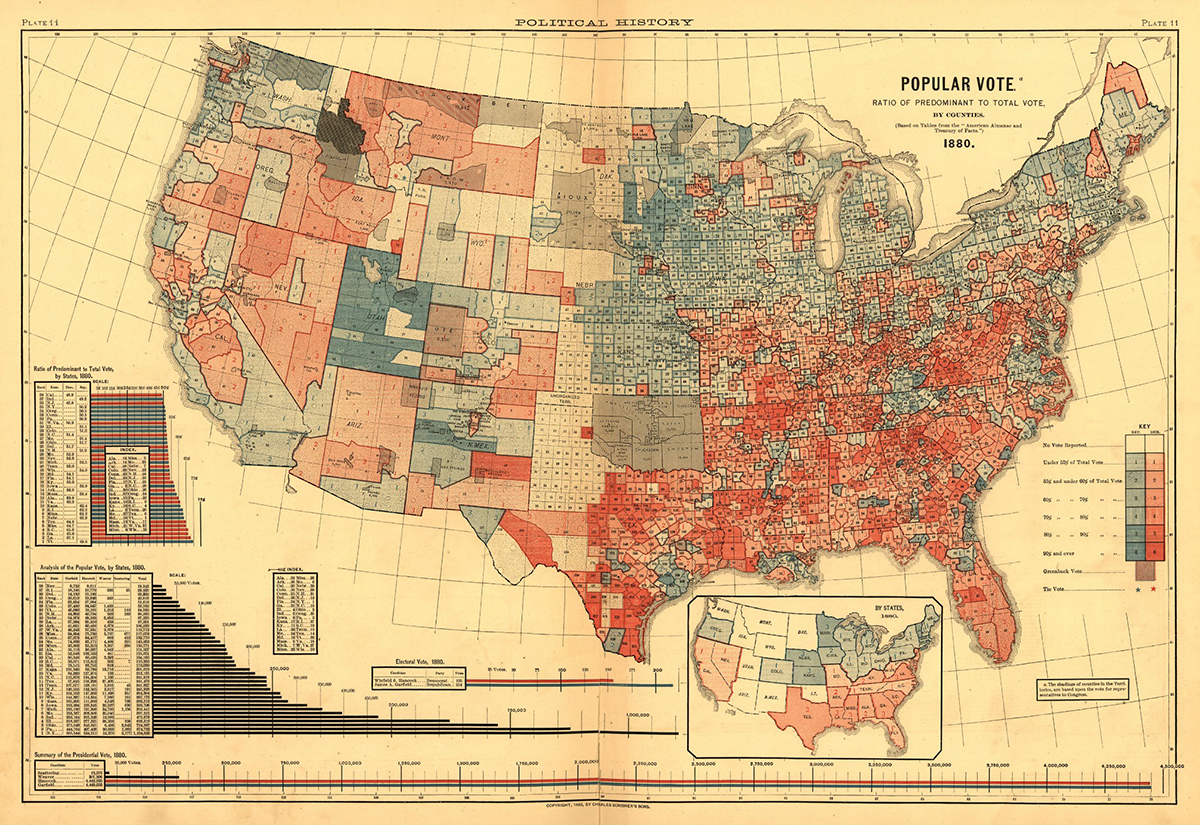
Historian Susan Schulten found this map of the 1880 election while leafing through the 1883 Statistical Atlas of the United States:

“That era was basically the last time the parties were as strong as they are now,” says Seth Masket, a political scientist at the University of Denver and colleague of Schulten’s. “We’re not talking about slavery or the aftermath of the Civil War,” he says, but “we are talking about fundamental ideological differences about what this country stands for.”

This was the era when a “solid South” emerged, although back then the parties were flipped, and white Southerners flocked to the then more conservative Democratic Party (in red on the map). The 1880 election, between Republican James Garfield and Democrat former Civil War general Winfield Scott Hancock, was remarkably close–with Garfield eking out the popular vote by the smallest of margins (48.3% vs. 48.2%). The biggest issue of the day was a debate over the tariff, which Republicans backed. More importantly, the election was viewed as a referendum on the painful process of Reconstruction.

Schulten points out why the map is remarkable. Not only did it break down results by county, which would have been cumbersome data to collect at the time, but it also shaded each county by the margin of victory–a mapping technique that imparted extra information and had not been used before. It helps us understand where the “swing” states of the Gilded Age were (Pennsylvania, Virginia), and assists observers in understanding why eastern Tennessee went “blue” (this region was loyal to the Union in the Civil War).

Could “Anti-Rape” Underwear Really Help?

This embed is invalid


AR Wear, or Anti-Rape Wear, is a crowdfunded line of undergarments designed to “frustrate an assault effectively.” Amanda Hess snarks, “The ‘AR’ stands for ‘ARe you kidding?’—no, sorry”. Jia Tolentino feels that “to some women, this product could feel tremendously welcome,” but she has reservations:

Many parts of the video for AR Wear really grind my gears … and it’s very upsetting to think of $50,000 going to a product that plays on fear, a wildly inaccurate and persistent definition of “real” rape (“This isn’t for domestic rape, or rape by people you know,” stated one of the creators. “This is for those situations when you’re on a blind date, or in unfamiliar places”), and of course the why-won’t-it-die idea that rape prevention falls on anyone except the rapist. And there are so many offensive fear-mongering ways in which I can imagine this product being deployed: an overprotective mom buying a whole set of these for her daughter who’s about to travel Amongst Foreigners, a girls’ cross-country team forced to wear these when they’re running through the “urban” part of town.

Audra Schroeder sees a dead end:

[T]hese ideas for anti-rape clothing never go anywhere, and that’s because preventing rape has nothing to do with what a woman is wearing, or not wearing, and everything to do with the rapist and a culture of victim-blaming. Are panties with thigh locks really making us safer, or is every woman’s fear simply being exploited for profit?

On that note, a reader adds to a recent thread, “The Pitfalls Of Rape Prevention”:

So it seems that Emily Yoffe has set off a firestorm of debate. There are also several points of view in a recent NYTimes “Room For Debate“. I really don’t understand the problem here.

Of course we have to educate women about the dangers of binge drinking.  When I was young, I just accepted it as something fun to do with my friends.  How is this advice equivalent to telling victims they “asked for it” by wearing a miniskirt? How you are dressed does not affect your brain’s ability to function.  (But really, as a woman, I know that what I wear sends a message, and we need to know that too, damn it!)

It’s not about “blaming the victim”; it’s about arming women with knowledge they need to protect themselves.  I only wish someone had given me this advice in middle school.  It might have saved me a lot of trouble.  And of course we should educate men about respecting women’s wishes, etc. But women can’t express their wishes or even be aware of what they want when they are wasted. Geez, it’s not that hard to figure this out.

A longer discussion thread on rape, “The Rape Double-Standard”, is here.

The Good Kind Of Working For Free

Amid the lively debate we recently aired on unpaid labor, Rebecca Huval wonders what drives volunteerism:

At the San Francisco literacy center where I work, I see more than 40 volunteers every week. They drive an hour from Intel or ride the bus from high school to read with a kid for at least 45 minutes for $0. Some are required to volunteer as part of a class, but most are there of their own free will. Why do they do it?

Don’t get me wrong, I’m not trying to go all Ayn Rand and suggest that everyone should have a selfish motive for their actions. But I do think the choice to volunteer is a curious one, and that a mix of intentions drive otherwise practical people to work for free. For one thing, our digital lives rarely give us the chance to talk one-on-one, face-to-face with a human – let alone a moldable, eager child – and build a relationship from scratch. For another, savvy professionals know that volunteering looks good, especially in these lean times. Volunteers are 27 percent likelier to find a job after being unemployed than those who simply plop in front of job websites, according to the Corporation for National and Community Service.

Secret Agent Ma’am

5416825098_9b6a279270_b

Tasneem Raja revisits the early days of women in the CIA:

A few years ago, four veteran CIA officers, with more than a 100 years of collective experience over four decades, were asked to speak frankly about serving in the agency as women. The taped conversations, used for internal review by the CIA, reveal encounters with male attitudes from the officers’ early years that aren’t surprising—it was indeed a Mad Men world, albeit with security clearances. The transcripts, part of a trove of recently declassified CIA documents, also contain wry, Peggy Olson-esque recollections in which being a woman proved an asset—and hardly in the “femme fatale” vein of intelligence gathering.

Carla, who joined the agency in 1965 and was Deputy Chief of the Africa Division by the time she retired in 2004, recalled a time when male higher-ups in the agency warned that women would be ineffective for recruiting agents and gathering intel abroad. She recounted a successful assignment debunking that notion:

I never actually had to pitch the guy. I [played] sort of the “Dumb Dora” personality, and “Golly” “Gee!” and “Wow!” He would tell me, “I just love talking to you because you’re not very bright.” And I would just sit like this [makes an innocent expression]. The recruitment ended because he told me about a plot to go bomb the embassy in [redacted] and we arrested him and his gang of merry men as they crossed the border. He just told me everything and I got tons of intel out of him because I was just a woman who wasn’t very bright.

An internal survey from 1953 dubbed “The Petticoat Panel” shows that while women accounted for 40 percent of the agency’s employees at the time—better than the overall US workforce then, which was 30 percent female—only one-fifth of those women were above the midlevel GS-7 on the government’s salary grade, which went to GS-18. Meanwhile, 70 percent of men in the CIA were higher than G-7, and 10 percent topped GS-14, a grade no women had reached at the time. …

Yet, while men made up the lion’s share of highly paid roles in the agency, women accounted for 60 percent of the agency’s jobs in statistical analysis. Linda McCarthy, a CIA historian and former agency analyst, says that’s unsurprising: “During World War II, when it came to numbers, the war department went after women,” she told Mother Jones. “Same with maps and codework: They specifically wanted to find women for that kind of work. They were simply better at it.” McCarthy said the prevailing notion in the agency at the time ascribed women’s aptitude for stats, geography, and code breaking to maternal instinct. “They figured, you have to be patient to raise children, and you have to be patient to make maps by hand, so it must all be connected.”

For more on this subject, a reader recommends Sisterhood of Spies: The Women of the OSS, a book about a World War II intelligence agency called the Office of Strategic Services.

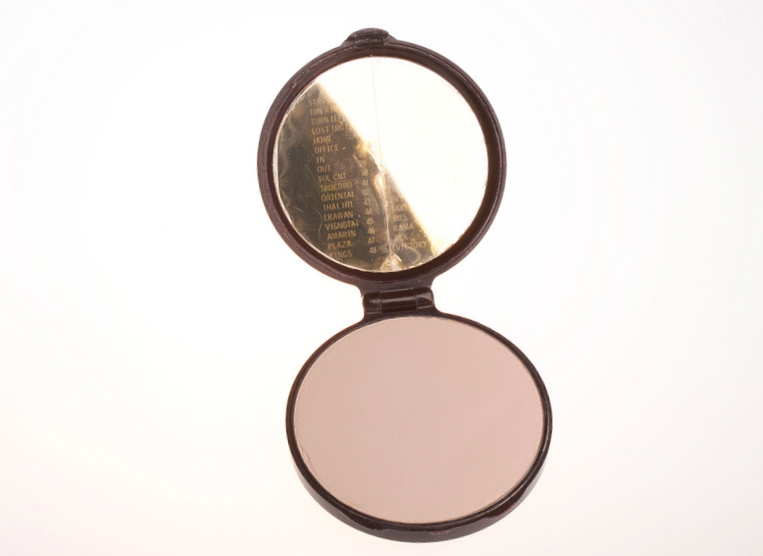
(This CIA device, designed to look like a makeup contact, features a code that’s revealed by tilting the mirror at the correct angle. Photo: The Central Intelligence Agency)

When Luxury Goods Are Necessities, Ctd

A reader provides some key conservative pushback:

The article you highlighted on luxury items being necessities may have been the most preposterous thing I have ever read on your blog. First off, the author appears to take aim at what is mostly a strawman: I don’t think anyone really begrudges poor people for buying a nice set of clothes and accessories for wearing to job interviews and other special occasions. That’s good sense and isn’t really the issue. The real problem is expenditures on items such as expensive rims or speaker systems for one’s car, buying designer parkas and jackets for casual wear (HellyHansen seems to be popular around the public housing near my house) or ridiculous tattoos that, rather than projecting an image of class and sophistication, actually do the opposite.

Also consider that, if buying luxury items is such a great strategy for getting ahead, shouldn’t groups who embrace such strategies be doing best while other poor people who engage in less conspicuous consumption and carefully save their money be performing worse? Does this comport with anyone’s actual experience?

The much more likely truth is that many poor people spend money on luxury goods not as part of a strategy to escape their plight, but as part of a misguided competition with their friends, neighbors and others in their social circle to project a false sense of prosperity. In short, it’s about status. The first step to correcting this behavior is to stop making excuses for it.

The Separation Of Haves And Have Nots

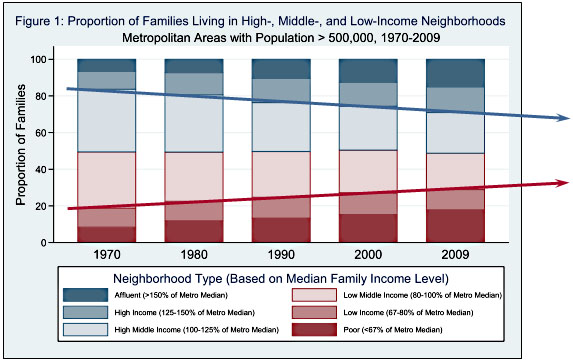
A recent study (pdf) finds that segregation by income is growing:

Neighborhood Types

Drum comments:

This is yet another sign of the collapse of the American middle class, and it’s a bad omen for the American political system. We increasingly lack a shared culture or shared experiences, and that makes democracy a tough act to pull off. The well-off have less and less interaction with the poor outside of the market economy, and less and less empathy for how they live their lives. For too many of us, the “general welfare” these days is just an academic abstraction, not a lived experience.

Mark R. Rank’s findings complicate Drum’s argument:

Put simply, poverty is a mainstream event experienced by a majority of Americans. For most of us, the question is not whether we will experience poverty, but when.

But while poverty strikes a majority of the population, the average time most people spend in poverty is relatively short. The standard image of the poor has been that of an entrenched underclass, impoverished for years at a time. While this captures a small and important slice of poverty, it is also a highly misleading picture of its more widespread and dynamic nature. The typical pattern is for an individual to experience poverty for a year or two, get above the poverty line for an extended period of time, and then perhaps encounter another spell at some later point. …

Just as poverty is widely dispersed with respect to time, it is also widely dispersed with respect to place. Only approximately 10 percent of those in poverty live in extremely poor urban neighborhoods. Households in poverty can be found throughout a variety of urban and suburban landscapes, as well as in small towns and communities across rural America. This dispersion of poverty has been increasing over the past 20 years, particularly within suburban areas.