A Pope Even Protestants Can Love

Reflecting on the way a number of evangelical heavyweights have praised Pope Francis, the Catholic commentator Raymond Arroyo explains the reasons behind the ecumenical admiration:

One is the great warmth, affection and magnetism of this man—Francis—and his willingness to allow the gospel to shape his ministry in a very profound and visual way. Additionally, the pressures of the culture we find ourselves in has, in a way, forced Catholics and Protestants together in a new way, where they realize that what divides them is far less than what unites them. … And when you hear a Pope stand up and talk about mercy, and forgiveness, and the broken hearts we all endure, and the need to push gossip aside and how destructive that can be in our lives, he’s getting down to the very granule level of faith that I think is appealing to the evangelical and Protestant mind.

The thing that has always impressed me about my evangelical friends—my in-laws are evangelicals, by the way—is their deep concern for the people in the pews next to them. And their willingness to go out of their own comfort zones to help those in their own community. And if the mainline churches and Catholicism have a problem, it’s that at times we can get very isolated. And though we check the boxes, we’re going to mass, we’re living our lives and we’re trying to be good people, extending that into our everyday lives can be a problem. Francis is calling people to allow that message to go deeper and to have personal reverberations in their own lives. I think that’s what they’re finding most appealing.

It’s also a very simple message. It’s a very blunt gospel, in some ways, which startles some people in the Catholic church. They go, “Wait a minute. What happened to the high theology? Where’s the graduate level exegesis here?” Francis isn’t that. I would argue that he’s boiling down the last two papacies with their the great messages and the intellectual heights that were scaled into a digestible message that the masses can absorb. And when I say “masses” I mean 99% of the people in the pews, whether they be Catholic or evangelical.

A Poem For Sunday

dickinson2

A second selection from Emily Dickinson’s newly published “scraps” and fragments:

Oh sumptuous

moment

slower   go

that I

till

may gloat    on

thee—

‘Twill    never

be   the   same

that

Now           I abundance

since

see—

Which    was   to

famish     then or

now—

the    difference

of Day

to

Ask      him

Unto   the Gallows

led–      called

With    morning

By

in    the sky

(From The Gorgeous Nothings by Emily Dickinson © 2013 by Christine Burgin and New Directions. Transcription images copyright © 2013 by Jen Bervin and Marta Werner. Reprinted by permission of New Directions Publishing Corp.)

A Vow Of Loneliness?

Bill Keller, an erstwhile Catholic, recently reiterated the case against priestly celibacy (NYT):

The arguments for lifting the requirement that priests forswear sex and marriage are not new, but they have become more urgent. Mandatory celibacy has driven away many good priests and prospects at a time when parishes in Europe and the United States are closing for lack of clergy. It deprives priests of experience that would make them more competent to counsel the families they minister. Celibacy — by breeding a culture of sexual exceptionalism and denial — surely played some role in the church’s shameful record of pedophilia and cover-up.

“Lots of people don’t see [celibacy] as some extraordinary act of witness,” said Thomas Groome, who heads the department of religious education and pastoral ministry at Boston College. “They see it as just a peculiar lifestyle, and one not to be trusted.” Groome was a priest for 17 years but left to be a husband and father. “The loneliness of it, I think, can drive people crazy,” he told me. “I’ve known hundreds of priests in my life,” from student days in an Irish seminary through the priesthood and decades as a theologian. “I don’t know too many diocesan priests, maybe three or four, who have lived a rich, life-giving, celibate lifestyle.”

James Martin, a Jesuit priest, read the piece with exasperation, noting that the article is “based largely on the opinions of two priests who left the priesthood and a sister who left her order, and [Keller’s] own speculation about what the celibate life must be like”:

Maybe it would have been helpful to look at some actual data.

Sure, there is some loneliness in the priesthood–and there are problems in married life too. But the picture that Mr. Keller paints is ridiculous. In the latest survey on priests from the Center for Applied Research on the Apostolate in 2009, 95 percent report they would “definitely or probably choose priesthood again,” up from 79 percent in 1970. Wow. Must be pretty lonely.

And as for celibacy “surely” leading to pedophilia and cover-ups, that overlooks the fact that most sexual abuse happens in families, many cases are found in schools and sometimes even in macho places like the Penn State football program. The reasons for the sexual abuse crisis in the church are complex. As they are in families and in schools. But no one says that (a) marriage, (b) teaching or (c) football leads to abuse. Celibacy must be the main culprit in the church, say pundits, because it’s so “weird.”

Previous Dish on the subject here, here, and here.

Who Is Matthew In The Calling Of St. Matthew?

CaravaggioContarelli

Richard Beck ponders Caravaggio’s intentions:

Most think Matthew is the bearded man. It appears that he’s pointing to himself as if to say “Me?” in response to Jesus’s call. This theory is supported by two others works of which The Calling is a part, The Inspiration of St. Matthew and The Martyrdom of St. Matthew. In those paintings St. Matthew looks similar to the bearded man who is pointing to himself in The Calling.

And yet, some think Matthew is the young man on the far left of the painting, the one at the table hanging his head. The gesture of the bearded man, if you look at it, is plausibly pointing to the young man with the unspoken question now being “Him?”. If the young man is Matthew the painting is capturing the moment just before Matthew lifts his head from the table to look at Jesus.

Beck goes on to write that he believes Matthew is the bearded man, but prefers the “drama” of imagining it to be the young man, about to look up and meet the eyes of Jesus. Pope Francis’s perspective on the painting, which he discussed in an interview with America in September:

“That finger of Jesus, pointing at Matthew. That’s me. I feel like him. Like Matthew.” Here the pope becomes determined, as if he had finally found the image he was looking for: “It is the gesture of Matthew that strikes me: he holds on to his money as if to say, ‘No, not me! No, this money is mine.’ Here, this is me, a sinner on whom the Lord has turned his gaze. And this is what I said when they asked me if I would accept my election as pontiff.” Then the pope whispers in Latin: “I am a sinner, but I trust in the infinite mercy and patience of our Lord Jesus Christ, and I accept in a spirit of penance.”

(Image of The Calling of St. Matthew by Caravaggio, c. 1600, via Wikimedia Commons)

A Pope For The Whiskey Priests

A reader writes:

Your post quoting Francis’s wish for a “bruised, hurting and dirty” Church suddenly sparked a match in my head – the face of the Whiskey Priest, the protagonist from one of my favourite novels, Graham Greene’s The Power and the Glory. And all at once I put my finger on what it is that makes Francis so exciting – he is Greene’s pope. The priest of that novel is drunken, adulterous and self-destructive, weak and self-pitying. He is a “hollow man”, filthy and unshaven. But he is the greatest priest in all fiction because his is the church of the street, the church that will take you however awful or fallen or destitute you are. The church needs to hurt and fail too, if it is to properly care for a fallen people.

“It was too easy to die for what was good or beautiful,” reflects the priest. “It needed a God to die for the half-hearted and corrupt”. Even as an atheist teenager I remember being struck by this radically beautiful idea. I came to see two Catholic Churches in my head: the untouchable hypocritical Ratzingers caught up in that perfect web of procedure, and the repugnant filthy whisky priests seeing pity in all humanity.  That Francis sees the ideal of the Church to be poor tells me he’s on the right track.

We will never get a whiskey Pope, I suppose, which is a shame. But something tells me Greene would have liked the idea of a hurting church and a Pope who washes the feet of convicts.

Smart People Get Wasted More

Alice Robb examines some research showing that drinking and drugging in adulthood correlate with higher childhood intelligence:

Drawing on the results of the National Child Development Study, which tracked for 50 years all British babies born during one week in March 1958, [evolutionary psychologist Satoshi] Kanazawa found that kids who scored higher on IQ tests grew up to drink larger quantities of alcohol on a more regular basis than their less intelligent peers. He evaluated other factors, including religion, frequency of church attendance, social class, parents’ education and self-reported satisfaction with life, and found that intelligence before age 16 was second only to gender in predicting alcohol consumption at age 23.

In Kanazawa’s model, illicit drugs constitute another evolutionarily novel experience—and he (and others) have also found a link between high IQ and experimentation with drugs. In Kanazawa’s study, the higher a respondent’s IQ before age 16, the more psychoactive substances he or she had tried by age 42. Another study found that 30-year-old women who had earned high scores on an IQ test at age five were more than twice as likely to have smoked weed or used cocaine in the previous year; men who had scored highly on IQ tests as children were 50 percent more likely to have recently consumed amphetamines or ecstasy.

Sizing Up Sexercise

Gretchen Reynolds examines research on the extent to which sex is exercise:

[Professor of exercise science Antony D.] Karelis and his colleagues recruited 21 young heterosexual committed couples … and had them jog on treadmills for 30 minutes, while researchers monitored their energy expenditure and other metrics, in order to provide a comparison for the physical demands of sex. The scientists next gave their volunteers unobtrusive armband activity monitors that gauge exertion in terms of calories and METs, or metabolic equivalent of task, a physiological measure comparing an activity to sitting perfectly still, which is a 1-MET task. Then the scientists sent the couples home, instructing them to complete at least one sex act a week for a month while wearing the armbands, and to fill out questionnaires about how each session made them feel, physically and psychologically, especially compared with running on the treadmill.

When the researchers analyzed all of the resulting data, it was clear, Karelis said, that sex qualified as “moderate exercise,” a 6-MET activity for men and 5.6-MET activity for women. That’s the equivalent, according to various estimates, of playing doubles tennis or walking uphill. The jogging, by comparison, was more strenuous, an 8.5-MET activity for the men in the study and 8.4 for women. (Though some men, according to their activity monitors, used more energy for brief periods during sex than they did jogging.) The sex also burned four calories per minute for men and three per minute for women, during sessions that ranged from 10 to 57 minutes, including foreplay. (The average was 25 minutes.) Men burned about 9 calories per minute jogging and women about 7.

The Logic Of Addiction, Ctd

A former family doctor and recovering morphine addict offers a harrowing account of what it’s like to take and withdraw from the drug:

I am an outcast; I see a father walking along the roadside, holding his children by the hand. It’s like a knife, a small parcel of anguish, why can’t I be like that, be a normal dad, with normal interests and normal concerns. I remember it, I remember walks and family picnics, birthdays, holidays, Christmas. The memories seem to come from a far distance, a long-lost place. I’ve sent this happiness, this contentment, away from me. The normal world is a rainbow of colours, mine is dull and grey. Why can’t I be like that still, how did I lose it?

It’s a selfish ordeal, I’m drowning, too immersed in my own misery to think about the people I am hurting, my wife, my children. “A devil in the house,” my wife calls it, no matter how many times she tries to push it out it keeps on getting back in again. The drug has come between us, has ruptured that bond, that presumption that we were a couple and a family, that we would meet everything together and handle it together. I have betrayed the trust, I have promised her again and again that I would stop, that no, I’m not acting strangely and no, I haven’t used and no, there’s nothing wrong with my voice, and yes, I’m clean, that this was definitely the last time, but I’m like all addicts; you know I’m lying because my lips are moving.

And I get angry when my lies are challenged, when she asks about a blood-stained tissue, or wants to see my arms to check for bruises, or finds a stray needle or empty ampoule. I make up some story, try to explain it away, I had a blood test today, or I banged my arm on the car door, the ampoule must have been there from a few months ago, it sounds stupid even as I’m saying it, but it’s all I’ve got. What about the kids, she asks, supposing Jack or Katie had hurt themselves on that needle, how would you feel, do you not consider them? I have no answer, I think I care, but the drug comes first every time.

Recent Dish on drug addiction here.

(Hat tip: Mind Hacks)

Standing Out Because Of The Crowd

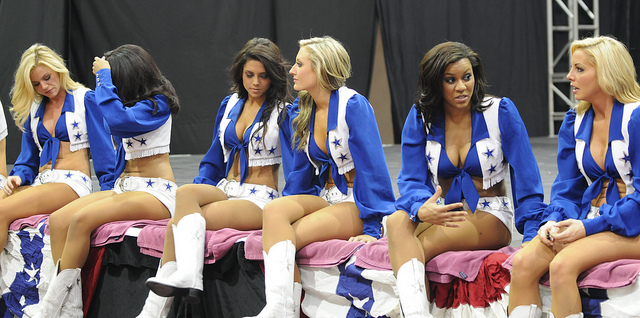
dish_cheerleaders

Group pictures flatter individual faces more than solo shots, recent research suggests.  Cindi May describes a study that “shows that individual faces appear more attractive when presented in a group than when presented alone — a perceptually driven phenomenon known as the cheerleader effect“:

Consider the Laker girls or Dallas Cowboy Cheerleaders. To many, these women are beautiful and sexy. However, their perceived beauty is in part a visual illusion, created by the fact that cheerleaders appear as a group rather than solo operators. Any one cheerleader seems far more attractive when she is with her team than when she is alone. …

[Researchers Drew] Walker and [Edward] Vul posit that the cheerleader effect arises from the interplay of three different visuo-cognitive processes.

First, whenever we view a set of objects like an array of dots or a group of faces, our visual system automatically computes general information about the entire set, including average size of group members, their average location, and even the average emotional expression on faces. Thus although the group contains many individual items, we naturally perceive those items as a set, and form our impressions on the basis of the collective whole.

In addition, the impression that we have of the group as a whole influences our perception of any one individual item. We tend to view individual members as being more like the group than they actually are. Thus when we see a face in a crowd, we tend to perceive that face as similar to the average of all the faces in that crowd. As it turns out, we find average faces very attractive. Composite faces, which are generated by averaging individual faces together, are rated as significantly more attractive than the individual faces used to create them. According to Walker and Vul, if presenting a face in a group causes us to perceive that face as more similar to the average, we are likely to find that face more attractive.

(Image of Dallas Cowboys cheerleaders via Flickr user USAG-Humphreys)