Campaigning On His Bible

Sen. Mark Pryor pitches himself to the devout:

http://youtu.be/mucYcm6moe0

Waldman provides background information:

The context here is that Arkansas is not just a state with a dwindling number of Democrats, it’s also one of the most religious states in the country, and of a particular kind. According to Gallup, Arkansas is tied for the fourth-most-religious state, measured by the proportion of people who say they are “very religious” (only Mississippi, Utah, and Alabama rank higher). And perhaps more importantly, according to the Pew Research Center, Arkansas is tied with Oklahoma for the largest percentage of evangelical Christians of any state, at 53 percent of the population. Arkansas ranks eighth in the frequency of attendance at religious service, seventh in the frequency of prayer, third in the percentage who say religion is very important in their lives, and fifth in the certainty with which people believe in God, with 84 percent saying they believe with “absolute certainty.”

Sarah Posner dissects the ad:

Pryor is trying to have it both ways: the Bible is his guide, but he doesn’t have all the answers, God does, leaving him enough wiggle room to seem bipartisan without actually explaining what his record is and why he has taken the positions he has. Setting aside the essential question that dogs us here—why in an increasingly pluralistic country do only Christian credentials seem to count as essential for holding public office—does Pryor’s ad actually meet a definition of humility? Or is this statement of faith merely a substitute for owning his voting record?

I actually thought it was pretty inoffensive. It doesn’t cross the line into Christianism of right or left, because he leaves space for disagreement on how a Christian might respond to emergent problems in a multi-cultural society. And it may seem a little desperate, but not completely phony to me.

Yglesias Award Nominee

“I would like to know that our national home has clear borders and that we hold the people sacred, not the land. I would like to see a national home that is not maintained by occupying another people. I say this even though it’s not popular: we need an agreement now, before we reach a point of no return from which the two-state solution is not an option any longer,” – Yuval Diskin, the head of Israel’s Shin Beit until two years ago.

“Interns Are People!”

Charles Davis has a thorough takedown of liberal magazines that pay their interns nothing (Harper’s, Salon, The New Republic) or next to nothing (The American Prospect). One of the more vivid examples:

In 2011, Democracy Now! asked its $15-a-day employees to work the program’s 15th anniversary gala, a major fundraiser. Interns were asked to “greet and thank guests, check their coats, make sure the event goes smoothly, and help clean up,” according to an email obtained by VICE. “We will provide you with a delicious pizza dinner, but ask that you refrain from eating the catered dinner at the event.” Back then, interns did not have to wait two months to get their $15 stipend, which probably made the Domino’s go down easier. But while entry-level staffers at Democracy Now! are paid less than ever, not all have shared in the sacrifice: [Amy] Goodman made more than $148,000 in 2011, twice what she took home in 2007—and that doesn’t include income from book sales or speaking engagements. Requests for comment were not acknowledged by Democracy Now!.

His broader points:

Money is not an excuse. If you set out believing you are obliged to pay your employees, you find a way to do it. The progressive Utne Reader manages to pay its interns minimum wage. Dissent magazine just started paying their college interns $2,000 a semester, which comes out to about $7.80 cents an hour by my calculations. And the left-wing Truthout.org pays every intern $10 an hour. None of these places are rolling in money. …

Experience is great and can open doors, but unpaid and low-paid internships can also slam doors shut. Failing to pay young journalists a decent wage is effectively a way of saying that those too poor to work for nothing need not apply. That socio-economic filter leads to a pool of journalists—even at good, upstanding progressive publications—that is wealthier and whiter than the public as a whole. And that hurts the final product.

Davis’ journalism has already done some good: “After the publication of this article, Mother Jones announced that it had increased its budget for interns/fellows in 2014,” above minimum wage. For the Dish’s own part, we pay our interns about one-and-a-half times the minimum wage and provide health insurance. And we certainly aren’t rolling in money.

A Girl On A Bike

A simple concept – revolutionary in Saudi Arabia. From Keerthik Sasidharan, a review of the movie, Wadjda:

A subtext to the film is the audience’s recognition that Saudi women — behind their abaya — have an inner life, a rich one at that, ones filled with intrigue, song, scandal, love and heartbreak. They aren’t a cipher, insists this film. No different than, say Amos Gitai’s Kadosh , which imagined the lives of some Orthodox Jewish women. Wadjda suggests that Saudi women are exemplary evidence of how humans make do, adjust, play it up, press against and push the boundaries given societal restrictions. More so, for many Arab women, it proffers a sense of continuity, a historical memory of their mothers and grandmothers.

Know hope.

Previous Dish on Wadjda here and here. Update from a reader:

It’s not just in Saudi Arabia that a girl on a bike means hope.  American suffragette Susan B. Anthony wrote:

Let me tell you what I think of bicycling. I think it has done more to emancipate women than anything else in the world. It gives women a feeling of freedom and self-reliance. I stand and rejoice every time I see a woman ride by on a wheel…the picture of free, untrammeled womanhood.

Frances Willard, famed prohibitionist and long-time director of the Women’s Christian Temperance Movement, agreed:

And so I found high moral uses in the bicycle and can commend it as a teacher without pulpit or creed. She who succeeds in gaining the mastery of the bicycle will gain the mastery of life.

She didn’t learn to ride till she was 53, and wrote about that experience here. Her bicycle is on exhibit at the museum located in her home in Evanston. I wonder how different the encumbering skirts and bustles of the Victorian female regalia really is from the hajib?

Reliving The Iraq War, Ctd

A reader writes:

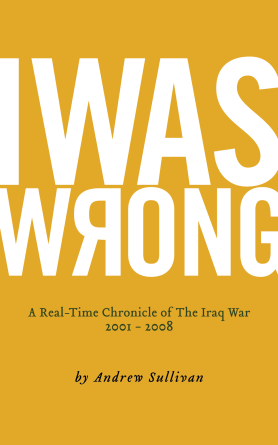
I just finished all 266 pages of the Deep Dish e-book on your blogging of the Iraq War. Phew! It was exhausting at times but always engaging.  It was also a smart idea format-wise, and a andrew-sullivan-i-was-wrong-covercommendable exercise overall.  As other readers have pointed out, the Andrew Sullivan of the early pages is jarring. But a fair reading of the whole book shows you admirably struggling, thinking and re-assessing far, far more than most political writers on this subject.
If I could request a relevant follow-up, I would like to hear you turn outward and now explain what the hell you think was really going on behind this war.  Not why you did or did not support the Iraq War, but what you think was the true impetus of the Bush administration behind this long confusing war.  The earlier parts of your book focus on the Bush administration’s incompetence (which was undeniable), but later you refer somewhat to unstated motives: “It wasn’t about WMDs or Saddam’s threat that motivated this war, we now understand, so much as the capacity to forward station U.S. troops in an oil-rich region and help contain Iran.”  (6/11/2008, 12.28 pm)

At the end, I was left unsure whether your support for the war was “wrong” because you ultimately disagreed with the policy, or the execution, or because you felt that real policy objectives were hidden from all of us … and/or that any such unstated policy goals were themselves ultimately wrong.   For example, being overconfident as to imposing democracy onto the complexities of Shia-Sunni history is a very valid point but a bit of a distraction if our real goal was to set up military bases in an oil-rich region.  Being wrong about Saddam’s threat or the existence of WMD’s is crucial, but not as much if this was more about containing Iran.  I understood your evolving personal reaction to unfolding events driven by others (the Bush administration), but I wonder what you now think, with hindsight, really happened.

After so much effort revisiting this, I wouldn’t be surprised if you thought you have answered these questions.  But I’ll give you an example.  I thought you had an excellent post on June 1, 2006 that rightly puzzled how the obvious incompetence could be ordinarily explained:

The great paradox of Iraq has been there from the start and it still, frankly, confounds me. We were told by the president that the Iraq war was the critical battle in the war on terror, an effort of enormous stakes that we couldn’t possibly lose. And then he went to war with half the troops necessary to win, with no plan for the aftermath, and refused to budge even when this became obvious to anyone with eyes and a brain.

He says there is no greater friend or supporter of the troops, yet he sent them to do an impossible task, with insufficient numbers or support or even armor to accomplish the job. He said we face the equivalent of the Third World War and yet he has done nothing to increase the size of the military to meet the task. He said the invasion was to advance the principles of freedom and democracy, and yet he immediately abandoned those principles in our detention policy and has done more damage to the moral standing of the United States than anyone since the Vietnam war. He says he wants to build democracy, and yet he has gutted reconstruction funds, and withdrawn support for building democratic institutions. He said he will keep troops there until the job is done, and yet sustains a policy to draw down the troops as soon as possible.

These contradictions are still unexplained.  The two best books I have read to try to understand the Iraq War are Imperial Life in the Emerald City by Rajiv Chandrasekaran and The Shock Doctrine by Naomi Klein. As you know, Chandrasekaran’s book is an excellent reporting of the jaw-dropping brew of ideology, nepotism, war profiteering, ignorance and capitalist-religious evangelical fervor that suffused the planning and execution of the occupation. While I doubt you are a fan of Klein, her theory of “disaster capitalism” remains the most coherent possible explanation I have read for the paradox you identify above and the inexplicable incompetence described in Imperial Life and your own writings.

But that is my take, after-the-fact, of what was actually happening (not a reassessment of my real-time opinions).  What is your after-the-fact take of the reality of the Iraq War?

I have written an answer to that in various forms, but not lately and not as a whole. I’m knee-deep in an essay on Pope Francis right now, but am grateful for your suggestion and will follow up. Another also shares his impressions of the book:

Reading your posts in the immediate aftermath of 9/11 really brought me back to the chaos and profound emotional devastation of that event. I think your words really spoke to what a lot of people were feeling at the time, both the good and bad – the hurt of the attack, but also the “rage” and desire for a revenge. Even though I disagreed with the policy of pre-emptive war, I understood where you and the neocons were coming from. 9/11 wasn’t just an attack that killed 3,000 people – it was symbolic.

With that said, two other things stood out, and forgive me for not remembering which pages of the e-book they were on. At one point you referenced an Osama bin Laden videotape in which he questioned the resolve of the American people and American troops in particular. You wrote something to the effect of “Tommy Franks should have that quote posted on every military base”. In retrospect, I think bin Laden was playing a masterful game of goading Americans into an unwise intervention that would not only burden the country in the cost of lives/treasure, but would also stir more anger in the Muslim world against the West, which would only enhance his position. In a strange twist, bin Laden NEEDED the Americans to play the part of the bogeyman for his own benefit. I think his pre-election video that seemed to support Bush enhances this view of bin Laden, the manipulator.

The other thing that also stood out to me was a discussion of where people stood on how to handle the problem of terrorism. You laid out the choice fairly and clearly: is it best fought more as a police-matter and a nuisance, or do we go on offense with pre-emptive war and regime change? To me this was basically the essential question of the 2004 election, even though I knew you based your support for Kerry on a different reason.  While your view on the Iraq war has changed over time, have you abandoned the theory of pre-emptive war completely?

Yes, I have. Completely. Another reader:

Unlike some of your readers, I don’t fault you for most of the things you wrote way back then, even though I too disagreed with the tone of some of your statements. It’s easy nowadays, with hindsight, for people to say Iraq was wrong, and we should have seen it as such and not gone in there at all.

Well, way back then, I didn’t think the Iraq war was wrong; I believed that the government was telling the truth, and I was afraid of the next attack that was certain to come. The idea that someone like Colin Powell could stand in front of the UN and declare so clearly that Iraq was a threat to us, when he was actually wrong, never crossed my mind. I’m no war supporter, but if ever there was a righteous battle, taking on those who had already attacked the US and would again by any means possible seemed like the right thing to do. And I would support doing the same thing someplace else, if there was a real threat, hopefully next time with a more informed decision not based on blind trust. Many who claim to have always known it was wrong are practicing selective memory.

So going after those who attacked us was and still is the right thing to do. As it turned out, we went after the wrong guy. I agree with you that the insistence of the Bush administration that everything they were doing was right, their ignoring of Abu Ghraib, or at least pretending it was justified, and, in general, their inability or unwillingness to admit error is the greatest sin. Even if they believed their own intelligence experts, it was clear shortly after we invaded Iraq that they were not the threat we were told they were. I’d like to think that if Bush had admitted the mistake and taken responsibility to fix the error, that I would have more respect for him than I now do. But again, that’s 20/20 hindsight, and there were plenty of other reasons to dislike Bush, IMHO.

It will be interesting to read the perspectives of those who also read I Was Wrong.

Our in-tray is open 24/7.

Quotes For The Day

“The delivery of relevant messages and cultivating user engagement are important goals, of course. That is the point of advertising, after all. But it’s equally important that advertising not mislead consumers. By presenting ads that resemble editorial content, an advertiser risks implying, deceptively, that the information comes from a nonbiased source,” – Edith Ramirez, the chairwoman of the F.T.C.

“The word ‘advertisement’ tells people what is being done to them. The whole point of the word ‘sponsored’ is to avoid calling it what it is,” – Robert Weissman, president of Public Citizen, a consumer advocacy group.

Are We Gaming The IQ Test?

A new paper on the phenomenon of steadily rising IQ scores, known as the “Flynn effect,” claims that people are simply getting better at taking tests. Alice Robb summarizes the paper’s key arguments:

People today are not only staying in school longer, the authors point out, but are more than ever taught to the test: Students are trained in test-taking strategies and heuristics that, according to the paper, can be applied to IQ-type problems. “People are exposed to the formats of tests all the time—they are able to detect certain regularities, and they are able to exploit those regularities,” said Michael Woodley, one of the paper’s co-authors, in an interview over Skype. “You were probably taught in school, for instance, to guess on multiple choice tests.” Even outside the classroom, increasing exposure—often online—to cognitive games like Sudoku, Bridge and Go mean that people are more familiar with IQ-type problems when they sit down to an IQ test. “We live in a more cognitively intense environment than ever,” said Woodley.

Psychology professor Dr. James Thompson praises the study:

[Co-author Elijah] Armstrong and Woodley argue that the Flynn effect is partly driven by the retest effect, whereby familiarity with the test material means that if you can learn a rule of thumb you can solve those particular sorts of problems when you see them again, without having to use much intelligence. In very simple terms, the test wears out quickly once you get to learn how it works. Using implicit learning and working memory, test takers learn how to solve rule dependent problems, which leads to apparent IQ gains which are partly independent of general intelligence.

A Market Dominated By “Masterpieces”

Art Auctions

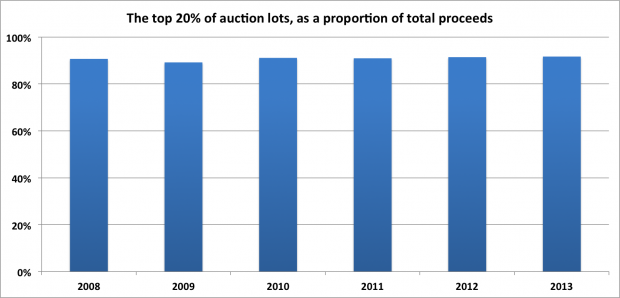
Felix Salmon presents the above chart, showing that the art market is actually remarkably stable, as “the top quintile of art works will always accounts for 90% of the value of the art sold”:

[T]he fact is, statistically speaking, that the distribution of art-market values never really changes at all. What’s true today was true yesterday, and was true a decade ago as well. The only difference is the way in which the art-market caravan has moved on and anointed a new set of art works as being the “masterpieces” worth spending insane amounts of money on.

Similarly, every season there’s breathless coverage of new auction records — a long list of artists, all of whom just saw a work sell for more money than that artist has ever received at auction before. The auction houses love to present those auction records as a sign that the market is particularly healthy. But in fact, it’s more of a sign of how fickle both the auction houses and the art market are. Each season, a new artist is hot, and sells for high prices; the superstars of yesteryear, by contrast, aren’t even accepted for auction at all, much of the time. Today’s masterpiece is tomorrow’s mildly embarrassing reminder of how bad our taste used to be.

Relatedly, Jed Perl fears that the “art world has become a fantasy object for the professional classes”:

To argue that an artist whose work sells for a few hundred or a few thousand dollars is superior to an artist whose work sells for millions is to invite condescension if not outright ridicule. The relationship between culture and commerce is frozen, with commerce invariably the winner.

Recent Dish on the art market here.

Censoring Tragedy

Chris Beam praises a new Chinese film, A Touch Of Sin:

Critics argue that for all the movie’s negativity, it goes easy on the country’s highest powers. The villains are all rotten individuals: local officials, corrupt businessmen, highway robbers. Blame falls on bad men, not on the system. This notion squares nicely with President Xi Jinping’s recent anti-corruption campaign. The problem, according to this logic, lies in the greed of BMW-driving, Rolex-wearing local officials—not, say, the absence of rule of law, a functioning court system, or political accountability.

But this read doesn’t give Jia enough credit. It’s clear from the film that evil deeds stem at least in part from a crushing system. Dahai reaches for his gun only after trying and failing to petition the central government. Xiaohui snaps not just because his boss is cruel, but because the factory doesn’t have insurance to pay for his friend’s injury.

His conclusion:

This isn’t exactly the image of China the Communist Party wants to project. Even though Jia cooperated with censors, agreeing to cut dialogue that was deemed inappropriate, the film’s takeaway—that violence is understandable, if not justified—can’t sit well with a government dealing with the fallout from two recent high-profile attacks. The irony of suppressing A Touch of Sin, of course, is that the movie is about the unintended consequences of suppression.

Yglesias Award Nominee

“The problem of poverty is complicated, different in important respects from in the past, and defies simplistic partisan explanations. The 352px-Sybilsolutions certainly extend beyond the actions of government. Indeed, misguided government policies have done a great deal to perpetuate inter-generational poverty. But it’s hard to argue that politics and government don’t have significant roles to play, direct and indirect, both in putting an end to failed policies and in supporting what works. And certainly the Republican Party has to do better than declaring utter indifference to the poor (which was the approach some otherwise very impressive individuals took in the 2012 presidential race).

Helping those most in need should be considered more than a peripheral virtue; and like Jews and Christians of old, we should all make more room in our moral imaginations for the care of the poor. Certainly if we’re told that God identifies with the least of these, so should we,” – Pete Wehner, Commentary.