Faces Of The Day

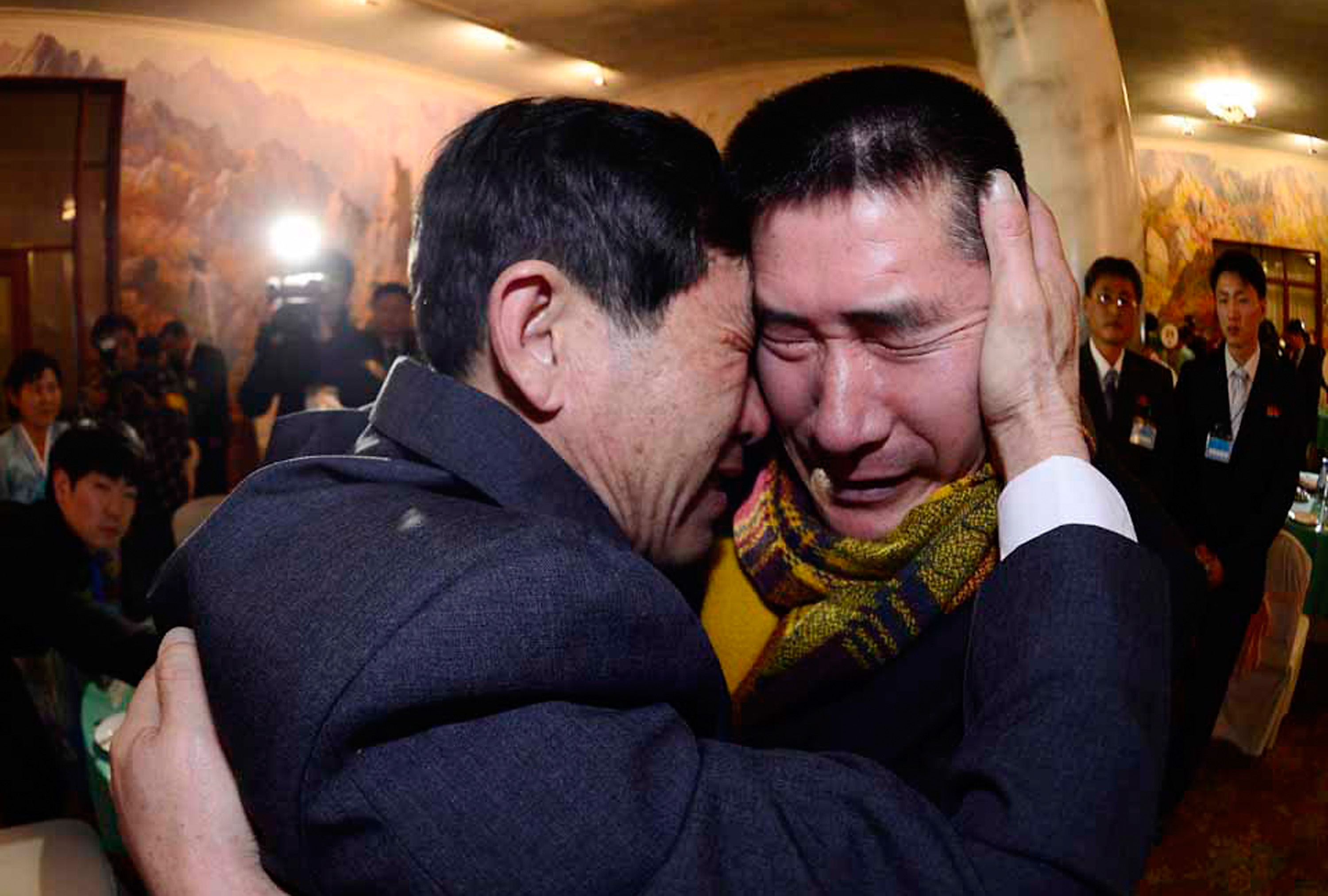
South and North Korea Resume Family Reunions

South Korean Park Yang-Gon meets with his North Korean brother Park Yang-Soo during a family reunion after being separated for 60 years in Mount Kumgang, North Korea on February 20, 2014. The program, which allows reunions of family members separated by the 1950-53 Korean war, is a result of recent agreement between Koreas which had been suspended since 2010. By Park Hae-Mook-Korea Pool/Getty Images.

House Of Tax Breaks

The producers of House Of Cards are demanding more tax credits from Maryland, where the show is filmed, and threatening to move production out of the state if they don’t get them:

Maryland reimbursed Media Rights Capital $11 million for season one of House of Cards; season two saw the state up that figure to $15 million. But officials haven’t yet increased Maryland’s annual TV and film tax credits enough to keep the money flowing for season three. That’s likely to happen at some point, but what’s not clear is whether the new number will be enough to keep House of Cards in Maryland. In a letter to [Governor Martin] O’Malley, Media Rights Capital’s Charlie Goldstein said, “I am sure you can understand that we would not be responsible financiers and a successful production company if we did not have viable options available.”

Liz Malm calls this a “political ploy” and urges states to stop competing to attract Hollywood producers:

Film production only creates temporary jobs, and companies can leave at the drop of a hat. The Maryland Film Office estimated that House of Cards Season 1 “resulted in local hiring of 2,193 Maryland crew, cast, and extras” but it’s pretty clear based on the letter above that companies can bolt the second they get a better deal. And those jobs aren’t available once filming wraps up.

Programs do not “pay for themselves” as is often touted. Proponents will argue that increased economic activity will create enough new tax revenue to make up for the initial loss of revenue from the credit. That’s not true. In fact, film tax incentives are a net loss to states, and there are plenty of studies demonstrating this.

Ed Morrissey doesn’t buy the state’s numbers:

Supposedly, this created 6,000 jobs and inflated the economy of Maryland by $250 million, according to economic data supplied by the state’s economic development office to the Post’s Jenna Johnson. I find those numbers incredible … in the most literal sense of the word. One season of a television show aired exclusively by Netflix created a quarter of a billion dollars in economic activity in a single year? What were the 6,000 jobs created by a television series in one season? The budget for the series is $3.8 million per episode, which includes salaries that get spent elsewhere than in Maryland. The first season ran 13 episodes, which puts the total production investment for Season 1 at $49.4 million. If even half of that got spent in Maryland, I’d be surprised, thanks to the star salaries involved — but it if did, Maryland is claiming a 10:1 multiplier factor. That’s utter nonsense.

Alyssa explains why the show isn’t shot in DC itself:

The District of Columbia doesn’t offer tax incentives to film and television productions. And complex jurisdictional and permitting issues make it hard for crews to get even good establishing shots of landmarks like the Capitol Dome. As a result, none of the current crop of political hit shows films in the District itself. House of Cards and HBO’s Vice Presidential comedy Veep film in Maryland. Showtime’s CIA thriller Homeland shoots in Charlotte, North Carolina, and overseas–I once told Homeland showrunner Alex Gansa that if the show had staged a bombing in the actual Farragut Square, rather than the wide-open park that substituted for it, Homeland would have been able to claim a lot more casualties. FX’s period drama The Americans, which is set in the District and Washington suburbs, films in Brooklyn, where production of its first season was interrupted by Hurricane Sandy. Scandal mocks up its images of Washington, but films on the West Coast.
The Rational Side Of Mental Illness

As Lisa Bartolotti notes, some psychological disorders make people less prone to cognitive biases:

Madness and irrationality may seem inextricably related. “You are crazy!” we say, when someone tells us about their risk-taking behavior or their self-defeating actions. The International Classification of Diseases (ICD-10) and the Diagnostic and Statistical Manual of Mental Disorders (DSM-5) describe people with depression, autism, schizophrenia, dementia, and personality disorders as people who infringe norms of rationality. But not all people diagnosed with a mental disorder behave irrationally, and not all people who behave irrationally are diagnosed with a mental disorder.

There is evidence that people with a diagnosis of schizophrenia, depression, or autism are, in some contexts, more epistemically rational, that is, more responsive to evidence and more likely to form true beliefs, than people without any psychiatric diagnosis. People make more accurate predictions when they are depressed, because the statistically normal way to make predictions is characterized by excessive optimism. People with autism score higher in social interaction games (such as Prisoner’s Dilemma) and are more logically consistent than control participants when making decisions involving possible financial gain, by not responding to emotional contextual cues in the same way as controls. People with schizophrenia are also less vulnerable to a statistically normal but irrational tendency to gamble when faced with a certain loss.

Map Of The Day II

Solar Time Map

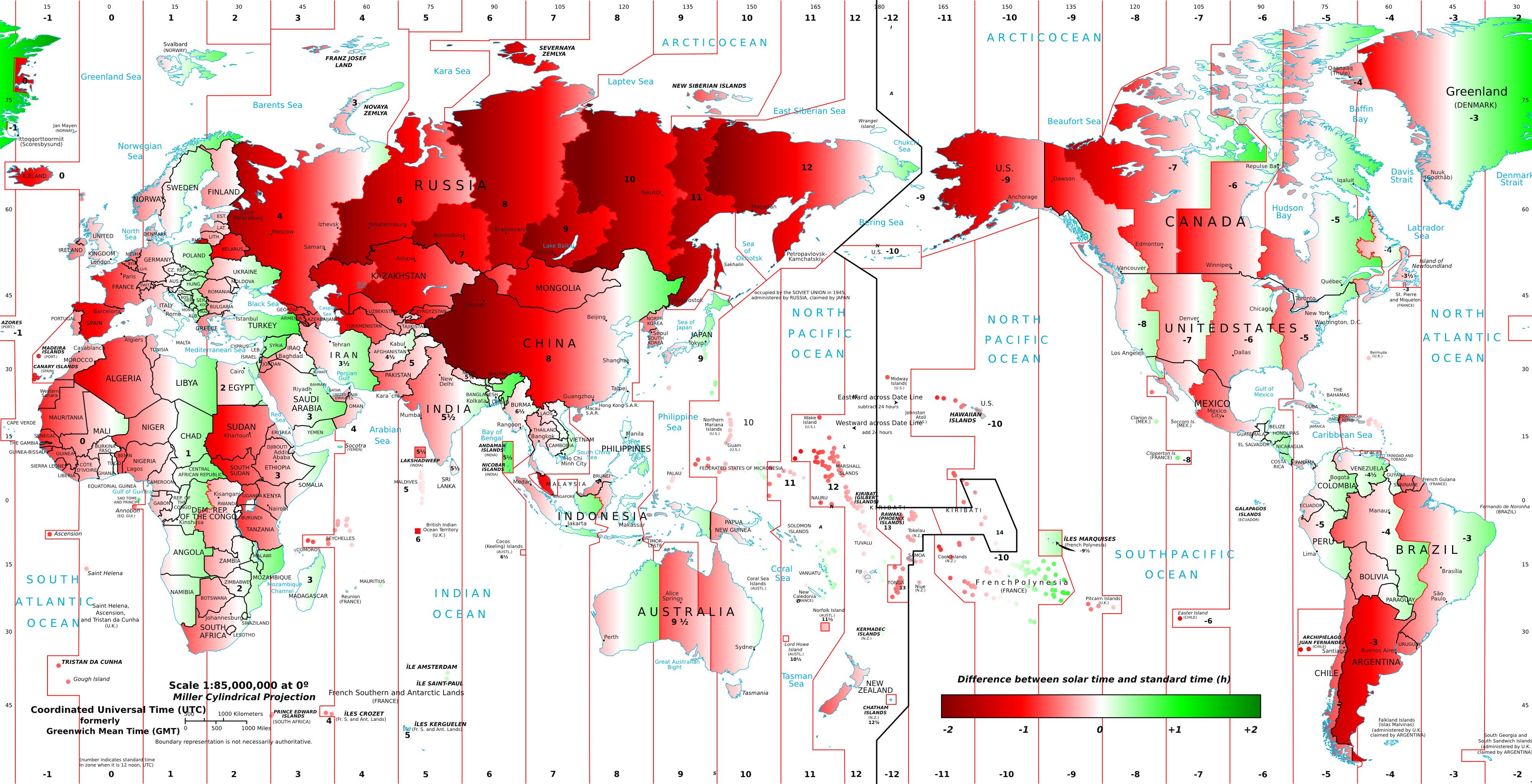
Keating passes along a timezone map:

The map above, created by math blogger and Google engineer Stefano Maggiolo (click here for a full-size version), shows the difference between clock time and “solar time”a schedule in which the sun is at its highest point in the sky at exactly 12 noon.

For whatever reason, more of the world seems to be a little bit like Spainthe sun rises and sets later in the day than it shouldthan the other way around. The “late” places are shown in red, the “early” places in green. The deeper the shade, the more off the time is.

Forget Governing, We Have Elections To Win

Alec MacGillis argues that both Christie’s Bridgegate and the maybe-scandal emerging around Scott Walker, whose aides did campaign work on government time, reflect the grip of the “permanent campaign” on our political culture:

This mindset has been with us for a long time, but it’s creeping ever outward, further back into the calendar and further down into lower and lower levels of office. It’s bipartisan—we know, for one thing, that the Obama administration all but shut down the rule-making process in late 2011 and all of 2012 so as not to cause any election-year troubles for itself, a decision that likely contributed to the bungled Obamacare rollout.

But it’s not hard to imagine why the mindset seems to have taken particular hold among Republicans, whether on the Hill or in Trenton or suburban Milwaukee. If you’re in government but philosophically anti-government, it’s all the more natural to let the governing be set aside for the sport of the permanent campaign. It’s easier, the goals are clearer, and it’s more fun.

Here’s the gist of the Walker story:

The release of 28,000 pages of documents connected with two criminal investigations involving former aides has put Governor Walker in an uncomfortable spot. … The documents, released Wednesday, showed how, in 2010, aides to then-Milwaukee County Executive Walker worked on his gubernatorial campaign while doing their government jobs, which is against the law. In all, six aides and allies were convicted, including two for doing campaign work on county time. Walker was never a target of investigation and has denied wrongdoing.

In addition, a new investigation launched by prosecutors in five Wisconsin counties is believed to be under way into whether his recall campaign in 2012 illegally coordinated with outside groups. In Wisconsin, people connected with such an inquiry – called a “John Doe investigation” – are generally not allowed to discuss it in public.

Philip Klein thinks the liberal press is grasping at straws:

Given that investigators who had access to these documents for years and heard testimony from hundreds of witnesses found no wrongdoing by Walker, it was unsurprising that the document release turned out to be a dud. Of course, this didn’t prevent headlines attempting to create the specter of scandal surrounding Walker where there is no evidence of one.

The Worst Place In America To Rent

6177086220_015235d125_b 2

Forget the West Village. In Williston, North Dakota, a 700-square-foot one-bedroom will set you back $2,394, the highest rate in the US for such “entry level apartments”:

In Williston, a city on the edge of the Bakken Oil Fields, the population has doubled in the last five years, from 14,700 in the 2010 census to over 30,000 people today. The growth is akin to the way the Gold Rush quickly urbanized parts of California in mid-1800s. In fact, so many people are moving to the area to work for oil companies that so-called “man camps” made from temporary structures were built over the last few years to keep up with demand. … The housing shortage is so dire that people are living in their cars and the homeless population has swelled 200 percent over the last year. Since there are no official homeless shelters, churches apply for temporary permits to help house the thousands of workers who come seeking employment. A $35-million housing incentive fund was introduced in 2011 with the hope of subsidizing the cost of new, affordable housing. Unfortunately, the fund was depleted late last year.

Previous Dish on the Bakken boom here and here.

(Photo by Flickr user Karendesuyo)

Crystal Myth

Sullum flags a new report debunking some drug-war hyperbole about methamphetamine:

Despite all the talk of a “meth epidemic,” the drug has never been very popular. “At the height of methamphetamine’s popularity,” [Columbia neuropsychopharmacologist Carl] Hart et al. write, “there were never more than a million current users of the drug in the United States. This number is considerably lower than the 2.5 million cocaine users, the 4.4 million illegal prescription opioid users, or the 15 million marijuana smokers during the same period.” Furthermore, illicit methamphetamine use had been waning for years at the point when Newsweek identified “The Meth Epidemic” as “America’s New Drug Crisis.”

Although methamphetamine is commonly portrayed as irresistible and inescapable, it does not look that way when you examine data on patterns of use. Of the 12.3 million or so Americans who have tried it, according to the National Survey on Drug Use and Health (NSDUH), about 1.2 million (9.4 percent) have consumed it in the last year, while less than half a million (3.6 percent) have consumed it in the last month (the standard definition of “current” use). In other words, more than 96 percent of the people who have tried “the most addictive drug known to mankind” are not currently using it even as often as once a month. A 2009 study based on NSDUH data found that 5 percent of nonmedical methamphetamine consumers become “dependent” within two years. Over a lifetime, Hart et al. say, “less than 15 percent” do.

The Modern Way To Kill Freedom

Steinglass wants us to “understand the nature of the threat to freedom we’re seeing these days, in Ukraine and around the world”:

Viktor Yanukovich is a democratically elected president who has used his powers to eliminate liberal-rights safeguards and jail political opponents on dubious charges. He has reinforced his political position by building cronyistic relationships with powerful business figures. In this system the state creates economic rents and awards them to favoured business interests, who in turn buttress the state’s political power, all while maintaining the trappings of democracy. In other words, Ukraine looks a lot like Russia or Egypt; more significantly, it looks like other states that are in the early stages of similar threats to liberal democracy, such as Turkey and Hungary. The enemy of liberal democracy today is more often kleptocracy, or “illiberal democracy” (as tiger-mom Amy Chua put it in her book “World on Fire“), than ideological totalitarianism. The threat is less obvious than in the days of single-party states and military dictators. But it ends up in the same place: economic stagnation, a corrupt elite of businessmen and politicians, censored media, and riot police shooting demonstrators.