
Los Angeles, California, 5.30 pm
Los Angeles, California, 5.30 pm
I don’t read her for the arguments any more. But she sure is feeling things:
I think a lot of people right now, certainly Republicans and conservatives, feel like a guy in a batting cage taking ball after ball from an automatic pitching machine. He’s hitting the ball and keeping up and suddenly the machine starts going berserk. It’s firing five balls a second, then 10. At first he tries to hit a few. Then he’s just trying to duck, trying not to get hurt.
That’s how people feel about the demands and dictates. The balls keep coming at them politically, locally, culturally. Republicans and conservatives comprise at least half the country. That’s a lot of people.
Ten balls a second! So I ask myself, as one does: what does she mean by balls? I can glean the following:
Rules, regulations, many of them stupid, from all the agencies—local, state, federal—on the building of a house, or the starting of a business. You can only employ so many before the new insurance rules kick in so don’t employ too many, don’t take a chance! Which means: Don’t grow. It takes the utmost commitment to start a school or improve an existing one because you’ll come up against the unions, which own the politicians.
Okay, so Obamacare. And yes, it does add a burden of mandated responsibility for employees’ healthcare and your own. Here at the Dish, we’ve gone through the tedious and time-consuming business of figuring out our new insurance policy in the exchanges, and I’ve found a new policy for myself here in DC. It was a hassle, but it would be hard to argue that it’s that much more burdensome than figuring out our insurance before Obamacare. And, in my case, for the first time in two decades, I feel secure in being able to keep my insurance regardless of what happens to my employment situation. I’d go further and say that Obamacare helped give me the security that allowed me to start a new small business. Has that ever occurred to Noonan? Maybe it takes having a pre-existing condition to see it from one potential employer’s point of view.
As for “local, state, federal” regulations on building a house or starting a business: is Noonan really saying that these only exist because of “angry progressives”? Please.
And she fails to provide any evidence that this kind of regulation has intensified these past few years.
Then there’s the invocation of the poor citizens of Arizona, being pelted with gay balls. I understand and sympathize with a sense of bewilderment, especially among fundamentalists and the older generations, at the advance of gay dignity and equality. But, as Jan Brewer noted, there had not been a single incident of alleged gay aggression in Arizona. If any group could be forgiven for feeling that it was being pummeled with a fusillade of balls, it has been the gay and lesbian community, suddenly confronted across several states with bills that would have decimated any protections against discrimination. Has it ever occurred to Noonan that gay people might feel under siege as well? From Russia to Uganda and Nigeria, aided and abetted by American Christianists, gay people are experiencing a wave of hatred and hostility far surpassing the discomfort of a fundamentalist wedding planner. And yet Noonan can only see things from the perspective of those seeking to keep sinners at arm’s length.
At some point, her editors might ask her to complement her feelings with actual arguments. But one senses she doesn’t really have any. Just a hell of a lot of balls.
More ominous developments after yesterday’s occupation of parliament by paramilitary forces:
Unidentified armed men have seized two airports in Crimea overnight, causing Ukraine’s new interior minister to talk of “a military invasion and occupation” by Russia. … They wore military fatigues with no insignia and refused to talk, though one told news agencies they were part of a self-defence unit who wanted to ensure that no “fascists” arrived in the region from Kiev.
At Sevastopol airport, a military airport that handles few commercial flights, a man who said he was a captain in the tactical aviation brigade but declined to give his name, told the Guardian there were about 300 people of unknown identity inside the airport. “We don’t consider it any invasion of our territory,” he said without elaborating. He said the men looked like military, were wearing two different types of uniform and were armed with sniper rifles and AK-47s. “We don’t know who they are, nor where they’ve come from.”
The interim Ukrainian president has dismissed the head of the armed forces, while Russia’s parliament “began considering a law that would allow Moscow to add new territories to Russia in a simplified manner”. There was also this incident at the Russian border:
At least 20 men wearing the uniform of Russia’s Black Sea fleet and carrying automatic rifles surrounded a Ukrainian border guard post on Friday, in a tense standoff near the port city of Sevastopol in Ukraine’s Crimea region. A Reuters reporter in the Balaklava district saw Ukrainian border police in helmets and riot gear shut inside the border post, with a metal gate pulled shut and metal riot shields placed behind the windows as protection. A servicemen who identified himself as an officer of the Black Sea Fleet told Reuters: “We are here … so as not to have a repeat of the Maidan.”
Paul Sonne reports that “Crimean special forces and local militiamen with Kalashnikovs and masks have hoisted Russian flags and set up checkpoints on the only two highways that connect the Black Sea peninsula to mainland Ukraine”:
In Chongar, the checkpoint on the highway that connects Crimea to Ukraine’s largely Russian-speaking east, Russian flags flapped in the wind Friday as about a dozen armed Crimea-based riot police, known as berkut, checked cars and trucks. An encampment of roughly 30 mostly Cossack volunteer militiamen set up tents beside the policemen to serve as backup in case pro-Ukrainian forces attempt to enter the territory.
In an overview of Crimean history, Adam Taylor warns against assuming the region’s Russian nationalists will be unified:
While the Russian nationalists in Crimea have been given a lot of attention in the past few days, some say they aren’t a coherent force. Ellie Knott, a doctoral candidate at London School of Economics who conducts research in Crimea, has argued convincingly that the Russian nationalist and Crimean separatists are in practice hindered by their own internal divisions, and that many ethnic Russians in Crimea have a more complicated sense of national identity than might first appear. And while Russia has shown itself willing to get involved in the affairs of post-Soviet states, most recently with Georgia over the breakaway state South Ossetia, few are predicting it will openly get involved in a dispute with Ukraine anytime soon.
Calming nerves, Eli Lake reports that so far the US intelligence community doesn’t think Putin will invade:
The assessment is based in part on the fact that not enough medical units have been ordered to accompany the Russian troops to the Ukrainian border to suggest preparation for war, according to one Congressional staffer who has seen intelligence on Russia. This source also said no signal intercepts have detected plans for an invasion. …
Fiona Hill, the director of the Center on the United States and Europe at the Brookings Institution, said she did not expect Russia to launch a land invasion into Ukraine. She did however say that the Russian Navy’s presence in the Black Sea port of Sevastopol in the Crimea would be a potential flash point. “There is one place where they could indeed do something militarily, Crimea,” Hill said. “If there was any kind of threat to the bases, they could mobilize their forces.”
The Guardian is live-blogging. Meanwhile, at a “surreal” press conference held in the Russian city of Rostov-on-Don, the deposed Ukrainian president spoke defiantly:
[Yanukovych] said Crimea should remain part of Ukraine, and called on Russia to act decisively against the new government in Kiev. “I think Russia should, and is obliged, to act, and knowing the character of Vladimir Vladimirovich Putin, I am surprised he is so restrained and keeping silent,” Yanukovych said. …
He said he believed there should be no military activity in Crimea, but insisted Russia should not “sit in the corner and not act”. Yanukovych, who had not been seen in public for a week since he fled Kiev, denied that he was on the run and that he had been overthrown, and claimed he had been “cynically tricked” by the international community, who had allowed “fascists” to take over. The ousted president said he would not take part in elections scheduled by Ukraine’s parliament because they were illegitimate and he is still the president.
A reader counters my analysis of these numbers:
On the issue of circumcision, you are biased and unbalanced. You call circumcision “male genital mutilation”. OK, that’s a bias you are entitled to. Attack circumcision as a moral abomination if you must, but eliminating circumcision will do little for healthcare costs. You cite its $1.8 billion cost and italicize it for emphasis. That is unbalanced. The data report you cite says that of the top 20 operating-room procedures, circumcision is the cheapest per procedure by far and is 20th on the list of 20. And the total cost of circumcisions is just 0.069% of total spending of $2.6 trillion on healthcare in 2010 in the US, and less than 1% of total OR procedures.
The biggest source of healthcare costs are in people over 65, of course, and the biggest source of healthcare costs in people over 65 are in the 25% or so of people with chronic diseases such as CHF, COPD or diabetes. The biggest driver of healthcare cost increases is medical technology driving new treatments to market. Circumcision has very little to do with medical costs.
Of course, mutilating infant boys’ genitals is a small factor in the context of the costs my reader cites. And yes, circumcision is itself not that expensive. But its ubiquity means a remarkable use of medical and operating room resources for an elective procedure. And by “elective”, I do not mean, of course, that the boys choose it. Their parents choose it without the patient’s consent. Another reader on the issue in general:
Okay, you win.
For years I’ve been a loyal reader despite the fact that you occasionally hammer on crusades that I can’t get behind – most notably, your war against “male genital mutilation”. As a parent of two boys, I reflexively had them circumcised at birth; because I was, and because I’d never seen an uncircumcised one in real life, and because I didn’t want my boys to grow up wondering why they looked different than me “down there”. In that context, I’ve always been annoyed by your relentless stance on this issue.
Until today. You see, I’m a healthcare actuary by profession, so today you finally hit on an argument that resonates with me – that male circumcision is symptomatic of our society’s over-utilization of healthcare. Way to keep attacking from different angles until your target finally yields …
Another really took the blogging to heart:
Just thought I’d share that your ongoing coverage reinforced the decision my wife and I made not to circumcise our son. We both come from Southern, conservative, Protestant families where circumcision has been the norm for who-knows-how-long, but our families haven’t made any complaints, and we feel we made the right choice.
Update from another:
I have always rolled my eyes at the term “male genital mutilation.” Same goes for some of the other hysterics of anti-circumcisionists. None of those arguments ever did much for me. (Less sensitivity? Things feel just fine for me down there, thank you. Psychological damage? Please. There are plenty of sources of adult neuroses other than the penis. The anesthetized trimming of a little skin is hardly the worst thing that happened to me in childhood.) And until a month ago I always would have thought that I would have my sons circumcised, like me. I am American, after all, and circumcision is just what we do, right? Why should I make my sons “different”?
But last month, with a newly-pregnant wife, my view changed for a very simple reason: I realized that I don’t have any reason to circumcise. I attended the bris of a friend’s son and saw it all happen. None of it grossed me out. Not the blood, not the scalpel. And the baby didn’t seem to be in any pain. But it struck me quite suddenly that while my Jewish friends have a very good, compelling reason to circumcise – a covenant with their God – I just don’t have one. And as a rational person, it is simply not in my nature to make a permanent and unalterable decision without a good reason.
A rebuttal from a reader:
When discussing what you call male genital mutilation, you keep saying that this is surgery that is done without the patient’s consent. Obviously, a new born can’t consent to anything but circumcision is a very different operation for a newborn than it is for an adult. Ignoring the issue of whether it is necessary surgery, it is a very minor procedure for a baby and a huge deal for an adult. A close friend of mine, born in China, was uncut. He had to be circumcised as an adult (I believe he had the same condition as Louis XVI) and it was as Joe Biden would say, “a big fucking deal.” He was in a lot of pain for a long time and the surgery came with risks of complications and scarring.
You argue that the parent makes the decision to circumcise an infant son without his consent but the parent is also essentially making the decision not to circumcise too. An adult may think/want/believe he is better off circumcised but if his parents did not make that decision for him as a baby, it may not be a realistic choice for him to make as an adult.
In addition to signing the “kill the gays” law, Ugandan president Yoweri Museveni approved an extraordinarily sweeping “anti-pornography” bill last week. “Pornography,” in this case, includes skimpy summer clothes:
According to Uganda’s Daily Monitor, [the law] bans “behavior or form of communication or speech or information or literature or publication in whole or publication in part or news story or entertainment or stage play or broadcast or music or dance or art or graphic or picture or photography or video recording or leisure activity or show or exhibition.” Ugandan media has largely focused on the possibility that the law would be a de facto ban on revealing clothing and has dubbed it the “miniskirt law.” … [I]f a Ugandan stages a play that includes sexualized, under-clothed thighs, she and the journalist who writes a review could both be locked up. Breaking the law could incur penalties of up to seven years in prison.
One consequence of the new law: women, like gays, now find themselves at increased risk of mob violence. Consider:
More than 40 women have been stripped naked in the different towns of Uganda, including the capital Kampala, in the last three days over misconception that they are breaking the law by wearing miniskirts. …
[A]n association of Ugandan women in parliament has lamented provisions of the new anti-pornography’s law that deals with women’s dressing. Rosemary Nyakikongolo, vice chairperson of the Uganda Women Parliamentary Association, claims “parliament rushed to pass the anti-pornography law.” She said the attacks on women are because “MPs passed the law [without] adequate public consultation.”
Earlier this week, police stopped 200 women from marching in Kampala to protest the law. In fact, if not for women’s earlier activism, the law would have been much worse:
Ever since Simon Lokodo, State Minister for Ethics and Integrity and lead proponent for a ban on miniskirts, announced that the Anti-Pornography Bill had been signed into law, women have faced violence, especially in taxi ranks. According to Lokodo, “If your miniskirt falls within the ambit of this definition then I am afraid you will be caught up by the law.”
Except that, despite Lokodo’s most fervent efforts, the miniskirt ban actually never made it into the final legislation. Women across Uganda shut it down. From #SaveTheMiniSkirt online campaigns to Save the Miniskirt parties to formal lobbying to organizing in the streets and off, women shut it down. Women understood that the issue of their clothing was nothing more or less than an attack on women’s autonomy. For Rita Aciro Lakor, the executive director of Uganda Women’s Network (Uwonet), “It’s about going back to controlling women. They’ll start with clothes. The next time they’re going to remove the little provisions in the law that promote and protect women’s rights.”
A recent NYT op-ed by Marcy Darnovsky warning about a procedure that uses donor-supplied mitochondria to allow women with mitochondrial diseases to give birth to healthy children has kicked off a new debate about “designer babies”. Nita Farahany, a member of the Presidential Commission for the Study of Bioethical Issues, emphasizes that using donated mitochondria doesn’t make the donor a “third parent,” as the scare stories would have it:
Embryos that result from these techniques have genetic material contributed from three different individuals, but the mitochondrial donor is not a parent — genetically, or otherwise. When using mitochondria from a donor egg, the resulting egg (which has the nucleus from the intending mother) has 99.9 percent of its coding DNA from the intending mother. The donor provides the energy necessary for the egg to function normally. When the egg is then fertilized by a sperm cell, the resulting embryo carries less than .1 percent of its DNA from the mitochondrial donor.
Ronald Bailey accuses the NYT of “immoral scaremongering”:
The mitochondrial replacement technique is not at all “deeply problematic.” In fact, the FDA panel has finally gotten around to considering a technique that the agency banned after essentially the same procedure was being successfully deployed by team led by fertility researcher Jacques Cohen 13 years ago. Cohen used the technique to help women to give birth to 20 children before the FDA shut down his work in 2001. At a conference some years later, I asked Cohen how the children were faring and he told me that 19 were healthy and one has an autism disorder. As it happens, some research finds a correlation between mitochondrial dysfunction and some cases of autism.
Jessica Grose also dismisses the fears over designer babies and describes what’s at stake for the pregnant women:
When a woman’s eggs have severe mitochondrial abnormalities, they can have many miscarriages, stillborn children, or extremely sick babies who are unlikely to survive past early childhood. “They will suffer immensely because they can’t get the energy” in order for their brains and hearts to grow, says [Nita] Farahany. They can have extreme pain and difficulty breathing. Fixing this huge amount of suffering for both mother and child seems like a far cry from creating “designer babies,” and paramount to any hyped-up concern about a slippery slope.
Although the mitochondrial procedure may not entail the creation of designer babies, Drum figures we’ll get there eventually:
It’s about time we faced up to this, I think. As the technology for this steadily advances, and designer babies become possible, parents are going to get designer babies. If the United States bans it, they’ll go to Switzerland. If Switzerland bans it, they’ll go to China. If China bans it, they’ll go underground. But one way or another, if this technology exists, the demand for it is going to be irresistible.
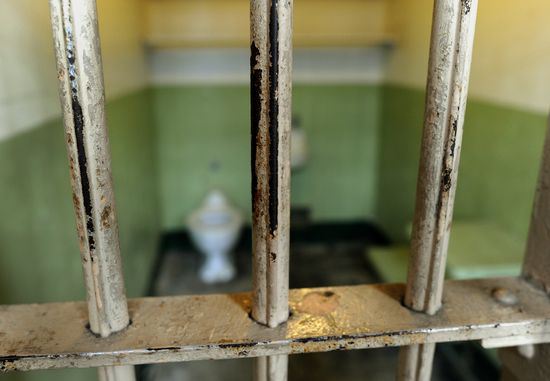
Robert A. Ferguson’s new book Inferno: An Anatomy of American Punishment explores the unusual cruelty and vengefulness in our criminal justice system. Andrew Cohen praises the book for positing “that America needs a fundamentally revised understanding of the concept of punishment itself if it is to save its soul”:
As a matter of law and politics, Ferguson asserts, the concept of retribution clearly has won in America. But what a terrible price to pay for such victory. With a few notable recent exceptions– including New York’s brave new foray into education as a defense against recidivism— we are a nation that seeks to punish, not rehabilitate, our prisoners. In this respect we have gone back in time, back to a dark age in our penological past, back to where in the 21st Century we justify locking away a mentally ill teenager in solitary for 17 years.
Joseph Stromberg looks at the damage wrought by solitary confinement:
A majority of those surveyed [by psychologist Craig Haney] experienced symptoms such as dizziness, heart palpitations, chronic depression, while 41 percent reported hallucinations, and 27 percent had suicidal thoughts—all levels significantly higher than those of the overall prison populations. An unrelated study published last week found that isolated inmates are seven times more likely to hurt or kill themselves than inmates at large. These effects, Haney says, don’t only show how isolation harms inmates—they tell us that it achieves the opposite of the supposed goal of rehabilitating them for re-entry into society.
Helen Vera adds:
Solitary increases the likelihood that a former prisoner, after release, will wind up back in prison. It is extremely expensive, costing as much as two or three times more to hold a prisoner in solitary confinement than in even a traditional maximum-security setting. And it exposes corrections systems to time-consuming and burdensome lawsuits. The commonplace reliance on solitary for prison discipline is a failed experiment, and it’s time for it to end.
Last week there was a glimmer of good news: the NY Department of Corrections decided it will no longer use solitary as a punishment for prisoners younger than 18. Meanwhile, Matt Stroud covers the failures of the private prison industry:
Alex Friedmann, who spent six years as a prisoner in a CCA facility in Clifton, Tennessee, now runs the prisoner rights magazine Prison Legal News. He advocates against private prison companies (and holds stock in CCA so he can speak up at its shareholder meetings). …
Public officials support private prisons because they often need the bed space, regardless if those beds are tied to companies that are “abusive, lead to higher recidivism rates and cost more,” Friedmann says. Second, he continues, public officials are often “ideologically wedded to the concept of privatization in spite of the industry’s abysmal track record,” and third, public officials “receive direct benefits from private prison companies, such as campaign contributions, consulting contracts or the promise of future employment by such firms.”
(Photo: Timothy A. Clary/AFP/Getty Images)
Taking the revamped test as an adult convinced Elizabeth Kolbert of just how useless it is:
As an adult, I found the test more difficult than I had as a teen and, at the same time, more disappointing. Many of the questions were tricky; some were genuinely hard. But, even at its most challenging, the exercise struck me as superficial. Critical thinking was never called for, let alone curiosity or imagination. Ironically—or was it defensively?—this was most apparent to me while I was blathering on about the Manhattan Project. A study by an instructor at M.I.T. has shown that success on the SAT essay is closely correlated with length: the more words pile up, the higher the score. When, at Advantage Testing, [Debbie] Stier [the author of The Perfect Score Project: Uncovering the Secrets of the SAT] is shown essays that have received top marks, she is horrified. They are, she writes, “terrible.”

Greg Grandin researches “the way the advancement of medical knowledge was paid for with the lives of slaves”:
The death rate on the trans-Atlantic voyage to the New World was staggeringly high. Slave ships, however, were more than floating tombs. They were floating laboratories, offering researchers a chance to examine the course of diseases in fairly controlled, quarantined environments. Doctors and medical researchers could take advantage of high mortality rates to identify a bewildering number of symptoms, classify them into diseases, and hypothesize about their causes.
Corps of doctors tended to slave ports up and down the Atlantic seaboard. Some of them were committed to relieving suffering; others were simply looking for ways to make the slave system more profitable. In either case, they identified types of fevers, learned how to decrease mortality and increase fertility, experimented with how much water was needed for optimum numbers of slaves to survive on a diet of salted fish and beef jerky, and identified the best ratio of caloric intake to labor hours. Priceless epidemiological information on a range of diseases — malaria, smallpox, yellow fever, dysentery, typhoid, cholera, and so on — was gleaned from the bodies of the dying and the dead.
Update from a reader:
It’s important to note that this experimentation on slaves was an ongoing practice. For example, there is the case of J. Marion Sims, considered the “Father of Modern Gynecology.”
Sims created some of the first basic tools for gynecological examination. But these breakthroughs came through the experimentation of untold, and largely unnamed, slave women (and later in New York City on destitute Irish immigrant women). I learned about Sims a few years ago on a visit to the State Capitol grounds in Columbia, South Carolina which features a beautiful memorial to Sims that presents him as a great hero and pioneer. There have been attempts to “right the record” and include a more complete story of his record along with the heroic inscriptions. These would include the sheer numbers of forced patients and the staggering numbers of surgeries (30 known on one patient). These were all done without anesthetic, which was known and used at that time. In any case it didn’t matter. The pain of the patient wasn’t a consideration. Gynecological problems that impeded their value as bearers of more slaves was what Sims was attempting to solve in these surgeries.
(Illustration: Diagram of a slave ship from the Atlantic slave trade. Via Wikimedia Commons)
 The Dish
