Getting Customers To Do The IRS’s Job

Charles Kenny wants “to enlist American citizens to help audit some of the most consistent tax cheats: retail businesses”:

In the State of Sao Paulo in Brazil, customers who ask for a receipt can give their social security number to the cashier. Businesses have to submit their copy of those receipts—with or without social security numbers—to the tax authority. The authority creates an account for every social security number entered into the system and reports to customers which receipts have been entered with their social security number and how much they are for. Customers receive a rebate worth about 30 percent of their share of sales taxes paid through the business each month, and for every $50 of receipts they are entered into a lottery with a maximum payout of $500,000. They can complain online if they think receipts are missing or have the wrong price.

Joana Naritomi, a Harvard economist, studied the impact of the Sao Paulo experiment, which has been running since 2007. She found 13 million consumers enrolled in the receipts database at the end of 2011. The system registered more than 1 million complaints involving about 13 percent of the 1 million retail and wholesale establishments in the region. Most important, Naritomi finds that the program increased the reported revenues of retail firms by 22 percent over four years. She shows that reported revenues went up not because real revenues increased, but because reporting became more honest. The result was an additional $2 billion in tax payments. The system paid out $1.6 billion in rewards to consumers over that time, translating into a $400 million increase in net income for the region.

Sell The Rhinos To Save The Rhinos?

Alexander Kasterine urges countries to reconsider their wildlife trade bans:

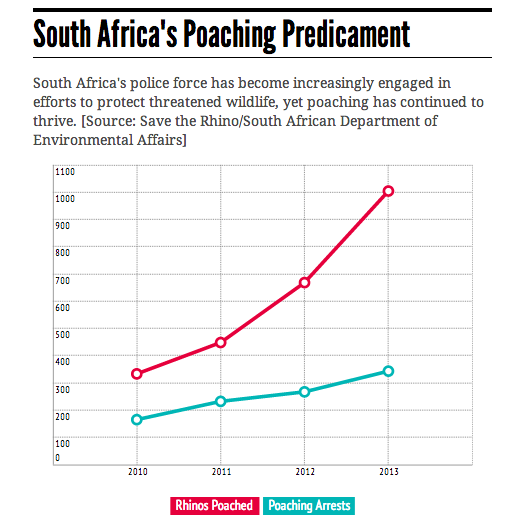
In South Africa, police and national defense forces have become increasingly engaged in efforts to Screen Shot 2014-02-10 at 6.47.21 PMprotect threatened wildlife, and the government has earmarked roughly $7 million in extra funding to ramp up security in its national parks. Yet poaching there has continued, just as it has throughout the continent. Last year alone, poachers killed a total of 22,000 elephants, the majority for tusks that were sold to feed rising demand in Asia.

Through the Convention on International Trade in Endangered Species of Flora and Fauna (CITES), an international agreement among 179 countries, governments can vote to ban the trade of products from species threatened with extinction. But such trade bans are failing in large part because they have run into the same basic problem as the war on drugs. Prohibitions on trading wildlife products such as tusks and timber have ultimately made them more valuable. And criminal organizations have moved in and taken over the market, imposing high costs – through violence and corruption – on weak societies.

Kasterine’s proposal? Legalize it:

[T]he South African government plans to propose lifting the ban on trading rhino horn at the next CITES meeting in 2016. South African officials argue that a legal trade would take profits away from criminal syndicates. Just as taxes on cigarettes fund education and health programs in the United States, similar levies would also provide ample funds for campaigns to combat poaching and reduce demand. Meanwhile, regular de-horning of the animals would increase the global horn supply, lowering prices and the attraction of poaching. Rhinos produce nearly one kilogram of horn each year, which can easily be harvested through a simple veterinary procedure. Farming the animals ethically, moreover, would allow consumers to demand horn products from sustainably managed sources.

But environmental blogger Adam Welz argues that legalization would backfire:

Legalizing the trade in rhino horn will incentivize everyone from producers/rhino custodians to sellers to maintain a high price on it. This, of course, will maintain the incentive to poach rhinos, which in turn will incentivize rhino custodians to maintain them in small areas that can be affordably defended (the current wave of rhino poaching is already causing this to happen). Trade might ‘work’ in the sense that it’ll incentivize the creation of high-density rhino farms, and thus perpetuate the existence of rhinos, but as little more than expensive feedlot cattle. Is this what we want?

Previous Dish on the wildlife trade here, here, here, here, and here.

Explaining The Gender Wage Gap

Economist Claudia Goldin suggests that a bias against workplace flexibility is to blame:

Many companies still richly reward people who are available and work long, continuous hours, Goldin says. They give premium pay to certain key players – mostly men who don’t take time off for children or aging relatives. So women or men who need flexible schedules obtain them “at a high price, particularly in the corporate, finance and legal worlds,” Goldin writes in her paper. Technology and science fields are better off in pay equity, as are certain health care careers. … “It isn’t, quote, a women’s issue,” says Goldin in an interview with Quartz. The pay disparity shows up equally when male MBAs need reduced schedules or time off for personal or family needs.

Previous Dish on the wage gap and workplace flexibility here, hereherehere, and here.

The Best of The Dish Today

Today, a clean lift of the debt-limit ceiling was passed, with 193 Democrats and just 28 Republicans. It’s a big win for the president, and also a sign that his refusal to negotiate actually helped instill a sense of fatalism among the GOP ranks, or, as Noam Scheiber would have it, an end of collective delusion. I’m more struck by what the GOP considered as bargaining chips for maintaining American solvency in only the last few weeks:

Republicans considered attaching language to change Obamacare, construct the Keystone XL pipeline, update the Medicare roadrunner-midairreimbursement rate and reverse recent cuts to military pensions. Each time leadership floated something new, the rank and file shot it down. On Monday, in a meeting in the Capitol, they settled on a 13-month debt limit increase alongside language to reverse retirement benefits for the military and create a fund to facilitate the long-term reform of the Medicare reimbursement rate for physicians. But later Monday, GOP leadership realized they wouldn’t have enough support. On Tuesday morning, Boehner announced during a meeting at the Capitol Hill Club that he would seek to pass a clean debt limit increase.

This is the party that wants to be seen as an alternative. It is rather, an unpredictable cauldron of crazy now grasping for more than the House. Perhaps it will win the Senate on a wave of Obamacare hysteria and opposition. But its conduct in the House does not bode well for coherent governing. They’re for immigration reform but not really. They want to repeal Obamacare but their only alternative covers way fewer people, and makes coverage for pre-existing conditions dependent on continuous coverage in a labor market far from anything close to full employment. They oppose a deal with Iran but remain fearful of persuading Americans of the need for another war in the Middle East. They now agree the Iraq War was a disaster but refuse to take ownership of the mistake. Today was another meep-meep for Obama, but a continuing weep-weep for the country.

On the Dish, we noted the remarkable popularity of that unsung institution: the public library. We gagged at Putin embracing Tchaikovsky and a lesbianish pop duo. We proffered an answer to the great theodicy question. And an epic window view contest started out in North Jersey and ended in deepest Russia. I opposed a Christianism of the left; and argued that the key question before Francis’ church remains contraception – the debate the hierarchy has decisively lost across the globe since 1968.

The most popular post of the day remained An Acid Test For Francis. Next up: Catholics, Contraceptives and Their Church.

A Year After Benedict

His Holiness Pope Benedict XVI Pays A State Visit To The UK - Day 2

Today’s the anniversary of Benedict XVI’s resignation announcement. I will down a Jager in honor of the occasion, even though we still don’t fully know why he did what he did. Mathew Schmalz credits the pope emeritus with paving the way for his successor’s humility:

It’s easy to see how Pope Francis’s simplicity stands in stark contrast and how this would be a welcome change for some. And Francis has emphasized different themes — the church is more of a community and less of a hierarchical institution; Jesus is less of a priest and more of an itinerant preacher close to the poor.

But Benedict XVI did one thing that allowed everything new that we’ve seen from Pope Francis: he resigned the papacy. Benedict believed the papacy, “the Petrine ministry,” was important, but that he himself was dispensable: when the time came, Benedict had no problem letting go. As he promised, Benedict XVI has remained quiet and out of public view. Benedict’s acts of humility, more than anything else, have given Francis the opportunity to be pope in a new kind of way.

But Marcus O’Donnell points out that Francis still has Benedict’s decades of reactionary appointments to overcome:

The main factor mitigating against change in the church is that nearly all its current Bishops were appointed during the reigns of John Paul II and Benedict XVI, who, between them, had 35 years to install like-minded conservative leaders throughout the church. Virtually no progressive leaders from the Vatican II reform generation remain. While there are still small pockets of progressive resistance it has been hard to sustain against an active Vatican campaign to stamp out dissent.

And Dennis Coday reminds readers of the chaotic state in which he left the church:

Remember what we, in the U.S. Catholic church, had been through: an “apostolic visitation” of congregations of American women religious; a doctrinal investigation of the Leadership Conference of Women Religious and the appointment of overlords to help them “reform.” Maryknoll Fr. Roy Bourgeois had been excommunicated because he supported women’s ordination. Long established and trusted scholars, Mercy Sr. Margaret Farley and St. Joseph Sr. Elizabeth Johnson, had been censured. The chairman of the U.S. bishops’ National Review Board for child protection had warned the bishops that complacency threatened the continuing implementation of their policies and guidelines meant to keep children safe. The U.S. bishops seemed to be doing their best to scuttle health care reform over — of all things — artificial contraception; their campaign for religious freedom seemed petty and partisan. A clunky, ideologically driven translation of the Mass prayers had been thrust upon us.

In an interview with Reuters, Archbishop Georg Gänswein says Benedict’s conscience is clear:

Pope Benedict is at peace with himself  and I think he is even at peace with the Lord. He is well but certainly he is a person who carries the weight of his years. So, he is a man who is physically old but his spirit is very vivacious and very clear. … I am certain, indeed convinced, that history will offer a judgment that will be different than what one often read in the last years of his pontificate because the sources are clear and clarity springs from them.

Rocco Palmo reports on what Benedict has been up to in the past year:

Since stepping away, the now Pope-emeritus has broadly held to his plan for his retirement to be spent “hidden from the world.” From his base in the former Mater Ecclesiae convent in the Vatican Gardens, Benedict – who’ll be 87 in April – is said to spend his days with the books he once called his “old friends,” still engaged in theological study, though he’s not expected to write again. A midday walk in the Vatican Gardens is often followed by time at the piano. Company does come, but the invitations tend to be limited to a relatively tight circle of longtime allies, who can be sufficiently trusted to not leak what he says.

The mail is another story, however. A lengthy letter Benedict wrote an atheist author last November was published in La Repubblica with his consent, and in yesterday’s edition of the leftist daily, it emerged that Ratzinger had resumed correspondence with Hans Kung, his colleague-turned-rival of half a century, who he famously hosted for dinner months after his election.

(Photo: By Stefan Wermuth/WPA Pool/Getty Images)

Keep Calm And Paddle On

Flood Warnings Continue As More Rain Is Forecast Across England

The UK is experiencing its “most exceptional period of rainfall in 248 years”, causing widespread flooding in southwest England and the Thames Valley:

After his most recent tour of the destruction caused by the relentless rains in Somerset, Prime Minister David Cameron referred to the flooded devastation as “biblical.” While experts warn that the insurance industry could be facing a bill of £500m from the winter flooding, farmers and environmental groups have been raising concerns about the consequences that the flooding will have on the nation’s food security.

Cameron is catching heat:

Scientists are blasting the government for failing to heed warnings that climate change and poorly controlled development in low-lying areas was heightening the risk of catastrophic floods. Richard Ashley of Sheffield University, author of a 2004 government-commissioned report on flood risks, says the government’s “obsession with deregulation” and budget-cutting had exacerbated the problem. In an interview with the Independent newspaper, he blamed “short-term politicians who don’t take notice of the science.”

Indeed, the science looks sobering. Ashley’s 2004 report predicted that winter rainfall in Britain could increase by as much as 15 percent by 2050 because of climate change. After extreme flooding in 2007, the government commissioned an update based on newer, more advanced climate-change modeling. The new study predicted that winter precipitation could rise by as much as 25 percent by 2050.

(Photo: Residents use a boat make their way through floodwater that has cut off their homes in Chertsey, United Kingdom on February 11, 2014. The Environment Agency contiues to issue severe flood warnings for a number of areas on the river Thames in the commuter belt west of London. With heavier rains forecast for the coming week people are preparing for for the water levels to rise. By Christopher Furlong/Getty Images)

Speaking Out About Suicide

Cara Anna, inspired by the Ted talk seen above, hopes more suicide-attempt survivors “come out” about their experiences:

For me, not being able to see anyone like myself talking about feeling suicidal only made me feel more suicidal, because it was easy to tell myself that I was a loser. What if we were encouraged to come out? What if there were a national campaign that built on JD’s speech, featuring the lawyers among us, the doctors, the artists, the tech workers, the grad students, the people who know so well the enormous effort of gritting their teeth and saying to colleagues and the world, “I feel fine?” …

I started Talking About Suicide with the goal of putting all the resources I could find, like JD’s video, in one place. It began with the nervous interview of another “out” attempt survivor, and it now features more than 50 conversations. Everyone has been direct and fascinating. Only once, briefly, has someone cried. The American Association of Suicidology took notice, and Attempt Survivors launched a year ago with essays, videos and resources.

I love that people are finding they’re not alone. It’s a relief for them, and it’s been a relief for me.

Previous Dish on suicide hereherehere, here, and here.  The thread “Suicide Leaves Behind Nothing” is here.

Forget The Whiskey And Drugs

Riffing on the life and work of Ingmar Bergman, Dorth Nors argues that great artists need solitude most of all:

Solitude, I think, heightens artistic receptivity in a way that can be challenging and painful. When you sit there, alone and working, you get thrown back on yourself. Your life and your emotions, what you think and what you feel, are constantly being thrown back on you. And then the “too much humanity” feeling is even stronger: you can’t run away from yourself. You can’t run away from your emotions and your memory and the material you’re working on. Artistic solitude is a decision to turn and face these feelings, to sit with them for long periods of time.

It takes the courage to be there. You run into your own pettiness. Your own cowardice. You run into all kinds of ugly sides of yourself. But the things that you’ve experienced in your life become the writing that you do. And there’s no easy way to get to it, if you want to write literary fiction. And that’s what Bergman and other Swedish writers have taught me—to stay in that painful zone, discipline myself through it to get where I want.

Scotland vs Britain, Round II

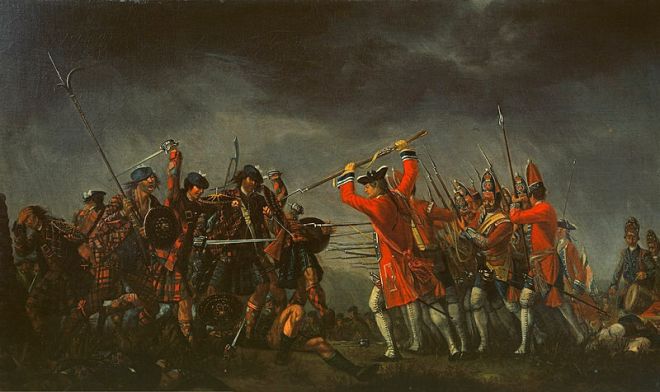
800px-The_Battle_of_Culloden

Massie thinks that September’s referendum on Scottish independence might pass:

Real Scots vote ‘yes’; timid Scots vote ‘no’ — and doubtless, in time, will fill a coward’s grave. This might seem a form of emotional blackmail, but it is a mightily effective one…

At the same time, Salmond argues that very little will change. The nationalist campaign might be subtitled ‘Project Reassurance’. Nevertheless, despite presenting his case as a question of fiscal accountancy and common sense, the true appeal of independence is still emotional. What kind of country, Salmond and his colleagues will ask, rejects the chance to govern itself? It is a good question. The answer, of course, is a country that rejects as false the choice between two identities. You can be a Highlander, Scottish and British — just as you can be Cornish, English and British. Even so, Salmond articulates a vision of a better, purely Scottish future in ways that no unionist politician has yet matched.

I saw the inexorable logic of this as far back as 1999:

Blair has allowed the Scottish Parliament the leeway to lower or raise the British rate of income tax by only 3 percentage points. But the direction is clear enough. Blair clearly believed that by devolving some power to Scotland he would defuse the independence movement. Instead, the opposite could happen. The latest polls suggest that in the new Edinburgh Parliament the largest single party may well be the Scottish Nationalists, who see the new Parliament as a way station to full independence. Of the dozens of conversations I had in London about the future of the United Kingdom, literally no one I spoke with believed that Scotland would be a part of Britain in 10 years’ time.

And since then, as Alex notes, the momentum has been pretty steady and, with a few setbacks, in a pretty clear direction. You see the impact of this in England too, where the flag of Saint George is far more popular now than the old Union Jack. And when Scotland competes in international rugby, it takes part in the Six Nations Cup – those six nations being England, France, Wales, Scotland, Ireland and Italy.

Party politics has only made the Unionist case less potent:

The Tories, bashful as ever, are reluctant to campaign vigorously for the Union lest their unpopularity in Scotland weaken the overall case for unionism. Labour are reluctant to be seen within spitting distance of any Tory. Moreover, the unionist alliance allows the SNP to argue that there is no functional difference between the Labour and Conservative parties. Only the SNP will stand up for Scotland’s interests by putting Scotland first.

Larison likewise argues that opponents of independence are defeating their own cause:

[I]f the unionists mainly rely on painting a gloomy picture of what post-independence Scotland will be like, enough people may conclude that there is no positive unionist case to be made and will decide to vote for the referendum whose advocates at least pretend to have a clear idea of where they want to take their country. I still doubt that Scotland will vote for independence in the end, but it is a lot more likely than it was just a few months ago.

Yglesias declares himself “favorably disposed” to Scottish independence:

The main reason is that it seems to me that in the European context where everyone is a stable democracy with a mixed-market economy, the small countries (Netherlands, Denmark, Finland, etc.) are generally a lot better run than the bigger ones. For one thing, smaller countries have simpler institutional arrangements since you’re not trying to accommodate size by embedding complicated federalism mechanisms into the already complicated framework of the European Union. But for another thing, I think the debate over welfare state design gets more sensible when you’re talking about a small jurisdiction. A place like Scotland is a sufficiently small share of the United Kingdom that it makes sense for a Scottish political activist to be more focused on “how much money does this program bring to Scotland?” than on “how good is this program at generating social benefits in a cost-effective way?” An independent Scotland—like an independent Wallonia or other possible new European mini-states—would have politics that I think would ultimately be more constructive.

(Painting: The Battle of Culloden (1746) by David Morier, oil on canvas. It was the last real battle between the forces of the Crown and Scottish insurgents.)
Face Of The Day

Pascal Tessier a gay scout receives Eagle scout badge

Pascal Tessier receives his Eagle scout badge at his weekly troop meeting, at the All Saints Church in Chevy Chase. Tessier will be one of the first openly gay Eagle scouts. In the past he would have been asked to leave or be booted from scouting, but BSA ruled that it would accept gay scouts but not gay scout leaders. By Evelyn Hockstein/For The Washington Post via Getty Images. Update from a reader:

Great to see you featured Pascal Tessier receiving his Eagle scout badge. I sat on his Eagle Scout Board of Review, and he’s a remarkable young man. He helped change policy in a huge organization, and moved history along a little in so doing. Our two oldest boys also made Eagle Scout the same night – there were 7 candidates from the region. Very proud of them all.