Theater Therapy

Ryan Jacobs highlights a cheaper form of couples therapy:

A recent study published in the Journal of Consulting and Clinical Psychology reveals that watching romance movies with your partner and then engaging in constructive discussions about the relationship implications afterward “can be just as effective” as more formalized “therapist-led methods.” A three-year analysis of 174 newlywed couples showed that those who participated in the “movie-and-talk” approach actually fared as well as those who completed the more rigorous “conflict management” and “compassion and acceptance” therapies. “All three methods halved the divorce-and-separation rate to 11 percent compared to the 24 percent rate among the couples in the control group,” according to a press release.

You Dream Like A Girl

A new study finds that men’s and women’s dreams, and particularly their nightmares, have distinctive themes:

Analyzing themes and emotional content, the researchers found that men were more likely to report having nightmares about natural disasters (floods, earthquakes, fires, volcanoes), chase or pursuit, and insects. Women’s nightmare records more often featured interpersonal conflicts, such as an argument with a spouse and more frequently involved feelings of humiliation, frustration, or inadequacy.

Why might this be? My first thought was that, while women may not mind admitting to researchers that an ex-boyfriend still haunts them, men were only reporting the more cataclysmic plots. (Tsunami!) On the other hand, “dream content is tied into waking concerns,” [researcher Antonio] Zadra explained over the phone. “For women, on average, social or interpersonal dimensions may be more emotionally salient.” As Zadra points out, an interpersonal focus also shows up in women’s erotic reveries. Whereas men often dream of sexual partners who don’t exist in real life, female sleepers are likelier to fantasize about specific acquaintances: spouses, former flames, co-workers, friends.

The Best Of The Dish Today

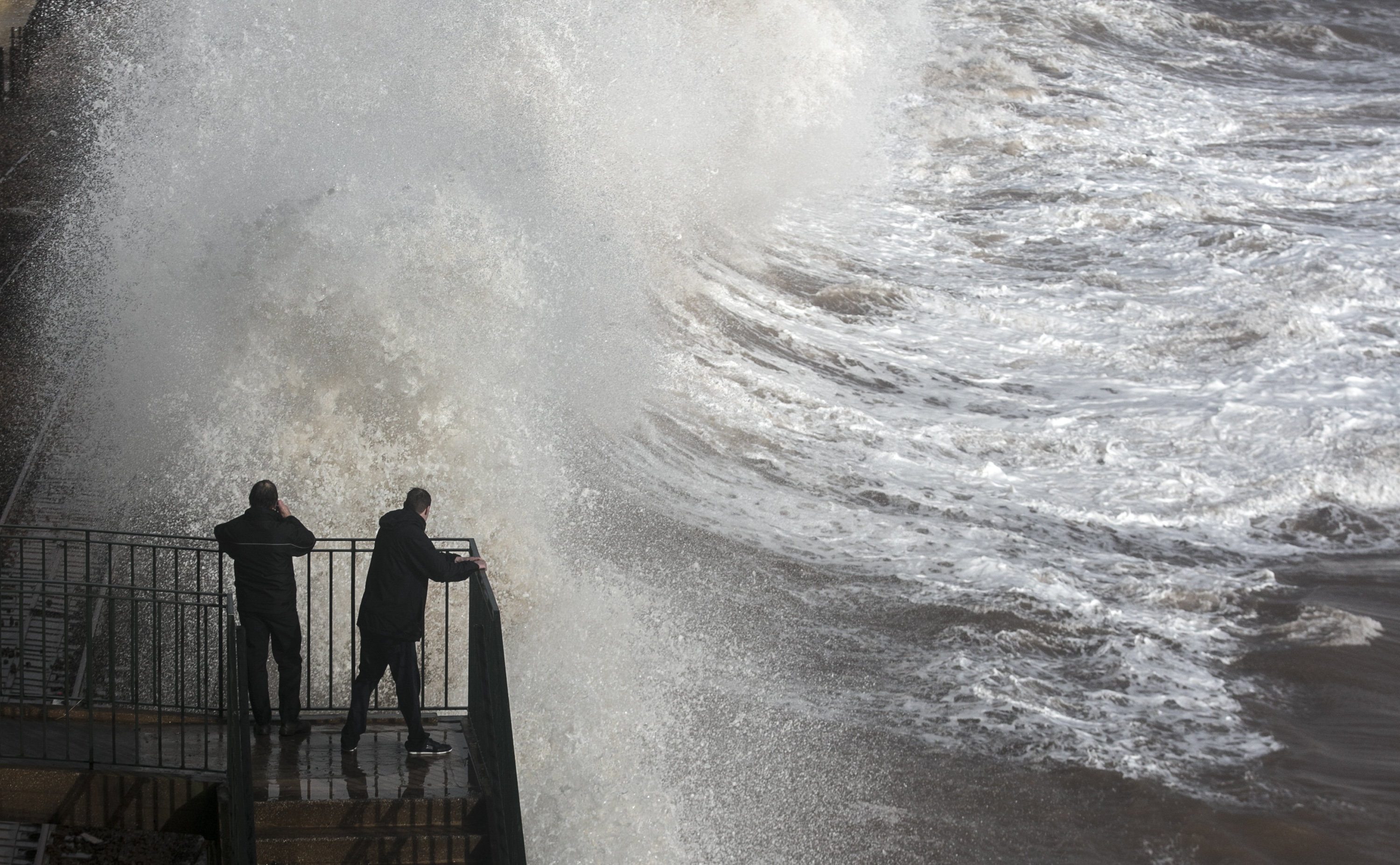
Storms Hit South West Of The UK

Five standouts: baked Alaska; Hillary Clinton’s close to non-existent record in twenty years of public life; cannabis’s non-proven relationship with schizophrenia; the promise of an anti-war Republican nominee; and the hideous abuse and violence against gay people in Putin’s near-fascist Russia. Oh, and Putin’s Olympic Potemkin Village.

The most popular post of the day remained Debating Woody Allen on Superbowl Sunday; followed by Where The Non-Believers Are.

See you in the morning.

(Photo: People watch as waves crash against the seafront and the railway line that has been closed due to storm damage at Dawlish on February 5, 2014 in Devon, England. By Matt Cardy/Getty Images.)

The Upside Of Being Down

Jonathan Rottenberg suggests that a “keen awareness of what has gone wrong and what can go wrong again can help a person avoid similar stressors in the future”:

In humans the value of low mood is put to the fullest test when people face serious situations in which current problems need to be carefully assessed. We might think of the groom who is left at the altar, the loyal employee who is suddenly fired from his job, the death of a child. If we had to find a unifying function for low mood across these diverse situations, it would be that it functions like a cocoon, a place to pause and analyze what has gone wrong. In this mode, we will stop what we are doing, assess the situation, draw in others, and, if necessary, change course.

A variety of experimental data have shown that low mood confers benefits to thinking and decision making. That lends credence to the idea that mood is part of a conservative behavioral guidance system that impels us toward actions that have been successful in the past—meaning, actions that helped our ancestors to reproduce and spread their genes. One way to appreciate why these states have enduring value is to ponder what might happen if we had no capacity for them. Just as animals with no capacity for anxiety were long ago gobbled up by predators, without a capacity for sadness, we and other animals would likely commit rash acts and repeat costly mistakes. Physical pain teaches a child to avoid hot burners; psychic pain teaches us to navigate life’s rocky shoals with due caution.

Godot’s Godlessness

Rob Weinert-Kendt praises it:

Beckett’s is not the blithe, hyper-confident, 21st-century atheism of Richard Dawkins, or the bland, self-satisfied scientism that constitutes a kind of default worldview in the educated West. It is instead the 20th century’s wounded, elegiac brand of letting-go-of-God—the entirely comprehensible incomprehension of intellectuals who felt poised between the Stygian maw of the Holocaust and the real probability of nuclear annihilation. For all its impish gallows humor, “Waiting for Godot” has, to my ears at least, an unmistakably valedictory timbre; it sounds like the lament of a one-time believer who once took the promise of faith seriously, or at the very least understood its high stakes. Put another way: Beckett’s is a voice that anyone conversant in the stark desert landscape of the Bible—anyone who has, so to speak, sat picking scabs with Job or eaten locusts with John the Baptist—will recognize in a heartbeat.

(Video: scene from Act 1 of a 1987 performance of Waiting for Godot)

From Kids’ Play To Poetry

Leafing through the Oxford Dictionary of Nursery Rhymes, Sandra Simonds wonders what poets can learn from the form:

The first thing is that sound itself intoxicates and that we connect sound, rhythm, and rhyme to form very early on, probably from infancy. The music of language forms our understanding of the world and that is why it seems so fundemental, in poems, to follow the music and sounds over sense, and to trust that your ear will take you where you want to go. We also learn that language is deeply connected to play—riddles, jokes, nonsense, and, for lack of a better word, fun. But it is also wedded to tragic losses, lost time, lost childhood, the loss of the child itself and the body of the child. Even when we survive childhood, some part of us has fallen through the ice never to return. Children are connected to that loss too. They are constantly warned about strangers, about the instability of their surroundings, constantly reminded about how small they are. As poets, we take that smallness with us into adulthood and turn it into poetry.

Banking On The Postal Service

Postal Banks

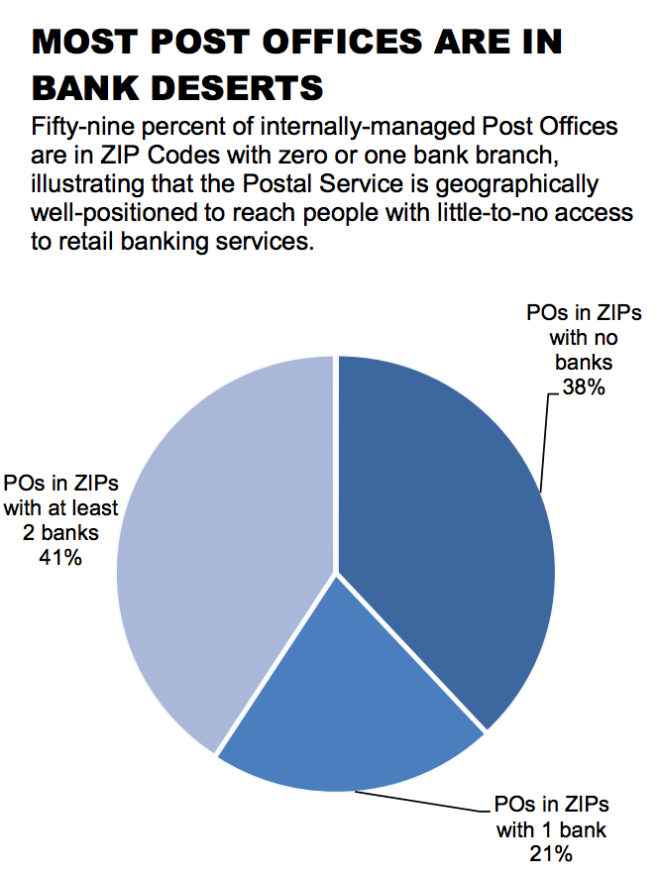
Last week, a white paper (pdf) from the USPS inspector general revived the idea of letting our post offices offer basic financial services:

The report suggests three types of potential products. First, it proposes a “Postal Card” that could make in-store purchases, access cash at ATMs, pay bills online, or transfer money internationally. Customers with paper checks could cash them at the post office or deposit them through their cell phones, loading them onto their Postal Card. Second, the USPS could offer an interest-bearing savings account, again through the Postal Card, encouraging savings from communities with little in the way of a personal safety net. Finally, the Postal Service could offer small-dollar loans, effectively an alternative to costly payday lending. The fees on all these services would be drastically lower than anything in the marketplace today.

Elizabeth Warren, naturally, loves the idea. So does Waldman:

Some people have referred to this as a “public option” for banking, which is an accurate description, but makes it more likely that Republicans will recoil in horror as they catch the whiff of the dreaded Obamacare about the proposal. But the big banks—the ones with all the power in Washington—should be perfectly fine with it, since they’re not interested in these customers anyway.

Helaine Olen disagrees:

Turns out banks are not actually losing money on low-income Americans.

In fact, the less than wealthy have turned into a nice little profit center for the big banks. If these customers want to stay, the banks make them pay. The median overdraft charge is $34 at large banks and $30 at smaller financial institutions, according to a report from the Consumer Financial Protection Bureau. The result? Moebs Services, a financial research firm, estimated banks took in $32 billion in overdraft fees in 2012.

Salmon doubts the USPS can compete with payday lenders:

Non-banks compete on convenience, not on cost, and tend to be open very long hours; while the Post Office has the advantage that a lot of the underserved go there anyway, it’s still going to have real difficulty competing with Western Union, check-cashing stores, and all the other high-cost non-bank financial-services shops which do exist in the ZIP codes without banks.

In order to make a postal bank work, it needs to be a postal bank: it has to be able to take market share away from existing banks. That in turn means that the existing banks will fight tooth and nail to prevent such a thing from ever seeing the light of day.

The Beautiful Creations Of Disturbed Minds

On Sunday, I argued that Woody Allen’s “art and his craft is so extraordinary in its range and scope and creative integrity that it escapes the twisted psyche that gave birth to it.” Gracy Olmstead disagrees:

There are many artists, it is true, who lived with little to no morals. But there seems to me an important difference between the person whose sins are voluntarily indulged in, and the person who takes advantage of the young, the vulnerable, and the voiceless. This seems to be too horrific to ignore. Perhaps I am too sensitive. But I do not want to douse my mind in the artistic thought of a man with such inexcusable inclinations and actions. … Art changes us: it affects our perceptions and our world views. Can we really trust ourselves—our minds, eyes, and ears—to Allen’s hands?

Eric Sasson wants journalists to stop assuming that Allen is guilty of molestation:

Woody Allen’s defenders point out that he was never charged with molesting Farrow, and a team of child-abuse specialists concluded that she hadn’t been molested. His detractors note that a state attorney at the time said there was “probable cause” to charge Allen, but that he chose not to prosecute the case to avoid traumatizing the young girl. There are plenty of reasons to doubt both sides. For journalists to “react” to Farrow’s letter without acknowledging those doubts does the public a disservice, and for them to question the morals of those who remain in doubt does journalism itself a disservice.

Rebecca Buckwalter-Poza, on the other hand, considers why the rich and famous often get away with these types of crimes:

Celebrities are particularly effective at discouraging victims and witnesses from cooperating with law enforcement and prosecutors in cases involving sex crimes against underage victims. Their testimony is critical to securing a conviction, but the alleged victims and their families are understandably reluctant to weather public scrutiny and a high-profile trial indefinitely and at uncertain cost for an unknown outcome.

Earlier Dish on Allen here and here.

Clinton’s Achilles Heels, Ctd

Drum agrees with me that Hillary’s achievements are underwhelming. He spots another possible weakness:

[B]y 2016 she will have been in the public eye for 24 years. That’s unprecedented. In the modern era, Richard Nixon holds the record for longest time in the public eye—about 20 years—before being elected president. The sweet spot is a little less than a decade. Longer than that and people just get tired of you. They want a fresh face. That’s largely what happened to Hillary in 2008, and it could happen again in 2016.

Carpenter’s misgivings:

I’m less concerned with Hillary’s rationale for running than I am for my own sanity.

For the next three years she’ll play it safe on the ever-Clintonian middle ground, which for the last three years has been exhaustively played out by Obama. The reasons for the latter are many, and some are valid. My complaint about Hillary is that the exciting promise of new and aggressive management will be lacking.

Linker fears we’ll have a match-up between Jeb Bush and Clinton:

 Since 1980, when I was 11 years old, a Bush or a Clinton has run for president or vice president in eight out of nine contests (with Obama’s 2012 re-election campaign being the only exception). Unless Hillary Clinton surprises everyone, 2016 is guaranteed to make it nine out of 10, which is bad enough. But the idea of the Republicans running a third Bush against her — it’s almost too much to bear.

Or rather, it’s almost enough to make me wonder why we don’t just scrap the pretense of the United States being a democracy at all and instead embrace the truth — that, at least when it comes to the nation’s highest office, we’re now a nepotistic oligarchy.

It’s a national embarrassment.