
Oxford, England, 3.30 pm
Oxford, England, 3.30 pm
In the Netherlands, a clinic that provides euthanasia for people whose doctors won’t sign off on it has ignited a debate over whether allowing psychiatric patients to undergo assisted suicide is acceptable:
Clinic Director Pleiter thinks giving psychiatric patients a chance at assisted suicide is important. “We are dealing with a group of patients that have no other place to go, that are also being ignored by psychiatry,” he said. “We are looking at their requests seriously, we treat them in all fairness. I believe it was a deliberate choice for the lawmakers to offer space legally, to which both patients with physical as well as psychological problems can turn.”
But where does one draw the line? Because these patients are not physically ill, the evaluations of independent psychiatrists are under scrutiny. Does this mean any person suffering from serious depression can shop around until he or she finds someone willing to help with suicide? And euthanasia is not only for old people. How young can you be and still get legal help if you want to die? How far should society go to overcome the biologically inbuilt threshold that makes it hard to take one’s own life by aiding someone to do so?
The Dish’s thread on suicide is here.
The early ’90s fad has seen a fascinating resurgence:
When the US military deployed soldiers to Afghanistan in 2001 for Operation Enduring Freedom, nickels and dimes probably weren’t important concerns. But soon, commanders realized that importing US coins for army purchases was, cumulatively, too heavy: there was simply no room for chump change in supply shipments.
In stepped the Army Air Force Exchange Service (AAFES), the Army’s merchandise supplier and foreign base exchange operator since 1895. On its website, the AAFES pledges to “go where you go in serving our troops worldwide.” And that they did: in November 2001, they brought pogs back into play and began shipping them to Afghanistan. They drastically reduced the weight of shipments: $100 in quarters (5 pounds, 1 ounce), was reduced to 14 ounces in equivalent pog currency. …
The pogs worked. Soldiers use them to this day to buy anything sold in the 181 AAFES department stores across 30 countries (and all 50 US states). In addition, the AAFES has partnered with over 1,000 major retail and food chains; pogs are now valid as a form of currency at Taco Bell, Cinnabon, Burger King, and Popeyes.
Update from a reader:
The pogs post cracked me up. When I was in Afghanistan in 2010, someone had glued perfectly cut and cropped pictures of dicks/balls/hairy asses to the pogs. Whoever was doing it had produced them so well that they looked and felt just like the regular pogs, except instead of a picture of a bald eagle or an American flag or whatever, it was a picture of a giant butt-plug. These pogs, of course, made it into the circulation of the base economy, and were also accepted by the locals at the small bazaar. Senior officers grumbled, I’m sure, but as far as I know, the person producing them was never caught.
(Photo by Wikipedia user Lando242)
Profiling some of New York’s newly mixed neighborhoods, Justin Davidson notes that the “link between a neighborhood’s economic fortunes and the number of people being forced to move away, while anecdotally obvious, is difficult to document”:
In 2005, Lance Freeman, a professor of urban planning at Columbia, examined national housing statistics to see whether low-income residents move more often once their neighborhoods start to gentrify. His conclusion was that they don’t. Mobility, he suggested, is a fact of American life, and he could find no evidence to suggest that gentrification intensifies it. Instead, it appears that many low-income renters stay put even as their rents go up. … [Freeman] doesn’t doubt that displacement occurs, but he describes it as an inevitable consequence of capitalism. “If we are going to allow housing to be a market commodity, then we have to live with the downsides, even though we can blunt the negative effects to some extent. It’s pretty hard to get around that.”
That infuriates the British scholar Tom Slater, who sees Freeman’s data studies as largely irrelevant because, he has written, they “cannot capture the struggles low-income and working-class people endure to remain where they are.” Freeman waves away the binary rhetoric. “You can’t boil gentrification down to good-guy-versus-bad-guy. That makes a good morality play, but life is a lot messier than that.”
A PhD student objects to Obama’s lighthearted dig against her field:
In the coming years, it’s likely that visual literacy will become a key skill, alongside textual literacy, for workers throughout our economy. This is why it’s important for President Obama to understand that art historians don’t simply teach the historical development of artistic styles; more critically, we teach people how to look at images. I don’t think he would make a public statement against teaching our children to read … so why should he implicitly ridicule teaching people how to read images, when images are now as important as text in the construction of our common culture?
It’s especially worrisome for a politician, of all people, to casually dismiss the very field most responsible for training American citizens in visual literacy (now that the arts are all but banished from high school curricula). Political campaigns and culture wars alike are now waged through images as much as through soundbites – just ask Michael Dukakis. An informed electorate has to know how to decode visual information: not just art history majors, but all Americans, should learn how to read images.
Last week, Clay Shirky argued that “number of high-school graduates underserved or unserved by higher education today dwarfs the number of people for whom that system works well.” Freddie doesn’t think technology can solve this problem:
[E]ducating “nontraditional” students– administrator speak for poor students, students whose parents are themselves uneducated, minority students, and students who struggled in high school– is really hard. Look, I don’t doubt that the American university system has failed these students in any number of ways. I could go on at length about those failures. But at some point you have to actually grapple with reality, which is that for a complex and controversial set of reasons, some people are harder to educate. Not everyone is equally capable of educational success. They just aren’t. I’m dedicated to the task as getting as many marginal students in and through as possible, and I think that’s an absolute moral need for our colleges and our society. But it’s not going to work for everyone, and it’s going to take great efforts, and online models are precisely the opposite of what’s likely to work. …
Pleasant lies about everyone’s ability to succeed in college, particularly in a new kind of college where by design individual students receive far less attention, are politically pleasing but practically destructive.
Alan Jacobs adds:
I’m still waiting for just one school in financial straits to completely restructure its priorities in favor of a near-total focus on the teaching of undergraduates. Then maybe others will follow. But in any event the idea that MOOCs are preferable to such genuine reform strikes me as nuts.
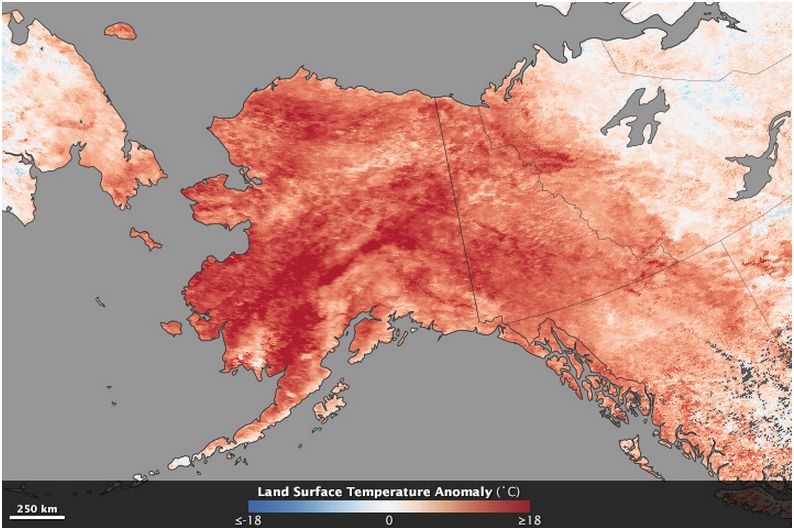
Visit Alaska, where temperatures are 40 degrees above average:
The abnormal spate of warmness – which far as I can tell has not been addressed by weatherperson Sarah Palin – forced the cancellation of skiing events, with one organizer saying, “We just don’t have the snow and way too much water in the hills to put together a quality race.” It also led to the 2014 Yukon Quest Sled Dog Race being launched in downtown Fairbanks, rather than its historical starting line on a frozen river, because the river ice was so thin spectators would’ve fallen through it. … To give people an idea how freaky an event this was for the 49th State, NASA has put together a visualization of phenomenal temperatures from January 23 to the 30th. Based on satellite readings, the map shows warm-weather abnormalities spreading in red all across the region.
Charles Kenny backs up Bill Gates’s controversial position, articulated in his foundation’s annual letter, that corruption isn’t as serious an obstacle to international development as people think it is:
As Gates suggests, there’s strong evidence corruption acts as a real tax in many countries—and not just on aid, but on all government transactions. But look at another question in the World Bank survey: “What’s the most serious obstacle facing the operation of this establishment?” Companies are given 15 possible answer choices, ranging from access to finance to regulations, infrastructure, tax rates, crime, and corruption. In less than 1 percent of countries was ‘corruption’ the most common answer. In only one out of seven countries did corruption even rank in the top three most common responses. Access to finance ranked first in 29 percent of countries, while electricity was the top concern in more than one out of five countries. Corruption ranked eighth out of the 15 obstacles, equal with customs and trade regulation and labor regulations. That put it below crime and disorder, political instability, informal sector competition, tax rates, and an inadequately educated workforce.
Meanwhile, readers continue the aid debate. One who works in military aid agrees with our jaded former foreign service officer that “much of what we provide is not particularly useful in terms of transforming or improving the target recipient institutions.” But, he adds, “that’s only part of the reason we provide the funding”:
I have worked in military assistance for over a decade – primarily Foreign Military Financing (money to buy US military equipment and services), International Military Education and Training (free military schools in the US), the Global Peace Operations Initiative (equipment and training to improve peacekeeping capability), and a variety of smaller but related programs falling loosely under the rubric of “security assistance.” In many cases, the millions we pour into these programs have done little to make the recipient country better, their military more professional, their institutions stronger, or their populations safer. Plenty will argue that our infusion of military equipment and training have often made them worse.
But making things better for the recipient is not the only reason we do it. We also do it to gain or enhance “access and influence” with the leadership and decision-making bodies running the country. And that part works great. Our military foreign area officers in our security cooperation offices, and our majors, lieutenant colonels and colonels, can pick up the phone and call the most senior generals in their respective partner nations. Within a day they can arrange a meeting with the Minister or Defense.
Is the amount we spend worth the access and influence we gain? I have no idea, and it’s a worthwhile discussion. But assessing the results solely on vague notions of “did we do good?” does not address the full picture.
Another:
Your reader who commented on Paul Farmer doesn’t seem to be too informed. Paul Farmer and his organization, Partners In Health have been in Haiti for nearly three decades and have actually made a great impact on HIV/AIDS infection rates. Without them, those rates would no doubt be worse. Are diarrheal diseases a big problem in Haiti? Yes, but not because of Paul Farmer. The United Nations introduced cholera, which has now killed over 8,300 people and the UN refuses to accept responsibility or commit actual funds to clean up their shitty mess. With over 10,000 NGO’s in Haiti, decades of foreign governments meddling in Haitian politics (supporting dictators and paramilitary organizations), and a weakened Haitian state, I fail to see how this is Paul Farmer’s fault or how fighting HIV/AIDS in Haiti is a “shenanigan.” I guess we could just throw HIV-infected Haitians in Guantanamo.
[Re-posted from earlier today]
Today is the Dish’s first anniversary of going independent on our own site with our own company. We launched for real on February 4, 2013. And that’s when I, along with a large swathe of you, started my subscription. Today it expires, and sooner or later, if you haven’t yet renewed, you’ll have the irritating prospect of being blocked by our meter system. We always promised transparency so here’s the state-of-play of the last thirteen months as of this lunchtime:
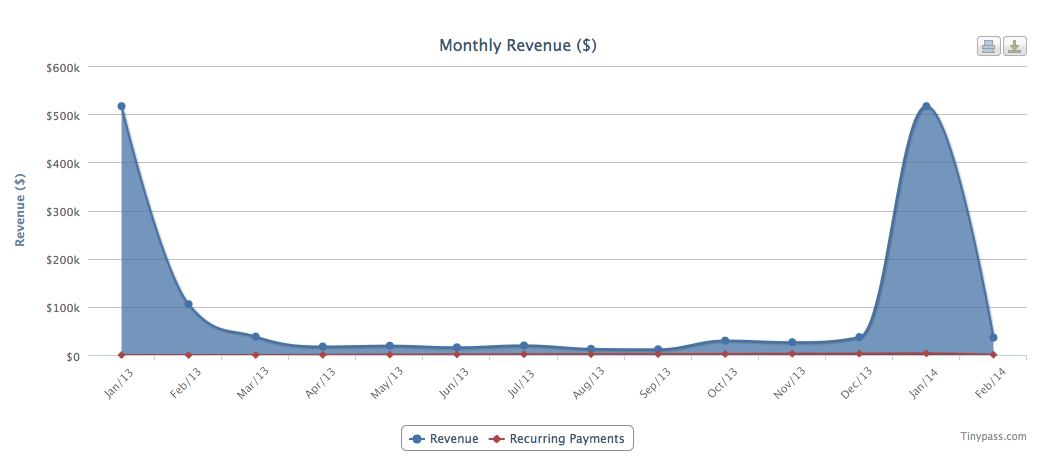
As you can see, we matched January 2013’s total in January 2014. Actually, we beat it by a smidgen last Friday night. That’s a pretty extraordinary result and an amazing start for the year. But it’s not enough to sustain us for the year ahead with even last year’s budget and February remains a critical month for us, as you can see from the graph above. More to the point, we know there are many of you out there who subscribed last January and February and who’ve understandably been putting off renewing until you absolutely have to. I get that, because it’s the kind of procrastination I’m pretty good at myself. But the moment when you actually have to renew in order to avoid any future interruptions is now here. Today is the last day you can simply renew your subscription and never get your reading intercepted by our meter. After today, you can still subscribe, of course, but you’ll have to start again as a new subscriber.
So if you’ve been procrastinating on this but always intended to renew – and we totally understand why –  count this as a friendly nudge to get it over with. It’s a truly simple and quick process, and you can get it done in a couple of minutes tops. Take a moment to ask yourself what the Dish is actually worth to you over the year – and plug it into the renewal box. It’s still only a minimum of $1.99 a month or $19.99 a year – but many renewing subscribers have picked price points more tailored to them. It could be the double chai option of $3.60 a month; or a pledge to support our coverage of the marijuana legalization debate at $4.20 a month; or a decision to back this new model for online journalism by upping your subscription to $100 a year (541 hardcore Dishheads have so far); or just a simple renewal at the same minimum price as last year. Our most popular price point right now is $25 a year; but the $50 a year is our fifth most popular, and our average price this year is still around $37.
We’ll leave it to you to create a price point tailored to you. And we’re thrilled to have you along for the ride at whatever price point you can afford. But today is the last day you can simply renew and avoid any future hassles or interruptions.
So renew here! Renew now! And make sure your Dish reading experience is never interrupted again. If you run into any problems renewing, please email us at support@andrewsullivan.com.
Update from a new subscriber, who throws another price-point in the mix:
Following in the new tradition of adding a tip to the bill, I paid 31.41 – because I’m a nerd.
Another reader’s formula:
I renewed my subscription at $32.99 because the Dish it is the first thing I check every morning and several times throughout the day. I think it is probably worth $40.00 a year, but I deducted $7.00 for the God stuff and a penny for the dogs. I hate dogs.
One more reader:
Yes, I was a straggler. Part of it was procrastination. Part of it was just wanting to push you to the edge (sorry!). Part of it was money struggles. But today I put fifty bucks into your till because, frankly, you’re irritatingly worth it. And I really don’t want to miss Deep Dish.
Keep up the good (yet sometimes infuriating) work. Thanks to you, Andrew, and the entire team. You help keep me sane.
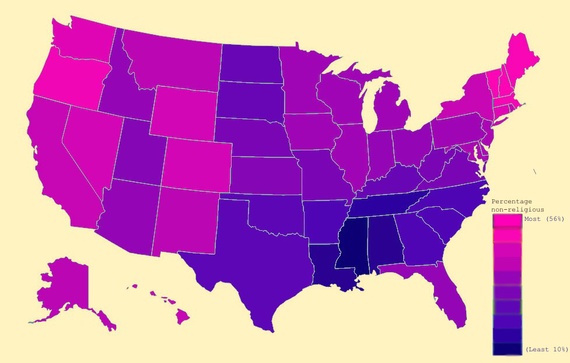
New Gallup data on religion breaks down by state how many Americans identify as “none”:
Take a look at the map. Vermont and Mississippi are on opposing ends of the spectrum: 56 percent of those surveyed in the Green Mountain State aren’t religious, while only 10 percent of those surveyed from the Magnolia State said the same. But each of those states represent an extreme, outranking the next most- and least-religious state by five percentage points. Compared to the rest of the country, Vermont is more the exception than the rule—the average for the U.S. skews toward the bottom end of the spectrum, at just 29.4 percent.
In one part of a larger essay, Beinart looks at how America’s religiosity is fading:
Americans remain far more willing than Europeans to affirm God’s importance in their lives (although that gap has closed somewhat among the young). But when the subject shifts from belief in God to association with churches, America’s famed religious exceptionalism virtually disappears.
In 1970, according to the World Religion Database, Europeans were more than 16 percentage points more likely than Americans to eschew any religious identification. By 2010, the gap was less than half of 1 percentage point.According to Pew, while Americans are today more likely to affirm a religious affiliation than people in Germany or France, they are actually less likely to do so than Italians and Danes.
Even more interesting is the reason for this change. Many of the Americans who today eschew religious affiliation are neither atheists nor agnostics. Most pray. In other words, Americans aren’t rejecting religion, or even Christianity. They are rejecting churches.
One cause Beinart identifies:
In Europe, noted the late political scientist James Q. Wilson in a 2006 essay on American exceptionalism, the existence of official state religions led secularists to see “Christians as political enemies.” America, Wilson argued, lacked this political hostility to organized religion because it separated church and state. But today, even without an established church, the Religious Right plays such a prominent and partisan role in American politics that it has spurred the kind of antireligious backlash long associated with the old world. Barack Obama is the beneficiary of that backlash, because voters who say they “never” attend religious services favored him by 37 percentage points in 2008 and 28 points in 2012. But he’s not the cause. The people most responsible for America’s declining religious exceptionalism are the conservatives who have made organized Christianity and right-wing politics inseparable in the minds of so many of America’s young.
 The Dish
