
What’s Next For Afghanistan?

AFGHANISTAN-ELECTION-ATTACK

With the country’s presidential elections some two weeks away, Dov Zekheim offers his endorsement:

It is critical not only for Afghanistan, but for the United States and the West, that his successor be a man – all remaining candidates of the original 27 who put their names forward are men – who appreciates not only Western values, but actually lives by them. That man clearly is the current front runner by the slightest of margins, Ashraf Ghani. The former finance minister, advisor to Karzai (though his advice was invariably ignored), and World Bank official is a genuine friend of the West in general and of the United States in particular.

I had the distinct pleasure of working alongside him when, as Under Secretary of Defense, I also was DoD’s civilian coordinator for Afghanistan. Ashraf was finance minister at the time, and he was doing his utmost to employ such power that his office afforded him to regularize Kabul’s intake of resources and its budgets. He tried to professionalize those civil servants who worked for him. He sought not to confront the warlords – he knew that was a losing battle – but rather to pursue a strategy of co-opting them even as he worked around them.

However, just yesterday Taliban militants attacked an election office next to Ashraf Ghani’s home. As Sean Carberry notes, during the Afghan election season, “the candidates are busy campaigning – and the Taliban are busy attacking”:

The latest attack came Tuesday morning in Kabul when two suicide bombers detonated themselves outside one of the offices of the Independent Election Commission. Moments later, several gunmen ran inside and waged a three-hour gun battle with dozens of Afghan police. … Last week, four teenage gunmen smuggled pistols through several checkpoints at a highly secure five-star hotel in Kabul and shot diners in the restaurant. They killed a highly regarded Afghan journalist, his wife and two of his children. They also killed four foreigners, including an international election monitor staying at the hotel.

As a result of that attack, two out of the three international election monitoring organizations that were planning to observe the elections have pulled their people out of Afghanistan, raising further questions about the integrity of the April 5 vote for a successor to President Hamid Karzai. There’s no clear-cut favorite in the race, and it’s quite likely that no candidate will get 50 percent of the vote, which will necessitate a runoff between the two top vote-getters. That would mean an extended campaign and the prospect of additional violence.

(Photo: A bloodied election poster that reads ‘Your vote is your future’ lies on the ground at the site of a suicide attack on an election commission office in Kabul on March 25. Fifteen people died in violence around Afghanistan less than a fortnight before the country’s presidential poll. Insurgents have vowed a campaign of violence to disrupt the ballot on April 5, urging their fighters to attack polling staff, voters, and security forces in the run-up to election day. By Wakil Kohsar/AFP/Getty Images)
Sticks And Stones And “Homosexual” Ctd

A reader writes:

A few years ago, a filmmaker brought a documentary to the ImageOUT festival in Rochester, and he also brought along some of the “Gay Pioneers” featured in the film. Some very big names, as I later came to find out, like Frank Kameny, Lilli Vincenz, and Barbara Gittings. Because I took care of the gay library at the community center (and still do) I had a small group meeting with Barbara at a cafe (she had been a librarian). It was very inspiring to chat with her about books and life and the movement, and we were all feeling very good about everything. And as it turned out, I was asked to give her a ride back to her hotel. As I moved onto the street, Barbara blurted out from the back seat in a loud and happy voice: “Isn’t it just wonderful to be homosexual?”

Surprised (as I had never heard anyone really phrase it that way), all I could say from up front in response was: “Yes, yes it is. Indeed!”

That’s exactly the kind of reclamation I’m talking about. It carries no whiff of victimhood; it is suffused with the joy of so much of gay life; and it’s unifying. And yes, it is just wonderful. I thank God for being gay all the time. It is, in so many ways, a charism.

Manipulated For The Greater Good?

Screen Shot 2014-03-27 at 10.43.02 AM

Nitsuh Abebe pulls the curtain back on Upworthy’s editorial process. On the site’s mission:

Much of Upworthy’s content does feel like reality TV. A lot of it also feels like advertising. This isn’t an accident; the site’s built, tactically and deliberately, to appeal to what skeptics once called the lowest common denominator. Its choices are the ones you’d normally associate with a race to the bottom—the manipulative techniques of ads, tabloids, direct-mail fund-raising, local TV news (“Think This Common Household Object Won’t Kill Your Children? You’d Be Wrong”). It’s just that Upworthy assumes the existence of a “lowest common denominator” that consists of a human craving for righteousness, or at least the satisfaction that comes from watching someone we disagree with get their rhetorical comeuppance.

In some respects, Upworthy does represent a slight paradigm shift in the constantly churning world of writing and the web. It’s really about producing writing or visuals or videos that people want to share. Their contribution to the evolution of the web, like Buzzfeed’s, is honing and finessing and mastering the tricks and techniques of getting people to share Upworthy items on their Facebook pages. One reason so many of the posts are indeed shared, as the piece points out, is not just the very catchy formulaic headlines (already expiring from over-use) but, more importantly, that they are not strident or edgy or in any way discomfiting. That way, the posts can be attached to a Facebook feed as a way of expressing your identity, of solidarity with the disadvantaged, of the appearance of caring. It really is a beautiful circle, designed, of course, to make shitloads of moolah at some point by dominating the sharable content that has become much of our common reading material.

But here’s the thing: is crafting “content” for sharing the same thing as writing or journalism? Here’s my basic test.

Does the writer of the piece select the topic because he or she believes it sincerely to be worth writing about? And does the writer want the piece to be read for its point rather than merely passed around to maximize revenues and traffic? Upworthy rather brilliantly collapses its business rationale – nothing but “evergreen standards like ‘Human rights are a good thing’ and ‘Children should be taken care of’” that will be easily shared – and its journalistic rationale – i.e. we want to make the world a better place by being nice to children, puppies, etc. The reason why it’s hard to be completely cynical about Upworthy is that the content, if anyone reads it, is so, well, uplifting. But of course, that’s the real, deep cynicism behind it.

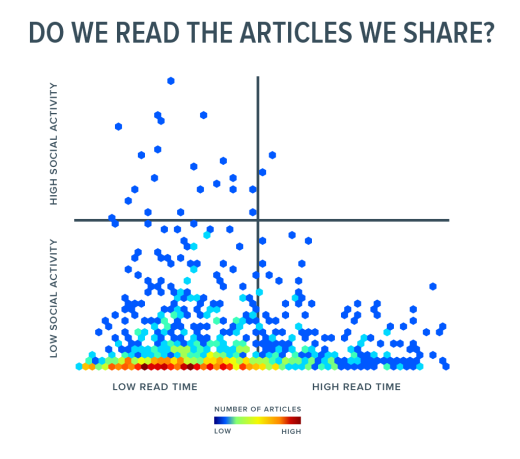
Next month, we’re told, Upworthy will unveil its monetization strategy. So at some point, we’ll see exactly what it’s about: the money or the writing? But it’s vital to recall what Tony Haile, CEO of Chartbeat has discovered, illustrated in the chart above:

A widespread assumption is that the more content is liked or shared, the more engaging it must be, the more willing people are to devote their attention to it. However, the data doesn’t back that up. We looked at 10,000 socially-shared articles and found that there is no relationship whatsoever between the amount a piece of content is shared and the amount of attention an average reader will give that content.

When we combined attention and traffic to find the story that had the largest volume of total engaged time, we found that it had fewer than 100 likes and fewer than 50 tweets. Conversely, the story with the largest number of tweets got about 20% of the total engaged time that the most engaging story received.

So Buzzfeed and Upworthy are really about sharing for money than reading for interest. We may be evolving into a web where everything is shared and nothing is actually read. And journalists are leading the charge.

Planes Are Safer Than Cars Everywhere

Increasing aviation safety in developing countries is a low priority for Charles Kenny:

The macabre but exhaustive website planecrashinfo.com put the odds of being killed on a single airline flight at about one in 4.7 million across 78 major world airlines; among the airlines with the worst safety records, the odds rise to one in 2 million. In the middle of the last decade, the fatal crash rate for Kenya Airways was about three in 1 million. For Ethiopian Airlines, it was four in 1 million. That’s higher than that of U.S. carriers such as American Airlines (0.6 fatal crashes per 1 million flights) or United (0.5 per million)—but it still suggests flying is safe, and that the gap between poor and rich countries is small.

That’s not true for driving.

While it’s widely known that flying is statistically safer than driving, just how much safer varies from country to country. Data from the World Health Organization and the World Bank suggest that, in the U.S., there are 1.4 fatalities per year for every 10,000 cars on the road. In Malaysia, there are seven; in Kenya, 87—more than 60 times the rate in the U.S., compared with about a fivefold gap in air safety. Given how often people drive, and how indispensable car travel is in most countries, the gap in developing countries’ road safety records is far more troubling than their air safety records are impressive.

In other MH370-inspired commentary, Emily Yoffe uses psychology to explain our fascination with flight 370:

[I]t’s the specific nature of the disappearance of Flight 370 that pings some of our most basic cognitive drives. In their book The Scientist in the Crib, Alison Gopnik, Andrew Meltzoff, and Patricia Kuhl write, “Babies become interested in, almost obsessed with, hiding-and-finding games when they are about a year old. There is the timeless appeal of peekaboo. … Babies also spontaneously undertake solo investigations of the mysterious Case of the Disappearing Object.” So, from our earliest days, we focus our attention on objects that are hidden, and then revealed. This consuming play, they write, “contributes to babies’ ability to solve the big, deep problems of disappearance, causality, and categorization.” No wonder we’re watching CNN’s nonstop coverage of a disappearing object.


Cuteness In Captivity

Bert Archer makes the perennial case against zoos:

I feel confident in saying that we, the animal-loving public, are idiots. We don’t pay attention (and step on nests), we don’t think things through (and pay companies to put whales in aquariums), and, since the entirety of our context for animal-human interaction seems to be cats and dogs, we have a deep desire to treat all animals the same way. We want to pet them and hug them and love them and kiss them. Hence the outrage directed of late at Sea World and its cognates, with their riding and caressing animals in a way that makes it clear, when put alongside the hoop-jumping sea lions and the dancing dolphins, that we as humans have dominion over these creatures, and can make them do our bidding, as is natural and just. Dogs and cats are our creations; those other creatures are not, no matter what it says in Genesis. Thinking that they are here for our use is the sort of logic that led to the sealing and whaling industries of the last two centuries, which nearly wiped out the upper echelons of the aquatic food chains.

Previous Dish on the ethics of zoos here.

Why Are We So Overwhelmed?

Brigid Schulte’s new book looks at why we’re constantly battling “the overwhelm.” Nicole Dubowitz explains how the idea for the book came about:

As a mom of two young kids, Schulte was incredulous when University of Maryland sociologist John Robinson asserted that women have at least thirty hours of leisure time every week — “not as much as men,” he said, “but women have more leisure now than they did in the 1960s, even though more women are working outside the home.” He encouraged Schulte to keep a diary on her leisure time usage and report back. Overwhelmed began with the author’s 2010 feature in The Washington Post magazine, where she posed the first of many questions: “How did researchers compile this statistic that said we were rolling in leisure — over four hours a day? Did any of us feel that we actually had downtime?”

In keeping her diary, Schulte was pretty sure she would prove Robinson wrong, or else find that she had been “squandering” away leisure time while feeling overwhelmed. More questions for the book developed: Do our daily commitments “contaminate” the leisure time we do have? Why are things the way they are, and is there anything we can do to make them better?

Hanna Rosin digs into Schulte’s findings:

To be deep in the overwhelm requires not just doing too many things in one 24-hour period but doing so many different kinds of things that they all blend into each other and a day has no sense of distinct phases.

Researchers call it “contaminated time,” and apparently women are more susceptible to it than men, because they have a harder time shutting down the tape that runs in their heads about what needs to get done that day. The only relief from the time pressure comes from cordoning off genuine stretches of free or leisure time, creating a sense of what Schulte calls “time serenity” or “flow.” But over the years, time use diaries show that women have become terrible at that, squeezing out any free time and instead, as Schulte puts it, resorting to “crappy bits of leisure time confetti.”

Helen Lewis points out that we bring on some of the stress ourselves:

The relatively affluent have to take some responsibility for worshipping at the Altar of Overwork, an attitude Schulte calls “busier than thou”. Just as having a tan became a status symbol once it denoted that you could afford foreign holidays, so being overwhelmed is a badge of honour for middle-class professionals. Oh, between Jonny’s clarinet lessons and my Mandarin classes and Steve getting promoted to partner, I don’t have a minute to myself, they trill. Having no free time makes the point you don’t just have a job. You have a career. You are Going Somewhere.

Schulte’s prescription is simple: decide whether you love the bragging rights of being busy enough to live in a debilitating whirlwind of activity. If you don’t, perhaps leave the clarinet unmolested and the boxercise class undone. As for housework, one researcher’s message to women is refreshingly simple: be a slattern. “Do you have to be able to do open-heart surgery on the kitchen floor?” he asks. Also, make sure Himself pulls his weight.

In an interview, Schulte explains how her perspective has changed:

I was just with my father who’s had a stroke, and sitting in a hospital room really makes you remember: … We don’t have that much time; what do you want to make of your life here on this Earth? And so, my to-do list is really: What are my priorities? What is most important to me? And then everything else, everything my to-do list used to be, I call the other 5 percent — it shouldn’t take more than 5 percent of my time or energy. There’s a lot of stuff that I used to do that I don’t do anymore.

Chart Of The Day

Marriage Business

Your marriage will likely outlast your startup:

From retail to gas extraction, none of the 19 sectors we looked at had an average life span longer than the average marriage. Management companies have the best survival rates, with 66 percent of companies formed in 1995 making it to the five-year mark (compared with 80 percent of marriages). Even locality didn’t make a big difference; no state had business-survival rates that came close to surpassing national ones for marriage.

“One Of The Most Ageist Places In America”

That’s how Noam Scheiber describes Silicon Valley:

Tech luminaries who otherwise pride themselves on their dedication to meritocracy don’t think twice about deriding the not-actually-old. “Young people are just smarter,” Facebook CEO Mark Zuckerberg told an audience at Stanford back in 2007. As I write, the website of ServiceNow, a large Santa Clara–based I.T. services company, features the following advisory in large letters atop its “careers” page: “We Want People Who Have Their Best Work Ahead of Them, Not Behind Them.”

And that’s just what gets said in public. An engineer in his forties recently told me about meeting a tech CEO who was trying to acquire his company. “You must be the token graybeard,” said the CEO, who was in his late twenties or early thirties. “I looked at him and said, ‘No, I’m the token grown-up.’ ”

One consequence: cosmetic surgery is in high demand:

In talking to dozens of people around Silicon Valley over the past eight months – engineers, entrepreneurs, moneymen, uncomfortably inquisitive cosmetic surgeons—I got the distinct sense that it’s better to be perceived as naïve and immature than to have voted in the 1980s. And so it has fallen to [San Francisco surgeon Seth] Matarasso to make older workers look like they still belong at the office. “It’s really morphed into, ‘Hey, I’m forty years old and I have to get in front of a board of fresh-faced kids. I can’t look like I have a wife and two-point-five kids and a mortgage,’ ” he told me.

McArdle wonders why venture capitalists prefer younger entrepreneurs:

One possibility is that VCs are looking for a lottery ticket of sorts — the fantastic scores that will make you Facebook money from a small initial investment. And maybe you’re more likely to get a winning lottery ticket from a young entrepreneur, not just because they’re unconstrained by past experience, but also because the markets they cater to simply have more of that potential than businesses based around an older demographic. Older people are more set in their ways and have more obligations; they’re unlikely to spend hours of their valuable time helping you build a sustainable user base for the next Facebook or Twitter.

Another possibility is that most of the people who want to be first-time entrepreneurs are in their 20s and early 30s, before they have families and mortgages that need to be paid every month. Because older entrepreneurs are rare, they don’t fit investors’ mental model of what an entrepreneur looks like.

The Down’s Spectrum, Ctd

The thread grows and grows:

A close relative of mine has a three-year-old girl with Down’s, and she is an angel. Whatever the spectrum is, she is on the high-functioning end. This year she started attending preschool, and the hope was to mainstream her eventually. All that is on hold now because she was just diagnosed with leukemia.

Seeing her family cope with this situation is quite difficult, but it is not uncommon. Even though this little girl was mentally high-functioning, she is more susceptible to physical problems because of her extra chromosome. Another reader mentioned a hole in the heart, which is another common health issue for Down’s kids. A quick Google search will show you just how many physical problems are more likely with Down’s. It’s daunting.

Some good news: prior to the ACA, Down’s was a pre-existing condition, subject to all the limitations that went along with that. Now my family is at least not worried about hitting a lifetime dollar limit on her care. (She is receiving excellent care and responding well to chemo.)

The thing about her Down’s is that it is tough, but it is manageable and a well-known, well-researched condition. Her family has immense support, and people truly do understand Down’s in a way they did not used to. This little girl requires far less care than, for example, my cousin who has hydrocephalus, among other things. He is 22 years old and over six feet tall, but he is cognitively two years old. He requires constant care and has no hope of ever functioning on a higher level. The mother of the girl with Down’s knew with a simple blood test that her fetus was at a higher risk for Down’s. My aunt did not know until after her son was born that he would be so disabled.

Because of my relationship with these two families, I do not understand choosing to terminate a pregnancy because of a blood test that says there is an extra chromosome in the fetus. That bit of information simply does not tell you much. Your child could have far more severe problems that don’t show up until well after birth. Getting pregnant at all is a huge risk and a commitment to another person for the rest of your and their life.

I am pro-choice, and I firmly believe the decision to end a pregnancy is too personal to be handled by the government or anyone but the person in that situation. I am not trying to pass judgment on someone who does choose to end a pregnancy because of the blood test; I just have trouble understanding it.

Another is on the same page:

I recently gave birth to my first child in November. I am part of a group of online mothers, and one mother delivered a premature baby girl who has Down Syndrome. She is an adorable baby and very lucky that she has such a caring mother. Her mother has recently become a very vocal advocate for banning abortion (in cases of Down’s) and even prenatal testing! I’ve kept my mouth shut, but it’s been hard. I do not know how someone, who is so intimately aware of the struggles that come from having a child with special needs, feels they can dictate other families decisions in this way. Then again, that’s the issue with the whole abortion debate. But special needs seems to be a special case, not only because of the suffering a child or adult with disabilities may endure, but because of the impact it will have on any other children or family members.

I should add that I have a sister-in-law with Down’s. She is at the higher end of the spectrum but could never live alone. She is very sweet and loving and caring. But she’s a child in a woman’s body. I’ve often asked my husband what would happen if her parent (my father-in-law and my husband’s step mother) passed away. Where would his sister go? He assures me that his step-mother has a large family who would care for her. But I really worry that there isn’t a plan. And where does that leave us?

Another:

Your reader who shared anecdotes about her 62-year-old cousin with Down syndrome is exactly why the PSA video you highlighted on World Down Syndrome Day is important and necessary. It’s important and necessary because it articulates a point of view that is often drowned out by messaging consistent with your reader’s mindset, i.e., your life will be horrible if you have a child with Down syndrome. It’s scary enough for parents who get a diagnosis of Down syndrome – pre or postnatal. Those parents will immediately seek out information, and often times the information they will find is overly pessimistic, horribly one-sided and often antiquated.

Hence, it is nice to see the other side of the story – the side that shows that while there will inevitably be challenges, your child will be more alike than different from your other children and will bring immense joy to your life. I know from experience that that is a dark and scary time and you naturally focus on the real or perceived negatives of your situation. I wish I had seen that video during those first few weeks for a brief respite from the doom and gloom. I have three sons, one of whom happens to have Down syndrome. I have a ton to be thankful for, both professionally and personally, but having and raising my son with Down syndrome is the best thing that has ever happened to me. I really could not care less if someone believes that is an overly optimistic viewpoint. It’s the truth.

Another reader sends another video, embedded above:

We found out our 12-year-old daughter Sophie had DS in our seventh month and just couldn’t go through with terminating the pregnancy.  When you see the video, you’ll know we made the right choice.

One more:

Reading this thread just about brought me to tears; it’s just so moving.  I’m so grateful for your site and the unparalleled reader feedback that makes it so special.

Asbestos Still Abounds

Nic Fleming traces the history of asbestos regulation. Its harmful effects have been known for a century, but the industry fought hard to keep scientists quiet:

Scientists who published inconvenient results were vilified and harassed. … Any natural gaps or uncertainties in the research that showed asbestos caused disease were highlighted and exploited in an early version of the now-prevalent ‘manufactured uncertainty’ tactic. If these strategies sound familiar, there’s a good reason: the industry was being advised by a U.S. public relations company that had previously defended big tobacco.

Even today, economic interests trump regulation across the globe:

From a peak of 5 million tonnes around 1980, asbestos production fell to 2 million tonnes around two decades ago, and has hovered around that mark ever since. Russia accounts for half of world production, with the other large producers China, Brazil and Kazakhstan. As of April 2013, bans on all types of asbestos use were in place in 54 countries—fewer than the number in which it is still used. China and India consume the most, together taking almost half of world production. Thailand, Indonesia, Sri Lanka, Brazil and Russia use significant amounts.

In 2013, an attempt to add white asbestos to the Rotterdam Convention [on hazardous substances] was blocked by Russia, Kazakhstan, Ukraine, Kyrgyzstan, Zimbabwe, India and Vietnam. Supporters of the move said it would have led to improved labelling, handling and safety regulations, and saved thousands of lives. Opponents said it would increase shipping and insurance costs.

Update from a reader:

My father gasped his last breaths somewhere between assisted death via morphine and suffocating to death in the late 1990s.  For his last four hours we discussed what he saw and what he dreamt as the drug took hold to relieve the incredible pain of his ravaged lungs until he simply became silent.  Then he passed.  On an x-ray, both lungs looked like a nighttime aerial view of twin cities with cluster after cluster of mutated cells stimulated by silicate fibers that were the critical size and shape gets trapped in our lungs and that imparts the disease.  Asbestos kills slowly and relentlessly.

He had worked in a factory all of his adult life and was a moderate smoker, mostly cigars, for the majority of 35 years he worked.  Several of his colleagues also died from mesothelioma.  About twice a year I still get my share of the modest checks tied to the asbestos settlements.  They are eerie reminders of the steady suffocation and pain that occupied my father’s late-50s, mad money that I refuse to spend on anything serious.

He came home every day from that job in his work clothes.  I wonder sometimes whether those of us with this type of secondary exposure are also at risk.   It makes you think a lot about ensuring today is a worthwhile day.