A Staggering Death Sentence

https://twitter.com/jonleeanderson/status/448176865929613312

The numbers:

An Egyptian judge on March 24 sentenced 529 Muslim Brotherhood supporters (147 in custody, the rest at large) to death for the killing of one police officer—in the largest capital punishment conviction in modern Egypt. Though the sentences can still be appealed, they offer a stark illustration of the depths to which Egypt’s political conflict has plunged.

Magdi Abdelhadi calls the decision “preposterously self-defeating”:

[M]ost observers will conclude that the verdict is political, designed to send a message to the Brotherhood and its backers abroad – in Cairo this usually means Turkey and Qatar, which have made no secret of their unwavering support for the Brotherhood– that the Egyptian state is still in no mood to compromise with the Islamists: surrender or annihilation.

But coming down with a sledgehammer on anything that moves makes the government look more like a raging bull than a confident operator playing by the rules. It also adds to perceptions of the Brotherhood in the outside world as clear victims, despite the fact that government action against the Islamists still enjoys broad support in Egypt itself.

McBain was repulsed by the reaction within Egypt:

So is the judge Saeed Elgazar acting on a personal grudge against Morsi’s Islamist party, or is he coming under political pressure? This isn’t clear, but what is more evident, and deeply disturbing is that several Egyptian news channels welcomed the verdict. One TV presenter argued yesterday that: “The state cannot meet violence with violence? What should it meet it with? A wedding procession? Ball gowns?”

Lucia Ardovini and Simon Mabon add historical context:

What must be remembered is that what is happening in Egypt is not new but can be traced back to several previous periods in recent history. This cycle of Islamist engagement within politics followed by violent repression also occurred under Nasser, Sadat and Mubarak. What is clear is that the Muslim Brotherhood faces the most severe challenge to its long-term stability since the time of Nasser.

Anna Newby believes that Egypt won’t actually kill all the convicted Muslim Brotherhood members:

The convicted group can appeal the ruling, and legal experts say the case is likely to be overturned or rejected by the Grand Mufti, the country’s official authority for issuing religious edicts, who reviews all capital punishment sentences. The court determined that a final verdict would be issued on April 28. In any case, the idea that Egypt would actually execute the 529 people it sentenced to death today is far-fetched. A state execution on that scale would be unprecedented, and as Karim Medhat Ennarah of the Egyptian Initiative for Personal Rights points out, it would be impossible to prove that each of the 500 people had a significant part in the killing of a single police officer. He adds: “Clearly this is an attempt to intimidate and terrorize the opposition, and specifically the Islamist opposition.”

Juan Cole weighs in:

Among Middle Eastern countries, the most execution happy is Iran, with over 300 a year. With just one trial, Egypt has made itself more Draconian than Iran.

And it appears to be just the beginning:

Update from a reader:

This seems minor, but it strikes me as odd: It seems that the Guardian and McBain both called the judge who handed down the sentence “Saeed Elgazar” (or in the case of some Guardian articles, “Saeed Youssef Elgazar”). The problem: “Saeed Elgazar” in Arabic literally translates to “Happy the Butcher.” I thought this was awfully poetic, so I searched for the name in Arabic sources. All I could find as far as clear references to him were in Brotherhood-related sources; the relatively reputable Almasry Alyoum, for its part, gave his name as simply “Saeed Youssef” in its original article on the sentencing (article is in Arabic). I suspect we may have a bit of Brotherhood spin leaking out. If I am wrong and that is his name, of course, it is delightfully if darkly poetic.
Yglesias Award Nominee

“Changing the employee conduct policy to allow someone in a same-sex marriage who is a professed believer in Jesus Christ to work for us makes our policy more consistent with our practice on other divisive issues. It also allows us to treat all of our employees the same way: abstinence outside of marriage, and fidelity within marriage,” – Richard Stearns, president of World Vision U.S., one of the largest evangelical aid organizations in the world, in Christianity Today, evangelicalism’s flagship publication.

If You Don’t Like Your Coverage, You Can Upgrade It

Underinsured

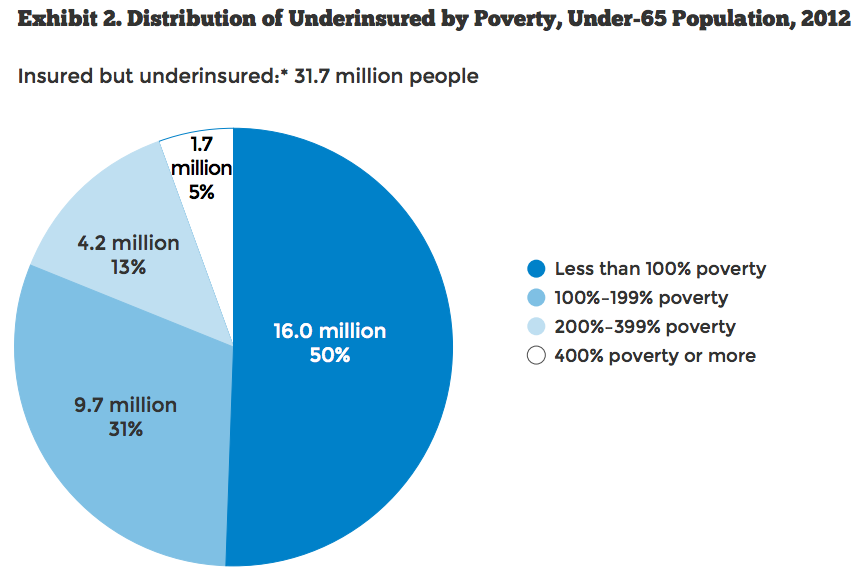
Cohn points to a new report (pdf) by the Commonwealth Fund indicating that Obamacare will help the underinsured:

According to the report, which became public early Tuesday morning, some 32 million non-elderly Americans were in households that spent a “high share of income on medical care” during 2012. That’s a little more than one in ten non-elderly Americans. The majority, though by no means all, are poor or near-poor. …

“The Affordable Care Act will significantly reduce underinsurance since it sets a national floor for benefits, requires that plans cover a minimum level of costs, bans pre-existing condition exclusions as well as lifetime and annual benefit limits, and increases cost-sharing protections for people with low and moderate incomes,” says Sara Collins, who is the Fund’s vice president for Health Care Coverage and Access and a co-author of the paper. “The problem of underinsurance is most pronounced among low and moderate income families and the provisions of the law are well-targeted at significantly improving coverage for people who have in the past spent large shares of their income on health care.”

Meanwhile, Khazan emphasizes that the uninsured are still massively confused about Obamacare:

Perversely, insured people and richer people had more knowledge about the ACA, and about how health insurance works in general, than did the uninsured. Knowledge about both the law and concepts such as premiums and deductibles increased with income. People who would qualify for the Obamacare subsidies were only able to answer an average of four of 11 questions about the law. Women were more ignorant than men were about healthcare reform, even though they arguably stand to benefit more.

A GOP Senate Is Getting More Likely, Ctd

Nate Silver responds to the DSCC’s criticism:

Our forecasts could be wrong in November. In fact, they probably will be wrong — it’s unlikely that Republicans will win exactly six seats. But we think it’s equally likely that our forecast will be biased in either direction. If Democrats retain just one more seat, they’ll hold the Senate. Or Republican gains could grow to seven seats, or quite a bit more.

And here’s the least surprising news: Political campaigns are hypocritical. At the same time the DSCC is criticizing our forecasts publicly, it’s sending out email pitches that cite Nate Silver’s “shocking, scary” forecasts to compel Democrats into donating.

You’d do well to shut out the noise the next time the DSCC writes a polling memo.

Weigel believes that “the Silver backlash was inevitable”:

Silver’s cachet on the left, which was high after 2008, became incomparable after 2012. That was the year FiveThirtyEight became a digital security blanket for liberals, a site they could refresh and refresh and refresh some more when their other news sources warned them that Mitt Romney might actually win.

Cillizza offers a few reasons why Democrats are so worried about Nate Silver’s latest predictions:

Know who REALLY listens to what Nate says? Major Democratic donors. They follow his projections extremely closely and, if he says the Senate majority won’t be held, they take it as the gospel truth. That, of course, is a major problem for the DSCC and other Democrats focused on keeping control of the Senate — particularly given that major outside conservative groups led by Americans for Prosperity are already spending heavily on ads bashing vulnerable Democratic incumbents. If the major donor community concludes that spending on the Senate isn’t a worthy investment, [Guy] Cecil and his Democratic colleagues know that their chances of holding the majority get very, very slim. Nate’s predictions move money in Democratic circles. Cecil knows that. Hence the memo.

Kilgore tries to stay optimistic:

Comparing 538’s forecast to its most credible rival, the Cook Political Report, is instructive. Cook’s Jennifer Duffy lists Arkansas as a toss-up race; Nate shows a 70/30 probability that Mark Pryor will lose. Similarly Cook shows the two vulnerable Republican seats, Kentucky and Georgia, as toss-ups. Nate gives Democrats a 25% chance of winning Kentucky and a 30% chance of winning Georgia. But his numbers would change rapidly with a few more likely-voter surveys in any of these states showing Democrats running even or ahead; Duffy tends to project races as very close until evidence emerges that they are not so close.

But there’s not a great deal of divergence in the factors used by 538 and Cook—polls, electoral history, money, national trends—and it’s very likely their forecasts will converge as we get closer to November.

Rumsfeld: Obama Worse Than A “Trained Ape”

What’s truly striking and amazing about Dick Cheney and Donald Rumsfeld is their persistent refusal/inability to reflect in any serious way on the immense moral, fiscal, and human costs of their failed wars. They are post-modern creatures – Rumsfeld never tackled an insurgency, he just “redefined” the word, just as he re-named torture – and you see this most graphically in Errol Morris’s small masterpiece, The Unknown Known. And so the very concept of personal accountability and responsibility is utterly absent. There was one flash of it: when Rumsfeld offered his resignation after the torture program’s reach and migration was revealed in the photos from Abu Ghraib. But even then, Rumsfeld was resigning because of the exposure – not because of the war crimes which he directly authorized.

And so it is fitting, perhaps, that after the massive misjudgment of the Iraq invasion and occupation, and after neglect in Afghanistan made that country even less safe from the Taliban, that Rumsfeld has the gall to attack the sitting president in a clear case of dealing with a foreign leader. Here is Rumsfeld, unable (unlike McNamara) to find a conscience within his massive, brittle ego, lashing out at the president yet again:

This administration, the White House and the State Department, have failed to get a status of forces agreement. A trained ape could get a status of forces agreement. It does not take a genius.

Here is the man who derided half of Europe and told the Brits they weren’t even needed on the eve of warfare talking about diplomacy:

United States diplomacy has been so bad, so embarrassingly bad, that I’m not the least bit surprised that he felt cornered and is feeling he has to defend himself in some way or he’s not president of that country. We have so mismanaged that relationship … I personally sympathize with him to some extent. Nobody likes to hear a foreign leader side with Putin on the Crimea the way he has. But I really think it’s understandable, given the terrible, terrible diplomacy that the United States has conducted with Afghanistan over the last several years.

So having described the first black president as inferior to a trained monkey, he actually sides with a current adversary of this country against his own commander-in-chief. There was a time when I would have been shocked by this. But Rumsfeld and Cheney can permanently reduce one’s ability to feel shock at anything.

A reader adds:

Rumsfeld fails to give his audience any hint of the fact that this is a problem that he made. America used to have no problem concluding SOFAs with its allies. Those agreements addressed Americans in uniform and provided that owing to the need for military discipline and control, the soldiers, sailors and airmen (and women) would be subject to military justice rather than the criminal justice system of the host government. However, under Rumsfeld, the footprint of the American military changed dramatically, and contractors came to constitute a majority of the force the US deployed. At the same time, American military and civilian justice failed utterly to deal with the contractors (think of the Blackwater contractors who massacred 14 Iraqis and wounded 20 more at Nissour Square in Baghdad in September 2008, for instance). These circumstances led both the Iraqis and the Afghans to refuse to sign a SOFA in the form the US sought, because the US’s terrible record (Rumsfeld’s record) of non enforcement. Thus, Rumsfeld created the problem and has made it increasingly difficult for the US to get these agreements.

The key problems, Iraq and Afghanistan, were problems under Bush as well as Obama, and were handled by the same professional team at the Pentagon. They really have next to nothing to do with the White House, under either Bush or Obama. But they have an awful lot to do with Rumsfeld and his scandalous mismanagement of the Pentagon.

Why Hasn’t Ukraine’s Revolution Spread?

Farid Guliyev and Nozima Akhrarkhodjaeva observe that “the Euromaidan protests did not spark similar political activism in other post-Soviet semi-autocratic regimes.” Among the reasons why:

Over the years, the ruling regimes in Azerbaijan, Belarus and Russia adjusted their repression strategies and adopted new ones to squash any signs of a color revolution. All three regimes were “late risers” during the color revolution wave. As Mark Beissinger shows, state elites in “later risers” have an advantage over those in “earlier risers” in that they know about actions and strategies used by protesters in the initial wave and therefore can adapt.

Institutional screws were tightened as post-Soviet autocrats took preemptive measures. Russia played a leading role in spreading various diffusion-proofing strategies. Examples include Russia’s restrictive legislation on non-governmental organizations in 2006 and the 2012 law requiring foreign-funded NGOs to register as “foreign agents”. Such measures foreclosed the success of anti-Kremlin mass rallies on the Bolotnaya Square in Moscow. And as Julia Ioffe rightly noted, “much of the stringency and verticality of the Russian political system is a direct result of [reaction to] Ukraine’s Orange Revolution.”

Ask Shane Bauer Anything: Iran’s Other Inmates

In the latest video from Shane, he discusses some of the prisoners, including a member of al-Qaeda, he came to know while behind bars in Iran’s notorious Evin Prison:

In a followup, he offers his take on the meaning of Rouhani’s election last year:

Shane Bauer is an investigative journalist and photographer who was one of the three American hikers imprisoned in Iran after being captured on the Iraqi border in 2009. He was held for 26 months, four of them in solitary confinement. He subsequently wrote a special report for Mother Jones about solitary confinement in America, and is also currently running a Kickstarter-like campaign to enable him to spend a full year investigating America’s prison system. Shane and his fellow former hostages, Sarah Shourd (now his wife) and Josh Fattal, have co-written the memoir A Sliver of Light based on their experiences. Except here. Shane’s previous videos are here.

(Archive)

Psychiatry’s State Of Mind

Joseph Pierre tackles claims of over-diagnosis in his profession:

The diagnostic creep of psychiatry becomes more understandable by conceptualising mental illness, like most things in nature, on a continuum. Many forms of psychiatric disorder, such as schizophrenia or severe dementia, are so severe – that is to say, divergent from normality – that whether they represent illness is rarely debated. Other syndromes, such as generalised anxiety disorder, might more closely resemble what seems, to some, like normal worry. And patients might even complain of isolated symptoms such as insomnia or lack of energy that arise in the absence of any fully formed disorder. In this way, a continuous view of mental illness extends into areas that might actually be normal, but still detract from optimal, day-to-day function. …

The truth is that while psychiatric diagnosis is helpful in understanding what ails a patient and formulating a treatment plan, psychiatrists don’t waste a lot of time fretting over whether a patient can be neatly categorised in DSM, or even whether or not that patient truly has a mental disorder at all. A patient comes in with a complaint of suffering, and the clinician tries to relieve that suffering independent of such exacting distinctions. If anything, such details become most important for insurance billing, where clinicians might err on the side of making a diagnosis to obtain reimbursement for a patient who might not otherwise be able to receive care.

Vaughan Bell praises Pierre’s piece as a “surprisingly good snapshot” of the field, but he has reservations:

Probably the most important thing it underlines is that most psychiatrists are less obsessed with diagnosis than people who are are obsessed about the fact that psychiatrists make diagnoses. Most psychiatrists typically don’t think that ‘every diagnosis is a disease’ and recognise the fuzziness of the boundaries – as indeed, do most medical professionals. …

I would also say that the piece reflects mainstream psychiatric thinking by what it leaves out: a sufficient discussion of the psychiatric deprivation of liberty and autonomy – and its emotional impact on individuals. Considering that this is the thing most likely to be experienced as traumatic, it is still greatly under-emphasised in internal debates and it remains conspicuous by its absence.

Bronies And Bullies, Ctd

A reader confides:

I’m a 41-year-old straight male … who likes to get dressed up in ball-gowns. So I can completely sympathize with those boys and men who get bullied and ridiculed for being feminine. I lived years feeling ashamed about it – pretty much since puberty – and it’s directly related to my sexuality. It’s really only been in the last year that I started to put out feelers with really close friends about it, including my wife, and I finally said “fuck it” after Frozen came out and I decided to “Let it Go”.

The response has been great for the most part, and I’m probably the happiest I’ve ever been. In a way, it’s just another step along accepting the “other” that I think the Internet will continue to encourage. First it was race; then it was homosexuality; now we’re starting to get into transgender, cross-dressing, cross-dreaming. None of these aspects of the human condition harm anyone. It’s only the fear of the unknown that causes the problems.

So many of these prejudices are simply because people are in the closet. Heck, in some cases there are conditions that people aren’t even awared exist (like cross-dreaming, which is the condition of becoming aroused by thinking you’re the other sex). The more people are exposed to the spectrum of human sexuality, the better it’ll be.

Is Big Data That Big A Deal?

Mark O’Connell, who recently read Uncharted: Big Data as a Lens on Human Culture, questions whether massive data analyses “typically tell us anything that we didn’t already know”:

We get stuff about how Helen Keller was “a hero to millions, a symbol of the triumph of the human spirit over adversity” and how “Marcel Proust became famous for writing good books,” which is one of those facts so incontrovertibly true that stating it sounds a mysteriously false note. And a data-mining examination of the history of fame, whereby we learn that Adolf Hitler is the most famous person born in the past two centuries (i.e., mentioned in the most books), leads to the insight that “darkness, too, lurks among the n-grams, and no secret darker than this: Nothing creates fame more efficiently than acts of extreme evil. We live in a world in which the surest route to fame is killing people, and we owe it to one another to think about what that means.”

After a while, you begin to suspect that this sort of wan reflection might be compensating for the fact that the data itself reveal little that is new.

The book is mostly entertaining, and its authors [Erez Lieberman Aiden and Jean-Baptiste Michel] are an amiable presence. But the claims that they make about the impact of their work—and the larger impact of big data on the humanities—are imposingly serious. “At its core,” they write, “this big data revolution is about how humans create and preserve a historical record of their activities. Its consequences will transform how we look at ourselves. It will enable the creation of new scopes that make it possible for our society to more effectively probe its own nature. Big data is going to change the humanities, transform the social sciences, and renegotiate the relationship between the world of commerce and the ivory tower.”

We are, in other words, deep in TED territory here, where no innovation can ever be merely useful or profitable, and must always mark something like a turning point in human history.

But Quentin Hardy spots a new and highly practical trend:

What if big data, that much-proclaimed multibillion-dollar hope of the enterprise software industry, is just a feature of something else?

On Wednesday, a company called New Relic announced that its product, used by information technology professionals to monitor the performance of software applications, would also carry real-time analytics about customer usage. That is the kind of thing that is useful to marketing departments, which are now spending money on custom big data systems. “We monitor how fast an application is, why it might be taking so long to load, why a line of code’s database query took so long,” said Lew Cirne, New Relic’s founder and chief executive. But the company can also tell “not just how long it took Airbnb to load an app, but what the best price point was in New York for completing a deal, or what products on Disney are getting the most customer hits.” …

The change in the product signifies [the] tendency for software developers to work in different parts of the company — the marketing department, for example — and not just in information technology. “The big trend we’re riding is that software will be in everything, and you’ll interact with it everywhere,” said Mr. Cirne.