Bill Donohue Asks To March In A Gay Pride Parade

This is priceless:

He filed a petition with the organizers of the New York Gay Pride Parade requesting that he be allowed to march under a “Straight is Great” banner. He was sure that this was a message that gay people would find offensive. And, being a hate-filled asshat, he assumed that gay people would act with the same animus and exclusion towards him that is Donahue’s standard action towards us.

But, of course, we don’t hate straight people. And we agree, straight actually is great – just like gay and bisexual. And, though Donahue probably didn’t know it, many many straight people – Catholics, even – happily march in the parade each year to show their support for the community. Heck, some Catholic churches even have delegations.

So the organizers immediately said yes. Sarah Kate Ellis, the head of GLAAD and a fellow Irish New-Yorker, said she’d be happy to march with him. The irony is, of course, that the last thing Donohue wants to do is march in a gay pride parade. And now, having been greeted with graciousness, he’s looking for a way to weasel out.

How more perfect could this response have been? You see: the gay rights movement can be magnanimous – and have some fun. Let’s get Bill some rainbow boas to make a splash. Update from a reader:

You missed the latest from yesterday: Donohue replied to the invitation saying that he would not be marching in the parade because he objected to mandatory attendance at what he called “gay training sessions” that, in reality, “address line-up times, check-in locations, our moment of silence, dispersal activity, NYPD safety policies, attire and vehicle/sound permits.”

And the beat goes on …

Marriage Equality’s Winning Streak

In response to the Michigan marriage equality news, Scott Shackford quips that “it’s getting harder to write these kinds of posts without just taking an old one and replacing the state.” Mark Joseph Stern puts the ruling in context:

As Windsor continues to trample anti-gay animus in state after state, it’s worth remembering how far we’ve come in so little time. Had Justice Kennedy voted the wrong way last year, gay plaintiffs would have essentially no legal ground upon which to assert their marriage rights. Instead, his words have thundered through federal courthouses across the country. When Windsor came out last June, constitutional protections for gay marriage were thrilling and novel. Today, just nine months later, they’re practically old news.

Nathaniel Frank highlights Judge Bernard Friedman’s evisceration of Mark Regnerus’ research:

“The Court finds Regnerus’s testimony entirely unbelievable and not worthy of serious consideration,” he wrote in what must be one of the most stinging and decisive repudiations of an expert witness in memory. He cited evidence that the conservative research was “hastily concocted at the behest of a third-party funder” which clearly expressed its wish for skewed results. Dismissing the defense’s other witnesses just as strongly, the judge wrote that “The Court was unable to accord the testimony of Marks, Price, and Allen any significant weight.” He concluded that “The most that can be said of these witnesses’ testimony is that the ‘no differences’ consensus has not been proven with scientific certainty, not that there is any credible evidence showing that children raised by same-sex couples fare worse than those raised by heterosexual couples.”

Nora Caplan-Bricker focuses on the judge:

The most surprising thing about a Michigan district court ruling striking down the state’s ban on same-sex marriage may be the judge who wrote it. Bernard Friedman, a 70-year-old Ronald Reagan nominee who ruled against the University of Michigan Law School’s affirmative action policy in 2001, said Friday that the state’s arguments did not amount to a “rational basis” for the law—echoing four Democratic appointees who have also declared prohibitions on gay marriage unconstitutional in the past year.

“Friedman’s opinion suggests that even a Reagan appointee—albeit in a northern state where opinion is probably already in favor of gay marriage by a majority—can no longer comprehend such laws as anything but bigotry,” said Michael Klarman, a constitutional law scholar at Harvard Law School, in an email.

Joe Jervis notes that the Michigan governor might not recognize the marriages that made it through before the stay:

We should coin a gay term to describe the status of same-sex marriages in places like Utah and Michigan. In both states gay couples stampeded to county clerks’ offices within hours of court rulings. And in both states all those marriages currently have a giant blinking asterisk next to them.

Yesterday a reader provided a view from a Michigan marriage.

Hathos Alert

A reader flags the NSFW music video seen above:

Have you heard of gay rapper Fly Young Red? Have you seen his new music video for “Throw That Boy Pussy”? All the worst aspects of rap culture have now made it to the gay community!

But you have to admit it’s pretty damn catchy. A fan of the video puts it in context:

Unfortunately I don’t get to read every Dish post, so you may have already covered the phenomenon of queer hip hop. Last week at the end of South by Southwest we had our annual Gay Bi Gay Gay party, a huge celebration of Austin’s queer community and the headlining acts were queer hip hop artists Cakes Da Killa (seen here) and Mykki Blanco (seen here).  Bounce artist and queer transwoman Big Freedia has become an icon, spreading “twerking” to the masses.  Profoundly straight rapper Macklemore has been accused of stealing the beat for “Thrift Shop” from queer rapper Le1f’s song “Wut” (judge for yourself).

The latest gay hip hop phenomenon, however, is the viral hardcore rap song “Throw That Boy Pussy” by Houston rapper Fly Young Red.

This song takes the basic hypersexual audacity of traditional hip hop and turns it on its head by applying it to boys. The result is an intensely homoerotic celebration of eating and fucking ass.  I don’t know if you are into hip hop, but for people under 40 it is our baseline music, much as rock and roll was for our parents before.  I saw your post about hip hop diplomacy to combat Islamic radicalism.  Now gay and queer artists are using it to celebrate not just “pride” and other more safe (if still powerful) expressions, but also an unapologetic gay sexuality.

I am not gay myself, though I suppose I am somewhat queer in that I have had sex with men and will again someday I would imagine.  My girlfriend is queer, my best friend is a gay man, and I spend a lot of my time at queer and gay events.  There is still plenty of house music and Britney Spears, but more and more often the best big gay parties feature not just rap music, but hardcore stuff.  Part of this is a function of the radicalized, militant queer culture in Austin, part of it is the fact that we have an upfront queer community of color that grew up on the real deal aggressive hip hop music, but part of it is that gay rap is getting really good.  I think there is some sort of story here, some sort of meditation.  I wanted to raise your attention to the phenomenon, and share some of this awesome music with you.  I hope you enjoy it!

Previous Dish on Big Freedia and sissy bounce here, and Dish on gay rappers here.

Ukraine’s Tea Party?

Motyl insists the new government in Kiev isn’t fascist:

Both Svoboda and Right Sector are on the right. They are decidedly not liberals—and some of them may be fascists—but they are far more like the Tea Party or right-wing Republicans than like fascists or neo-Nazis. I for one wouldn’t want them to be setting the tone for Ukrainian policy. But neither would I want the Tea Party to be in charge of Washington. No less important, their role in the Kyiv government is at best tertiary (they would probably win no more than 5 percent of the vote in a national election), and policy is set not by them but by the broad coalition of unquestioned liberal democrats.

He recommends focusing on “the activity of Putin and his fascist state.” Cathy Young also worries about Russian fascists:

[I]n Russia, nationalists in the upper echelons of power include such prominent figures as former NATO envoy and current Deputy Prime Minister Dmitry Rogozin, who first entered the political scene as a leader of the nationalist bloc Rodina (Motherland). In 2005, Rodina was banned from Moscow City Council elections for running a blatantly racist campaign ad: the clip showed three Azerbaijani migrants littering and insulting a Russian woman and Rogozin stepping in to tell them off, and ended with a slogan promising to “clean up the trash.” While Rogozin is no fan of America, he has some peculiar American fans: in 2011, a glowing tribute that concluded with, “Let’s hope that Rogozin rises to power in Russia—and for the rise of a ‘Rogozin’ in America and elsewhere throughout the West,” appeared on the “white identity” website, Occidental Observer.

Rodina co-founder and Rogozin’s erstwhile rival for its leadership, Sergei Glazyev, most recently served as Putin’s man in charge of developing the Customs Union—the alliance with Kazakhstan and Belarus that was also to include Ukraine. Like Rogozin, Glazyev has attracted the sympathetic attention of far-right kooks in the Unites States—in this case, Lyndon LaRouche: in 1999, LaRouche Books published an English translation of Glazyev’s book, Genocide: Russia and the New World Order, with a foreword by LaRouche himself.

Previous Dish on fascist fears in Ukraine here.

The GOP Burns Its Tax Reform Camp

Last week the House GOP, under pressure from Wall Street, rejected the financial tax component of Congressman Dave Camp’s tax reform plan. Chait is unsurprised:

Camp’s [plan] – not just the financial tax, but the whole thing — represented a shocking moment in Republican policymaking. Here was not just a vague gesture in the direction of moderation that characterizes most Republican “reform” proposals, but a genuinely serious effort to grapple with trade-offs and impose the real, necessary pain on Republican constituencies that any such effort requires.

He adds that plan’s demise may prove telling:

The whole point of the push-back from Wall Street, which has reinforced a wildly unenthusiastic reception within the GOP, is not only to prevent Republicans from striking a deal with Democrats and actually passing a tax reform, which could happen if Republicans wanted it. … It’s to murder his plan in a public way so as to prevent it from becoming the baseline for any future Republican agenda. That effort seems to be meeting with predictable, depressing success.

Ben White And Maggie Haberman sound a similarly ominous note:

Republican elites on Wall Street and elsewhere in corporate America are now actually cheering inaction in Congress as preferable to ideas such as Camp’s. “The Camp draft catalyzed most of the business community around the notion that it was so bad, and it’s not just private equity and financial services — there were so many other punitive measures in there — that people just decided, the whole system’s broken here, nothing’s going to get done,” another senior Republican business leader said. “And that’s what we need to work toward. We need to work toward gridlock.”

In another post, Chait notes that the Tea Party seems to have jumped into bed with its one-time enemy:

[B]ecause [Wall Steet] is pushing for partisan combat rather than bipartisan cooperation, it has provoked zero backlash from conservative activists – even though it is killing a reformist, preference-eliminating, tax-rate-lowering reform that is the most promising legislative incarnation of a populist reform to have emerged in years.

Religious Belief And Bigotry

Supreme Court Hears First Amendment Case On Protests At Military Funerals

One of the many great things about blogcations is they take you away for a while from the frenetic day-to-day pace of opinion. You get to see some of the debates with a little more clarity a few steps out of the fray. So here’s a small addendum to the argument about whether all those opposed to marriage equality are ipso facto bigots, which seems to be the position of various writers out there.

One obvious objection is that the word bigotry is far too crude to define the vast array of feelings, ideas, arguments or mere ignorance that can lie behind opposition to gays getting married. Using the term “bigotry” or, even worse, the hideous propaganda term “hate”, just doesn’t do justice to the range of human reaction to profound social change. To make an obvious point – around a third of Americans have changed their minds on the subject in the last decade and a half. Bigots, by definition, are not open to such shifts in opinion. You can’t reason someone out of something they didn’t use reason to get into. So a third of previous opponents were persuaded. Not harangued, persuaded. Of course, as time goes by, that makes the remaining residue of opponents more likely to be bigoted overall. So how to tell if that’s truly the case with those who are left?

There are two basic reasons behind religious objections to marriage equality. The fundamentalist Protestant one is simply Biblical. Gay sex is outlawed in Leviticus and Romans. The test for bigotry here, it seems to me, is consistency. The fundamentalist has to account for her choices about which Biblical verses she takes seriously today. Does she follow all of Leviticus? So why not the death penalty for gays? And why is she eating shrimp? Does she regard marriage as a realistic, short-term concession to human nature before the End Times, as Paul did? It’s not hard to see if consistency is at work here. If the only sins a fundamentalist wants outlawed relate to gay people, then we’re talking prejudice. If a fundamentalist has no objection to divorce, but wants gays outside of marriage, we’re talking very selective sins. True Biblical consistency – not politicized cafeteria fundamentalism – is quite hard to sustain in modernity.

Equally, the Catholic position – that all sex outside procreative marital monogamy  is immoral –  requires consistency.

If gay marriage should be illegal, so should divorce. If a Catholic is campaigning against gay equality while doing nothing and saying nothing about civil divorce, my alarm bells go off. If a Catholic insists on the immorality of gay sex and yet uses contraception, the same point applies. Or if a baker is happy to make a cake for a Satanist gathering, a re-marriage or an IVF child, but not for a gay couple, then, hell yes, they’re bigots (even though I wouldn’t sue them).

This leads to a remnant of principled, non-bigoted opposition to civil marriage equality. The first and most defensible variety, it seems to me, is a pure and minimalist conservatism that distrusts such a big change in a core social institution, and just says no. (Of course this may change as the landscape alters, and no obvious harm seems to be happening.) The second is a consistent religious position – either Biblical or in natural law. To conflate these sincere people with hateful bigots is as empirically false as it is politically counter-productive.

Twenty years ago, I was confidently told by my leftist gay friends that Americans were all anti-gay bigots and would never, ever back marriage rights so I should stop trying to reason them out of their opposition. My friends were wrong. Americans are not all bigots. Not even close. They can be persuaded rather than attacked. And if we behave magnanimously and give maximal space for those who sincerely oppose us, then eventual persuasion will be more likely. And our victory more moral and more enduring.

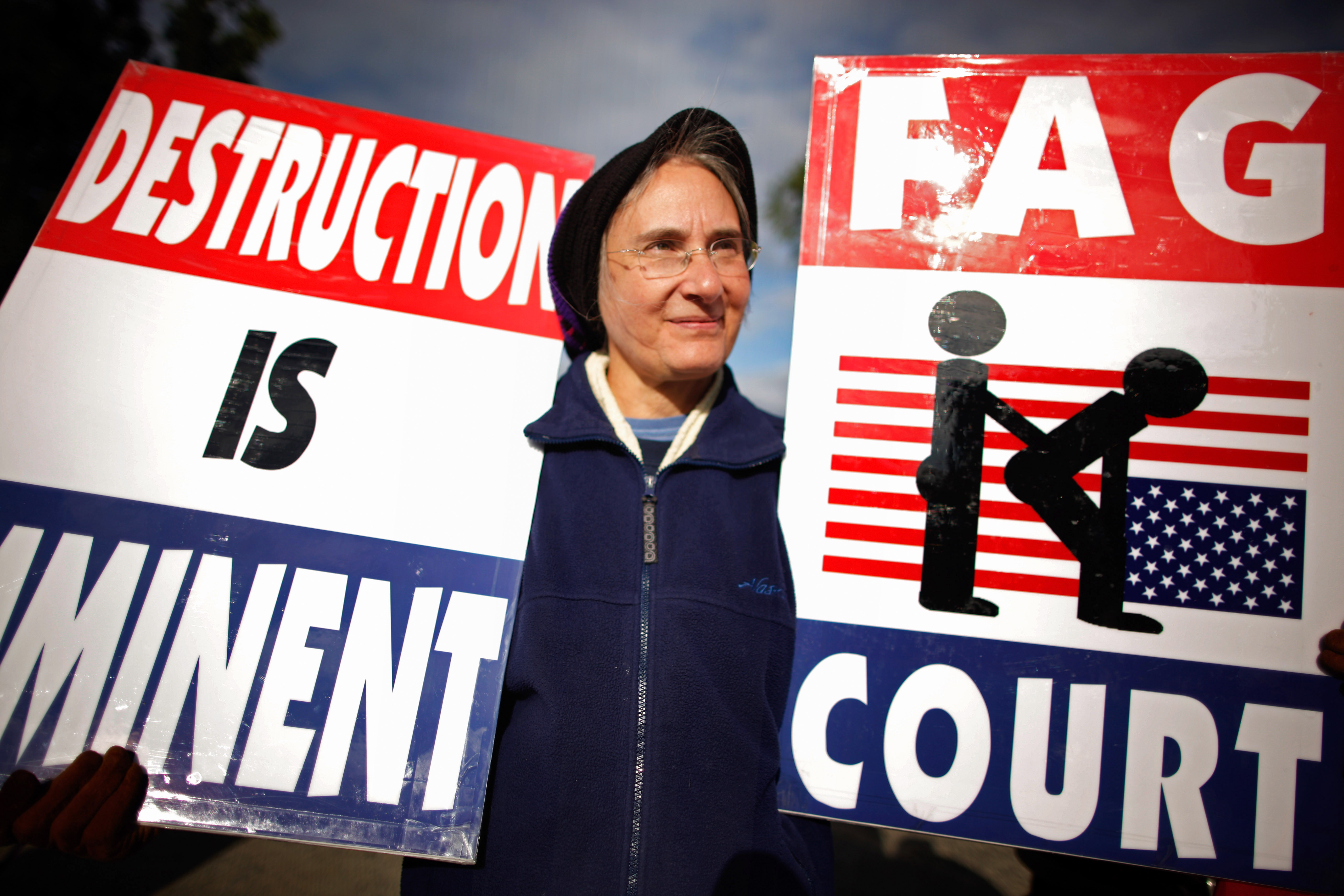
(Photo: Betty Phelps, daughter-in-law of pastor Fred Phelps and a member of the Westboro Baptist Church, demonstrates outside the Supreme Court while justices hear oral arguements in Snyder v. Phelps, which tests the limits of the First Amendment, October 6, 2010 in Washington, DC. By Chip Somodevilla/Getty.)

A GOP Senate Is Getting More Likely

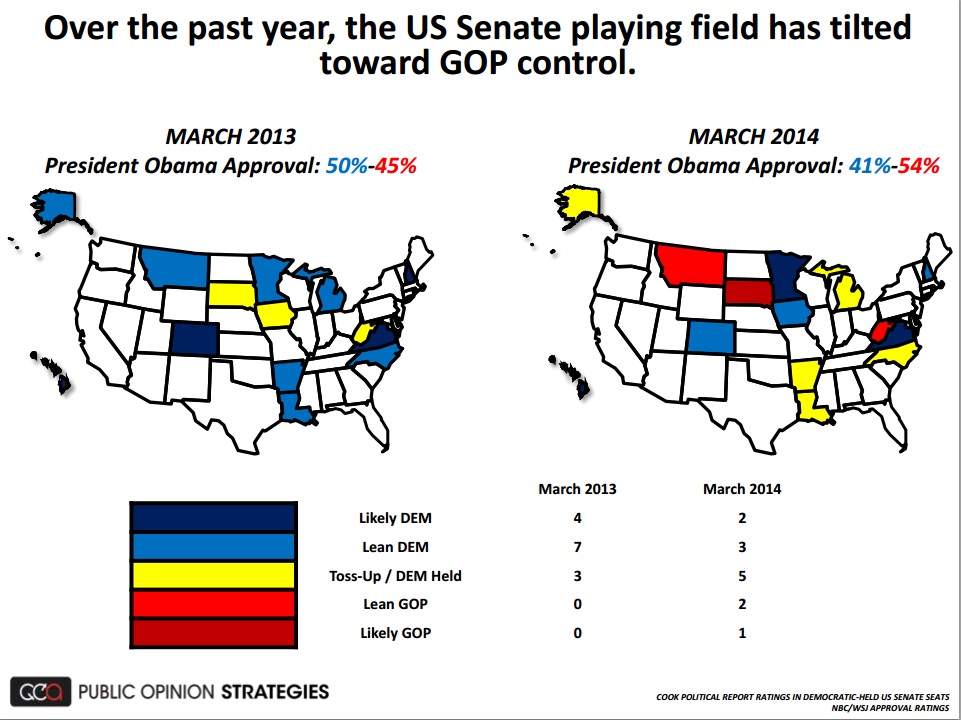
Sean Sullivan looks at how the Senate landscape has changed:

Senate Landscape

Nate Silver calculates that “Republicans are now slight favorites to win at least six seats and capture the chamber.” His rather large qualifier:

There are 10 races that each party has at least a 25 percent chance of winning, according to our ratings. If Republicans were to win all of them, they would gain a net of 11 seats from Democrats, which would give them a 56-44 majority in the new Senate. If Democrats were to sweep, they would lose a net of just one seat and hold a 54-46 majority. So our forecast might be thought of as a Republican gain of six seats — plus or minus five. The balance has shifted slightly toward the GOP. But it wouldn’t take much for it to revert to the Democrats, nor for this year to develop into a Republican rout along the lines of 2010.

The Democratic Senatorial Campaign Committee is challenging Silver’s math. Carpenter takes the DSCC to task:

There’s nothing like happy-face propaganda in the sorryass face of facts. Should Silver’s facts re-shift in favor of Democrats, he will again be hailed by the DSCC as America’s one statistician who has never erred.

Meanwhile, Cillizza remakes a point Trende made awhile back:

So, let’s say Republicans retake the Senate this fall.  Can they keep it in 2016? Much of that depends on just how many seats they win in November.  Yes, they technically need six seats for the majority. But, they probably need to pick up in the neighborhood of eight or even nine seats in order to ensure themselves a fair shot at holding the Senate for more than two years.

Here’s why: There are 23 Republican seats up compared to just 10 for Democrats in 2016. (This is the class that got elected in 2010, a great year to be a Republican.)

Sponsored Content On TV

A reader elaborates on a recent “Sponsored Content Watch” (a depressingly ongoing feature on the Dish):

What your reader is describing is called a video news release, or VNR. It’s a publicity tactic – basically an advertisement made to look like a news report. In a way, they serve a purpose, as news agencies (especially smaller local stations with limited budgets) can use pieces of them to supplement ongoing reports, the same way newspapers will use information from a press release. The problem with them comes when they’re just aired whole without attribution, as if they’re regular news. Your reader’s note that the segments discussed ended with a “sponsored by” notice is actually an improvement; until about a decade ago, many VNRs aired without any notice at all, such as being produced by a pharmaceutical company or government agency. In 2005, the FCC started cracking down on the practice and said stations could be fined for airing VNRs without attribution, so news programs are a little more cautious about it nowadays (not to say the practice has gone away entirely).

Another points to a more disappointing offender:

Regarding the growth of sponsored content on TV, last month PandoDaily broke the huge story that PBS received $3.5 million from anti-pensions billionaire John Arnold to fund a scare series called “Pension Peril”.

The point of the series – that public pensions are underfunded and therefore benefits should be slashed – is a baldly partisan argument that happens to coincide perfectly with one of the Laura and John Arnold Foundation’s main lobbying goals. Arnold also personally helped finance a California initiative to roll back public employee pensions. The irony is Arnold made his fortunes as an energy trader at Enron, the company notorious for manipulating the energy markets of – you guessed it – California.

PBS stonewalled the journalists, refusing to show a copy of their agreement with the Arnold Foundation, but once the shit hit the media fan, they backed down and returned Arnold’s funding, and now the series is “on hiatus,” according to the NYT. The whole thing brazenly violated PBS’s own rules that forbid accepting funding from a source whose interests align with a project, and not just for partisan issues: even for something as benign as advocating cancer research, which they give as an example in their own rules: “Similarly, a nonprofit organization whose mission is to eradicate heart disease or to raise money for leukemia research could not fund a program designed to educate the public about these respective illnesses.”

The icing on the cake was that PBS never disclosed the funding source on TV, and the evidence for the connection was virtually non-existent online. Perhaps they hoped to keep it quiet, because according to PandoDaily, a source at a meeting with PBS execs said, “I asked who was funding that project, and the executive said that at this point they are not disclosing who their funders are, and everybody sitting around the room kind of paused.” If PandoDaily hadn’t dug up the dirt and published it, no one might have ever known. Whoever set this thing up at PBS needs to be shown the door, and soon.

Cremains Of The Day

In an excerpt from her book American Afterlife: Encounters in the Customs of Mourning, Kate Sweeney ships out with Eternal Reefs, a company that “mixes the cremated ashes of your loved one with a cement compound to create part of an artificial coral reef”:

The company encourages the bereaved to participate in the creation of the artificial “reef balls,” and to oversee their deliverance into the ocean at one of several designated offshore reef beds. I’m not sure what to expect at one of Eternal Reefs’ two-day reef ball deployment events, so I dress in a gray, nondescript top, black pants, and pearl earrings, and drive to a fishy-smelling dock at Shem Creek off the Charleston Harbor, in Mount Pleasant, South Carolina. Six families have congregated here beside the Thunderstar, our vessel today; they wear vivid sundresses, shorts and t-shirts, and chat away brightly over bottled water and sodas. Eternal Reefs’ staff, including founder and CEO Don Brawley, wear khaki shorts and ironed sea-blue polos bearing the company’s logo.

Despite the preponderance of dark sunglasses on this sunny, muggy morning, the spirit here is not at all funereal. Instead, far-flung family members greet one another with the warmth of long-awaited reunions. Small children abound and mothers rummage through their purses for baggies of Cheerios, juice boxes, and toys. There is a tamped-down sense of thrill in the air, the sort brought on by novelty.