Charity Can’t Cut It

by Jonah Shepp

Mike Konczal tears down the right-wing trope that private charity can be an adequate substitute for government social insurance, looking at the historical role of the state in building and maintaining America’s safety net:

One problem with the conservative vision of charity is that it assumes the government hasn’t been playing a role in the management of risk and social insurance from the beginning. It imagines that there is some golden period to return to, free from any and all government interference. As Senator Lee has said, “From our very Founding, we not only fought a war on poverty—we were winning.” How did we do it? According to Lee, it was with our “voluntary civil society.” We started losing only when the government got involved.

This was never the case, and a significant amount of research has been done over the past several decades to overturn the myth of a stateless nineteenth century and to rediscover the lost role of the state in the pre-New Deal world.

The government’s footprint has always grown alongside the rest of society. The public post office helped unite the national civil society Alexis de Tocqueville found and celebrated in his travels throughout the United States. From tariff walls to the continental railroad system to the educated workforce coming out of land-grant schools, the budding industrial power of the United States was always joined with the growth of the government. The government played a major role throughout the nineteenth century in providing disaster relief in the aftermath of fires, floods, storms, droughts, famine, and more.

James Kwak backs him up:

This shouldn’t come as a surprise. There are basic economic reasons why public social insurance is superior to voluntary charity. The goal here is to protect people against risk: of unemployment, of health emergency, of outliving one’s savings, and so on. For a risk-mitigation scheme to work, there are a few things that are necessary. One is that people actually be covered. This is something you can never have with a private system (unless it’s regulated to the point of being essentially public), since charities get to pick and choose whom they want to help. …

Another thing you want is the assurance that the system has the financial capacity to actually protect you in the event of a crisis. That’s why you don’t depend on your neighbors to rebuild your house if it burns down. Besides the fact that they may not like you, they probably don’t have enough money—especially if you lose your house in a fire that burns down the entire neighborhood. As I’ve said many times before, there is no other entity in the country—and not really one in the world—with the financial capacity of the federal government. Even state governments scramble to cut benefits when push comes to shove, which is one reason why some states provide Medicaid coverage to almost no one.

Cool Ad Watch

by Chris Bodenner

Seeing the fine quality of speakers:

Jobson has details:

In her second experimental clip exploring the effect of sound waves on lycopodium powder, filmmaker Susie Sie just released this new promotional video for high-end audio system manufacturer Burkhardtsmaier. The super fine (and super flammable) powder made of clubmoss spores creates fascinating patterns and forms as it vibrates due to a subwoofer positioned just below the surface. If you liked this you’ll also like her previous short Cymatics.

Lord Of The Slides

by Katie Zavadski

Hanna Rosin doesn’t remember being under constant surveillance as a kid, but today’s children are rarely away from watchful adults when it comes to the outdoors:

It’s hard to absorb how much childhood norms have shifted in just one generation. Actions that would have been considered paranoid in the ’70s—walking third-graders to school, forbidding your kid to play ball in the street, going down the slide with your child in your lap—are now routine. In fact, they are the markers of good, responsible parenting.

One very thorough study of “children’s independent mobility,” conducted in urban, suburban, and rural neighborhoods in the U.K., shows that in 1971, 80 percent of third-graders walked to school alone. By 1990, that measure had dropped to 9 percent, and now it’s even lower. When you ask parents why they are more protective than their parents were, they might answer that the world is more dangerous than it was when they were growing up. But this isn’t true, or at least not in the way that we think.

She thinks fewer rules are probably the way to go:

For example, beginning in 2011, Swanson Primary School in New Zealand submitted itself to a university experiment and agreed to suspend all playground rules, allowing the kids to run, climb trees, slide down a muddy hill, jump off swings, and play in a “loose-parts pit” that was like a mini adventure playground. The teachers feared chaos, but in fact what they got was less naughtiness and bullying—because the kids were too busy and engaged to want to cause trouble, the principal said.

The Rightwing Books Glut

by Patrick Appel

GOP Candidates

McKay Coppins heralds the decline of conservative publishing:

Borders bookstores, whose widespread placement in exurban malls and rural communities made them magnets for right-leaning customers, shut down in 2011. And the web has decimated the subscription-based “book clubs” that launched a slew of conservative best-sellers in the ’90s and early 2000s.

Meanwhile, the proliferation of conservative publishers has made the economics of their genre much tougher, with an ever-increasing number of books competing for an audience that hasn’t grown much since the ’90s. One agent compared conservative literature to Young Adult fiction, an unsexy niche genre that quietly pulled in respectable profits for years until the big houses took notice, and began entering into bidding wars for promising authors, and flooding the market in a frenzied attempt to find the next Twilight.

While best-sellers by famous pundits like Bill O’Reilly’s Killing Jesus, and Charles Krauthammer’s Things That Matter continue to give conservative publishing a veneer of wild success, publishers say the ruthless competition on the right has made it increasingly difficult to turn a profit on midlist books.

Waldman thinks this “is mostly a reflection of the problems in the publishing industry as a whole”:

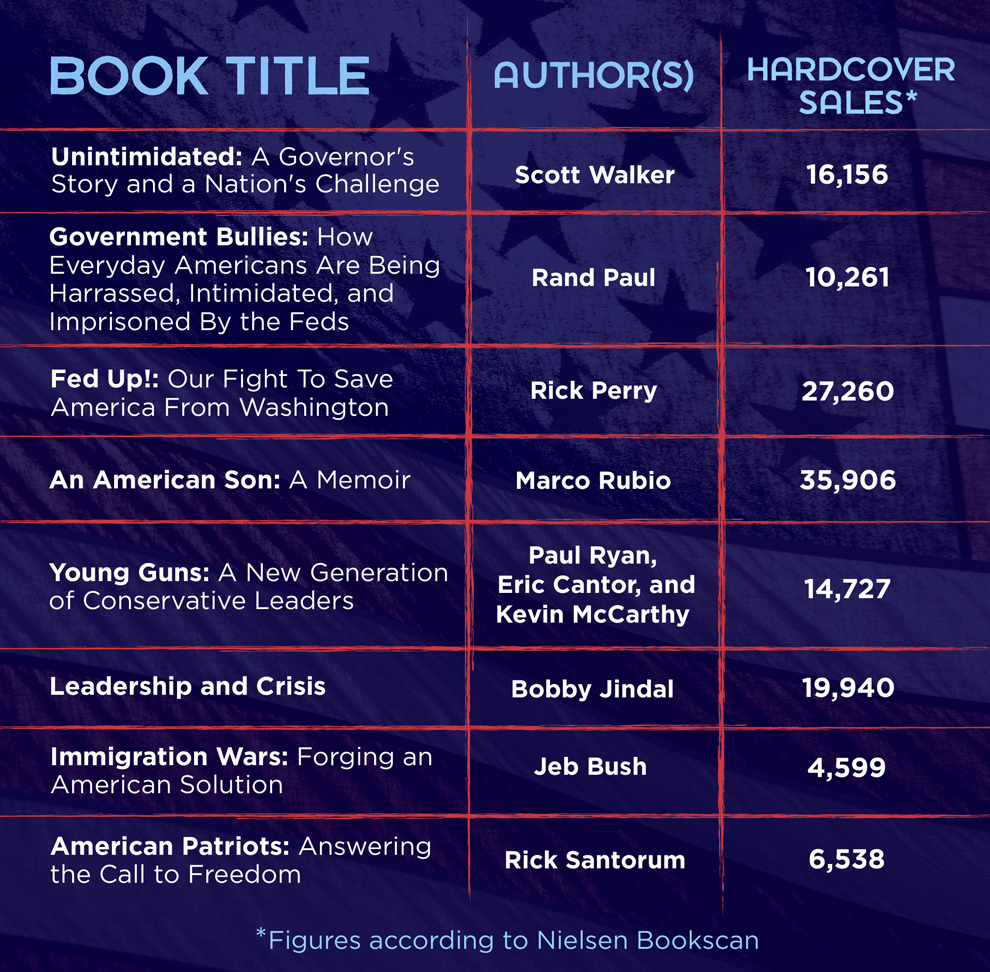
But one sub-niche that is definitely suffering is the pre-presidential-campaign book. Bizarrely, publishers still compete fervently to sign every last senator running a quixotic presidential campaign, on the off-chance that he might become president and then his book would sell spectacularly. But all but one of the candidates fails, and then the publishers have wasted their money. Just look at the pathetic sales some of these guys have generated [see chart above]

Drum blames Obama Derangement Syndrome:

Obama drove conservatives into such frenzies of hysteria that their books lost the potential to appeal to anyone except the most hardcore dittoheads. I mean, Ann Coulter built a whole career on writing ever more outrageous things in order to get a rise out of liberals, but what can you do when you’re competing with, say, Jerome R. Corsi, PhD? It’s hopeless. He makes Coulter look positively sedate.

When everyone turns the dial to 11, you aren’t a niche anymore. You’re just a crackpot fringe.

When The Eiffel Tower Disappears, Ctd

by Katie Zavadski

On Monday, in order to reduce smog, Paris tried ban half of its cars from driving that day. Emily Badger warns that these types of bans can backfire:

From an environmental standpoint, there are at least two ways to try to rein in pollution from vehicles: We can either improve the technology itself (getting cleaner, more efficient cars on the road), or we can try to reduce how much people use it. Unfortunately, evidence suggests that attempts at the second strategy often undercut the first one.

Research out of Beijing has found that the ongoing one-day-a-week ban has reduced particulate matter there by about nine percent. But a study out of Mexico City found no positive environmental benefits from the regular ban there, for a fascinating reason.

People really like to drive, and they’ll come up with some seriously inventive ways around restrictions. In Mexico City, it appears that many people bought cheap, used second cars (you’ve got your odd car and your even car) to get around the license plate rule. In effect, it appears as if the ban caused an increase in the total number of cars on Mexico City’s roads, tilting the makeup of the entire fleet toward less fuel-efficient vehicles.

Zachary Shan considers what Paris did wrong and right:

The positive move taken in Paris, in my opinion, is that the ban excluded electric cars, hybrids, and people who carpooled (3 or more people to a car). So, rather than being encouraged to buy more cars of lower quality, such a policy would encourage people to buy electric cars and hybrids. But the concern mentioned above still seems valid. So far, studies on such bans have reportedly come to mixed conclusions.

Is there a better solution? It seems there are a couple of solutions that have been shown to work better: low emission zones (LEZs) and congestion charges. They go about the matter in different ways, so can actually offer better results when combined.

Will Russia Derail The Iran Deal?

by Patrick Appel

Rogin and Lake see it as a possibility:

Nobody knows if and how Russia will follow through on its threats to sacrifice the Iran talks to try rob Obama of the main diplomatic accomplishment of his second term as president. Russia could pull out of the so-called “P5+1” group—the world powers currently negotiating with Iran. Or Moscow could stop cooperating on international sanctions on Iran, easing pressure on Tehran and helping Russian businesses.

Roger Cohen casts doubt on the idea that Russia would cease working on the Iranian nuclear deal, noting that “Russia has its own interest in stopping nuclear proliferation, and even the Cold War did not preclude cooperation in some areas.” Larison isn’t so sure:

Moscow has been much less alarmed by Iran’s nuclear program than Western governments are. Russia may not want Iran to have nuclear weapons, but it seems much less worried that Iran is likely to acquire them. The other argument is that Russia doesn’t want to sabotage diplomacy with Iran because that would make U.S. military action more likely, but it’s not so obvious that it would greatly harm Russian interests if the U.S. and Iran couldn’t resolve the nuclear issue peacefully. Russia benefits in some ways from ongoing U.S.-Iranian hostility, and it is not harmed if the U.S. ends up waging yet another war in the Near East.

Walter Russell Mead makes related points:

[I]f Russia did manage to stop the talks dead, the result wouldn’t automatically be an Iranian bomb. The first result would be to put Obama into the horrible, no-win situation he has spent his whole presidency working hard to avoid: where his only two choices are military action against Iran and accepting an Iranian nuclear weapon. If (as the White House has continually insisted that he would) he goes for force, the United States gets involved in another Middle Eastern war, and Russia enjoys a huge financial windfall as oil prices skyrocket and a propaganda windfall as the United States (without a UN mandate, which Russia would take care to block) takes on yet another preventative war in a Middle Eastern country.

Or, alternatively, the United States endures its most humiliating and devastating foreign policy defeat in decades, leaving its prestige in tatters and its global alliance system fundamentally weakened as yet another of President Obama’s red lines, this one much brighter and deeper than the one in Syria, gets crossed—with impunity.

Turkey Kills Twitter

by Tracy R. Walsh

https://twitter.com/Timcast/statuses/446766583005077504

Juan Cole summarizes:

At midnight last night, Twitter went dark in Turkey after the service was lambasted by Prime Minister Tayyip Erdogan. News of his massive corruption has been leaking out on social media, with damning audio clips and other evidence. Erdogan controls the old media – television and the print press – in Turkey, but has no way to stop the ten million Turkish Twitter users from sharing around the leaked material (which he maintains is fraudulent). So Erdogan said, “We Will eradicate Twitter.” Erdogan’s Justice and Development Party (AKP) is facing local municipal elections at the end of the month and it may be he hoped to close down conversations about the corruption issue in the run-up to them. If AKP does well in those elections, they will form a platform for his anticipated run for the presidency in five months.

If the audio clips are actually fraudulent, it should be possible for Erdogan to have forensics performed on them and to discredit them. In a democracy, you deal with allegations by debating them, not by trying to close down national discussions. Erdogan is demonstrating an increasingly troubling tendency toward dictatorial methods.

Brian Merchant isn’t surprised:

My colleague Tim Pool, broke the news from Istanbul. He tells me that “the reaction seems to be anger and confusion. I see a lot of people on facebook just asking ‘is twitter down for you?'” Erdogan called Twitter a “menace to society” when a popular uprising swept the country last year, and has made noise about curtailing social media use in Turkey ever since.

Prime minister Recep Tayyip Erdoğan huffed, “We now have a court order. We’ll eradicate Twitter. I don’t care what the international community says. Everyone will witness the power of the Turkish Republic.” But the ban doesn’t doesn’t appear to have been that successful:

Not even a day after Prime Minister Recep Tayyip Erdogan said the social media service would be “eradicated” from the country, Turks were still actively tweeting by the millions through a variety of workarounds. A Turkish website, Zete.com, said 2.5 million tweets had been posted since the ban, reportedly setting traffic records in Turkey.

Yoree Koh and Danny Yadron detail another way people are circumventing the ban

Twitter has relationships with carriers in many countries, including four in Turkey, that have provided Twitter with short codes that allow users to send tweets. Users type in the code – either 2444 or 2555 in Turkey to signal the start of a tweet. The website then matches the sender’s phone number with their Twitter account. It makes for a handy back up plan when other methods may be compromised. Users receive all the texts sent by accounts they follow.

On Thursday, Twitter advised users in Turkey to text their tweets shortly after news stories of the shutdown surfaced. Twitter offered the same suggestion to users when the Venezuelan government restricted certain access to the service last month.

David Kenner notes that it’s not just the opposition that’s up in arms:

[T]he ban also appears to have exacerbated divisions within Erdogan’s party. President Abdullah Gul, who visited the headquarters of Twitter in 2012, said a ban on the site was “unacceptable” – and to add insult to injury, he made his comments via his Twitter account.

Gul isn’t alone. Melih Gokcek, the mayor of Ankara and another member of the ruling party, also continued to tweet. His first message after the ban was announced could’ve been interpreted as support or defiance – whatever he meant, it was retweeted thousands of times by Twitter users within Turkey:

Michael Koplow views the ban as a mistake:

Erdoğan, whose political instincts used to be top notch, appears to have badly miscalculated this time. The courts are denying that they issued any shutdown orders, other countries and NGOs are criticizing him left and right, and the economy has taken yet another dip in response to his latest move. Even if the local elections at the end of the month go the AKP’s way, Erdoğan’s own political viability has never been more in question. He may have some more tricks up his sleeve, but it is difficult to envision how Erdoğan ever recovers the colossal stature he had only a couple of short years ago.

A New Low For Cable News

by Patrick Appel

Sarah Gary rounds up ridiculous cable news segments on MH370. Nick Martin tackles CNN’s Don Lemon, who is featured in the clip above:

Lemon has spent the last several days exploring every crazy conspiracy theory on the internet, like something out of InfoWars or an Art Bell broadcast.

On Sunday, he brought up the possibility that “the supernatural” was somehow involved in the disappearance. On Monday, he floated the idea that the plane could be hiding in North Korea. But [Wednesday] night, he really outdid himself, asking a former U.S. Department of Transportation inspector general whether the airplane was somehow sucked into a black hole. Yes, a black hole.

“I know it’s preposterous,” he said to her, “but is it preposterous?”

Abby Ohlheiser fact-checked Lemon:

A somewhat gruff Columbia astronomy professor named David J. Helfand told The Wire by email that, simply put, “black holes comparable to the mass of an airplane or somewhat bigger that could attract and swallow a plane do not exist.”

Even if a black hole capable of swallowing a plane out of the sky did exist, Peter Michelson, a professor of physics and Stanford University added, “a lot of other things would be missing as well.” when asked for examples of what we’d notice missing, Michelson said, “probably the Earth.”

Bateman piles on:

My problem is not that [individuals at CNN] are focusing on what they see as a story at the core of their capability because that is to be expected. And I do not mind at all that they are looking all over for experts. Quite a few of those they ring are obviously both professional and appropriate. My problem is that their reporters and some of their editors are doing so in such an incompetent manner.

Ambinder mounts an uncharacteristically unpersuasive defense of CNN. The strongest part:

The criticism of CNN is larded with slippery assumptions. One is that, at some point, CNN lost its way, and that’s why it no longer commands the respect and viewership it once did. That’s a tenuous theory. Competition, and CNN’s unwillingness to lose or change its ways in the face of it, helped fragment the national cable audience. We don’t get our breaking news now from cable. We get it from the internet, or radio (still). When CNN was the only place news junkies could plug in to, CNN could pretty much set whatever standard it wanted. Once Roger Ailes masterfully realized that partisan television could attract as many eyeballs as talk radio grabbed ears, most people’s expectations of cable news changed accordingly.

Jaime Weinman’s theory about why the story has boosted CNN’s ratings:

What can account for this split personality on CNN’s part, between the successful purveyor of big ongoing stories and the brutally unsuccessful network that operates on all the other days of the year? The clue might be in something veteran media analyst Brad Adgate said to Reuters last year: “CNN, despite its ratings woes, is still a destination network for the light and casual news viewers. They have been around longer than anyone else.” The people who follow something like the Flight 370 story may, in many cases, be people who don’t usually watch 24-hour news. But when a story breaks that they’re interested in following all day and all night, CNN is still the place they instinctively go. It has the brand name left over from the Gulf War in the ’90s; it has the resources for doing this kind of saturation coverage. CNN is the first network that comes to mind for this type of story.

But when there isn’t a story this juicy, with this kind of crossover appeal to people who aren’t news junkies, then CNN is lost.

Meanwhile, Chris Beam believes China was wrong to tell its media not to “independently analyze or comment on the lost Malaysia Airlines flight”:

News may be the one industry in which, rather than helping out domestic business, the Chinese government actively punishes it. China takes its international news efforts seriously, targeting overseas audiences with China Radio International, CCTV America, and China Daily—all key elements of the Party’s “soft power” push. But by forcing Chinese journalists to sit out a major story like MH370, they’re actively undermining their own quest for global influence.