Communicating The Climate Consensus

by Patrick Appel

The AAAS is campaigning to debunk the idea that scientists disagree about climate change:

The report points to a 2013 Yale paper that found around a third of Americans thought that “there is a lot of disagreement among scientists about global warming.” Twenty percent said they didn’t know enough to say, and only 42 percent knew that “most scientists think global warming is happening.” The truth, the AAAS repeatedly states in its campaign, is that 97 percent of climate experts agree that climate change is happening.

“Based on well-established evidence, about 97% of climate scientists have concluded that human-caused climate change is happening,” they state unequivocally. “This agreement is documented not just by a single study, but by a converging stream of evidence over the past two decades from surveys of scientists, content analyses of peer-reviewed studies, and public statements issued by virtually every membership organisation of experts in this field.”

Yet according to one recent survey, an unparalleled 23 percent of the general public still doesn’t get it.

Christopher Flavelle considers the reasons Americans disbelieve in global warming:

The available polling data suggests Americans’ views on climate change increasingly have more to do with politics than science.

As I wrote in December, Republicans and Democrats used to agree about the need for stricter laws to protect the environment: More than 90 percent of respondents from both parties supported the idea in 1992.

Two decades later, the share of Democrats who said they support stricter environmental protections was still above 90 percent. But the share of Republicans who said the same had dropped by half, to 47 percent. The Pew Research Center, which performed the survey, called environmental protection arguably “the most pointed area of polarization” over that period.

What’s interesting about that change is that whatever you think about the strength of the scientific consensus on climate in 2012, it was leagues stronger than in 1992. So even as the science was becoming clearer, Republican support for doing anything about it was plummeting.

Liberal Arts Intervention

by Jonah Shepp

To support democracy abroad, Charles Kenny advocates inviting more foreign students to study at American universities:

Student experiences can have a huge impact on attitudes toward democracy and governance, and those with foreign education are an incredibly influential group in their home countries regardless of where they live. In national security terms, that points to a high return on efforts to increase the number of foreign students studying in U.S. universities—and suggests that recent policy has been going in completely the wrong direction. The share of foreign students studying in the U.S. dropped from 23 percent to 18 percent between 2000 and 2009, a decrease attributed not least to toughened immigration procedures.

We want those future leaders coming to the U.S. Along with easing the burden of visa application, the U.S. should offer more financial support for scholarship programs and consider it a highly effective form of foreign aid. The Fulbright program alone has supported the education of 29 heads of state or government. For U.S. government funding of $243 million, supplemented by $80 million in overseas and private contributions, there are around 3,000 students in the U.S. as well as over 4,000 U.S. citizens abroad. That makes the program considerably cheaper than other U.S. efforts to make friends overseas—it’s about $20,000 less per enrollee than the Peace Corps, for example. On an annual basis, the price tag is about 0.2 percent of the annual cost of the military effort to promote security and democracy in Afghanistan and Iraq in 2011.

The preponderance of autocrats and apparatchiks in developing countries with American or European diplomas might dampen enthusiasm for this idea, but only by a bit. Kenny focuses on how an American education can produce more democrats, but there’s another side to the coin: it stands to reason that many of those who seek an American education do so because they are already attracted to liberal ideas, but can’t engage those ideas freely in their own societies. Reaching out to these people is of a piece with the notion, advanced by Masha Gessen among others, that sometimes the best (or only) thing we can do for oppressed people in illiberal societies is to get them the hell out of Dodge. That includes those who would like a Western education but can’t get one.

Perhaps there’s a way to target Kenny’s proposal toward those proto-democrats rather than the children of privileged classes seeking only to purchase prestige diplomas.

Why Animals Adopt

by Jessie Roberts

dish_seals

Humans aren’t the only animals who foster-parent. Jason G. Goldman highlights a study on the seals of Año Nuevo Island, off the coast of California:

[A]ll the foster parents were female. That’s perhaps unsurprising, since part of what drives orphans to seek out care is the need to nurse. Yet among females, the most common foster seal was a mother who had lost her own pup. Why might this be? One possible reason is that fostering helped these females reproduce later on. Regular nursing may induce ovulation, which in turn could make a female more likely to give birth to her own pup the following season. The evidence supporting this explanation is tenuous, but the hypothesis is at least reasonable.

Another possibility is that mothers are behaviourally and physiologically prepared to care for their pups immediately following birth. Given the absence of their own young, the motivation towards maternal care may be so great that they redirect their attention onto other, unrelated pups. Biologist George C Williams called this phenomenon “misplaced reproductive function”.

One other common form of adoption occurred when a female who had never given birth still cared for an unrelated infant. Riedman speculated that those females might gain valuable maternal experience, increasing their own parenting competence. So perhaps there is something in it for foster parents after all.

(Photo of elephant seal with pup at Piedras Blancas elephant seal beach by Anita Ritenour)

Ask Shane Bauer Anything: Inflexible Isolation

By Chas Danner

In our next video from Shane, who spent four months in solitary confinement while imprisoned in Iran, he shares what most shocked him when he subsequently investigated solitary here in America:

Bauer goes on to explain how reforming the way American prisons use solitary confinement starts with treating it as a temporary, rather than permanent, solution:

Shane and his fellow former hostages, Sarah Shourd (now his wife) and Josh Fattal, have co-written the memoir, A Sliver of Light, about their experience as Iranian political prisoners. You can read some excerpts from the book here. The Dish’s ongoing coverage of the horrors of solitary confinement is here. Shane’s previous videos in the series are here.

A Faster FAFSA?

by Tracy R. Walsh

Sophie Quinton looks at an attempt to simplify the notoriously complex Free Application for Federal Student Aid (FAFSA):

The Education Department has made it easier for students and families to fill out the FAFSA on their own by removing repetitive questions and streamlining the online application using methods common to tax-preparation software. The online form—which almost all students now use – skips questions that don’t apply to that student, alerts them to glaring errors, and will automatically input tax information from the Internal Revenue Service. It takes most students about a half-hour to complete.

But Laura M. Colarusso isn’t too impressed with the new form:

[T]here are still 100 questions on the FAFSA’s six pages, many of which have several parts and ask for sensitive financial data beyond what’s required even on a tax return. Some are straightforward, but many are so convoluted they require their own separate sections of instructions.

Take, for example, Question 45, which has 10 parts.

It requires that students list any “untaxed income not reported in items 45a through 45h, such as workers’ compensation, disability, etc. Also include the untaxed portions of health savings accounts from IRS Form 1040—line 25. Don’t include extended foster care benefits, student aid, earned income credit, additional child tax credit, welfare payments, untaxed Social Security benefits, Supplemental Security Income, Workforce Investment Act educational benefits, on-base military housing or a military housing allowance, combat pay, benefits from flexible spending arrangements (e.g. cafeteria plans), foreign income exclusion or credit for federal tax on special fuels.”

And that’s just Part I.

Update from a reader:

My kids are hopefully college bound in the next couple years, and after doing the research on funding college tuition, I am currently engrossed with rearranging my assets just so that I won’t have to spend a big chunk of my savings on tuition. If you own anything – a vacation home for instance, that was part of my retirement plan – you get nothing, nada. The colleges might just as well be raiding your retirement fund. So now I have to sell real estate, pay off debt, find alternative investments, make big changes in my portfolio just so that I can send my kids to college without wrecking my retirement plans or sending them into a debt spiral.

We have to jump through so many hoops just for affordable health care and education. Is this what America has become? Every man for himself? I envy the citizens of other nations – even if they do have to pay higher taxes – because they don’t have to worry so much, or expend so much energy, to take care of their health and education needs.

An expected update from another:

Really? This person is upset at the idea that he/she might have to spend savings to pay for the kids’ college education? Really??? Might I suggest that paying for your child’s education is something you should do if you can? Financial aid is there for families that do not, in fact, have second homes waiting for them when they retire; people without substantial real estate holdings and stock portfolios; people who might hold jobs well into their 70s just to pay off the loans they take to ensure their kids get the college education they did not?

Is filling out the FAFSA a pain in the tail? Sure. Most “help” comes at the cost of time and effort. Streamlining would be a good thing, but making it easier for wealthy kids to get aid so their parents don’t have to use their savings? Not really what the whole thing is about.

Is Libya’s Government Losing Control?

by Patrick Appel

Bombing in Libya

The Guardian worries about the situation:

There can be few better symbols of Libya‘s post-Gaddafi trauma than the plight of the oil tanker Morning Glory. On 11 March, the North Korea-registered ship slipped out of the Libyan port of Es Sider during a storm and headed out into the Mediterranean. It was under the command of a group of rebels from Libya’s most oil-rich region, Cyrenaica, who intended to sell its £20m cargo of crude to help fund an autonomous government.

The Libyan navy, whose capital ships are mostly at the bottom of the sea following Nato’s 2011 air campaign, was unable to stop it, as was the air force, which was in a state of near-mutiny. After Morning Glory had shouldered its way out into international waters, the Islamist-dominated Congress in Tripoli sacked the country’s long-suffering prime minister, Ali Zeidan, with whom it had been at loggerheads, and he fled to Germany. On Monday, US navy Seals seized control of the Morning Glory near Cyprus, and began to sail it back to a Tripoli-controlled port.

Christian Caryl weighs in:

Libya is in urgent need of help.

The post-Qaddafi government, chosen by the people in free and fair elections, is struggling to survive challenges to its power from myriad armed militias, Islamist death squads, and regional separatists. All of these forces share an interest in keeping the central government destabilized and weak. None of them wants to see democracy succeed. So even though it can genuinely claim a genuine democratic mandate, the government’s writ is shrinking by the day.

Recently, the biggest challenge to the central government’s authority has come from so-called “federalists,” armed groups who are demanding far-reaching autonomy for Cyrenaica, Libya’s easternmost region. The federalists, led by Ibrahim Jathran, don’t seem to be especially interested in negotiating with the government in Tripoli; instead they’ve tried to blackmail it into accepting their demands by seizing oil installations in the region and declaring that they’re going to sell off the resources under their control.

Wayne White thinks “it’s time for Western and Arab governments that came together to support Muammar Qadhafi’s overthrow so robustly to make a strenuous effort to help salvage the mess that has developed since”:

Of concern to the international community is that as long as so much of the country remains beyond central authority, a large amount of arms from Qadhafi’s former arsenals will continue flowing across Libya’s borders.  A panel of UN experts recently submitted a 97-page report to the Security Council stating that Libya has “become a primary source of illicit weapons.” The panel is investigating alleged shipments to 14 countries. A number of its findings relate to attempts to transfer particularly dangerous shoulder-fired surface-to-air missiles. One such shipment, stopped by Lebanon, was bound for Syrian rebels.

Moreover, especially lawless portions of Libya like the desert southwest and some areas in the east adjacent to Egypt serve as safe havens for Islamic extremist elements staging from Libyan territory into neighboring states or assisting foreign jihadists. This has been true of al-Qaeda in the Islamic Maghreb (IQIM) elements lunging into Algeria and Mali, other groups supplying munitions to militant elements in Egypt following the suppression of the Muslim Brotherhood, and shipments into Tunisia aiding terrorist cells there.

Meanwhile, Raphael Cohen and Gabriel Scheinmann tally the costs of America’s intervention in the country:

The President may have billed the war as less costly than a fortnight in Iraq—approximately $1.65 billion with no American lives lost—but the total cost of the war and its aftermath is far higher. First, Libyan oil and gas production, which accounts for 96% of total government revenue, remains far below pre-war levels. Having produced on average 1.65 million barrels per day (bpd) of high-quality light, sweet crude oil before the war, Libya’s oil production today is at 230,000 bpd as militias and protests over revenue distribution have wreaked havoc on the energy industry. Just last week, after being ousted for failing to stop the independent export of oil by Eastern rebels, Libyan prime minister Ali Zeidan fled, seeking refuge in Europe. Second, without an effective means of securing Gaddafi’s fifteen to twenty thousand Soviet-era MANPADS, many of these weapons have found their way into other regional conflicts. They are likely responsible for the downing of an Egyptian military helicopter in the Sinai and have been used by militant groups across the region. More broadly, Libyan-trained extremists have found their way into conflicts from Syria to Mali.

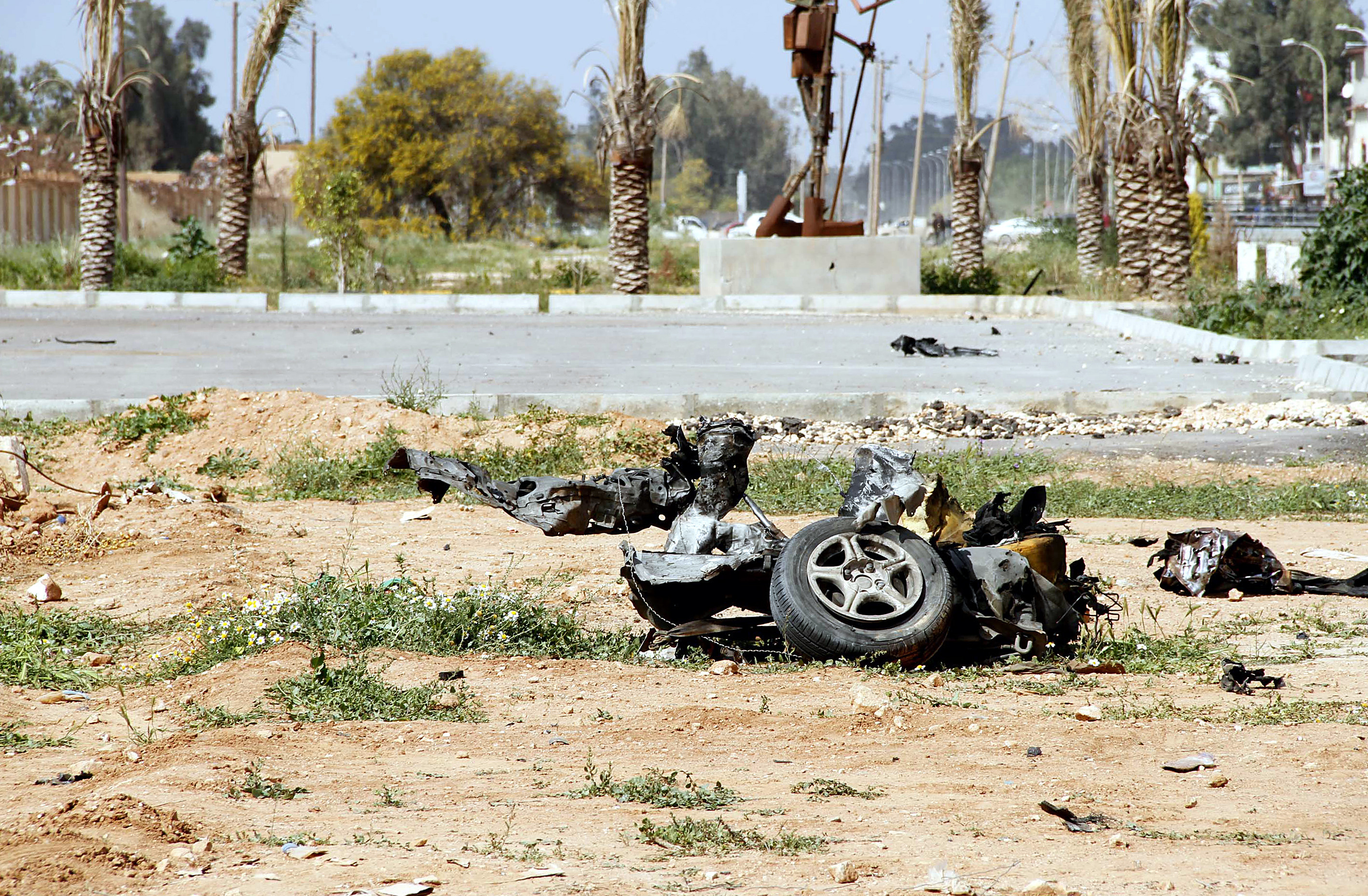
(Photo: Wreckage from a car bomb that killed at least 8 and injured many others in Benghazi, Libya on March 17, 2014. By Mohammed Elshaiky/Anadolu Agency/Getty Images)

The Mysterious Fate of Flight 370, Ctd

By Jonah Shepp

Chris Goodfellow doesn’t think MH370 was hijacked:

For me, the loss of transponders and communications makes perfect sense in a fire. And there most likely was an electrical fire. In the case of a fire, the first response is to pull the main busses and restore circuits one by one until you have isolated the bad one. If they pulled the busses, the plane would go silent. It probably was a serious event and the flight crew was occupied with controlling the plane and trying to fight the fire. Aviate, navigate, and lastly, communicate is the mantra in such situations. …

What I think happened is the flight crew was overcome by smoke and the plane continued on the heading, probably on George (autopilot), until it ran out of fuel or the fire destroyed the control surfaces and it crashed. You will find it along that route–looking elsewhere is pointless.

Jeff Wise shoots down that theory:

Goodfellow’s account is emotionally compelling, and it is based on some of the most important facts that have been established so far. And it is simple—to a fault. Take other major findings of the investigation into account, and Goodfellow’s theory falls apart.

For one thing, while it’s true that MH370 did turn toward Langkawi and wound up overflying it, whoever was at the controls continued to maneuver after that point as well, turning sharply right at VAMPI waypoint, then left again at GIVAL. Such vigorous navigating would have been impossible for unconscious men.

Goodfellow’s theory fails further when one remembers the electronic ping detected by the Inmarsat satellite at 8:11 on the morning of March 8. According to analysis provided by the Malaysian and United States governments, the pings narrowed the location of MH370 at that moment to one of two arcs, one in Central Asia and the other in the southern Indian Ocean. As MH370 flew from its original course toward Langkawi, it was headed toward neither. Without human intervention—which would go against Goodfellow’s theory—it simply could not have reached the position we know it attained at 8:11 a.m.

Meanwhile, Jessica Trisko Darden considers how the search reflects on national security and politics in Asia:

While the countries of the region lack the ability to effectively monitor their airspace and maritime borders, they clearly have the capacity to blame one another. Political haranguing has been an evident part of the Malaysian-led search process. Both China and Vietnam repeatedly expressed frustration with Malaysia for providing contradictory details that hampered their ability to search for wreckage. Vietnam temporarily downgraded its search in the absence of credible information before ending it following word that Malaysia had suspended its search in the same area. Relations between Malaysia and China have been strained by an inability to locate the 153 Chinese citizens on board the flight and Malaysia Airlines’ handling of the passengers’ families.

David Wertime zeroes in on China’s mounting frustration with Malaysia:

Malaysian authorities have certainly given China ample room for angst. The New York Times reported on March 16 that a series of errors, delays, and obfuscations by the Malaysian government and military has hampered the search process. Chinese social media, which provides the best available public indicator of citizen sentiment, has not shown a proclivity to forgive. An online short comic series shared over 50,000 times on Weibo depicts a haggard boss (China) defenestrating a lazy employee (Malaysia) after he gives lackadaisical answers at a meeting about MH370 also attended by well-prepped Vietnamese and U.S. avatars. (In an introduction, the artist calls the Malaysians a “pig troupe.”) A phrase combining the character for Malaysia with a popular Internet curse word became a Weibo hashtag and been used more than 400,000 times.

Follow all the Dish’s coverage of the missing plane here.

Cool Ad Watch

by Chris Bodenner

tumblr-n1p601L0JW1ttbzubo1-r2-1280

Copyranter features a campaign that solicited ad ideas from convicts behind bars (“To be clear: These are speculative ads and are not endorsed by the companies mentioned”). He reviews the one seen above, for a tattoo removal and laser salon:

It’s a perfect headline targeting tatted ex-cons. The placement is flawless as well. Excellent ad. Bravo.

A Dispatch From Putinstan

by Jonah Shepp

Vladimir Putin’s speech announcing Crimea’s annexation yesterday offered some insight into how the Russian president sees the world, history, and international law. Bershidsky calls the speech “historic,” saying, “It would have been easy to fall under the spell of the moment, to bask in a Russia resurgent. Except for the lies”:

It is … impossible to accept the notion of a threat to Ukraine’s Russian-speaking population. As a Russian who has lived and worked in Ukraine, I have never encountered any sign of hostility. It’s only now, thanks to Putin’s actions in Crimea, that Ukrainians are turning against Russians.

And it’s only now, thanks to Putin’s craftily brilliant speech, that Russians are trapped. All of us, “traitors” and empire revivalists, are in one way or another accountable for Putin’s tour de force. We are part of the well-armed, swashbuckling entity that Putin equates with Russia, and which will now be Russia in the eyes of the world. Putin wants it that way: He is out to prove that a non-Communist incarnation of the Soviet Union, which he still mourns, is back, and it’s got teeth.

Adam Taylor highlights Putin’s selective history of Crimea:

Putin’s theory on Crimea’s place in Russian history makes some sense: The peninsula had been part of Russia from 1783 to 1954, and even under Ukrainian rule housed Russia’s Black Sea Fleet. It’s not always a pretty history, though. For example, the entire Crimean Tatar population was deported from Crimea during World War II, and a huge number are believed to have died. Putin touched on this in his speech, admitting that the Crimean Tatars were “treated unfairly” but adding that “millions of people of various ethnicities suffered during those repressions, and primarily Russians.”

Putin also neglects to mention that Crimea’s decision to remain part of Ukraine after the collapse of the Soviet Union was decided by a referendum on independence in December 1991. That election found that 54 percent of Crimean voters favored independence from Russia – a majority, though the lowest one found in Ukraine.

Posner annotates Putin:

Our western partners, led by the United States of America, prefer not to be guided by international law in their practical policies, but by the rule of the gun. [Hmm] They have come to believe in their exclusivity and exceptionalism[ahem], that they can decide the destinies of the world, that only they can ever be right. They act as they please: here and there, they use force against sovereign states, building coalitions based on the principle “If you are not with us, you are against us.”

In other words, we did not act illegally but if we did, you did first. The subtext, I think, is that the United States claims for itself as a great power a license to disregard international law that binds everyone else, and Russia will do the same in its sphere of influence where the United States cannot compete with it.

But Christopher Dickey warns against dismissing Putin’s resentments:

[I]n a crisis where the slightest miscalculation could lead to a catastrophic war, we in the West would do well to listen closely to what Putin is saying.  The bitterness in his narrative was palpable as he described more than two decades of humiliation at the hands of American and European governments that treated his country like a second- or even third-rate power. For him and for many of his people, whatever their other rationales may be, winning back Crimea is about winning back pride.

The world’s history is rife with wars begun to restore national dignity, and nowhere has that been more true or more disastrous than in Europe, where the link between humiliations and conflagrations is all too well known.

And Andrew Foxall thinks we ought to stop ignoring Kiev’s shadier characters:

[W]hile Western governments and pundits are correct to dismiss Putin’s pretenses for invading Ukraine, they are wrong to presume his Ukrainian opponents are necessarily in the right. The uncomfortable truth is that a sizeable portion of Kiev’s current government — and the protesters who brought it to power — are, indeed, fascists. If Western governments hope to steer Ukraine clear from the most unsavory characters in Moscow and Kiev, they will need to wage a two-pronged diplomatic offensive: against Putin’s propaganda and, at the same time, against Ukraine’s resurgent far-right.

It Doesn’t Feel Like A Recovery

by Patrick Appel

Economy Impressions

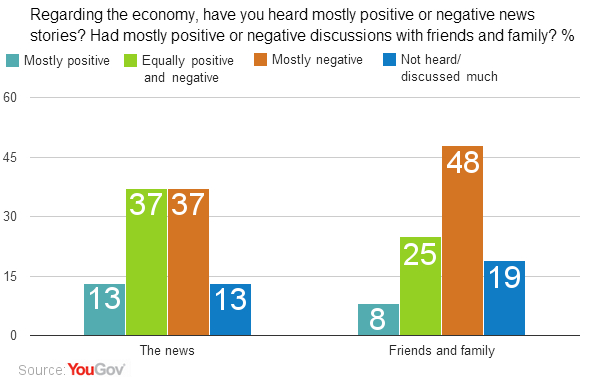
Americans mostly hear bad news about the economy:

Frequently, assessments of the economy have a partisan dimension – and in this week’s poll that is true when it comes to overall judgments.  But that isn’t the case when it comes to what people are hearing.  For example, 58% of Republicans say the overall economy is getting worse, and only 6% say it is improving.  Democrats say the economy is improving, by 35% to 23%.  While that is a much smaller margin in the positive direction than the Republicans’ negative evaluation, it is still positive. But both Democrats and Republicans hear bad news more than good news – and from both the news media and from friends and relatives.

Last week, Josh Barro tackled why many Americans incorrectly believe we’re still in a recession:

Two trends are responsible. The labor market is still slack, meaning millions who would like to work can’t, and those who do work have limited ability to demand higher wages …

For four decades, even in stronger economic times, wage gains have not kept pace with economic growth. Wages and salaries peaked at more than 51 percent of the economy in the late 1960s; they fell to 45 percent by the start of the last recession in 2007 and have since fallen to 42 percent.

When the economy does grow, that growth disproportionately accrues to the owners of capital instead of to wage earners; and in the last few years, weak growth and abundant labor have made that pattern even stronger than normal.

Arnold Kling adds a caveat:

I would note that a very important part of that trend is the shift from “straight” wages and salaries to other forms of compensation, notably health insurance. Higher payroll taxes also play a role. The share of total compensation to GDP held up fairly well until recently.