Reveling In Repetition

When it comes to music:

[O]ver the past century, a number of composers expressly began to avoid repetitiveness in their work. In a recent study at the Music Cognition lab, we played people samples of this sort of music, written by such renowned 20th-century composers as Luciano Berio and Elliott Carter. Unbeknownst to the participants, some of these samples had been digitally altered. Segments of these excerpts, chosen only for convenience and not for aesthetic effect, had been extracted and reinserted. These altered excerpts differed from the original excerpts only in that they featured repetition.

The altered excerpts should have been fairly cringeworthy; after all, the originals were written by some of the most celebrated composers of recent times, and the altered versions were spliced together without regard to aesthetic effect. But listeners in the study consistently rated the altered excerpts as more enjoyable, more interesting, and – most tellingly – more likely to have been composed by a human artist rather than randomly generated by a computer.

Alexis Madrigal’s takeaway:

[Elizabeth Hellmuth] Margulis’ essay takes a fascinating turn to explain what it is about repetition that makes it so key to music. The secret, the evidence suggests, is that listening to music is an active process: We’re making the music in our heads as the sounds play our brains.

Bike Safety In Numbers

Lesley Evans Ogden visited seven cities where cycling is a common mode of transportation and concluded:

Safety improves in a city as the total number of cyclists increases. This effect has been seen in studies in Denmark, the Netherlands, 14 other European countries, Australia, and 68 cities in California. “It is likely that causation runs in both directions: safer cycling encourages more cycling, and more cycling encourages greater safety,” writes John Pucher, professor of Urban Planning at Rutgers University, in his 2012 book City Cycling, written with Ralph Buehler. Motorist behavior probably contributes to this phenomenon. In places like Copenhagen—where four out of five individuals have access to a bicycle—most drivers are also cyclists, and so are accustomed to sharing public space with bicycles.

Industrial Art

Screen shot 2014-02-28 at 10.05.08 AM

Jennifer Norman turns the camera on photography, capturing pictures of the environmental costs of the artform:

While pursuing a Ph.D. in photography at the University of Sydney, Norman spent four years photographing some of the heavy industries that directly and indirectly make photography possible, including oil refineries, pulp and paper mills, and chemical plants. “It was a way of making myself a personal experiment and trying to not ignore all the factors of production that I rely on every day to have the luxuries I have,” she said.

Photographers, it turns out, rely on more industries than Norman had time to shoot, including asphalt for roads to get to their subjects, chemicals for photo development, and power to operate their computers and other equipment. After researching various facilities, Norman traveled as much as 17 hours by car to make her photographs. She resolved to photograph alone and at night in order to recreate the fear that we push aside in our everyday lives in order to enjoy the fruits of environmental destruction.

Norman’s work is currently at the Pith Gallery as part of the Exposure Festival.

Why So Few Green Conservatives?

Sean McElwee blames messaging:

According to Dr. Robert Bartlett, chair of the Department of Political Science at the University of Vermont, the problem has been framing. “Environmentalists tend to frame the issue in terms of harm and justice, while conservatives respond to in-group loyalty, sanctity, respect and stewardship.” Aaron Sparks, a Ph.D. student at the University of California, Santa Barbara who is studying the issue with Phillip Ehret, finds that about 20 to 30 percent of strong conservatives hold pro-environment attitudes (meaning they are willing to sacrifice economic growth to protect the environment). But Democrats must be “smart about how they frame their appeal,” Sparks says. “Conservatives can be persuaded to accept the environmental argument if is pitched in a way that is consistent with their morality, which tends to emphasize the sacredness of nature and a focus on local, community-building issues.”

But a 2012 study finds that climate campaigns overwhelming continue to frame the issue as harm and care, fairness and oppression of marginalized groups.

The Best Of The Dish Today

First up: a must-read from the invaluable Marcy Wheeler on how the Obama administration has tried to protect the presidency from full accountability for the torture program. Could it be because the presidential authorization of torture also authorized drone strikes which the current president has embraced? Read the whole thing. As I said today, I now consider the White House to be part of the problem here, rather than part of the solution. And if the report on torture gets stifled permanently, it will be an unforgivable betrayal.

Four other posts worth revisiting: the cooptation of yoga; the grinding persistence of Obama’s agenda; a genius cartoon about where we are now in the gay rights debate; and Colin Powell’s awesome ur-selfie.

The most popular post of the day was The Way We Live Now followed by The Boring, Relentless Advance Of Obama’s Agenda.

See you in the morning – Pacific Time, that is, as I’ll be on Bill Maher’s show tomorrow night.

The Hounding Of A Young Gay Writer

So I’m perusing the web on the airplane to Los Angeles and saw a blast of incandescent gay fury all over the place. It turns out that Ezra Klein had the gall to offer a writing fellowship at Vox to one Brandon Ambrosino, a 23 year-old professional dancer who is a graduate of Liberty College, Jerry Falwell’s joint. Judging from the reaction, you might have thought Ezra had hired Rick Santorum. Oh! the screeds and harrumphs, the sighs and the gasps! Here’s the gay politburo official at Slate, Mark Joseph Stern, in a dreary tract against what he calls Klein’s “unbelievably bad hire”:

Ambrosino’s ideas are not brash, unconventional, exciting, or avant-garde. They are reckless, retrograde, and vapid—and hiring Ambrosino reflects startlingly bad, potentially catastrophic judgment by Vox.

“Potentially catastrophic!” A 23-year old who doesn’t parrot what the left likes could bring the entire Ezra Klein venture down! Not to be outdone, we get this from my friend John Aravosis:

While I think Brandon Ambrosino is sloppy, unimaginative, a bad writer, and a not-very-complicated thinker, my biggest concern is that he comes across, to me, as having an agenda that borders on animus … Brandon Ambrosino is the Allen West of homosexuality. He’s your go-to guy, if your goal has nothing to do with finding a legitimate minority voice on the issues of the day.

Notice the disturbing notion of a “legitimate minority voice.” And who decides what’s legitimate? Why John of course! As for the imputation of anti-gay animus: it’s as lame as neocons calling critics of Israel anti-Semites or self-hating Jews. Equality Matters calls him baldly an anti-gay apologist and then proceeds to tell us solemnly that

The announcement was met with widespread condemnation from LGBT activists and writers who called his hiring an “embarrassment” and a “major mistake.”

So, as you would, I went and read some of Ambrosino’s work. We posted about one recently but I hadn’t read much else. The most impressive by far is a funny, sometimes moving, self-deprecating and brutally honest memoir of his time as a gay kid at Falwell’s school. Maybe The Atlantic‘s editors made it better (as they do) – but as a piece of writing, it’s livelier and funnier than anything I’ve read from, say, Mark Joseph Stern. As for his other pieces, they do suffer from some occasional cluelessness and attention-seeking pyrotechnics. But is a young writer not allowed some attention-seeking pieces any more? And his critique of gay-left intolerance gains a little poignancy as the rhetorical lynch mob now prowls the interwebs in order to get him fired.

Here’s what I also found: He wants the gay rights movement to adopt more of the forgiveness and compassion that marked the spirit (if not always the letter) of Martin Luther King Jr. He gets a little grossed out by hyper-sexual antics at gay rights parades – which is a bit of a bore, at this point, but within his rights (and certainly something some gay people say sotto voce). He conflates too many issues when discussing gay identity – but, in his emphasis on choosing sexual identity, he echoes the new left rather than the gay right. Sure he trades on being the gay writer willing to criticize the gay world, but he seems perfectly sincere to me, if a little jejune. And why is he not allowed to criticize what he sees? Is he supposed to take some gay test before he’s allowed a voice?

He is unusual, in as much as his journey into gay life from religious fundamentalism inevitably makes his take on being gay a very particular – and fascinating – one. But guess what? Millions of gay people are born and brought up in fundamentalist Christian environments and families. Understanding their lives and finding a place for them in the world is something we should be striving to achieve rather than attempting to snuff out. And gays from fundamentalist backgrounds can help us engage in dialogue with some of our most dedicated opponents. What I found truly disgusting about some of the commentary is that they tried to portray the man as somehow a Jerry Falwell clone. That’s a deliberate lie and a smear. And it springs from anti-Christian animus.

Gabriel Arana flatters me thus:

Sullivan’s and Rauch’s positions are thoughtfully staked out and stem from nuanced views about the role of government, Ambrosino’s iconoclasm amounts to heedless self-promotion.

Yes, but no one’s making him the editor of The New Republic, are they? He’s just got a gig as a writing fellow at Vox, for Pete’s sake. Give him time and some mentoring and editing (which is presumably what such a fellowship is for), and his 23-year-old talent might indeed go on to become more thoughtful and nuanced. And why would these harrumphing lefties want to stop that?

Could it be because they don’t actually want to continue the dialogue with people of faith, but rather seek to leverage the growing majority in favor of gay equality to rhetorically bludgeon the “bigots” into submission, to create a world in which they call the shots the way homophobes used to? Could it be that they enjoy policing the discourse now that they seem in the majority? This latest surge of gay intolerance needs to be beaten back as forcefully as the anti-gay right’s cornered animus. It’s particularly brutal when that intolerance is directed at a young gay writer whose work and life are being trashed as somehow illegitimate. If anything is anti-gay in this kerfuffle, that is.

Suspected Of Being An Adult

Age Perception

Jamelle Bouie looks at a recent study (pdf) about our perceptions of black children:

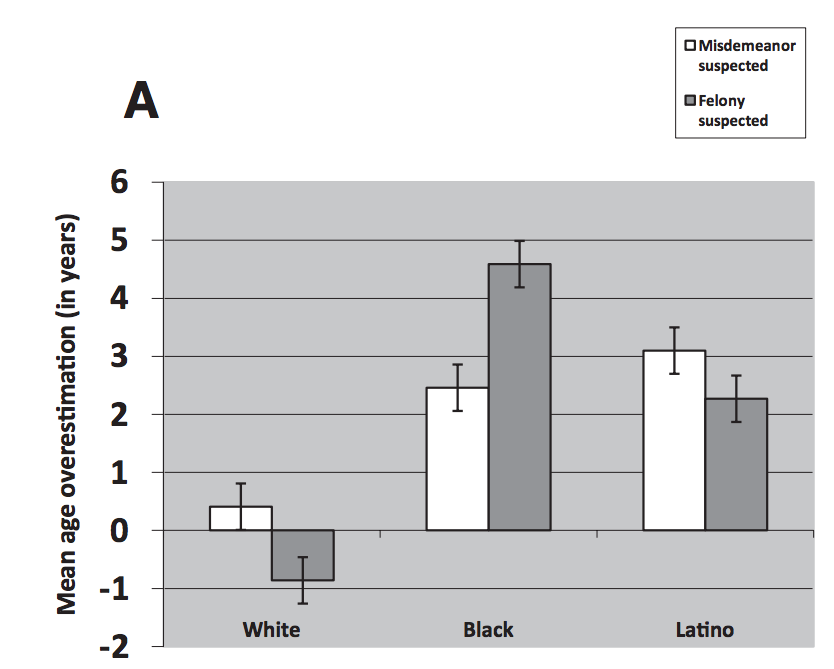
Researchers used implicit association tests to gauge racial attitudes and observe how people perceived misdemeanor or felony acts. The results were startling. When comparing felony acts by whites, blacks, and Latinos, respondents overestimated black boys’ ages by 4.53 years. Police officers, who were also included in the pool of participants, overestimated their ages by 4.59 years. To put this in more concrete terms, when participants saw a 14 year-old African American boy, they perceived him as an 18 to 19-year-old adult. And the effect of this was to deny the presumption of innocence—after all, adults are seen as fully responsible for their actions.

Philip Bump puts the study in context:

In 2012, data from the Department of Education revealed that black students were far more likely than white students to face harsh discipline following infractions at school than student of other races. That sort of uneven system of discipline prompted the Obama administration to call for zero-tolerance policies to be dropped. If this study is any guide — and it’s only one study, of course — the tendency to give white kids the presumption of innocence and youth that isn’t afforded to black students might be one of the reasons for that discrepancy.

(Figure: “Officers’ average age estimation accuracy for child suspects of different races.”)

A Foreign Policy Full Of Gas

Rory Johnston explains why the US can’t use liquified natural gas exports to undercut Russia in Europe:

Most of the natural gas that could potentially head for Europe is already committed in long-term supply contracts. … Furthermore, most of those contracts are in Asia, where natural gas prices are higher than in Europe. The United States does not sell natural gas, nor does Europe buy it; commercial entities do, and these companies are not going to voluntarily lose money in order to advance American interests. As Michael Levi explains, the U.S. government “can create a framework in which commercial entities can sell gas, but after that, it’s up to those businesses to decide where the gas goes.”

Meghan O’Sullivan suggests US oil production could hit Russia harder and faster:

Russia’s real vulnerability lies in the price of oil, not in the realm of gas.

Revenue from gas sales abroad make up 8 percent to 9 percent of the Russian budget, while oil revenue accounts for a much heftier 37 percent to 38 percent. It was not that long ago that a prolonged collapse in the price of oil undermined the foundations of the Soviet Union, according to former Deputy Prime Minister Yegor Gaidar. The U.S., by adding 2.5 million barrels of oil to global markets in the last three years, has prevented the price of oil from edging higher in the face of disruptions in Libya, Iran and elsewhere. Should the U.S. continue to increase its oil production, as is widely assumed, it could create pressure to further lower the price.

It would not take a huge price collapse to harm Putin’s regime; already, the Russian economy is struggling, and the government has made across-the-board cuts. Plus, Putin’s power comes in large measure from extensive patronage networks made possible by high oil prices. To balance its budget, Russia needs oil prices of about $110 (the current price is about $108). A further dip in oil prices is the largest challenge on the horizon to Putin.

Matt Steinglass calls a time-out:

The idea that America can defeat Russian irredentism in Eastern Europe by deregulating its own energy industries is frankly ridiculous. Deregulation can make airline tickets cheaper. It cannot stop the Russian army. Energy-industry deregulation has become part of the standard Republican line on Crimea largely because of the relentless self-congratulatory process by which political actors cement their followers’ ideological convictions. Leaders apply such flattery like a soothing unguent, assuring their backers that the things they already believe in would have solved every imaginable problem in advance, if only the foolish opposition had gone along. This helps fuse ideological blocs into coherent, hard-to-dent juggernauts.

Chart Of The Day II

Obamacare Enrollment

Cohn discovers that the latest Obamacare enrollment data is being misreported:

The facts are right but the interpretation is not. The months HHS has been using for tabulation don’t correspond precisely to the calendar, because of state reporting methods and where weekends fall. As it turns out, “February” is actually February 2 through March 1. That’s 28 days. “January” is actually December 29 through February 1. That’s 35 days. Plug in the numbers, and you’ll see the average daily enrollment for January was 32,744 and for February it was 33,673. As you can see in the graph, the pace actually increased a bit. Among the very few who noticed were Charles Gaba of ACASingups.net and Sy Mukherjee of ThinkProgress.

The Mysterious Fate Of Flight 370, Ctd

Jeff Wise finds it very odd that we still have no idea what happened to the plane:

Past air crashes have always turned up some definitive evidence by this stage of the proceedings. This incident (frankly, we’re not even 100 percent sure it is a crash) is different. So far, no debris field has been found, the Pentagon reports that it detected no midair explosions in the area, and Malaysian authorities have issued contradictory statements about what primary-radar tracks they may or may not have observed. Based on the vast search area, it appears that authorities believe that the plane may have been deliberately flown far from its original heading. If that’s the case, then whoever redirected the plane might well have timed its abduction to coincide with the period when it would have slipped out of sight of the air traffic control system anyway—presumed to be operating normally, but actually veiled in the fog of unknowability.

Ben Branstetter discusses how better technology could prevent such fiascos:

There are forces trying to implement the full benefits of satellite technology into the consumer aircraft market. One system, dubbed Automatic Dependent Surveillance-Broadcast (ADS-B) by Boeing itself, would create a worldwide network between Air Traffic Controllers and planes in the air, allowing any ATC to see where any ADS-B-equipped plane is at any moment thanks to second-by-second reporting to GPS satellites. Such a system, if adopted globally, could have solved the mystery of Flight 370 and the a dozen other aerial disappearances since the 1970s. Many delays stand in the way of ADS-B, otherwise known as NextGen, including a plethora of delays and an estimated $11 billion price tag.

But with 1 billion people expected to be flying annually by 2024—many of them on transcontinental flights—it is not only astonishing but pathetically negligent that such a crucial system relies on such archaic systems. The bewildering tragedy of Flight 370 highlights the anachronism of radar systems in a world where Google can identify my position within a single room. GPS technology went commercial more than 30 years ago and has only grown more widespread and accurate since then, yet the airline industry prefers the system used by Iceman and Maverick.

Update from a reader:

Many have brought up the possibility that the plane has been hijacked, but I’m surprised that no one is honing in on the potential motivations for such a hijacking.  Specifically, wouldn’t it make sense to consider that separatist Muslim Uyghur’s from the northwest region of China might be responsible.  The Chinese government blamed them for the deadly knife attack that occurred just two weeks ago.  A hijacked plane diverted to Xinjiang province would appear to cover a distance comparable to the distance between Kuala Lumpur and Beijing. It has already been reported that the plane dramatically changed its route to the northwest and reached the Andaman Islands. From there, it appears the plane could simply travel due north to reach Xinjiang.

Lastly, it is being reported that the plane flew for more than 5 hours after the transponders were turned off.  It would not take 5 hours for that plane to get to the Andaman Islands, so the question is, where did it go after that? My crazy, wild, and almost certainly incorrect guess is Xinjiang, home of the East Turkestan Islamic Movement.  Remember, most of the passengers on the flight were Chinese, so successfully hijacking and landing the plane in Xinjiang would be, in the eyes of the Uyghurs, and incredible source of leverage.

Previous Dish on the disappeared plane here and here.