Ukraine’s Nuclear Mistake?

Stephen L. Carter flags a paper (pdf) by Robert Mathers “about the trade-offs involved in Ukraine’s 1994 decision to give up the weapons that had made it the third-largest nuclear power on earth”:

The West basically purchased the weapons, by investing in refitting Ukrainian industry. Some 1,900 warheads were transferred to Russia. Some 111 ICBMs and 46 heavy bombers were destroyed.

And, as Mathers points out, Ukraine also gave up the means to rebuild its arsenal: From the mid-1950s through 1991, a plant in Dnipropetrovsk “produced over eight types of intermediate-range and ICBMs, to include the 10-warhead behemoth SS-24.” In return for all of this, Ukraine received what Mathers presciently refers to as “perceived” promises that the U.S. would guarantee its safety against Russian attack.

Walter Russell Mead claims that Russia’s aggression toward Ukraine could mark “the end of a rational case for non-proliferation in many countries around the world”:

If Ukraine still had its nukes, it would probably still have Crimea. It gave up its nukes, got worthless paper guarantees, and also got an invasion from a more powerful and nuclear neighbor.

The choice here could not be more stark. Keep your nukes and keep your land. Give up your nukes and get raped. This will be the second time that Obama administration policy has taught the rest of the world that nuclear weapons are important things to have. The Great Loon of Libya gave up his nuclear program and the west, as other leaders see it, came in and wasted him.

It is almost unimaginable after these two powerful demonstrations of the importance of nuclear weapons that a country like Iran will give up its nuclear ambitions. Its heavily armed, Shiite-persecuting neighbor Pakistan has a hefty nuclear arsenal and Pakistan’s links with Iran’s nemesis and arch-rival Saudi Arabia grow closer with every passing day. What piece of paper could Obama possibly sign—especially given that his successor is almost certainly going to be more hawkish—that would replace the security that Iran can derive from nuclear weapons? North Korea would be foolish not to make the same calculation, and a number of other countries will study Ukraine’s fate and draw the obvious conclusions.


No Warm Welcome For Bibi

Goldblog interviewed Obama in anticipation of Netanyahu’s visit to the White House today:

In an hourlong interview Thursday in the Oval Office, Obama, borrowing from the Jewish sage Rabbi Hillel, told me that his message to Netanyahu will be this: “If not now, when? And if not you, Mr. Prime Minister, then who?” He then took a sharper tone, saying that if Netanyahu “does not believe that a peace deal with the Palestinians is the right thing to do for Israel, then he needs to articulate an alternative approach.” He added, “It’s hard to come up with one that’s plausible.” …

Obama was blunter about Israel’s future than I’ve ever heard him.

His language was striking, but of a piece with observations made in recent months by his secretary of state, John Kerry, who until this interview, had taken the lead in pressuring both Netanyahu and the Palestinian leader, Mahmoud Abbas, to agree to a framework deal. Obama made it clear that he views Abbas as the most politically moderate leader the Palestinians may ever have. It seemed obvious to me that the president believes that the next move is Netanyahu’s.

Marc Tracy’s takeaway:

What most struck me about the interview is the way Obama speaks of Israel’s interests and the end of the settlements as though he were a typical American Jewish “liberal Zionist”—an Israel supporter, a settlements opponent, constantly trying to calibrate his mind and his heart (or his kishke)—kibitzing on some progressive listserv. “I have not yet heard, however, a persuasive vision of how Israel survives as a democracy and a Jewish state at peace with its neighbors in the absence of a peace deal with the Palestinians and a two-state solution,” he said. “Nobody has presented me a credible scenario.”

David Horovitz thinks the interview illustrated Obama’s lack of faith in Netanyahu:

Since even before he became president, Obama has made plain his conviction that Israel’s settlement enterprise is profoundly counterproductive for the Jewish state. Many Israelis share this belief. That Obama chose to highlight his concern in such ominous and pointed terms, going so far as to warn that it would become harder in the future for the US to protect Israel from the consequences of its misguided West Bank building, would suggest that he has all but despaired of Netanyahu’s willingness to rein in construction. Otherwise, surely, he would have held his fire, and first consulted face-to-face with the prime minister.

For one thing is certain, the president’s resort to a newspaper interview on the eve of their talks to issue near-apocalyptic warnings about the disaster Netanyahu risks bringing upon Israel is just about the last thing likely to bolster the prime minister’s confidence in their alliance, and just about the last thing likely to encourage Netanyahu to further alienate his hawkish home base by taking steps such as halting building outside the settlement blocs.

What Can We Do For Uganda’s Gays?

European countries and international institutions are cutting aid to Uganda over its new law criminalizing homosexuality:

Norway, Demark and the Netherlands, which collectively had provided $27 million in aid to Uganda, have announced that they are cutting aid to the Ugandan government. On Friday, the World Bank announced that it was putting on hold a $90 million loan to Uganda’s health service. U.S. Secretary of State John Kerry has said that the State Department is reviewing its relationship with Uganda. The U.S. currently gives more that $486 million in bilateral aid. On Wednesday, the U.S. Ambassador to Kampala said that the U.S. would deny visas to Ugandans who “incite violence, people who propagate hate, (and) who have used political violence.”

But Jonathan Zasloff is concerned that heavy-handed condemnation could just strengthen the resolve of the homophobes in Uganda. He suggests an alternative response:

At this point, the administration’s best option is to order the US Embassy in Kampala to start processing LGBT Ugandans for humanitarian parole.

According to United States Citizenship and Immigration Services, humanitarian parole can “bring someone who is otherwise inadmissible into the United States for a temporary period of time due to a compelling emergency.” USCIS may grant parole temporarily “to anyone applying for admission into the United States based on urgent humanitarian reasons or if there is a significant public benefit for a period of time that corresponds with the length of the emergency or humanitarian situation.” Humanitarian parole does not bring with it immigration status, although it is very rare for parolees to return their country of origin.

Scotland is looking to offer asylum:

Humza Yousaf, Minister For External Affairs, has written to UK Foreign Secretary William Hague detailing the Scottish Government’s gesture to welcome “any Ugandan” persecuted by the new laws. It comes on the back of … concern over the welcome being extended to countries with anti-gay laws during the Glasgow 2014 Commonwealth Games. With prominent members of the Ugandan government due in Glasgow this summer, the Scottish Government will also meet representatives of LGBT (lesbian, gay, bisexual, and transgender) groups to discuss proposals on handling human rights issues during the event.

Meanwhile, the outing campaign proceeds apace in Ugandan tabloids, previously covered here:

Red Pepper‘s reign of terror has continued unabated all week, with some issues coming out as much asuganda-paper1 a full day earlier than usual, and each with more salacious stories reputedly “exposing” Uganda’s gay underground. Thursday’s Red Pepper included a cover story warning that “Homos go to court over anti-gay law.”  That same day, Red Pepper rushed out its Friday edition, which twisted earlier interviews and statements from Ugandan LGBT advocates and turned them into potentially violence-inciting anti-gay propaganda. The same issue also claimed to have stories of Ugandan celebrities “spill(ing) gay secrets.”
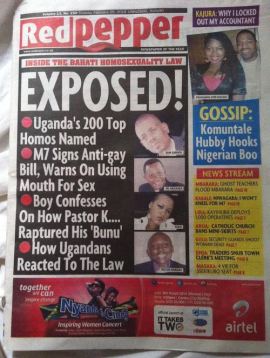
Saturday’s edition, which was out by 2:00 p.m. Friday, included a spread featuring photos, names and addresses of LGBT Ugandans were allegedly part of a “homo cabinet.” The same issue boasted another feature titled, “How to precent your child from becoming a homo.”

Alexis Okeowo checks on how rising anti-gay sentiment is playing out in other parts of Africa:

Homosexuality was already criminalized in Uganda, but the new law, which comes a month after similar anti-gay legislation was passed in Nigeria, is part of a rising tide of anti-gay sentiment in Africa. The intense popular vitriol being whipped up against gays, combined with the political calculations of the leaders of the countries enacting these laws, has turned homosexuality into one of the greatest supposed threats facing the continent: the root of all social, economic, and political ills.

At a time when gay-rights movements in Africa, some of which have been in existence for nearly a decade, should be making headway in the public discourse, their leaders are being forced to go underground again for fear of their lives. (In 2012, I wrote for the magazine about the Ugandan gay-rights movement, which had been winning court battles and participating in mainstream discussions on sexuality up until the new law was signed this week.) Other countries like Senegal and Kenya have started to enforce, or are pushing to enforce, long-ignored existing anti-gay laws. “I am so sad and worried about ordinary gay people,” the leading Ugandan gay activist, Frank Mugisha, told me this week. “And especially for my friends.”

“This Is Putin’s Waterloo, Not Ours”

GERMANY-CARNIVAL-ROSE-MONDAY-STREET-PARADE

Michael Cohen has a splendid rebuttal to the all the hyper-ventilating from the liberal internationalists and unreconstructed neocons among the punditariat. Money quote:

You don’t have to listen to the “do something” crowd. These are the same people who brought you the wars in Iraq and Afghanistan, among other greatest hits. These are armchair “experts” convinced that every international problem is a vital interest of the US; that the maintenance of “credibility” and “strength” is essential, and that any demonstration of “weakness” is a slippery slope to global anarchy and American obsolescence; and that being wrong and/or needlessly alarmist never loses one a seat at the table.

The funny thing is, these are often the same people who bemoan the lack of public support for a more muscular American foreign policy. Gee, I wonder why.

(Photo: People look at a figure of Russian President Vladimir Putin showing a bomb reading “Crimea” on his arm during the traditional Rose Monday parade in Duesseldorf, Germany on March 3, 2014. By Patrick Stollarz/AFP/Getty.)

The Uni-Polar Moment Has Passed

Larison tackles Rubio:

Over the weekend, Rubio offered eight proposals for “punishing” Russia. Some are old stand-bys of symbolic retribution (e.g., condemnation at the U.N., boycotting the next G-8 summit, expelling Russia from the G-8) that are more or less easy enough to do and will have no effect, while others are much more reckless and foolish, such as pushing harder for Georgian membership in NATO, that will certainly make Russia more intransigent. Speeding up the process of bringing Georgia into NATO is just the sort of useless, ill-considered goading that will make it even more difficult to avoid further escalation in Ukraine. It is the sort of proposal one would make if one wanted U.S.-Russian relations and the situation in Ukraine to keep getting worse.

Daniel Berman sees Rubio’s op-ed as a symptom of America’s refusal to accept a multi-polar world:

The defenders of American preeminence while warning fearfully of the rise of China have in fact latched onto it as way of avoiding the more dreadful prospect of a multi-polar world and a return to great power politics. If China is a rising superpower seeking world domination, then the US can lead an alliance of the rest of the world, a force sure to trump whatever resources China can muster.

But China has been MIA in this crisis, revealing a dirty little secret. China has never been as interested in the reality of overseas empire in the same way the European powers have been, and its international efforts have mostly been used to block EU and American efforts to force their “norms” on the world, not to promote its own “Chinese Model” an invention of Thomas Friedman and the NYT editorial page.

The new world looks increasingly multipolar and based on state, not sub-state actors. China will throw its power into ensuring this takes place by blocking Western efforts to create a one-world order, but will at the same time refrain from giving the West its second choice, a two-world order. And that means that China is not going bail out Western geopolitical thinkers, they will have to do it on their own.

Cleavers Of Mass Destruction

On Saturday, at least 29 people were killed and 134 injured in a horrific knife attack at a subway station in the southwest Chinese city of Kunming:

The attack on the evening of March 1st has shocked China, and prompted a call from Xi Jinping, the president, “to crack down on violent terrorist activities in all forms”. Initial reports said there were ten attackers, all dressed in black, and witnesses described grisly scenes of victims bleeding after being struck by curved knives and meat cleavers.

On Monday police announced that eight attackers had been involved in all, including the three most recently captured. Police said that at the scene of the attack they had shot and killed four, and injured and captured one. Police also named the leader of the gang as Abdurehim Kurban. The name appears to indicate a member of China’s Uighur ethnic minority, a Muslim Turkic group from Xinjiang.

Peter Ford expects a heavy-handed response:

Now they will crack down hard, as they have done before. Police have already begun rounding up Uighurs in Kunming for questioning. …

The prospects for ordinary Uighurs in Xinjiang are grim. Already they chafe under strict controls on religious expression, education and other cultural aspects of daily life, and under the close eye of the police. For years, Western governments have privately advised Chinese officials to ease popular resentment by relaxing those controls. But Beijing is in no mood to win hearts and minds in the aftermath of a terror attack that a state newspaper dubbed China‘s 9/11. And, judging by the anger and shock expressed on Chinese social media, a steely approach to terrorism resonates with the public.

David Wertime and Rachel Lu examine how the attack reverberated through China’s tightly controlled press and social media:

Related chatter has dominated Sina Weibo since. “Kunming” is the most popular discussion topic by far, with many lighting digital candles, writing, “pray for Kunming” or “we are all Kunmingers,” or sharing graphic images purporting to show the aftermath of the slaughter. Several users wrote that the incident “was our 9-11,” in reference to the far more deadly terrorist attack on U.S. soil in September 11, 2001.

This attack may also presage a further deterioration in the relationship between the majority Han, who comprise approximately 92 percent of China’s population, and the country’s approximately 10 million Uighurs, a Muslim minority who predominantly live in Xinjiang. The carnage has “deepened my prejudice against Uighurs,” admitted one Weibo user; “don’t tell me most of them are good.”

James Palmer has more on Uighur-Han relations. Meanwhile, Julian Ku wonders why the US has hesitated to call the Kunming attack an act of terrorism:

[T]he failure of the U.S. State Department to use the term “terrorist” has drawn outrage in Chinese social media. I understand the U.S. government’s reluctance to endorse the Chinese government’s description of these attacks, but I still think the term “terrorist” is perfectly appropriate for this situation.  The attackers indiscriminately killed and injured civilians in a train station, and there seems plenty of evidence that it is motivated by politics and ideology.  To be sure, the international definition of terrorism remains contested, but the US law definition seems applicable.

Hobbled By The Iraq Legacy

President Bush Holds News Conference

The Bush administration faced Putin’s Russia with the same mixture of sticks and carrots that the Obama administration has – although, quite clearly, Putin saw in Cheney a man with identical instincts and beliefs about the wielding of military power. But the invasion of Iraq makes the US’s current position in defense of Ukraine’s inviolable sovereignty fraught with historical parallels. Only Dick Cheney would fail to hear the irony in John Kerry’s words yesterday:

You just don’t invade another country on phony pretext in order to assert your interests.

Jack Matlock, in a shrewd analysis, notes further:

So far as violating sovereignty is concerned, Russia would point out that the U.S. invaded Panama to arrest Noriega, invaded Grenada to prevent American citizens from being taken hostage (even though they had not been taken hostage), invaded Iraq on spurious grounds that Saddam Hussein possessed weapons of mass destruction, targets people in other countries with drones, etc., etc. In other words, for the U.S. to preach about respect for sovereignty and preservation of territorial integrity to a Russian president can seem a claim to special rights not allowed others.

It gives me absolutely no pleasure to note this. But Iraq is a lot further away from the US than Ukraine is from Russia, and while WMDs did not exist in Iraq, pro-Russian populations sure do exist in Crimea and Eastern Ukraine.

What interests me most about this is whether China will be consistent, and isolate Russia still further.

(Photo from Getty)

Giving Putin An Off-Ramp?

It may make no tangible difference, but no responsible Western leader should seek now to escalate the crisis. Even in the Bush administration, the Cold War nostalgics lost the debate:

A faction around Vice President Cheney would embrace the view of Russia as an enemy and attempt to recruit ex-Soviet states such as Georgia and the Ukraine against them. Yet this faction would never dominate US policy. During the Georgian War of 2008 Rice remained committed to the partnership, blaming the Georgians for provoking the crisis and urging them to accept Russian terms for mediation, even going so far as to imply Cheney’s responsibility for the crisis.

Jacob Heilbrunn observes that Obama “has few tools at his disposal to compel a change in Russian behavior”:

[T]he main constraint on Putin’s freedom of movement in Ukraine will be that it’s dangerous for him to enmesh himself in a prolonged war in Ukraine. If he seeks to occupy the eastern Ukraine, all bets are off–Ukraine is not Georgia. It has 200,000 troops–ten times, Elke Windisch notes, as many as Tbilisi did. And it is calling up a million reservists. Still, Ukraine would be unlikely to be able to withstand a full-scale Russian invasion. Its tanks, for example, consist mostly of fifty-year-old Soviet era T-64s. The real trouble would come in occupying Ukraine. It would likely become not only a geopolitical but also a military nightmare for Putin, on the order of Iraq or Afghanistan.

Rather than threatening Putin, Obama should continue to seek to offer him an exit strategy–just as Putin offered him one out of Syria. By all accounts, this is what Obama is seeking to do. Such a course won’t satisfy the nostalgic cold warriors in Washington, but it would defuse a conflict that should not be allowed to jeopardize the West’s relations with Moscow.

Kaplan suggests a specific way forward:

Perhaps Obama could offer assurances that he won’t offer Ukraine membership in NATO (that’s not a live issue anyway), nor will he push to revive the plan for Ukraine to join the European Union. This latter pledge would be a big deal:

The protests were set off when Yanukovich cancelled plans for a formal association with the EU, after Putin lured him back into Moscow’s bed with a $15 billion aid program. In exchange for these assurances, Putin would call off his shock troops, recognize the Ukrainian parliament’s ouster of Yanukovich (whom Putin never liked anyway), and allow Ukrainian elections to go ahead this May, perhaps under international observation. Obama could present the deal as a victory for democracy (the Ukrainian people will decide!). Putin could swallow the deal, believing that a pro-Russia candidate might win (legitimately or otherwise). In any event, the Ukrainian politicians will have been shown what Putin could do if they get out in front of their skis again.

Well, here’s hoping. But that happy scenario does not seem consonant with the emotions roiling the Kremlin as we speak. Here’s the balancing act Beinart recommends:

The U.S. and its European allies should do everything possible to strengthen the government in Kiev politically, economically, and maybe even—clandestinely—militarily. And they should think creatively about what kinds of economic and diplomatic measures might hit the Russian elite where it hurts, with the hope of at least stopping a Russian conquest of all of eastern Ukraine. That such efforts may undermine Russian cooperation on other issues, like Iran and Syria, is a risk the West will have to take.

But the Obama administration will also have to tell Kiev’s revolutionaries that while it supports a unified, democratic Ukraine, it does not support an anti-Russian Ukraine. Russia will not permit it, and at the end of the day, the United States cannot protect Ukraine from Russia’s wrath. It’s a bit like Finland’s dilemma during the Cold War or Taiwan’s now. Even if Ukraine regains control over its domestic affairs, it will never enjoy complete control over its foreign policy. The U.S. has a moral obligation to support democracy and self-determination. But it also has a moral obligation not to make promises it can’t keep.

Which Side Would Make Ukraine Richer?

Europe:

Lost amid the upheaval in Kiev is the fundamental question: Would the country be better off if its economy became more integrated with the West, or if it remained in Russia’s orbit? Economic history suggests that the protestors, not Yanukovych, are right. Although global income convergence is at best a stuttering phenomenon, being a poor member of a rich region is a better course to wealth than midlevel status in a poor region. …

When it comes to convergence within economic communities, the evidence suggests that two lessons of real estate apply: First, you’d rather be the last house on the right side of the tracks than the first house on the other side. Second, if you want your investment to appreciate, it’s best to be the cheapest house in an expensive community than the luxury condo in a lousy neighborhood.

On Friday, Cassidy outlined the risks of helping Ukraine financially:

If nothing is done, Ukraine will default on its loans, and its currency will collapse: that much is pretty certain. But another bailout wouldn’t resolve all the country’s problems. In the short run, it may well intensify them. As the price of extending new loans, the I.M.F. and other lenders would surely insist that the Ukrainian government take some unpopular steps, such as phasing out costly energy subsidies and balancing its budget. Such austerity policies often makes things worse, at least for a while. Even in places where bailouts eventually work, such as Ireland, they involve a very painful transition.

Update from a Dutch reader:

That map you posted makes me very proud to be European. It feels counter intuitive that Europeans are pretty much refusing to take up arms right now. However, their strategy works. The map proves it. Sure, European peace gloves have always been backed by a nuclear American stick, but the gloves work. They move borders and bring peace. Estonians and Lats now pay with the same currency my parents do. There are no more borders between my parents’ home and the Baltic states. Kids who were born when I was in high school as citizens of the USSR – enemies of the West – are now EU citizens, paying with the euro and can travel as easily throughout the EU as Americans can in America. That’s not something people anyone would have predicted a mere 25 years ago.