Putin’s Posture, Ctd

How Dickey sees it:

In many ways the most dangerous aspect of the rationale Moscow has laid out for its intervention is what might be called “the Putin doctrine,” which is that it has the right to intervene to “protect” Russian populations wherever they may be. It used that rationale in its war against Georgia in 2008. And since there are large Russian populations in the Baltics, which are NATO members, that’s a red flag right there that has to be a red line.

Erik Voeten bets against Putin messing with NATO:

NATO is built around a promise that its member states defend each other from military threats. Ukraine is not a member but the Baltic states and Poland are. Given Russia’s extremely broad assertions that it has a right to defend Russian speakers (and the Baltic states have many that are not always treated so well) the current actions constitute a threat for these states. NATO has both military and institutional resources that can reinforce its commitment to defend the Baltic states and Poland. It is likely to use those. This is, of course, one way in which a smaller conflict could erupt into a bigger one. Yet, despite all the protestations that we wrongly see Putin through Western eyes, I remain confident that a military conflict with NATO is not something he wishes to risk.

Meanwhile, Masha Lipman compares contemporary US-Russia relationship to the US-USSR one:

One major difference between then and now is the absence of ideological antagonism: the postwar Soviet empire proclaimed the advantage of the socialist path over the capitalist one. Today, Russia’s opposition to the West has evolved as a purely nationalist project. Russia’s military response to the events in Ukraine is framed as a protection of “ours”—and “ours” are Russian, no matter where they live. The idea of Ukrainian sovereignty is totally disregarded.

This is Putin’s response to Ukraine’s attempt to build a new nationhood that combines a leaning toward the Western world with the nationalism of Ukraine’s own west; both “wests” are regarded by Putin as utterly hostile to Russian interests. In the words of Dmitry Trenin, an expert on Russian foreign policy, the fear in Moscow is that “the new official Ukrainian narrative would change from the post-Soviet ‘Ukraine is not Russia’ to something like ‘Ukraine in opposition to Russia.’ ”

Earlier Dish on Putin’s posture toward the world here.

“In Another World”?

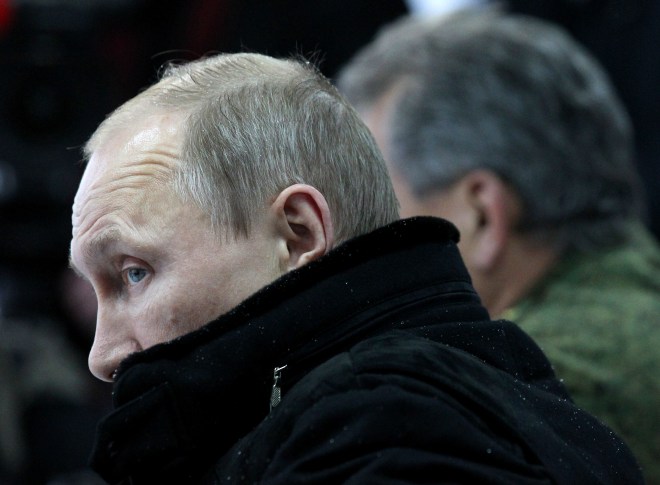
Russian President Vladimir Putin Attends Military Exercise Near Saint Petersburg

Reading all the grim reports from Ukraine this morning, this quote really stood out. It’s a report of what Angela Merkel reportedly told Barack Obama in a phone-call last night, after speaking with Vladimir Putin:

She was not sure he was in touch with reality, people briefed on the call said. “In another world,” she said.

That is the truly worrying thing. But it is always worth trying to see things from the point of view of our foe, to see if his madness makes some kind of internal sense, and to see if we have any blind-spots that may hinder us from the smartest response. Greg Dejerejian notes:

One need not be a Putin apologist to recognize some salient facts: 1) the Maidan movement included ultra-nationalists and even neo-fascists, 2) the Yanukovych transition deal was crudely scuppered leaving the Russian side caught unawares and looking flat-footed (never appreciated by Vladimir Putin); and 3) this was followed by deeply provocative measures by the new Government in Kiev to move to extinguish Russian minority language rights. More assertiveness was surely on tap, as the mood was manifestly one of triumphalism.

I fell prey to this myself, buoyed by obvious and instinctive support for any country resisting the boot of the Kremlin, and too blithe about the consequences of a revolution that overthrew a democratically elected president. But as we now know only too well, Ukraine is deeply divided between its pro-Western West and its pro-Russian East; any attempt to resolve this underlying tension decisively was bound to risk real rifts within the country and tempt Russia to intervene. Anatol Lieven has a must-read:

President Viktor Yanukovych’s rejection of the EU offer led to an uprising in Kiev and the western and central parts of Ukraine, and to his own flight from Kiev, together with many of his supporters in the Ukrainian parliament. This marks a very serious geopolitical defeat for Russia. It is now obvious that Ukraine as a whole cannot be brought into the Eurasian Union, reducing that union to a shadow of what the Putin administration hoped. And though Russia continues officially to recognize him, President Yanukovych can only be restored to power in Kiev if Moscow is prepared to launch a full-scale invasion of Ukraine and seize its capital by force. The result would be horrendous bloodshed, a complete collapse of Russia’s relations with the West and of Western investment in Russia, a shattering economic crisis, and Russia’s inevitable economic and geopolitical dependency on China.

It seems vital to me that we see what Putin is doing from his point of view. What seems to us like an unprovoked, Sudetenland-style invasion is both mercifully less than that (so far) and also, critically, a function of Putin’s string of recent setbacks. He has already lost a huge amount. And he is now recklessly and thoughtlessly acting out as a result. Dmitri Trenin describes Moscow’s current worldview thus:

In Moscow, there is a growing fatigue with the west, with the EU and the United States. Their role in Ukraine is believed to be particularly obnoxious: imposing on Ukraine a choice between the EU and Russia that it could not afford; supporting the opposition against an elected government; turning a blind eye to right-wing radical descendants of wartime Nazi collaborators; siding with the opposition to pressure the government into submission; finally, condoning an unconstitutional regime change. The Kremlin is yet again convinced of the truth of the famous maxim of Alexander III, that Russia has only two friends in the world, its army and its navy. Both now defend its interests in Crimea.

How to deal with an authoritarian leader, increasingly paranoid about the West, his greater regional aspirations turned to dust, who is now wielding military power in a manner more reminiscent of the Cold War than of anything since? One obvious response is counter-provocation, of the kind that John McCain and the Washington Post editorial board would instinctively prefer. It seems to me that, given how Putin has reacted to Western pressure so far, this would merely invite more recklessness.

The saner approach is to try and mollify some of Russia’s legitimate concerns about Ukraine – the rights of the pro-Russian Ukrainians in the East, for example, some of which were suspended (and now restored) by the new Kiev government, while persuading him of unstated but profoundly adverse consequences if he ratchets up the use of force even further. David Ignatius – unlike the breathless neocons on the WaPo editorial page – makes the case very effectively this morning. What our goal must be now, above everything, is avoiding any pretext for a Russian invasion of Eastern Ukraine.

And the truth is: this is very much in Russia’s actual interests. Its stock market and currency are in free-fall this morning, but a full-scale invasion of Ukraine would mean a mutual bloodbath, effectively destroying Russia’s standing in the world, tearing up its relations with the major powers, including, possibly China, and rendering it a rogue, primitive, paranoid power, whose elites would be cut off from the global trade and financial markets they rely on. There must be some faction in the Kremlin able to see this, even if it only occupies a small part of Putin’s mind.

But it will not be enough. Ukraine has long occupied a powerful place in the Russian imagination. Pride and identity are at stake now, and they make a catastrophe much likelier. And so the West needs both to be firm about military intervention but also cognizant of Russia’s genuine fears and insecurity in the wake of recent events. Djerejian again:

Further aid to Ukraine should likely be made conditional on ensuring minority rights in Eastern and Southern Ukraine are better respected, and critically, that no preemptive military activity by Kiev in those areas take place … By moving to soften the tone and policy in Kiev, better respecting Russia’s historic interests (please let us retire talk of NATO Membership Action Plans and such), and offering honest broker type conflict resolution channels (not bidding up an East-West show-down in Pavlovian fashion as if inevitable) the following goals could possibly be accomplished in the short-term: 1) delaying or ideally preventing formal annexation of Crimea; 2) restraining Putin from invading Eastern Ukraine and 3) most important, helping defuse the specter of a horrible civil war in the heart of Europe’s eastern flank.

These options do not have the emotional satisfaction of McCain’s outrage and Cold War nostalgia. They will not satiate the neoconservative lust for conflict or for simple black-and-white moralism in foreign affairs. They may be politically difficult for the president to sustain. But they might actually be the only way to defuse some of the extremely dangerous dynamics now in play in Euro-Asia. This is all happening, one should recall, on the 100th anniversary of the outbreak of the Great War. I’ll leave the last word to Lieven:

A century ago, two groups of countries whose real common interests vastly outweighed their differences allowed themselves to be drawn into a European war in which more than 10 million of their people died and every country suffered irreparable losses. In the name of those dead, every sane and responsible citizen in the West, Russia, and Ukraine itself should now urge caution and restraint on the part of their respective leaders.

The alternative is unthinkable.

(Photo: Russian President Vladimir Putin watches a military exercises at Kamenka polygon on March 3, 2014 near Saint Petersburg, Russia. By Sasha Mordovets/Getty Images)
Putin’s Posture

Maria Snegovaya unpacks his view of foreign policy:

The recent literature on Putin is [correctly] drawing attention to his pro-Soviet imperialistic views: remember, to Putin the collapse of the USSR the biggest geopolitical catastrophe of 20th century. But what exactly this pro-Soviet worldview means is fairly poorly understood. To get a grasp on one needs to check what Putin’s preferred readings are. Putin’s favorites include a bunch of Russian nationalist philosophers of early 20th century – Berdyaev, Solovyev, Ilyin — whom he often quotes in his public speeches. Moreover, recently the Kremlin has specifically assigned Russia’s regional governors to read the works by these philosophers during 2014 winter holidays. The main message of these authors is Russia’s messianic role in world history, preservation and restoration of Russia’s historical borders and Orthodoxy.

She illustrates her point by quoting from a 1950 essay by Ilyin:

We know that Western nations don’t understand and don’t tolerate Russian identity… They are going to divide the united Russian ‘broom’ into twigs to break these twigs one by one and rekindle with them the fading light of their civilization. They need to partition Russia to equate it with the West, and thus destroy it: a plan of hatred and lust for power

KermlinRussia, the highly influential satirical duo, explains Putin’s calculus:

The West has already begun to threaten Russia with political and economic isolation, but this stems from a misunderstanding of the nature of Putin’s power.

For example, Western analysts say that “Russia will not invade Crimea because Russia’s economy is in bad shape and this would only weaken it further.” They are mistaken. Putin no longer needs economic growth. He has grasped the contradiction between economic growth and the consolidation of his own power, and he has made his choice. He understands very well that in 2011-2012 it was the most economically active and wealthy segments of the population that protested against him. He understands that millions of entrepreneurs and workers of the knowledge economy had already emigrated to the U.S. and European Union during his reign. And he understands that a solution which simultaneously halts economic growth and strengthens the patriotism of the poorest segments of the population is an opportunity to kill two birds with one stone.

On that note, Andrew Ryvkin looks at how the Crimea invasion is playing in Russia:

A growing number of right-leaning Russians, known for their resentment of Putin due to his lax stance on Central Asian immigrants and his support of the Muslim republics of Northern Caucasus, are praising the invasion. To many of them, this regime’s shortcomings can now be overlooked, overshadowed as they are by the image of a “Great Russia” finally reunited with its prodigal sibling, Ukraine. No one really cares what happens in Russia, as long as this country still has the balls to send a military force outside of its borders to protect ethnic Russians. The fact that Russia often can’t provide security for its citizens—mostly ethnic Russians—within its own borders, often losing in its never-ending war on homegrown terror, fades away at the prospect of a territorial gain and a victorious war.

With Ukraine, the Kremlin is creating its own axis of evil: America, the “fascists” who seized power in Kiev, and their liberal Russian supporters.

Motyl’s view:

If one considers Russia’s interests, none of this — the armed intervention in Crimea, the claimed right to intervene anywhere in Ukraine — makes sense. Putin’s arguments simply do not hold water. As objective observers will confirm, there is absolutely no threat to Russian citizens anywhere in Ukraine. There may have been a diminution of overall law and order following the collapse of Viktor Yanukovich’s regime, but that affects all Ukrainian residents equally. Nor is the Kremlin’s claim that putative “fascists” from Western Ukraine are about to descend on Crimea and the southeast even remotely true. By the same token, intervention, war, international isolation, and the like will not enhance Russians’ living standards or their sense of well-being. There may be a temporary spurt of excitement at seeing the Russian tricolor hoisted in Donetsk, but that enthusiasm will quickly fade when Russians realize that these regions will impose an enormous economic liability. And, finally, there is no way that a truncated Ukraine’s transformation into a hostile anti-Russian state and a permanent occupation by Russian troops of potentially rebellious provinces — after all, there are also large numbers of pro-Western Ukrainians in the southeast — could possibly serve Russia’s interests.

There is only one reason Putin has embarked on what Russian democratic opposition leader Boris Nemtsov calls “folly”: flexing his military muscle enhances Putin’s authority as a strongman who will reestablish Russia’s grandeur and brook no people-power in former Soviet states.

Ukraine On The Brink, Ctd

Go here to catch up on our coverage over the weekend. The latest tweets punctuating the crisis:

https://twitter.com/ilyamuz/status/440477813431607296

The Lede is live-blogging.

Correction Of The Day

“The original [article] stated that Bradley Manning took Ellen’s selfie. In fact, it was Bradley Cooper. This has been corrected,” – the Guardian, from their Oscar write-up.

Powering Down Storms With Green Energy

Sarah Sloat highlights the work of Stanford’s Mark Jacobson, whose research suggests that offshore wind farms may diminish the destructive force of hurricanes:

[H]e plugged in “tens of thousands” of wind turbines into his models, placing them within 100 kilometers off the coast in water depths ranging from 30 to 200 meters. Then he ran simulations for three different hurricanes: Katrina, Isaac, and Sandy. Not only were the turbines undamaged by the conditions, they also disrupted peak winds by up to 92 percent and storm surge by up to 79 percent. In the case of Katrina, 78,000 wind turbines decreased wind speeds by 80 to 98 miles per hour.

Is Social Media Anti-Social?

danah boyd (who for some reason prefers her name lowercased) is the author of It’s Complicated: The Social Lives of Networked Teen. Denise Tanton appreciates that the book “helps adults get past the very confusing and often frightening stories we see often see about bullying, online sexual predators and teen addiction to the internet to understand what’s really happening with kids online”:

Our kids are over-scheduled. We don’t believe it’s safe for them to ride their bikes around their neighborhoods. Malls and diners often have restrictions in place that prevent teens from gathering in public spaces. Sometimes the only place our kids can hang out with their friends IS on social media. And, when they are with their friends, they aren’t using social media to escape — they’re using their using the smart phones to connect with other friends, take photos and otherwise document their in-real-life experience, (which is not necessarily the way adults use their smart phones when they’re out and about), an example danah mentions in the introduction her her book, from a high school football game:

They whipped out their phones to take photos of the Homecoming Court, and many were texting frantically while trying to find one another in the crowd. Once they connected, the texting often stopped…. And even though many teens are frequent texters, the teens were not directing most of their attention to their devices. When they did look at their phones, they were often sharing the screen with the person sitting next to them, reading or viewing something together.

The parents in the stands were paying much more attention to their devices. They were even more universally equipped with smartphones than their children and those devices dominated their focus.

Emily Bazelon asked the author about how adults should interact with kids on social media. Her response:

I tell parents to build a network for your child—the older cousin, the cool aunt, the awesome coach. That way, when they need advice, you’re not the only person they have to turn to. You should really encourage those other relationships, and they’ll form on technology, on social media or via texting. As a parent, there are times your kid won’t want to talk to you. So the more you’ve thought through how they have a support network that’s not just you, the better off they’ll be when they hit any bump. And increasingly, the way that happens is online. As a parent, you can also reach out to other kids in your friend networks, so you’re an adult those kids can turn to.

How Much Is Privacy Worth?

Julia Angwin, author of Dragnet Nationspeculates about the future of privacy-protection tools:

I think that it’s hard to know whether there will be a robust market. What’s happening now that’s really weird is that the more companies that collect data about us, the more they all have the same data and the uniqueness of their data actually falls. So in some ways, the companies that are collecting data are bringing down the price of our data because there’s no scarcity. There are hundreds, literally hundreds of companies have information about me. And many of them have the exact same information about me. So they can’t sell it for very much.

There are people who argue that privacy would help us make our data more scarce. And then actually those companies would benefit, they would actually be able to sell it for more because they would be the only one that had it.

There’s also the fact that they’re going to be people who will pay for privacy, and it might just become a luxury good. Where some people will buy their way out of it. And that might be an unfair situation societally, in the sense that some people will have this protection that some people won’t. And I’m not sure where the market will go, but I suspect that we will see a rise in maybe both these markets.

In an excerpt from her book, Angwin details how a pro-privacy search engine helped her say goodbye to Google:

I found a tiny search engine called DuckDuckGo that has a zero-data-retention policy.

It doesn’t store any of the information that is automatically transmitted by my computer — the IP address and other digital footprints. As a result, DuckDuckGo has no way to link my search queries to me. “When you access DuckDuckGo (or any website), your web browser automatically sends information about your computer,” the company’s privacy policy states. “Because this information could be used to link you to your searches, we do not log (store) it at all. This is a very unusual practice, but we feel it is an important step to protect your privacy.”

As soon as I switched, I realized how dependent on Google I had become. Without Google’s suggested searches and perfect memory of what I usually search for, each search required more work from me. … In fact, I had gotten so accustomed to letting Google do my work that I found it a bit jarring to have to finish typing an entire word without Google’s finishing it for me. Without Google’s suggestions, however, I found that I was less distracted to search for things I didn’t need. No more typing in the letter a and having Google suggest “amazon,” and then suddenly remembering that I needed to order something from Amazon.com. With DuckDuckGo, I usually found what I wanted, although sometimes it was strange to be confronted with just three results. I was so conditioned to seeing millions of results for everything on Google.

Update from a reader:

Excited to see DuckDuckGo mentioned. I’m nearing my first year after switching from Google/Bing to DuckDuckGo and I’m not looking back. A few months into using DDG, I found out about DuckDuckGo Goodies, and they’re absolutely awesome. Maybe you already mentioned how DDG popularity exploded after NSA/PRISM leaks. There’s also a recent profile of them on FastCompany.

Artistry In Bloom

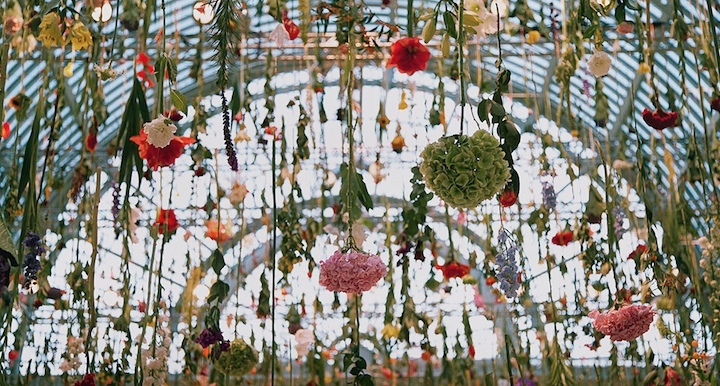
Screen shot 2014-02-19 at 11.48.18 AM

Artist Rebecca Louise Law takes her skills as a florist to the next level:

Rebecca Louise Law is known for her breathtaking installations that consist of thousands of hanging flowers suspended overhead. Last February, she was commissioned by London’s Garden Museum to create a temporary, site-specific work for their Floriculture: Flowers, Love and Money exhibition. 3,500 multicolored roses were hung on copper wire and suspended in the central part of the historic building. Visitors were invited to walk beneath the ethereal canopy.

In an interview last summer, she offered insight into the field:

You work a lot with dried flowers…

There are certain flowers that look really beautiful and ethereal dried rather than zingy, fresh and bang in your face, which I do like, but I really enjoy the process of preserving and prolonging the experience of that flower. Most of my work’s a physical thing, you’re surrounded by it, you can touch it rather than view it in a vase, out of reach. I suppose I want people to notice flowers, because you can walk into a room and not really register them; if you’ve seen the same traditional arrangements the whole of your life you don’t truly consider what you’re seeing. …

Florists repeatedly top job satisfaction polls – why do you think this is?

For me, the satisfaction comes from that fact that there’s a start and finish to each job, and because the season’s change, your creations are always changing. When I was a florist, I could get satisfaction ten times in one day by doing a beautiful bouquet and pleasing people – a guy comes in who’s got no idea what he wants to buy for his girlfriend and you have to do some detective work – are they a classic, elegant or arty? You say all these different words and they go: ‘oh yeah that one!’

See more of Law’s work here.

The Loneliness Loop

Does shopping make you sad? Nicholas Hune-Brown reviews a recent study that explored the connection between materialism and loneliness:

In the study [PDF], [researcher Rik] Pieters followed more than 2,500 Dutch people over six years. For more specificity, the researcher broke materialism down into three categories that have subtle but significant differences. What Pieters calls “acquisition centrality” is pure, unfettered materialism. It’s the consumerism of the shopaholic—an unadulterated love of acquiring and owning possessions. “Possession-defined success” is the desire to keep up with your neighbours, a status-driven urge to make sure you’re not falling behind. And “acquisition in the pursuit of happiness” is exactly what it sounds like: buying with the belief that happiness is just one more Apple product away. It is materialism that “reflects a deficit.” …

He found that, over time, loneliness increased materialism and materialism increased loneliness (though the effects here were much smaller). Consumers can find themselves in a vicious circle, shopping because they’re sad, getting sadder as they shop, shopping some more—a loneliness loop that threatens to end with authorities discovering you alone in your apartment, long since dead, surrounded by a heaps of unopened Amazon boxes.

Surprisingly, however, as Pieters dug down into the different types of materialism, he found that not all materialism makes you miserable. While those who shopped in pursuit of happiness or to attain a particular status predictably increased loneliness over time, the people shopping out of “acquisitive centrality” actually seemed to decrease their loneliness.