An Oscar-worthy set of impressions:
Month: March 2014
The Birth Of Boredom
Kate Greene explores it:
According to the contemporary Norwegian philosopher Lars Svendsen, the concept of boredom as we understand it today is distinctly modern. In A Philosophy of Boredom (2005), Svendsen notes that while it’s ‘always possible to find earlier texts that seem to anticipate the later phenomenon… boredom is not thematised to any major extent before the Romantic era’. It was during that time, he writes, that the concept became democratised, and not solely ‘a marginal phenomenon reserved for monks and the nobility’. ‘Boredom is the “privilege” of modern man,’ he adds.
Greene goes on to note that some claim “there are generative benefits that come from spending time in a state of low arousal and monotony, as though boredom primes their minds to receive new ideas and connections.” She highlights a note that David Foster Wallace attached to his manuscript of The Pale King, a novel that explores the boredom of IRS employees:
Bliss – a second-by-second joy and gratitude at the gift of being alive, conscious – lies on the other side of crushing, crushing boredom… Pay close attention to the most tedious thing you can find (Tax Returns, Televised Golf) and, in waves, a boredom like you’ve never known will wash over you and just about kill you. Ride these out, and it’s like stepping back from black and white into colour. Like water after days in the desert. Instant bliss in every atom.
Leaving God On The Cutting Room Floor?
A former Columbia Pictures producer, Michael Cieply, recently waxed nostalgic (NYT) for a time when “studios routinely made movies with overtly religious themes for the mainstream audience.” He’s not sure films like the soon-to-be released Noah (trailer above) can undo the “years of neglect or occasional hostility” that made believers wary of Hollywood:
For months, Hollywood has been buzzing about the film’s postproduction woes. Under the guidance of Paramount’s vice chairman, Rob Moore, who says he is a devout Christian but has also been eager for a mainstream hit, “Noah” has been screened for test audiences, who have been lukewarm, regardless of their beliefs.
As described recently in The Hollywood Reporter, various editing teams tried to make the film more appealing to Christian audiences without much improving the results, eventually leaving creative control with [director Darren] Aronofsky. One complaint, according to the publication, was a sense among religious viewers that the movie, at its core, was appropriating the biblical account of the flood to preach about current concerns like overpopulation and environmental abuse. That churchgoers should be leery of a progressive agenda wrapped in Scripture is perhaps understandable, given Hollywood’s recent treatment of religious characters, who are often hypocrites and villains, driving plot lines that make, at best, a token bow toward the virtues of a faith-based life.
In response, Linker argues that religious people should be happy that Hollywood doesn’t offer them more:
Cieply’s article will no doubt provide aid and comfort to the religious right by confirming its suspicions about Hollywood’s barely concealed contempt for faith. But those who care more about artistic quality than quantitative point-scoring will have a hard time getting worked up about Cieply’s lament.
Yes, Hollywood produces relatively few films about religious subjects and themes. But that might not be a bad thing for religion. Religion is a serious subject, and Hollywood doesn’t do well with serious subjects — because Hollywood’s goal is to make money, not art. If the major studios started producing more big-budget movies on religious topics, all we’d end up with are more dumbed-down portrayals of religion.
Millman contends that economics, more than animus toward religion, drives Hollywood:
Cieply’s complaint seems to be about marketing rather than about substance – he’s interested in films that “appeal to a Christian audience.” As Cieply knows, there is a whole industry of Christian filmmaking out there providing that kind of product. Hollywood is perfectly good at flattering its audience – that’s its standard modus operandi, so I wouldn’t be at all surprised if Hollywood tried to break into a lucrative niche market. And if it doesn’t, then Christian filmmakers will fill the void – they are already doing so, much as Tyler Perry has done with a different lucrative niche market that Hollywood has had trouble cracking.
But what Cieply seems to want is a variety of mass-market films with a sensibility that flatters a specifically religious audience. The barriers to that, though, aren’t some kind of anti-religious bias in Hollywood, which was likely as secular in the 1950s as it now, and just as focused on the bottom line. It’s changes in film economics – and cultural changes in the larger society.
Whole Foods Worship
Michael Schulson wonders why educated liberals “get riled up about creationists and climate-change deniers, but lap up the quasi-religious snake oil at Whole Foods”:
At times, the Whole Foods selection slips from the pseudoscientific into the quasi-religious. It’s not just
the Ezekiel 4:9 bread (its recipe drawn from the eponymous Bible verse), or Dr. Bronner’s Magic Soaps, or Vitamineral Earth’s “Sacred Healing Food.” It’s also, at least for Jewish shoppers, the taboos thathave grown up around the company’s Organic Integrity effort, all of which sound eerily like kosher law. There’s a sign in the Durham store suggesting that shoppers bag their organic and conventional fruit separately – lest one rub off on the other – and grind their organic coffees at home – because the Whole Foods grinders process conventional coffee, too, and so might transfer some non-organic dust. “This slicer used for cutting both CONVENTIONAL and ORGANIC breads” warns a sign above the Durham location’s bread slicer. Synagogue kitchens are the only other places in which I’ve seen signs implying that level of food-separation purity.
Look, if homeopathic remedies make you feel better, take them. If the Paleo diet helps you eat fewer TV dinners, that’s great – even if the Paleo diet is probably premised more on The Flintstones than it is on any actual evidence about human evolutionary history. If non-organic crumbs bother you, avoid them. And there’s much to praise in Whole Foods’ commitment to sustainability and healthful foods. Still: a significant portion of what Whole Foods sells is based on simple pseudoscience. And sometimes that can spill over into outright anti-science (think What Doctors Don’t Tell You, or Whole Foods’ overblown GMO campaign, which could merit its own article).
(Photo by Flickr user Bookchen)
Who Are The Tatars?
Crimean Tatars are in target of Russian racists of Crimea! Kırımlı Tatarlar tehlike altında! Les Tartars en danger… pic.twitter.com/gbCLYn0Fzi
— Cihangir Bilgin (@CiciBilgin) March 1, 2014
Think of the forgotten Tartars, Crimea’s original people. Oppressed, exiled, flooded with Russians, they’re now just 12% of the population.
— Ben Goldsmith (@BJGoldsmith) March 2, 2014
1000 Crimean #Tartars came as “human shields” to defend the army base from Russian invaders,acc. to the Ukrainian MoD http://t.co/qyeCgAK1eI
— Middle East News (@MiddleEast_BRK) March 2, 2014
Come on Tatars! Keep the country together! You are our hope! :) #euromaidan #ukraineprotests pic.twitter.com/bUEL2AtYjO
— Johnny Semeniuk (@jsemeniuk11) February 26, 2014
Oxana Shevel puts the pro-Ukrainian minority in context:
The new Ukrainian government leaders have called for calm, the far right Right Sector said it will not be sending its men to Crimea, and in a conciliatory gesture to Russian-speakers, acting president Turchynov today vetoed the law the Ukrainian parliament adopted several days earlier repealing the 2012 law elevating the status of the Russian language. With the Security Council in session to discuss events in Crimea and Western leaders urging restraint and warning Russia that violations of Ukrainian sovereignty and territorial integrity are unacceptable, there is hope that a diplomatic solution to the crisis could be found.
But even if diplomacy fails and the Russian military seizes Crimean territory with the intention of controlling it permanently, it will be much harder for Russia to establish control of Crimea than it was in South Ossetia, Abkhazia and Transnistria. The main reason for this is the Crimean Tatars.
The Tatars — a Muslim group that was deported en masse from Crimea by Stalin in 1944 and that for decades has waged a peaceful struggle for the right to return — have been coming back in droves since 1989. According to the latest Ukrainian census, from 2001, 243,433 Crimean Tatars account for 12.1 percent of the Crimean population of 2,033,700. They represent a highly mobilized and unified constituency that has consistently been pro-Ukrainian and opposed to pro-Russian separatism on the peninsula. Going back to the 1991 independence referendum, the narrow vote in favor of Ukrainian state independence in Crimea may have been thanks to the vote of the Crimean Tatars. Since then, the Crimean Tatars and their representative organ, the Mejlis, have cooperated with the pro-Ukrainian political parties. …
There has been no comparable local mobilized group opposed to Russian takeover in any other of the breakaway regions.
And they would likely fight to the finish:
Analyst Semivolos says the Crimean Tatars, as a nation, have a “post-genocidal mentality.” “Crimean Tatars in many ways are still living through the experience of genocide to the present day. For them, in many ways, it isn’t over, the process of returning, in many ways it is continuing,” he explains. “That is why there is this perception of threats, of existential threats, threats to their lives, their physical existence. And they view all sorts of actions, even ones that Russians themselves consider defensive, but for Crimean Tatars, they are attacks.”
Catch up on all of the Dish’s Ukraine coverage here.
Quote For The Day
“Art is not a visual illustration of the artist’s worldview. We often presume that a work of art represents the ‘worldview’ of the artist. This is simply untrue. No human being possesses a unified ‘worldview’ that is manifest in and through each of her intentional acts or artifacts she produces. We don’t need art critics to tell us this. We can read the words of the prophet Jeremiah: ‘the heart is perverse above all things, and unsearchable, who can know it’ (Jer 17: 9)? Why then do we presume that every work of art is the product of a particular, distinctive set of ‘ideas’ or a ‘philosophy’ that the artist consciously possesses and that we as viewers can discern? An artist does not paint a picture to express what she already knows or believes. She paints to learn something about herself and the world—something she doesn’t already know. Oscar Wilde wrote that the work of art ‘has an independent life of its own, and may deliver a message far other than what which was put into its lips to say.’ A work of art does not point back to its maker, but looks out to you the viewer. It’s not concerned with beliefs or thoughts of its maker. It’s addressing you and your heart,” – Daniel A. Siedell, “5 Things Art is Not.”
(Hat tip: Wesley Hill)
Cool Ad Watch
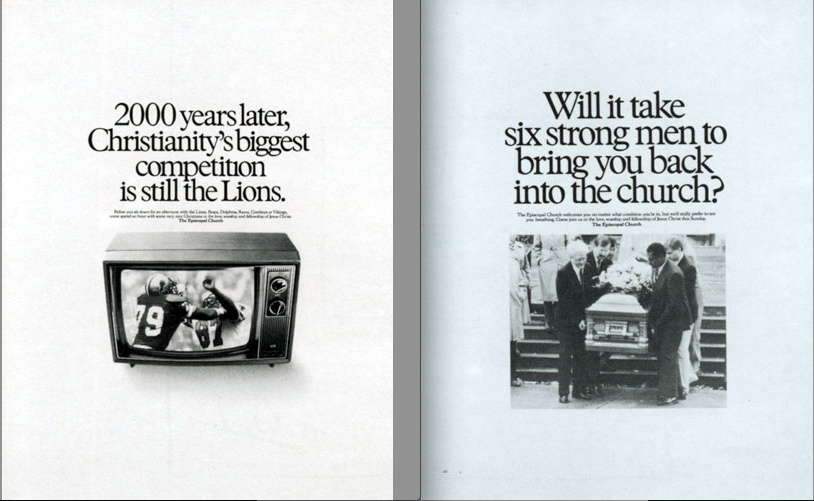
Copyranter has a retrospective on the man he calls “the greatest American copywriter”:
You won’t find much information about Tom McElligott online. He didn’t give very many interviews. He doesn’t have a Wikipedia page. And his Minneapolis start-up agency, Fallon McElligott Rice, made its mark in the pre-internet years of 1981–1988. This was smack in the middle of the mega-merger phenomenon of big Madison Avenue agencies swallowing other big Madison Avenue agencies—a development that forever destroyed a lot of the creativity and spirit of the advertising industry. … I plastered the felt-covered cubicle walls at my first ad-agency copywriting job with [McElligott ads], carefully, selfishly X-Acto’d out of the annuals. Another thing on my wall was this quote by McElligott:
“I’d much rather overestimate the intelligence of the consumer than underestimate it.”
On the print ads seen above:
One of McElligott’s early clients was the Episcopal Church. Better ads for a church have never been written. Period.
On Conviction And Creed
Gary Gutting spoke with Louise Antony, a philosophy professor and atheist, about the roles that reason and religion play in public policy (NYT):
L.A.: … In the public sphere, I think reasons are extremely important. If I’m advocating a social policy that stems from some belief of mine, I need to be able to provide compelling reasons for it — reasons that I can expect a rational person to be moved by. If I refuse to give my employees insurance coverage for contraception because I think contraception is wrong, then I ought — and this is a moral ought — to be able to articulate reasons for this position. I can’t just say, “that’s my belief, and that’s that.” A sense of responsibility about one’s beliefs, a willingness to defend them if challenged, and a willingness to listen to the reasons given by others is one of the guiding ideals of civil society.
G.G.: But doesn’t a belief in God often lead people to advocate social policies? For some people, their beliefs about God lead them to oppose gay marriage or abortion. Others’ beliefs lead them to oppose conservative economic policies. On your view, then, aren’t they required to provide a rational defense of their religious belief in the public sphere? If so, doesn’t it follow that their religious belief shouldn’t be viewed as just a personal opinion that’s nobody else’s business?
L.A.: No one needs to defend their religious beliefs to me — not unless they think that those beliefs are essential to the defense of the policy they are advocating. If the only argument for a policy is that Catholic doctrine says it’s bad, why should a policy that applies to everyone reflect that particular doctrine? “Religious freedom” means that no one’s religion gets to be the boss. But usually, religious people who become politically active think that there are good moral reasons independent of religious doctrine, reasons that ought to persuade any person of conscience. I think — and many religious people agree with me — that the United States policy of drone attacks is morally wrong, because it’s wrong to kill innocent people for political ends. It’s the moral principle, not the existence of God, that they are appealing to.
G.G.: That makes it sounds like you don’t think it much matters whether we believe in God or not.
L.A.: Well, I do wonder about that. Why do theists care so much about belief in God? Disagreement over that question is really no more than a difference in philosophical opinion. Specifically, it’s just a disagreement about ontology — about what kinds of things exist. Why should a disagreement like that bear any moral significance? Why shouldn’t theists just look for allies among us atheists in the battles that matter — the ones concerned with justice, civil rights, peace, etc. — and forget about our differences with respect to such arcane matters as the origins of the universe?
The View From Your Window

Edinburgh, Scotland, 4.30 pm
The Question That Haunted Tolstoy
It was this:
Is there any meaning in my life that wouldn’t be destroyed by the death that inevitably awaits me?
Reviewing Peter Carson’s new translation of two works Tolstory wrote in the aftermath of a spiritual awakening, The Death of Ivan Ilyich and Confession, William Giraldi explores how legendary Russian writer approached an answer:
It’s the very question—the very horror—that pesters Ivan Ilyich during his months-long agon against death. And Camus must have had these lines in mind when he was composing Meursault’s demise [in The Stranger]: “You can only live as long as you’re drunk with life; but when you sober up, you can’t help but see that all this is just a fraud, and a stupid fraud. Precisely that: there’s nothing even amusing or witty about it; it’s simply cruel and stupid.”
And so the great man searched. Schopenhauer, Solomon, and Buddha offered no solace. Scientific rationalism was a coffin for his soul. Others of his own class and education had no clue. Then, in a suicidal stupor, he began to see that the supernaturalism and irrationality of faith, and all the vulgate attached to it, wasn’t so stupid after all:
“It alone gives mankind answers to the questions of life and consequently the possibility of living.” Writing War and Peace and Anna Karenina wasn’t enough; the love of his wife wasn’t enough; the lives of his children weren’t enough; Leo Tolstoy also had to have an invitation from the infinite. And those who mailed him this invitation to the infinite were the peasants—because, like Gerasim in Ivan Ilyich and unlike all the poseurs from Tolstoy’s own set, the peasants didn’t pretend. Their beliefs weren’t disconnected from their lives; their superstitions were meaningful because they enhanced happiness. Furthermore, their privation and ceaseless hardship were not sources of wonder or remorse—they accepted existence as it was. And by accepting existence as it was they accepted its cessation too.
 The Dish