Don’t Judge A Fruit By Its Covering

9267683887_bfd8ce8c16_b

Bonnie Tsui chides our aversion to ugly produce, which results in massive waste:

A recent report commissioned by the U.K. global food security program shows that of a given crop of fruit or vegetables grown in the country, up to 40 percent is rejected because it doesn’t meet retailer standards on size or shape. That’s a sizable chunk of the $31.3 billion of food that gets jettisoned in Britain every year. American supermarkets lose $15 billion each year in unsold fruits and vegetables. American consumers like their apples red and their bananas unspotted, so grocery stores comply—sometimes even dyeing and cutting to fit.

Changing mainstream culture to accept a crooked cucumber has bigger implications than just cost. Given that 20 to 30 percent of greenhouse gas emissions come from agriculture, food waste is a huge piece of the global climate problem. Last month, a new study by the Intergovernmental Panel on Climate Change revealed scientists’ deep concerns about dropping agricultural production—as much as 2 percent per decade for the rest of the century. The panel’s researchers have also found that though minor improvements can be made to improve efficiency in agriculture, the real game changers will lie on the consumption side.

(Image via Flickr user comedynose)

Surviving As A Stowaway

Kent Sepkowitz explains how the 16-year-old boy who stowed away in the wheel well of a Hawaiian Airlines flight from San Jose to Maui on Sunday survived the ordeal:

[A] confluence of dangers sometimes works to some small advantage.

The extreme cold of the upper atmosphere—wheel well riders have had body temperatures recorded at around 80 degrees Fahrenheit—slows the body’s cellular activities, sharply reducing the demand by cells for oxygen. A normal person becomes unconscious—comatose really—in this extreme cold. Just as once in a while, a drowning victim will survive because the extreme cold water acted in a similar fashion to suspend normal function, so too does some lucky wheel well stowaway occasionally make it back to the ground alive. According to the FAA data, younger men, like this week’s 16-year-old, are the survivors.

That is, unless they fall out as the plane lands:

The bodies of stowaways falling from airplanes on final approach has happened a few times in recent history, including on flights from Angola to London and from Charlotte, N.C. to Boston. The FAA lists several instances where a stowaway managed to survive the extreme temperatures with little oxygen, only to fall to his or her death when the airplane started to land.

Chad Griffin Responds

This embed is invalid


The head of the Human Rights Campaign doesn’t take on the distortions and exaggerations in the Becker book, but he does necessary damage control by saluting just a few of the countless individuals who, far from allowing marriage equality to “languish in obscurity” for years, actually made everything we are tackling now possible. The statement is made under obvious duress, but it’s also graceful. And true.

With any luck, we can get past this ugly, unnecessary spat and get on with the business of making marriage equality a reality in every state. Internal debates about strategy are inevitable and usually good things. But the point must never be about who’s getting credit. It must always be about getting the job done. We owe it to this vital moral cause not to lose sight of that.

Update – a reader writes:

This reader comment on his parva mea culpa made me spit coffee on the monitor:

Truly, he stands on the necks of giants.

He made a nice first start, but it’s not nearly enough, IMO.

Fathering In The Mother Tongue

After speaking only Hebrew to his daughter for three years, Noam Scheiber explains why he decided to stop trying “to mold her in the Israeliness that shaped me as a kid”:

[T]he older my daughter got, the less plausible the whole routine felt. Last fall, she started going to pre-school five days a week. Like any parent, I was keen to know what she’d been up to all day. We’d turn out the lights at bedtime and lie on her bed, and I’d pump her for information. In English, my natural sensibility is patient and understated. My style in Hebrew was hectoring and prosecutorial. At some point it occurred to me that I was mimicking an Israeli. It also occurred to me that I was getting nowhere—my daughter was clamming up.

One night a few months ago, I finally switched languages. The effect was magical. I hear my daughter speak English all the time and still I was shocked by her verbiage. She would riff about what she’d done at the playground and what she’d concocted in art class. As is her wont, she would also tell me who’d bitten whom that day, and who’d broken down in tears. Part of it, surely, was that she is much more fluent in English.

But that couldn’t have been the whole story. After all, she would answer me in English even when I spoke to her in Hebrew. It was hard to avoid the conclusion that, just as I felt more myself in English, I felt to my daughter more like her father.

Weighing A Masterpiece

dish_david

David was originally intended for the buttress of the Florence Cathedral. But William E. Wallace figures that Michelangelo knew that at a weight of 8.5 tons, devising a proper support system for the sculpture would be “an impossible task.” The artist “realized the impossibility of the job from the earliest moment, even before he began carving the figure,” insists Wallace. “This realization, in effect, liberated him”:

Given the familiarity of the David, it is difficult for us to appreciate just how novel it is. Despite many highly regarded precedents in Florentine art for the representation of David, Michelangelo carved a unique work: an oversize, illogically nude figure with almost no identifying attributes. One could hardly imagine a more peculiar means of representing the young shepherd boy of the Bible, nor a more inappropriate figure to adorn the cathedral. I believe David looks as it does because Michelangelo, realizing that it would not be placed on the cathedral buttress, was free to carve a completely original work. And that is precisely what he did.

(Photo by John W. Schulze)

“Justice” Under Occupation

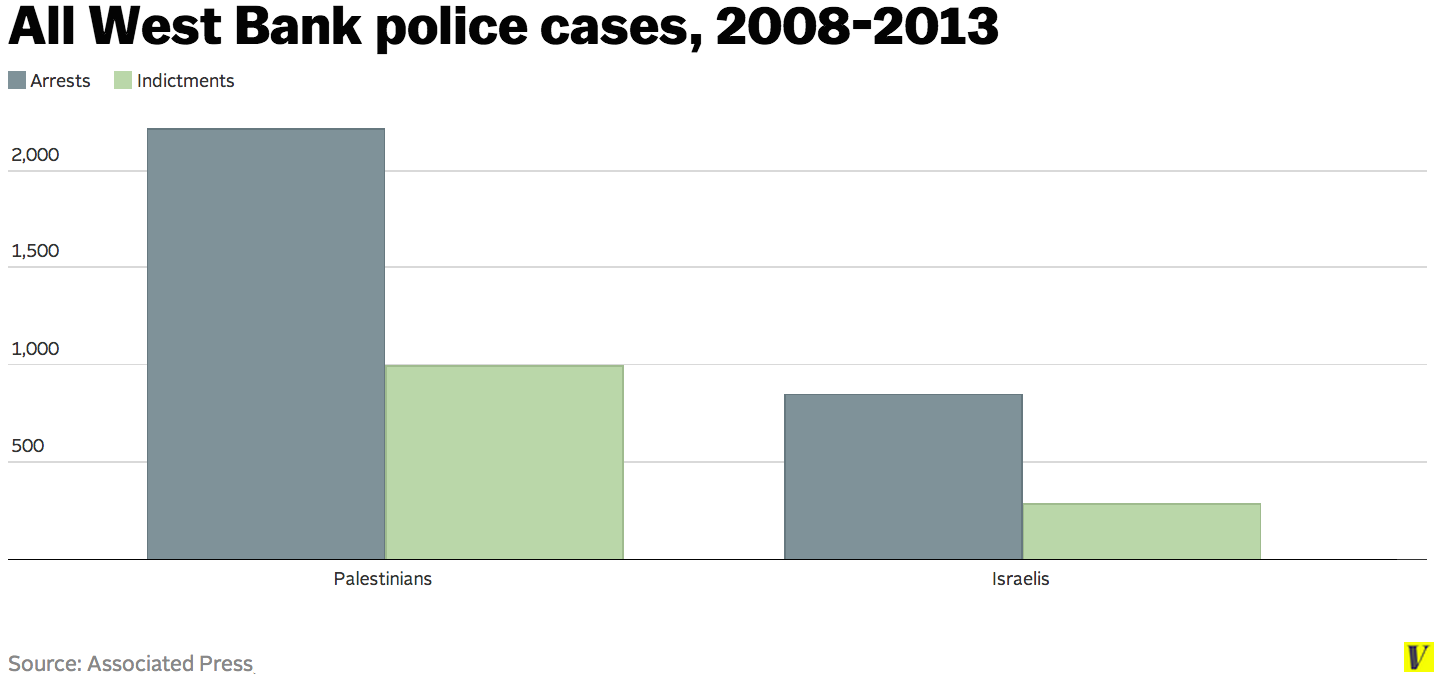
west_bank_all_cases

Dish alum Zack Beauchamp illustrates the consequences of the West Bank’s two-tiered criminal justice system on young Palestinians:

Take stone-throwing, a historically common Palestinian attack on Israelis that some Jewish settlers have adopted. 45 percent of all Palestinians arrested were convicted, and exactly zero of the 54 arrested Israelis were. … Now, since most stone-throwers are likely Palestinians, it makes sense that many more Palestinians would be arrested for that particular crime. However, it turns out that Palestinians are also more likely to be indicted (conviction data wasn’t available) than Israelis in general. Once again, the difference in legal system is the clearest explanation. It’s much easier to arrest and detain Palestinians in military courts than Israelis in civil ones. That makes it correspondingly easier for prosecutors to get what they need for indictments.

Roi Maor provides more background that complicates the picture a little:

The most important fact overlooked in the article is that the Israel Police, which provided the figures, does not investigate crimes committed by Palestinians against other Palestinians. These investigations are carried out by the Palestinian Authority. On the other hand, the Israel Police investigates all crimes committed by Israelis in the West Bank, regardless of the nationality of the victim. It is only natural then, that Israelis will be massively overrepresented in its arrest statistics. This overrepresentation is exacerbated by the fact that many crimes committed by Palestinians against Israelis are also investigated by the Palestinian Authority, depending on the nature of the crime and the residence of the perpetrator.

Second, Beauchamp seems to have missed the fact that the figures provided to AP are solely about minors. Admittedly, AP does not do a good job of highlighting this distinction, but it does mention it twice in the same short piece. Why does it matter? Because until October 2010, Israel defined the age of minority differently for Israelis and Palestinians. For the former, it was up to the age of 18, for the latter it ended at 16. The figures provided by the Israel Police are for 2008-2013, and it is unclear which definition the police used. Knowing their record-keeping practices, I would venture to guess it is based on a chaotic mix of both definitions.

An interactive feature from Al Jazeera explores the matter of youth detention in more depth:

About 700 Palestinians under the age of 18 are detained in the occupied territories annually. Since 2000, more than 8,000 Palestinian youth have been arrested. Most are detained on charges of throwing stones. As of March 1st, 210 Palestinian youth were held in Israeli detention. A 2013 UNICEF report concluded that the mistreatment of Palestinian children in Israel’s military detention system is “widespread, systematic and institutionalised”.

A Blow To Race-Based Admissions, Ctd

Counterintuitively, Jeffrey Rosen argues that liberals should be happy about the Schuette ruling:

In cases like affirmative action bans, where citizens (including minority citizens) vigorously disagree about whether the policy in question are likely to harm minorities or help them, the conservatives held, the court should practice judicial restraint and defer to democratic decision making. Breyer didn’t need to hold his nose to support this. Far from it. He enthusiastically defended the importance of letting democratically accountable bodies decide whether affirmative action should be adopted or rejected. …

Liberal defenders of affirmative action should embrace Breyer’s reasoning, rather than reluctantly tolerating it. The framework provides a principled reason for criticizing conservatives when they resort to judicial activism to strike down state policies that permit affirmative action. As Breyer wrote: the Constitution “favors decisionmaking though the democratic process. Just as this principle strongly supports the right of the people, or their elected representatives, to adopt race-conscious policies for reasons of inclusion, so must it give them the right to vote not to do so.”

Richard Kahlenberg thinks race-based affirmative action is on its way out, which he says is a good thing:

In 2012, my colleague Halley Potter and I examined a number of states that had outlawed considering race in admissions, often by voter referendum. In addition to Michigan, these states include Arizona, California, Florida, Nebraska, Washington and others. Six states, we found, have spent money to create new partnerships with disadvantaged schools to improve the pipeline of low-income and minority students.

Eight states have provided new admissions preferences to low-income and working-class students of all races. Eight states have expanded financial-aid budgets to support the needs of economically disadvantaged students. In three states, individual universities have dropped legacy preferences for the generally privileged—and disproportionately white—children of alumni. In three states, colleges created policies to admit students who graduated at the top of their high-school classes. And in two states, stronger programs have been created to facilitate transfer from community colleges to four-year institutions.

How well have these programs done in promoting racial and ethnic diversity? In examining 10 leading public universities, we found that seven were able to maintain, or exceed, the proportion of African American and Latino students they had achieved through racial preferences in the past. So it can be done.

Frum also supports the “class, not race” argument:

Lyndon Johnson’s America was a country slashed by a color line of racial domination and subordination. Even the most affluent black citizen of the United States could expect to face humiliating economic and social discrimination. Meanwhile, the white majority overwhelmingly regarded itself as “middle class,” standing on a more or less equal footing with other “middle-class” whites.

Today’s America is a country whose class distinctions are growing as extreme as those in Edwardian England. Johnson’s assumption that non-black Americans all enjoyed more or less equivalent opportunities “to learn and grow, to work and share in society, to develop their abilities” seems poignantly out of date. A white skin may still correlate less with poverty than does a darker skin. But that skin alone long ago ceased to convey much in the way of privilege to the less affluent half of white America.

It’s true, even Oprah can encounter rude treatment in a Swiss boutique. Day in, day out, however, William Julius Wilson’s prediction has been vindicated and more than vindicated: In 21st-century America, class trumps race.

But Julianne Hing points out that class-based solutions don’t always help black students:

California, for one, has yet to recover from the disastrous impact of Proposition 209, the nation’s first statewide affirmative action ban, which state voters passed in 1996. Despite adopting aggressively class-based, race-neutral admissions policies to stay in line with Prop 209, the state’s flagship universities have not been able to return black student enrollment to their pre-1996 levels.

Today, California’s university system is educating an increasingly economically diverse but racially isolated crop of students. Roughly one-third of University of California undergrads qualify for federal Pell Grants, but in 2012-2013, black students made up just 2.4% of UC-Berkeley’s enrolled undergrads. African-Americans, meanwhile, make up about 6.6% of the state’s population. The economic workaround is not working alone.


What Is Your Cat Thinking?

It’s hard to say:

Dogs have lived with us for as many as 30,000 years—20,000 years longer than cats. More than any 194other animal on the planet, dogs are tuned in to the “human radio frequency”—the broadcast of our feelings and desires. Indeed, we may be the only station dogs listen to.

Cats, on the other hand, can tune us in if they want to (that’s why they pass the pointing test as well as dogs), but they don’t hang on our every word like dogs do. They’re surfing other channels on the dial. And that’s ultimately what makes them so hard to study. Cats, as any owner knows, are highly intelligent beings. But to science, their minds may forever be a black box.

Still, there may be hope. As scientists begin to experiment with new ways to study animal intelligence—from eye-tracking technology to fMRI machines—they may yet find a way to peek inside the feline mind.

Where The Males Have (Little) Vaginas And The Females Have (Big) Penises, Ctd

A reader calls the headline of this post “offensive and biologically wrong”:

A new sexuality is found in nature if it gets crunched down to chicks with dicks? Bullshit! The gynosome is an amazing discovery; it is not like anything else ever found. But to reduce it to human sexuality removes the wonder of the diversity on this earth.

She points us to Annalee Newitz, who asserts that “the gynosome isn’t a penis”:

As Jason Goldman explains in an article about the gynosome, this is a hitherto unknown form of sexual organ in the animal kingdom. When female members of the Brazilian bug species Neotrogla mate with males, they insert their gynosomes into the male’s sexual organ. Once inside the male’s body, the gynosome inflates and grows spines, then absorbs both sperm and nutrients from the male for several days.

I’m sorry, but does this sound like a penis to you? When was the last time you found a penis that grew spines, absorbed nutrients, remained erect for 75 hours, or allowed its owner to get pregnant? Pretty much the only thing this organ has in common with a penis is that it’s used to penetrate a partner during sex.

She scoffs, “when it comes to sex, humans are still hopelessly in thrall to our anthropomorphic urges – which is to say, our urge to see every animal’s behavior as a reflection of our own.” Ed Yong, on the other hand, defends the characterization:

As Diane Kelly, who studies penises, points out:

“As a technical term, a penis is a reproductive structure that transfers gametes from one member of a mating pair to another.” Which is exactly what is happening here.

Newitz points to differences. “When was the last time you found a penis that grew spines, absorbed nutrients, remained erect for 75 hours, or allowed its owner to get pregnant?” Actually spines are pretty common; long sexual bouts are pretty common; and the gynosome doesn’t absorb nutrients—it collects sperm packets that contain nutrients, which the animal then eats in the normal way. The key difference is that rather than delivering sperm, it collects it—as I stated right up top. And the only reason we think of penises as sending sex cells in that direction is that we never knew any other set-up could occur. Now we do, which either forces us to introduce a new term and demand that it be used, or to expand the bounds of our old term. I prefer the latter. I’m generally a lumper, rather than a splitter.

TWSS?

The Best Of The Dish Today

Never forget E.B. White!

Today, I argued that Obama was on the verge of another meep meep in foreign policy with Syria and Iran; that Rand Paul’s criticism of Reagan’s spending and deficits is a vital part of resuscitating conservatism; and that the Onion should have the last word on the circumcision debate. Plus: climate change’s threat to global security; and the power of psilocybin in tackling anxiety.

Some brief links on the Becker book. Ronan Farrow had a terrific interview with Becker today – tough but fair. Check it out. Lisa Keen has a superb takedown, as does Kevin Jennings. Petrelis piles on to HRC’s spin. I think it’s safe to say that there have been episodes of the 700 Club that have gotten a better reception in the gay community.

You can leave your unfiltered comments at our Facebook page and @sullydish.

35 more of you became subscribers today. Join them here.

And see you in the morning.