Capital Accounting

Piketty’s new book is already a huge financial success:

The unlikely bestseller, clocking in at nearly 700 pages, is already serving as an interesting case study for modern book publishing. One of the hallmarks of the book’s success is that it is sold out on Amazon, even though there is a digital version available on Kindle, too. … “You can have it on your e-book reader, but that’s not the same as having the book,” said [Harvard University Press sales and marketing director Susan] Donnelly. “I’m not saying this book is a Tiffany’s bag, but nobody goes to Tiffany’s and buys something and doesn’t get that little blue bag. I think there’s still some of that about books.”

The bestseller is already poised to become the most popular book ever for Harvard University Press. Donnelly predicts it will become akin to another classic for the publisher, John Rawls’ “A Theory of Justice.”

Yglesias points out that the book’s success is itself an example of inequality:

Piketty’s best-seller status — though well-deserved — also highlights one of the drivers of contemporary economic inequality. Superstar effects.

People like to buy great books and listen to great songs and watch great movies and TV shows. But people also like to be part of the “in crowd” and “the conversation.” So when certain things reach a certain level of popularity, other people check them out precisely because everyone is talking about them. That means that being the book on economic inequality is much more lucrative than being the fourth-best book on economic inequality.

These kind of disproportionate rewards for superstars have probably always been with us. But as the number of people who could conceivably buy a book grows — because of a mix of population growth and economic progress in poor countries — the returns to being the superstar grow disproportionately fast and inequality rises.

Earlier coverage of Piketty’s book hereherehere, and here.

The Senate Could Go Either Way

Senate Odds

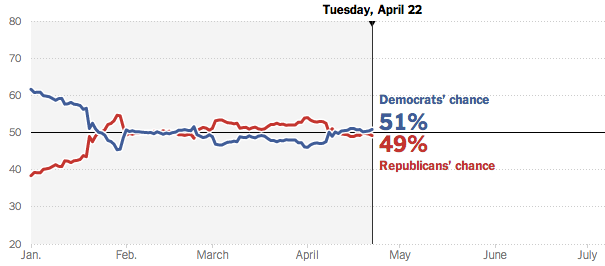
The Upshot calculates the Democrats’ current chances of holding the Senate:

Every day, our computer churns through the latest polls and reams of historical data to calculate both parties’ chances of winning control of the Senate. Although the Democrats currently have a 51 percent chance, that doesn’t mean we’re predicting the Democrats to win the Senate — the probability is essentially the same as a coin flip.

Nate Cohn looks at the role incumbency plays:

Democrats’ hopes of keeping their Senate majority this November may well hinge on the ability of three of their incumbents to hold onto their seats deep in enemy territory: the South. To take the Senate and consolidate their control of Congress, Republicans need only extend their stranglehold on Dixie to Arkansas, Louisiana and North Carolina, all of which voted for Mitt Romney in the 2012 presidential election.

Yet the hopes of these three states’ incumbent Democratic senators — Mark Pryor, Mary Landrieu and Kay Hagan — are still alive. That may be surprising in light of the region’s lurch to the right, but it shouldn’t be: Incumbency is powerful. In the South, Democratic incumbents have won 85 percent of the time since 1990, and 77 percent since 2000.

The big Republican gains in the South have come mainly in open contests without an incumbent, often after a longtime Southern Democrat retires. Republicans have won 84 percent of open races in the South since 2000 — and three of their four losses came in Virginia and Florida, states that are different from the rest of the region.

The Onion On Circumcision

An exhaustive look at the pros and cons. Among the pros:

Kid already European enough as it is

Among the cons:

Mohel looks like he’s had about eight cups of coffee

Yeah, I know. Sullybait. A reader adds:

I think there is a third way of looking at the question of circumcision.  As my grandfather likes to say, “Don’t cut it off; wear it off.”

A Rising Tide Lifts Some Boats

Living Standards

David Leonhardt and Kevin Quealy introduce the graphic above (click to enlarge):

In 1980, the American rich and middle class and most of the poor had higher incomes than their counterparts almost anywhere in the world. But incomes for the middle class and poor in the United States have since been growing more slowly than elsewhere.

The accompanying article goes into more detail:

The findings are striking because the most commonly cited economic statistics — such as per capita gross domestic product — continue to show that the United States has maintained its lead as the world’s richest large country. But those numbers are averages, which do not capture the distribution of income. With a big share of recent income gains in this country flowing to a relatively small slice of high-earning households, most Americans are not keeping pace with their counterparts around the world.

“The idea that the median American has so much more income than the middle class in all other parts of the world is not true these days,” saidLawrence Katz, a Harvard economist who is not associated with LIS. “In 1960, we were massively richer than anyone else. In 1980, we were richer. In the 1990s, we were still richer.”

That is no longer the case, Professor Katz added.

Douthat considers what this change means for politics:

If we get back to where we were in the 1990s, with an economy that’s delivering for the 40th-through-the-60th percentiles but a welfare state that isn’t as generous as the social democracies to the 10th-through-30th, most Americans will probably be inclined to say, well, that’s just our system’s traditional “growth over fairness, opportunity over equality” trade-off working as expected, and there will be more support for efforts to keep the tax-and-transfer share of the U.S. economy close to historic norms. (Though it would help, obviously, if there were more mobility out of the 10th and 20th percentiles than we’re currently seeing.) But if the advantages of the American system are only visible from, say, the 70th or even 80th percentile up, then the case for the low-tax model will seem weaker relative to how its been received and debated in the past, and American politics will probably shift leftward on size-of-government issues (as it already has among the rising generation).

Derek Thompson, meanwhile, looks at why Canada’s middle class is becoming richer than ours:

How did we lose the lead? The authors blame three broad factors: (1) Canada’s education attainment is outpacing the U.S. and most of the world; (2) American middle-class market wages aren’t keeping up with overall economic growth; and (3) Other governments are doing more to redistribute income to poorer families in other countries, particularly in western and northern Europe. One word that doesn’t appear in the article, however, is housing. The U.S. is emerging from a catastrophic collapse of the housing market that obliterated household wealth for millions of middle-class families. Canada, however, is in the midst of a delirious housing boom and a personal debt craze that reminds some economists of the U.S. market exactly a decade ago (before you-know-what happened).

Reihan also focuses on housing:

[H]ere’s the thing: If the U.S. had done more to address the wealth destruction that followed from the housing bust, it is hard to deny that middle- and low-income households would be in a much better position. Indeed, the really scary thing is that, as Mian and Sufi have argued, it’s not clear that low- and middle-income Americans are in a less vulnerable position now than they were before the bust. And if Canada ever does see a house-price correction, as seems at least plausible, it is not clear that the contrast between Canada and the United States will look quite so favorable a few years down the road.

And finally, I’ll make a brief political point. Many conservatives believe that to win Latino voters, they need to take a particular position on immigration reform. They might instead consider paying more attention to the fact that Hispanic household wealth fell by 66 percent from 2005 to 2009, and that many Latino families, and indeed many middle-income families of all backgrounds, are still reeling from the wealth destruction of that era.

Update from a reader:

I own a small Real Estate company in Calgary, Alberta, Canada. The quotes from Derek Thompson and Reihan seem to elude that the housing situation in Canada is similar to that in the US in 2007 and that the risks for Canada are the same. This is simply not the case and shows a lack of understanding of our system here in Canada.

First off, in Canada in order to qualify for a mortgage you must have at least a 5% down payment in cash. There are also  qualifying “Gross Debt Service” and Total Debt Service” ratios that ensure any mortgage payment is, on its own and in conjunction with your other monthly debt payments, below a certain percentage of your income (I think 39% and 44% respectively). Part of the problem in the US prior to the collapse was that people were financing 100% (or more) of the cost of the home.

Second, the biggest problem in the US prior to the collapse was the so-called “Adjustable Rate Mortgage”. To my understanding, this instrument kept rates very low and then unexpectedly raised the rates drastically either at a certain point or upon a default thus leaving many homeowners unable to pay and forcing foreclosure. In Canada, this simply does not exist. Mortgage rules here prohibit such practices. You can get either a “fixed rate”, “variable rate” or some combination of the two and that’s it. A fixed rate mortgage is just like it sounds, the rate never changes during the duration of the term. Variable rate mortgages rise and fall with the prevailing prime rates. While this has some risk, these risks are low because prime rates charged by the banks are derived from the rate set by the Bank of Canada (our “FED”) and typically are slow, predictable adjustments.

Thirdly, and most important, banks in Canada are largely protected from the effects of default and foreclosure because here, any person who obtains a mortgage with less than a 20% down payment (what we call a “high ratio mortgage”)is required by law to buy mortgage insurance (between 0.5% and 3.0% in most cases) . The lower the down payment, the higher the insurance premium. This insurance is typically bundled into their monthly mortgage payments. This insurance protects the banks and promotes lending as there is zero risk to them. When homeowner with a high ratio mortgage defaults, the typical foreclosure process occurs, but any shortfall of the amounts recovered are covered by the insurance.

Further, mortgage insurance is not offered outside of your principal residence so investors and speculators must have at least 20% down payment to buy a property and expensive homes (I think those over $1M) are also not covered by mortgage insurance, so again, 20% down payment would be required.

This is why Canada fared better than any G7 country during the global recession. Property values decreased here in 2007/2008 and in fact have only just recovered from that in the last year, but the difference is that here, prudent policy kept risk prone people (those who couldn’t save at least 5%) out of the market to begin with, prevented predatory lending from even occurring in the first place and protected the banks while promoting access to home ownership to the population.

Canada will continue to be able to weather housing bubbles better than the US too. Since the recession, our government has further increased this protection by limiting a mortgage refinance to a maximum of 80% of equity, capped mortgage amortization to 25 years and has put pressure on the banks not to lower mortgage rates too much.
The “War” In Global Warming

Last month, in an op-ed for Fox News, retired Navy Rear Admiral David Titley made a national security-based case for worrying about climate change. Eric Holthaus interviews Titley about his belief that the changing climate will be a main driving force for conflict in the 21st century:

Q. What’s the worst-case scenario, in your view?

A. … You could imagine a scenario in which both Russia and China have prolonged droughts. China decides to exert rights on foreign contracts and gets assertive in Africa. If you start getting instability in large powers with nuclear weapons, that’s not a good day.

Here’s another one: We basically do nothing on emissions. Sea level keeps rising, three to six feet by the end of the century. Then, you get a series of super-typhoons into Shanghai and millions of people die. Does the population there lose faith in Chinese government? Does China start to fissure? I’d prefer to deal with a rising, dominant China any day.

Titley thinks it’s time for conservatives to start grappling with the problem:

Where are the free-market, conservative ideas? The science is settled. Instead, we should have a legitimate policy debate between the center-right and the center-left on what to do about climate change. If you’re a conservative – half of America – why would you take yourself out of the debate? C’mon, don’t be stupid. Conservative people want to conserve things. Preserving the climate should be high on that list.

Sean McElwee thinks that environmentalists could probably garner more support on the right if they framed the issue differently:

Republican support for environmental causes is stronger than it might appear. Two Ph.D. students at the University of California Santa Barbara, Phillip Ehret and Aaron Sparks, found that a quarter of individuals self-identifying as “very conservative” or “conservative” support environmental regulations, even if they risk harming the economy. A Yale Study finds that 85 percent of Democrats and 55 percent of Republicans favor “regulating CO2 as a pollutant” and majorities from both parties favor investing in renewable energy. If Republican voters are concerned about the environment, haven’t we seen an action?

One explanation is that the framing of environmental issues is often anathema to conservatives. Matthew Feinberg and Robb Willer’s important paper on the subject, “The Moral Roots of Environmental Attitudes,” finds that liberals view environmental issues as moral concerns informed by a harm principle, while conservatives view environmental issues through the lens of purity, and particularly for religious people, stewardship.

One great challenge for environmentalists is finding a way to frame the issue in terms real conservatives intuitively grasp. To wit: If you love this land, why would you want to see it changed irreparably by our behavior? If you believe, as Christians do, that conserving the planet is our sacred duty, why would you treat the earth as disposable? Should we behave like Noah and conserve the earth – or ransack it for material ends? The trouble, of course, is that these deep conservative themes have been displaced on the right by know-nothing hatred of anything defined as “liberal”. And so you get outright mockery of concerns for the planet and too-clever-by-half attempts to deny the reality and moral challenge of climate change.

In the end, that is a crisis for conservatism, as much as environmentalism.

The Freedom To Marry And The Freedom To Dissent

I’m not much of a joiner, but I was more than glad to sign the joint statement by a wide array of supporters of marriage equality, gay and straight, declaring our commitment both to open and respectful, if robust, debate, and to ensuring that gay people have their fundamental constitutional right to marry. You can read the statement here. Money quote:

As a viewpoint, opposition to gay marriage is not a punishable offense. It can be expressed hatefully, but it can also be expressed respectfully. We strongly believe that opposition to same-sex marriage is wrong, but the consequence of holding a wrong opinion kamenypickets.jpgshould not be the loss of a job. Inflicting such consequences on others is sadly ironic in light of our movement’s hard-won victory over a social order in which LGBT people were fired, harassed, and socially marginalized for holding unorthodox opinions.

LGBT Americans can and do demand to be treated fairly. But we also recognize that absolute agreement on any issue does not exist. Franklin Kameny, one of America’s earliest and greatest gay-rights proponents, lost his job in 1957 because he was gay. Just as some now celebrate Eich’s departure as simply reflecting market demands, the government justified the firing of gay people because of “the possible embarrassment to, and loss of public confidence in . . . the Federal civil service.” Kameny devoted his life to fighting back. He was both tireless and confrontational in his advocacy of equality, but he never tried to silence or punish his adversaries.

Now that we are entering a new season in the debate that Frank Kameny helped to open, it is important to live up to the standard he set. Like him, we place our confidence in persuasion, not punishment. We believe it is the only truly secure path to equal rights.

Read the whole thing. We felt it necessary to take a joint, public stand, in the wake of the illiberal response to the Eich affair and some truly troubling sentiments in favor of shutting opponents up, demonizing rather than engaging, intimidating rather than persuading. Conor comments here; Peter Berkowitz here. The statement is also open for anyone to sign and join us in affirming these principles. Add your name here, if you want.

(Photo: Posters and placards from some of the very first public protests in defense of gay equality – from the Frank Kameny archive)

The $84,000 Cure

Earlier this month, Polly Mosendz covered the debate over Hepatitis C drug Sovaldi:

[I]nsurers cannot stand this life saving, revolutionary medication. That’s because it runs $1,000 a day and the average patient requires a 12-week treatment of Sovaldi.That’s $84,000 for one cycle. For patients with a strain that is more difficult to treat, the regiment is 24 weeks. That comes in at $168,000. It is projected to rake in between $5 billion and $9 billion in profits in the United States this year alone. There are an estimated 4 million Americans with Hepatitis C, and 15,000 are killed each year by untreated chronic infections.

Unfortunately, there is not much insurers can do about the price. A comparable drug is not yet on the market.

Dr. Frank Huyler fumes:

The low cost of manufacturing the drug means that it can be sold all over the world. Only the price varies, and that price is set by Gilead executives and protected by patent law and the FDA. At the moment, Gilead has a monopoly.

In poor countries, such as Egypt, they can’t sell many $1,000 pills. But they can sell a lot of $10 pills. So that’s how much Sovaldi costs in Egypt — and Gilead Sciences is still making a profit. Thanks to the FDA, the Egyptian version of the drug can’t be imported.

This sort of blood money is nothing new. But it is among the worst of recent examples; yet another evil act, yet another predation on mostly poor, mostly desperate people, who inevitably will ask taxpayers to save them.

“Blood money?” “Evil act?” I have to say I find that rhetoric appalling.

A miracle drug like this does not appear out of thin air. Developing these kinds of drugs can be hugely risky – so many end up as duds – and extremely expensive. If there were no real return on the few that make it to market, the economic incentives that make them possible in the first place would disappear, along with the drugs. And these drugs really do save lives – as Tim Mullaney, who has Hepatitis C, notes:

After two bouts with cancer, I can check hep C off the list of things that may kill me, thanks to virus-clearance rates of 97% in cases like mine. I’ve had no side effects. Prior therapies had much lower cure rates, and so many complications that patients refused treatment. Including me.

Surowiecki uses the outcry over Sovaldi to discuss drug pricing more generally:

Price restrictions have always been a political non-starter here, but at some point the math of the situation will be hard to resist. According to a study by the research group I.S.I., by 2018 spending on “specialty drugs” like Sovaldi could account for half of all drug spending in the U.S. Furthermore, one traditional argument against price controls is looking weaker: biotech companies claim that prices need to be high to reward risky and expensive innovation, but the fact that they’re churning out drugs and profits so consistently seems to undermine that claim. Biotech, in other words, may become the victim of its own success: the bigger the profits, the bigger the likelihood of regulation.

You might think that this prospect would encourage companies to be more cautious. But, if you assume that price controls are coming, the rational play is to squeeze out all the profits you can now.

I think there’s a trade-off here. Price controls on drugs in existence could make them far more affordable for the healthcare system as a whole. And there is a strong, moral argument for doing that. But the trade-off is that the innovation that occurs outside the NIH – and the bulk of all drug research is done by the pharmaceutical industry – would inevitably suffer. At some point a society has to navigate these two goals – innovation and access. And both matter.

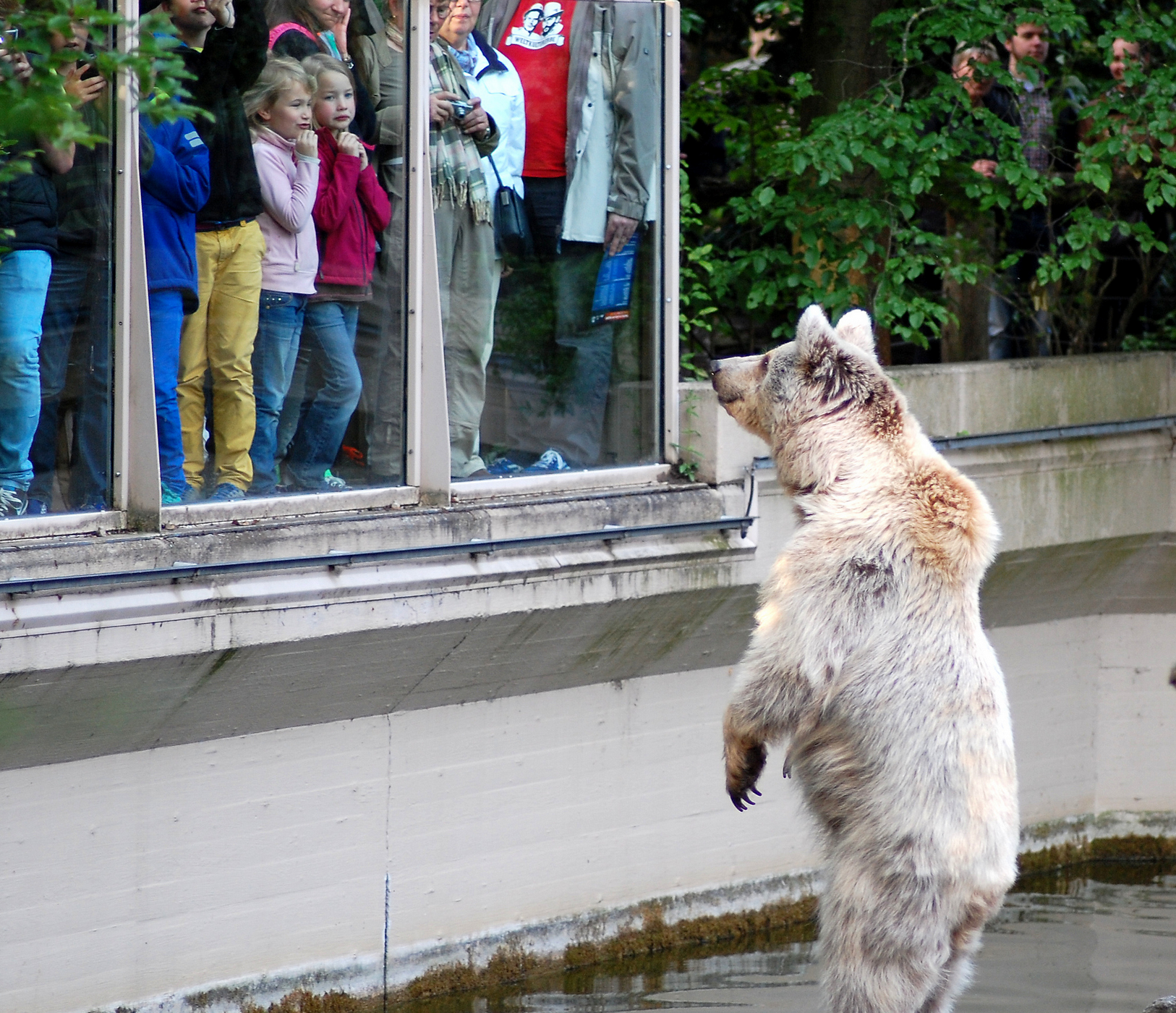
Cuteness In Captivity, Ctd

Screen Shot 2014-04-22 at 2.07.38 AM

Unlike Bert Archer, Rachel Lu loves the zoo (joined by several readers below):

I’m confident [our local zoo] will linger in my kids’ memories as one of the most beloved places of their childhood. I joke to my friends that we’re “zoo junkies” because we generally visit once a week. Those animals are like old friends to my kids, and I’ve outlined many an article from the bench of the monkey house on a quiet winter afternoon. When there are no other visitors, the monkeys will sometimes come down and interact with the boys from the other side of the glass. …

When we see animals in real life, we get a perspective on the natural world that we just can’t get through television.

My kids watch TV, but at their age, understanding the reality of what lies behind the flickering images is quite difficult. (I find that older people often have this problem too.) Recognizing that fact makes me that much more grateful for the opportunity to give them a direct encounter with lions, tigers and bears.

Zoo animals have been their primary conduit for coming to understand that the world contains a diverse array of climates and ecosystems. We discuss why it is that the tiger comes outside in the winter but the giraffes not. We note how the arctic foxes exchange their white coats for grey ones as the seasons change. Even contrived, pseudo-ecosystems enable the kids to recognize how particular animals are suited to their environments. They marvel at the upper-body strength of monkeys and note with amazement that both polar bears and seals, despite their many differences, are adapted to swimming. A nature show could point this out, but they benefit far more from making the connection themselves.

A related email from the archives, responding to this post on captive orcas:

I have at times felt uncomfortable in zoos as well, for the same reason as your reader – it seems an unnatural state in which to view these animals, akin to imprisonment (and often, in a climate that is vastly different from the ones they would typically experience).  But your reader is wrong to speak of animals being “snatched from their normal lives”.  Perhaps generations ago, that was the case.  Yet the majority zoo animals alive today are born into captivity, including over 80% of mammals according to industry counts.

Of course, that doesn’t lessen the power of your slavery analogy (and in fact, it may strengthen it).  But bear in mind, too, that many zoo animals are endangered species – sometimes severely so.  The practice of keeping such animals in zoos, and breeding them in captivity, is in some cases the only thing standing between a species’ existence and extinction.

Recent Dish on breeding endangered animals in captivity is here. An animal keeper also responded to the orca thread:

The debate over zoos and aquariums is a good and healthy one to have, especially when it results in improvements in the welfare of the animals we are caring for.  But this statement by one reader just went right through me: “It just seems incredibly selfish of the human race to snatch these innocent animals from their normal lives and dump them into one we see fit to create for them, all to give families something to do on weekends.”

What were these animals “normal” lives?  I readily acknowledge that not all zoos treat animals equally, and some are incredibly abusive, which is sickening.  But not all animals in zoos were born in the wild – they were bred in a zoo, raised in a zoo, and would not be able to live in the wild even if we wanted to release them.  Others were rescued from the pet trade or taken in from the wild after their mothers were killed or they were injured by human action.  Do we simply let these animals fend for themselves? And if not zoos, where else to we put them?

I, and most animal keepers that I know, would love it if the animals we care for didn’t have to be paraded around for dog and pony shows to entertain people.  It can be stressful for the animals (no matter how well they tolerate people) and exhausting for the handlers.  We would love it if the animals we cared for could roam huge open expanses without fences or bars or cages.  We would also love it if it were still possible to see a snow leopard outside of a zoo without having to sit for weeks on end to glimpse ONE of the last remaining of the species.  We don’t live in that world, and unless a significant number of us were to die off, we never will.

While zoos may have been originally created to house unusual animals so that people other than rich trophy hunters could see them, zoos do not simply exist for that now.  If the people weren’t allowed to see the animals the zoos wouldn’t be able to help conserve the animals we have left.  The zoos wouldn’t be able to care for the animals that poachers try to kill, that cars maim, or that people try to keep as pets.  A family’s “weekend entertainment” is the bargain that zoos make so that they can help do some good in the world.

But that family’s visit DOES come with a bonus because every once in while if you’re really lucky you get to see the face of a small city-born child who comes face to face with an animal they have never seen before – even common animals like birds and turtles and frogs.  And that child realizes that there is something more than steel, concrete and rats in the world.  And if that child can appreciate the simple wonder of a turtle, that child might, just might grow up and realize that animals have just as much right to this planet as humans do, and that they are not just for entertainment.  And that is priceless.

Another reader is on the same page:

At the headquarters of Denali National Park, there is an exhibit on caribou. They do not have an easy life. Four-fifths of the calves never make it to adulthood, mostly falling to predators who rip them apart and eat them alive. The survivors are plagued by swarms of biting flies and parasites that burrow tunnels in the haunches before they are weakened by age or disease, and ripped apart by a predator.

This contrasts with responsibly-raised farm animals, who have room, board, and medical care, live much longer than their cousins in the wild. They certainly die more humanely than being eaten alive, in fact they die more humanely than most of us do hooked up to machines.

I grew up in the country and saw how wild animals lived. I suspect that most animal rights peoples’ experience with animals is limited to dog, cats, and zoos. While on a bus at Denali, we saw a fox walk by with a bloody squirrel dripping from his jaws. This was a revelation to my wife who was raised in a genteel suburb. From the oohs and aahs it caused it seemed to be a revelation to most of the passengers.

While I certainly back humane treatment of captive animals, I think at the further end, animal rights people, isolated from nature, are projecting their human selves on animals.

(Photo by Günter Hentschel)

How The Arab World Votes

Marking the presidential elections in Algeria last week and the upcoming votes in Iraq, Egypt, and Syria, Marc Lynch reflects on Arab voting:

[W]hile elections have never been sufficient for meaningful democracy, they are manifestly necessary. It is painfully ironic that the mantra “democracy is more than elections” took hold following one of the only Arab elections that actually approached the minimal standard for democracy. Those votes really were different from the dozens of earlier elections across the region, offering a tantalizing potential for the consolidation of representative, accountable government and the peaceful rotation of power. That’s now mostly gone, with even the idea of democratic legitimacy mortally wounded. Few of the current round of elections have much to do with any of that.

Instead, the current round of elections should point us back toward the pre-uprisings literature on authoritarian elections, nicely summarized by a 2009 Jennifer Gandhi and Ellen Lust review essay. Elections under authoritarianism serve many purposes, none of which involve the peaceful rotation of power, the imposition of accountability on elites, or the representation of citizen interests. Instead, as Jason Brownlee points out, they do things like offering a safety valve for regimes, serving as a form of political theater, and activating patronage networks.

The West Is Burning Up

fire-trends

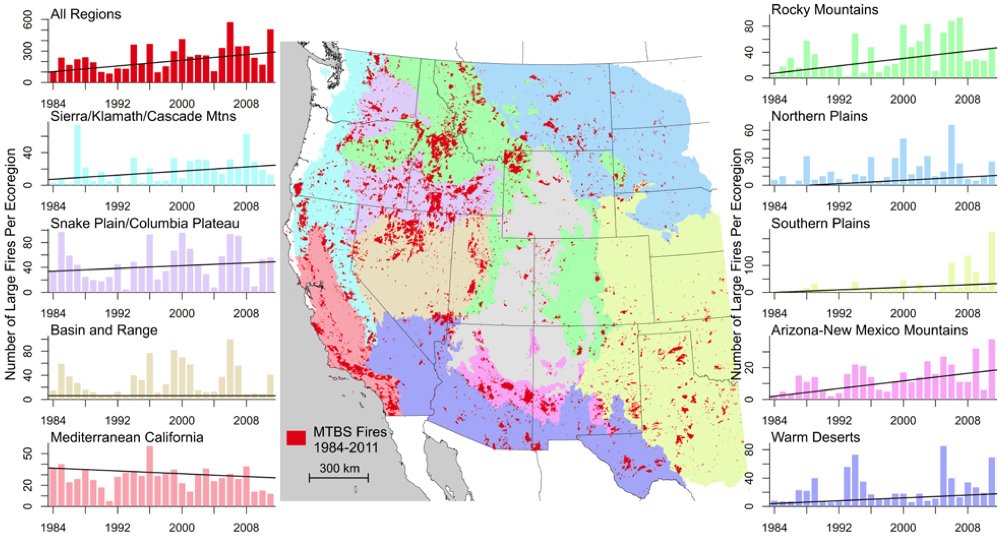
John Upton flags a recent study showing that wildfires are affecting more and more of the Western US each year:

The numbers of big fires that strike annually are on the rise throughout most of the region, from the Rocky Mountains’ pine forests to the wind-whipped deserts that border Mexico. Worsening droughts are taking searing tolls, helping to nudge vast biomes into combustion. The only region spared seems to be coastal California—and, even there, in the relative respite of a Mediterranean climate, the amount of land affected by large fires continues to grow.

Researchers recently pored over satellite fire data and climate data before concluding that monster wildfires—the types of uncontrolled blazes that tear through at least 1,000 acres of forests, parched grasslands, and neighborhoods—increased at a rate of seven every year throughout the region from 1984 to 2011. That helped push the amount of area that burned in such blazes up by an average of nearly 90,000 acres every year.

Becky Oskin talks to the study’s lead author, geographer Phil Dennison of the University of Utah:

“There are a lot of different causes for fire and a lot of different things that contribute to a fire regime, and those vary tremendously across the West,” Dennison said. But because the bump in wildfires seen in the study is so widespread, Dennison thinks one main factor likely underlies the trend: climate change. “This is over too short of a period to say this is definitely climate change, but it does point in the direction of changing climate having an impact on fire,” he said.

And Ari Phillips looks at the attention this problem is getting in Washington:

In February, President Obama called for shifting the costs of fighting the biggest wildfires to the same emergency fund that handles other natural disasters such as hurricanes and earthquakes. The move is intended to allow the U.S. Forest Service to avoid using their mitigation and prevention budget to pay for the costs of massive, and extremely costly, western fires.