John Kerry Tells The Truth … Therefore He Has To Apologize, Ctd

The above tweet is not exactly atypical of many supporters of Greater Israel. And David Harsanyi rightly bemoans its absurdly broad brush. But then, rather than responding to the substance of my post on John Kerry’s truth-telling at the Trilateral Commission, he insinuates that I am also anti-Semitic and even links to the poisonous and deranged screed that Leon Wieseltier maliciously penned about me.

Sigh. Harsanyi disputes the term ethnic cleansing to describe what happened in 1948. Maybe that term, along with the invocation of the a-word, inflames more than it enlightens. But it remains true that around 700,000 of the 1.2 million inhabitants of Palestine were either evicted from their homes or fled during the war of independence for Israel. All of them were Arab. In 1946, the Jewish share of the population of Israel was 30 percent. In 1950, it was closer to 50 percent. By the 1970s, it was over 80 percent.

Now we can debate for ever the nuances of this, who was to blame, etc. (and the Arab world definitely shares that responsibility, by its intransigent and violent stand against a Jewish state). But that’s a massive demographic shift along religious and ethnic lines. If today, 700,000 inhabitants of a country were expelled or fled to make way for a population of a different ethnicity, and if the ethnic/religious majority was changed in a matter of a few years, I don’t think we would be debating the question of ethnic cleansing. And it is that history that hangs over the ethnic engineering Israel is attempting on the West Bank. On that occupied land, Israel is settling hundreds of thousands of Jewish Israelis, in order to shift the demography some more. It is my contention that this further act of colonization is completely incompatible with any short- or long-term two-state solution; and that the Israeli refusal to stop it – even during negotiations – is the essential obstacle to any possible peace agreement. And using Occam’s razor, I cannot see any reason for it other than a longstanding commitment to build the Jewish state with a Jewish majority over the entire territory in dispute.

Harsanyi says I single out only Israel for censure. Of course that’s untrue. The very day I wrote that post, we also covered the appalling regime in Egypt. We covered the foul regime in Iran obsessively in 2009. We haven’t shied from the gruesome human toll in Syria, even as I oppose deeper intervention there as well. So to Harsanyi’s point, I favor ending aid to Egypt as well as to Israel, and I’ve written so several times. My own view is that the US should do what it can to get out of meddling in the entire Middle East. It’s a mug’s game, in which the eternal loser is the US.

Harsanyi further insinuates that I regard the Greater Israel lobby as the only force for Israel’s interests vis-a-vis America’s in American politics. Again not true. Yes, the lobby is ferocious and intransigent and disciplined and, in my view, has actively worsened Israel’s global position in the last decade. But it would not have that clout without overwhelming American identification with Israel as opposed to Palestine’s Arabs, or indeed anywhere in the Arab world.

The trouble is that that emotional support can, in my view, prevent Israel from taking necessary steps to salvage its reputation, its morality, and its survival as a Jewish state.

Max Fisher rightly points out that the apartheid metaphor could lead some to infer that a Jewish state should be abolished just as the Afrikaner state was. That’s not my view at all. My view is motivated primarily by frustration at Israeli extremism but also by a view that a Jewish state must survive and prosper as a moral cause. Because I’m so harsh on Israel’s policies right now, that might seem surprising to some. But if I weren’t committed to a Jewish state in existence as a safe harbor for the Jewish people, I wouldn’t even be writing about this much at all. My view – shared, for example, by the current Israeli ambassador to the US, Ron Dermer – is that a Jewish state permanently disenfranchising a hefty proportion of the people it controls is immoral and self-destructive and toxic to the entire enterprise and unworthy of the great civilization that the Jewish people, against hideous odds, have constructed over the centuries. And no amount of insinuation or name-calling is going to make me change my mind.

GDP Growth Stalls

Jared Bernstein reacts to the new Commerce report:

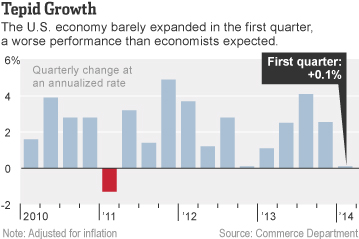
OG-AB335_GDPchr_E_20140430103641[R]eal GDP grew only 0.1% in the first quarter of the year, according to this morning’s report from the Commerce Dept.  That’s a huge deceleration from last quarter’s 2.6%, and well below analysts expectations of around 1.2%.

Remember, that 0.1% is an annualized number–the actual, quarterly percent growth of GDP was 0.03%, meaning that the real level of the value of goods and services in the US economy was essentially unchanged in the first three months of the year.  That’s unusual and alarming, if it’s correct.

However, given the jumpiness in the quarterly estimates, and this is the first of three estimates, based on preliminary data, it’s important to look at year-over-year results as well, to smooth out some noise, including recent weather effects.  By that measure, real GDP is up 2.3%, a deceleration from last quarter’s 2.6%.  In that regard, look at this quarter’s number as a stern warning, one that may or may not herald a downshift in GDP growth, but one that is hopefully not indicative of the underlying trend.

Neil Irwin digs into the data:

Business investment … contributed quite a lot to growth from 2011 to 2013, as companies increased their investments. Companies have been adding buildings, buying new equipment and acquiring new software packages strongly enough that such investment contributed 0.84 percentage points to growth in 2011, almost precisely the same as in 2012. The contribution shifted down to a third of a percentage point in 2013.

In the first quarter of 2014, however, the corporate sector was a net negative for the economy, with investment in structures, equipment and intellectual property falling at a 2.1 percent annual rate, enough to subtract a quarter of a percentage point from overall G.D.P. That was surely in part caused by the harsh winter weather, but the basic trend is real: American business, once a major driver of the expansion, no longer is.

Ben Casselman adds an important caveat:

A key note of caution: Preliminary GDP estimates are notoriously unreliable. On average, the figures get revised by half a percentage point between the first and second estimate (which we’ll get next month) and by a whopping 1.3 percentage points when the final numbers come in.

Jordan Weissmann chimes in:

Most economists seem ready to chalk up much of the slowdown to the miserable winter weather, which kept shoppers indoors, slowed construction, and otherwise turned the last few months into a cold and soggy mess. Chances are, there will be some rebound this quarter—a spring awakening, if you will.

Still, one part of the report seems like a genuine cause for concern: housing.Residential investment has now fallen for two straight quarters.

James Pethokoukis’s view:

How does the economy typically respond after a weak, but positive GDP quarter? It varies. After that weak 4Q 2012, GDP growth averaged 1.8% over the next two quarters. After 0.3% growth in 1Q 2007, growth averaged 2.9% over the next six months. A 0.2% 4Q 2002 was also followed by 2.9% growth the subsequent two quarters. Then again, weak quarters in late 1990 and 2000 were quickly followed by recessions within six months. This time around, however, odds are growth will accelerate — weather permitting.

(Chart via the WSJ)

The Slow And Agonizing Death Of Clayton Lockett

This embed is invalid


Katie Fretland passes along the above chart:

After the failure of a 20-minute attempt to execute him, Clayton Lockett was left to die of a heart attack in the execution chamber at the Oklahoma state penitentiary in McAlester. A lawyer said Lockett had effectively been “tortured to death”. For three minutes after the first drugs were delivered Lockett struggled violently, groaned and writhed, lifting his shoulders and head from the gurney. Some 16 minutes after the execution began, and without Lockett being declared dead, the blinds separating the chamber from the viewing room were closed. The process was called off shortly afterwards. Lockett died 43 minutes after the first executions drugs were adminsitered.

Tulsa World offers a minute-by-minute account:

6:37 p.m. The inmate’s body starts writhing and bucking and it looks like he’s trying to get up. Both arms are strapped down and several straps secure his body to the gurney. He utters another unintelligible statement. Defense Attorney Dean Sanderford is quietly crying in the observation area.

6:38 p.m. Lockett is grimacing, grunting and lifting his head and shoulders entirely up from the gurney. He begins rolling his head from side to side. He again mumbles something we can’t understand, except for the word “man.” He lifts his head and shoulders off the gurney several times, as if he’s trying to sit up. He appears to be in pain.

Will Bunch asks,“If this isn’t torture, what the hell is?”:

The craving by the state’s top elected officials to murder Lockett and another man (whose execution was postponed in a case of too-little-too-late mercy) was so great that Gov. Mary Fallin and lawmakers went to extraordinary lengths to carry it out — arguably circumventing the state constitution and threatening to impeach judges who tried to uphold the rule of law. … As noted in news accounts tonight, drug companies have for the most part halted supplying the “conventional” drugs that were used in executions, so Oklahoma turned to unlawful state secrecy and used an apparently untested lethal cocktail, with predictable and pathetic results. The governor of an American state ordered the torture of a man tonight — that is immoral and unconscionable.

Regarding that state secrecy, Max Fisher adds:

Some states have even passed laws requiring drug suppliers to keep secret about the sales. Officials in Oklahoma have even taken to using petty cash when they purchase individual drugs for the cocktail in order to cover their tracks. The idea is to make it harder for lawyers to challenge the legality of their lethal injections by simply hiding the details.

Before the execution, Stephanie Mencimer covered the untested lethal injection drugs:

The public knows very little about the drugs that will be used to kill Lockett and Warner who stand convicted of murder. ​​Lockett shot a teenage girl, then buried her alive, while Warner raped and killed his girlfriend’s 11-month-old daughter in 1997. Initially, the state said it would deploy a three-drug cocktail, including the sedative pentobarbital (normally used to euthanize animals); vercuronium bromide, which paralyzes the inmate; and potassium chloride, which stops the heart. The first drug is supposed to knock out the inmate so he doesn’t feel pain. The second drug paralyzes him so onlookers can’t tell if he’s suffering. But pentobarbital, which states substituted for sodium thiopental after it went off the market, works more slowly than the old drug, and wasn’t tested in advance to make sure it was an appropriate substitute. Also, lawyers argue that it doesn’t prevent pain during an execution. For that reason, injecting it into a conscious animal in California is actually a crime.

Brad Plumer looks at the history of botched executions:

It’s not the first time an execution dragged on because of the new drugs being used for lethal injections. In January, Ohio tried to execute a man with an untested cocktail — and it took 24 minutes for him to die. “[Dennis] McGuire started struggling and gasping loudly for air,” NPR reported, “making snorting and choking sounds which lasted for at least 10 minutes.”

And the history goes back even further than that. As Amherst law professor Austin Sarat documents in his new book, Gruesome Spectacles, executions gone horribly wrong have been a mainstay in the US for as long as the death penalty has been around.

By Sarat’s calculations, 3 percent of all executions between 1890 and 2010 have been “botched” (that is, they didn’t go according to protocol). That includes electric chairs catching on fire and hangings that led to decapitations. And, in fact, these “botched” executions have become even more common with the advent of lethal injections — about 7 percent have gone awry.

Ben Crair also looks at the specifics of this and other botched injections:

[A] “blown vein” occurs when an IV catheter is either pushed through both sides of a vein or misses the vein completely, causing the drugs to flow into the surrounding tissue. As a result, the drugs don’t reach their target. In a normal medical setting, a doctor and his team will establish IV access and supervise the administration of drugs. But the death chamber is not a normal medical setting. The American Medical Association prohibits its members from participating in executions, arguing doctors’ would violate their oath to protect their patients. …

[Inserting the IV]  is a harder job than you might think, especially in prisons, where inmates are often overweight and inactive, making their veins difficult to find. (Though Lockett’s lawyer insisted his client had “had large arms and very prominent veins.”) There is little oversight of the state’s selection of the individuals tasked with inserting the IV, whether they are physicians or paramedics. And this is the stage where, in the past, many executions have gone wrong. In 2006, a prisoner in Florida named Angel Diaz died a death similar to Lockett’s: After a blown vein, the chemicals pooled in his arms, causing burns. Diaz needed a second dose of drugs and took 34 minutes to die. That same year, in Ohio, Joseph Clark’s execution took 86 minutes as EMTs struggled to find a vein. In 2009, an EMT in Ohio jabbed Rommell Broom with a needle 18 times,trying to establish access. His execution was eventually postponed: He walked out of the death chamber alive. At that time, Deborah Denno, a professor of law at Fordham University, told me Broom’s execution was “the worst botched execution that has happened in the history of this country.”

Lockett’s execution might have surpassed it. In all likelihood, the executioner who inserted Lockett’s IV—and, in Oklahoma, an IV is inserted into both arms—missed the veins or went right through them.

Previous Dish on the guillotine alternative here and firing squad here.

A De Facto Abortion Ban In Mississippi?

Molly Redden warns that the Magnolia State might soon be “the first state in 41 years—since Roe v. Wade—to be without a single legal abortion provider”:

[T]he odds don’t look good. The law, HB 1390, requires abortion providers to have admitting privileges at a local hospital or face criminal penalties. Obtaining admitting privileges, however, poses an impossible burden, since most of Mississippi’s providers travel to Jackson from out of state and local hospitals have all refused to be associated with abortion.

Hillary Crosley confirms that the state’s goal in this legal battle is to ban abortion entirely:

[Paul] Barnes [of the Mississippi Attorney General’s Office] argued that the Supreme Court upheld the Constitution’s guarantee to an abortion but not one that risks the patient’s life. He continued that the law demanding admittance privileges is merely trying to save women’s lives! It has nothing to do with banning abortion in the state! Though Mississippi Governor Phil Bryant publicly expressed exactly that as his goal earlier this year and is incrementally dismantling the practice at home. According to Mother Jones, the Jackson Women’s doctors have been rejected for admitting privileges at every hospital they’ve applied or barred from submitting applications at all. In addition, just last week Bryant banned abortions at 20 weeks, with no exceptions for rape or incest. The law takes effect July 1.

Amanda Marcotte is pessimistic:

The 5th Circuit is notoriously right-leaning and recently decided to uphold a similar law in Texas, forcing many clinics in the state to shutter their doors or stop providing abortions. The fact that these kinds of regulations are not medically necessary at all doesn’t seem to matter to the court, as Irin Carmon of MSNBC writes. The 5th Circuit judge on the Texas case wrote that legislators have every right to craft medical regulations “based on rational speculation unsupported by evidence or empirical data.” In other words, the court has found that facts and evidence need not apply here, and if a state wants to make up regulations out of thin air that have no medical basis of support but just happen to end legal access to abortion, they should feel free to do so.

With that kind of precedent, it’s not looking good for the last abortion clinic in Mississippi. And as Carmon notes, if the 5th Circuit goes this expected way, it will create a path for other highly conservative Southern states to functionally ban abortion without coming right out and banning it. It’s not entirely crazy to think that, eventually, women who need abortions in the South won’t just have to travel to the next state—they’ll have to come North.

The Facebook Model

Derek Thompson illustrates how much the site depends on mobile:

Facebook

John Cassidy unpacks Zuckerberg’s business strategy:

[F]or all its youth and technological sheen, Facebook is, at heart, a very simple and recognizable business. More than eighty per cent of its revenues come from advertising, which has grown enormously since it started featuring ads in its news stream rather than just in banners. Where Facebook outdoes other big media companies is in its ability to target ads based upon its users’ activities on the site. In many ways, in fact, Facebook is the world’s first global direct-marketing company.

Through its automated advertising platform, advertisers, large and small, can create ads that slip into the news stream of select Facebook users, based upon their age, location, and interests, as reflected in their activities on the site. Every time you click the “like” button, Facebook records it. If you say you like a certain yoga video, chances are you will see ads from local studios cropping up in your news stream. Since the ads are targeted at users’ interests, they can be pretty effective; Facebook provides tools for advertisers to measure just how effective.

Condoms Shouldn’t Be A Crime

New York might bar prosecutors from using condoms as evidence:

New York City spends more than a million dollars every year to distribute free condoms to combat unintended pregnancies and diseases such as AIDS. Yet police are allowed to confiscate those very condoms as evidence of prostitution. That conflict is behind the latest legislative proposal to make New York the first state to prohibit condoms — specifically the existence of multiple condoms — from being used as evidence in prostitution cases, a widespread practice that advocates say undermines decades of public health goals.

Elizabeth Nolan Brown supports the proposal:

In a 2012 report from the Sex Workers Project at the Urban Justice Center (UJC) and The PROS Network, half of sex workers surveyed said they sometimes didn’t carry condoms for fear of law enforcement repercussions or had unprotected sex after police had confiscated condoms. “It’s not a myth,” Sienna Baskin, co-director of the Sex Workers Project at the UJC, told The Village Voice last year. “The practice of using condoms as evidence is very prevalent in New York.”

But this isn’t a police practice limited to New York. Washington, D.C., Los Angeles, and Pittsburgh are just a few cities where condoms can still be used as evidence. San Francisco only recently ended the practice. Carrying condoms is still criminalized in all of Louisiana and North Carolina.

These practices put us in line with anti-prostitution efforts in places like Kenya, Namibia, Russia, South Africa, and Zimbabwe—and out of line with established American privacy rights.

It’s Not Just Obamacare That Republicans Dislike

Health Insurnace

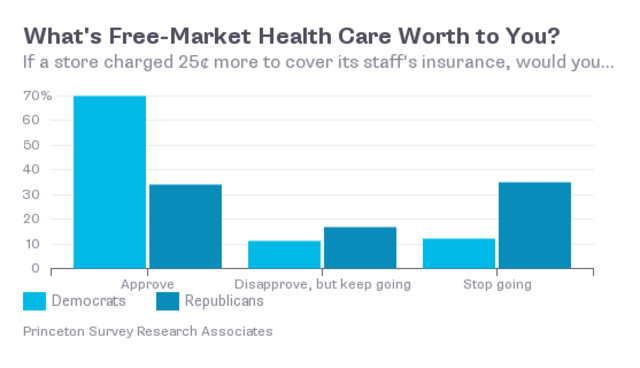
Flavelle highlights a survey that “asked 3,496 people how they would react if a business tacked on an extra 25 cents to every bill to help cover the cost of health insurance for its employees.” Republicans were much less likely than Democrats to say they’d continue shopping at such an establishment:

Here’s what makes that a head-scratcher: The vast majority of Republican respondents — 78 percent — also told questioners that Obamacare should be repealed. So a significant portion of Republicans don’t think the government should pay for people’s health insurance, but they are not willing to pay even a small amount more so that those people can get covered through their employer.

Which leads to a puzzling question: How, exactly, are these people supposed to get insurance?

Over The Hill On The Hill

Nate Silver and Dhrumil Mehta confirm that Congress is not getting younger:

We collected data from a variety of sources, including GovTrack.us, the Sunlight Foundation and The New York Times’ Congress API, on members of Congress since 1947. (We’ve posted our data compilation here.) The people who represent us are considerably older than the population as a whole. The average member of the current 113th Congress was 57.6 years old as of the start of the term on Jan. 3, 2013. This is close to the all-time high of 57.8 years, which was achieved in the 111th Congress, which came into office with Obama in 2009. By contrast, the average age was 53.0 in January 1993, when Bill Clinton took office, and 49.5 when Ronald Reagan did in 1981.

Bernstein wonders if this is “a function of perceptions (or reality) that wealth is increasingly necessary to win office”:

If being rich (and therefore unrepresentative) is linked to being older (and therefore unrepresentative), the demographics of Congress will be increasingly out of sync with the demographics of the nation.

A more benign hypothesis is that our elderly Congress is related to the growing numbers of women legislators. Women often enter Congress later in life than men (perhaps because they are less likely to want to commute between their districts and Washington, D.C. when they have young children?). That might also explain why incoming Democrats, who are far more likely to be women, are also older.

Digital Warhol

dish_warholamiga

Andy Warhol’s mid-1980s art experiments with a Commodore Amiga home computer just surfaced:

It all started with a YouTube clip of Andy Warhol at the Amiga launch event, making a portrait of Debbie Harry. Artist Cory Arcangel saw the clip and embarked on trying to find the images. Working with curators from the Carnegie Museum of Art and the Warhol Museum’s chief archivist, they found Amiga floppy disks. Fortunately, Carnegie Mellon University Computer Club is known for its “collection of obsolete computer hardware” and was able to easily extract many doodles, photographs, and riffs on classic Warhol images like the banana, Marilyn Monroe, and … the Campbell’s soup can.

Archivist Matt Wrbican elaborates (pdf):

In the images, we see a mature artist who had spent about 50 years developing a specific hand-to-eye coordination now suddenly grappling with the bizarre new sensation of a mouse in his palm held several inches from the screen. No doubt he resisted the urge to physically touch the screen – it had to be enormously frustrating, but it also marked a huge transformation in our culture: the dawn of the era of affordable home computing. We can only wonder how he would explore and exploit the technologies that are so ubiquitous today.

Watch a video of Warhol painting an Amiga portrait of Debbie Harry in 1985. Check out the other released images here. Update from a reader:

Before Andy Warhol painted on the Amiga, Steve Jobs introduced him to the very first MacBook. At a party at Yoko Ono’s house in 1984. The entire narrative is fascinating – Warhol picks up the mouse and tries to wave it in the air like a paintbrush – only to exclaim emphatically after ‘mastering’ an early version of Paint “”I drew a circle!” A far cry from a iridescent Marilyn Monroe.

(Image: Andy Warhol, Campbell’s, 1985, © The Andy Warhol Foundation for the Visuals Arts, Inc., courtesy of The Andy Warhol Museum)

An Electoral College Advantage For Democrats?

Electoral College

Ben Highton finds one:

To make predictions for 2016, I analyzed how the popular vote margin (the Democratic minus the Republican percentage of the vote) compared to the national vote in every state from 1992 through 2012.  I examined the states individually to detect any long-term trends.  For example, while Oklahoma was already significantly more Republican than the nation in 1992, it steadily became even more Republican over time. …

Even if the trends across the states slow to – on average – half their current rates, things still look very good for the Democrats.  Under this scenario, the probability of the Democrats winning the Electoral vote is 83 percent. Taken together, these two sets of simulations suggest that if the national vote is evenly split, then the Democrats’ chances of winning the Electoral College vote are between 83 and 89 percent.

Harry Enten casts doubt on this alleged advantage:

From 1952 to 2012, the majority of electoral votes leaned more Republican than the nation seven times and more Democratic nine times. But in the past five elections, Democrats appear to have opened up a bit of an edge. They could have won the Electoral College while losing the popular vote four of five times. Still, in that streak was 2000, when Republicans won the Electoral College without winning the popular vote.

Indeed, knowing how many electoral votes leaned more toward one party than the nation in one election tells us very little about how many will lean toward that party in the next election. An Electoral College advantage is often taken as a sign of a structural advantage, but for the most part, it’s been cyclical. The Democratic edge in 2008 and 2012 may be more due to randomness than demographics.