Are Fewer Black Baseball Players A Sign Of Progress?

Marking Jackie Robinson Day earlier this week, Matt Welch attributes the declining percentage of black baseball players in recent years to the expansion of opportunities for black men elsewhere:

Baseball, ahead of other professions, and ahead of other sports, allowed people with black skin to compete. Combined with the deep bench of talent that had been nurtured in the Negro Leagues, this opening led to black participation rates that quickly zoomed north of U.S. Census figures (which these days put the African-American population at 12.6 percent). But as other professional sports opened up and—importantly—became popular, black Americans started picking up the shoulder pads and lacing up the high-tops. Happiest of all, black kids in school nowadays know they are not doomed to max out as porters or bellhops. That doesn’t mean racism is behind us in the workplace, but it does mean that fields of competition in all walks of life have opened up in ways that even optimists would have found difficult to believe in 1964.

Meanwhile, actual “diversity” in baseball has never been higher. More than 26 percent of big-league baseball players were born outside of the United States, across 16 different countries.

Kavitha Davidson pushes back a bit:

He’s not necessarily wrong: Professional football and basketball, both in their infancy in 1947, have supplanted baseball as the primary destination for elite black athletes. But the percentage of black players in the National Football League and the National Basketball Association has been relatively stable over the past 25 years, while representation in MLB has steadily declined.

The problems baseball faces mirror many of the problems hockey encounters in fostering diversity: The equipment and travel are relatively expensive (especially when compared with basketball), and most big cities that have concentrated black populations don’t have the space or resources for sufficient public baseball fields.

There’s also the economics of higher education and the invisible hand of the NCAA: As on the professional level, college football and basketball are now booming businesses, while college baseball is a nonrevenue sport in the vast majority of schools.

“The Most Trafficked Animal You’ve Never Heard Of”

John D. Sutter worries that the pangolin, or “scaly anteater,” could die out due to lack of publicity:

The pangolin possesses none of the cachet of better-known animals that are hot on the international black market. It lacks the tiger’s grace, the rhino’s brute strength. If the pangolin went to high school, it would be the drama geek – elusive, nocturnal, rarely appreciated and barely understood. When it’s frightened, it actually curls up into a roly-poly ball. The pangolin could go extinct before most people realize it exists. Or, more to the point: It could go extinct because of that.

Pangolins — two species of which are endangered and all of which are protected by international treaty — are trafficked by the thousands for their scales, which are boiled off their bodies for use in traditional medicine; for their meat, which is a high-end delicacy here and in China; and for their blood, which is seen as a healing tonic. …

The numbers are astounding. By the most conservative estimates, 10,000 pangolins are trafficked illegally each year. If you assume only 10 percent to 20 percent of the actual trade is reported by the news media, the true number trafficked over a two-year period was 116,990 to 233,980, according to Annamiticus, an advocacy group. No one knows how many pangolins are left in the wild. But scientists and activists say the number is shrinking fast. Some experts say the pangolin is likely the most trafficked mammal in the world. … Yet, few seem to care. International environmental groups and governments have been slow to fund pangolin research and rescue. You don’t see them on the cover of National Geographic. You rarely find them in marketing campaigns.

But that could change; following the publication of Sutter’s story, at least 13 petitions sprung up on Change.org asking Disney and Pixar to feature pangolins in their movies. Previous Dish on the curious creature here.

Algeria Votes

In a primer written before yesterday’s election, Hicham Yezza outlined the state of play:

Of course, rather than a credible contest pitting six viable pretenders, the 2014 elections were always destined to be a popular referendum on the past record – and future legacy – of the one candidate many have already accepted as the inevitable winner, presidential incumbent Abdelaziz Bouteflika. In power since his election to a first term in 1999, and already the country’s longest serving leader, the 77-year-old has had a rather eventful 12 months. Having suffered a minor stroke a year ago – which consigned him to a 3-month hospital stay in Paris – he has spent much of the period since his return in June 2013 trying to shore up his position at the helm of the Algerian governing ship. Seeing him as fatally weakened, many thought the prospect of a fourth term no longer thinkable, and the outspoken nature of such scepticism presaged a palace mutiny. Instead, Bouteflika took everyone by surprise with a brutal and wide-ranging summer reshuffle at the heart of the state apparatus, chiefly an attempt to cut his key rivals within the DRS (secret services), the FLN and the army, down to size. Whatever Bouteflika’s plans for 2014 were, a side-door gentle exit was not one of them.

Nabila Ramdani provides some background on the ailing president, who local media have declared the winner before the vote count is even finished:

Bouteflika is by no means a Gaddafi, Ben Ali or Mubarak, but his decision to stand in what were described by his government as fair and free elections was unwise.

He won an unlikely 90.24% of the vote when he last stood for re-election, in 2009, and his opponents are still making accusations about vote rigging. Bouteflika’s main rival [yesterday] was the former prime minister Ali Benflis, who won just 6% of the vote five years ago. Little wonder that many Benflis supporters called for a boycott this time around and an abstention rate of up to 80% was forecast.

Bouteflika’s record of national service is unquestionable but he has always placed security above democratic and economic progress.

Michael Robbins explains why Bouteflika’s regime has actually become more popular in recent years:

The most recent Arab Barometer survey, carried out from March through April 2013, reveals that opinion about the government has improved dramatically since its nadir in the months after the Arab Spring. Although the majority of Algerians remain dissatisfied with conditions in their country, their discontent has diminished. Four in 10 rate the government’s performance as good or very good, a 30-point increase over 2011. About three in 10 have favorable views of the government’s performance on narrowing the income gap (27 percent) and creating jobs (31 percent) up 17 points and 16 points respectively. The overall rate of satisfaction with the economic situation has also risen dramatically to 66 percent – more than double that of 2011. Increased happiness was not limited to the economy – 32 percent say the state of democracy and human rights is good or very good – a four fold increase from 2011.

What accounts for these dramatic shifts? First, the Algerian regime took modest steps following the Arab Spring to address some of the problems facing ordinary Algerians. In early 2011 the regime gave public servants a 34 percent raise and boosted subsidies for basic commodities. The regime also lifted the long-standing state of emergency law, in effect for nearly two decades, and passed a set of modest reforms including new laws governing the media and political parties.

But Amel Boubekeur argues that its grip is much more tenuous than it looks:

The leadership’s focus on retaining power has produced countless problems. Growing street protests and rising inner-regime conflicts are compelling Algeria’s rulers to redistribute power yet again in order to stay in place. The sense of crisis is compounded by an imminent generational shift. Bouteflika is too sick to finish his potential fourth mandate. Gaid Salah, the army chief-of-staff, and Tewfik Mediene, the head of the intelligence services, the Département du Renseignement et de la Sécurité (DRS), are 78 and 74, respectively. Whether the transition to come is conducted under the guidance of the army or negotiated with demonstrators, the image of stability Algerian rulers have tried to convey to the international community for so many years can no longer be regarded as a given.

Mehdi Lazar and Sidi-Mohammed Nehad focus on Algeria’s regional significance:

The condition of this North African pivot-state is essential for Europe: Algiers is the third largest energy supplier to the EU, while its population of 38 million inhabitants, its anti-terrorism security expertise and the size of its armed forces (130,000 men) make their security capabilities necessary to the stability of the Sahel zone.

Moreover, with a gross domestic product (GDP) of 208 million dollars in 2013, Algeria remains the largest regional economy. Algeria was the least affected by the wave of the Arab Spring despite negative societal indicators. This situation contrasts with that of Tunisia or Egypt, notably due to the political impact of the major redistribution of wealth gained from oil revenues, but also due to the people’s fear of a return to a decade of stagnation.

However, rapidly dwindling exchange reserves since 2011 and the lack of vision with regard to energy policy over several years is enough to make anyone fear a return to the gas and oil circumstances that landed Algeria in its period of greatest national trauma.

How To Stamp Out Stampedes

With the 25th anniversary of the Hillsborough disaster falling this week, Chris Cocking looks at the lessons learned:

The way the police viewed football (and other) crowds in the 1980s influenced how they policed them. This is why they failed to spot the fatal crush developing until it was too late; it was exacerbated by the police believing that Liverpool fans were attempting to invade the pitch (hence the cordon they maintained near the half-way line while the disaster was at its height), when in fact they were merely trying to escape the fatal crush. This misplaced belief resulted in police pushing fans back into the pens while people still inside them were dying.

A common theme emerges runs through this catalogue of mistakes:

that football matches and crowd events in general in the 1980s were too often seen as a public order problem, instead of a public safety issue. Along with others involved in the study of crowd emergency behavior and safety management, I am very critical of such approaches. … There is almost a sense of moral panic in the way society views crowds, in that they are often seen as vehicles for potential “disorder” or mass panic, despite decades’ worth of research by psychologists finding that such concepts are largely myths, and that crowds often behave much more sensibly than they are usually given credit for. When tragedies happen, it is almost always because of a failure of crowd management, as opposed to any “irrational” behavior on the part of the victims.

Other Voices, Other Points, On Becker

I’m done venting. Promise. For a sane and reality-based short history of the marriage equality movement, check out this Buzzfeed piece from a year ago by Chris Geidner, the best reporter on gay politics online. For a more objective take on Becker, here’s a very solid, informed critique by Adam Teicholz. He helps you see better why Becker’s disparagement of the key men and women who made marriage equality is so offensive. Money quote:

It will be tempting for those on the outside to dismiss Sullivan’s critique (and those, to come, of the slighted activists who will surely line up to take potshots) as the infighting and backbiting of sore losers. They are not. I have no skin in the fight between factions; to the extent I have personal connections, they are on both sides. I know Evan and others at Freedom to Marry, and Ken Mehlman, whom Becker features prominently, is a friend. I believe that marriage would not have come to New York State in 2011 if it weren’t for Melhman’s savvy, and obstinacy. But there is simply no plausible case to be made that he, Griffin, Black, Olson, and Boies—as hardworking and smart as they are—are the protagonists of the gay-rights revolution.

He’s particularly sharp on how Becker/Griffin disses one of the most gifted political strategists of the movement, Tim Gill. Hank Plante notes how Becker’s attack on everyone in the movement apart from Griffin is just an extension of Griffin’s own contempt for the two decades of staggering progress that made his unseemly credit-grabbing possible:

Griffin’s group sued to keep [all the other gay groups] from intervening in the Prop. 8 case, with Griffin writing to them, “You have unrelentingly and unequivocally acted to undermine this case even before it was filed.  In light of this it is inconceivable that you would zealously and effectively litigate this case if you were successful in intervening.”

Now you can better see where Becker’s contempt for and ignorance of the marriage equality movement comes from. The staggering thing is that the man who sowed this division, who engineered this book, and who will continue to grab exclusive credit for marriage equality in the forthcoming HBO movie on the subject … is now the head of the biggest gay rights group in the country. How can he lead a movement he has now publicly announced his contempt for?

Meanwhile, I guess I should respond to this ad hominem by HRC’s former head, Elizabeth Birch. So some corrections: I’ve long noted that marriage equality predates Evan and me by decades in the US and by centuries across the world. An anthology I edited on the subject makes that quite clear. The graphic in the post she lambastes starts in 1970, for goodness’ sake. I only cited one book of mine in that post, the first best-seller in the world on marriage equality, translated into seven languages, and prompting a global debate on the question. I cited one article, which the Nation – and not as a compliment – touted as “the most influential essay of the decade in the gay rights movement.”

Birch substantively agrees with me that it was the Hawaii lawsuit that truly began the revolution in 1993 – not, as Becker’s book has it, Chad Griffin in 2008 –  but then repeats what she said at the time: there was no point in fighting for such an impossible goal, we should hope it goes away, the whole thing is a terrible distraction, we’ll get “slaughtered” if we go ahead, etc. So she effectively conveys what the internal fight was about at the time. Evan and I were eager to seize on any lawsuit to leverage it into headlines, to build the case. We knew there would be failures at first, and backlash soon after.

But Evan and I, unlike Elizabeth, believed that we would eventually win because our arguments were so strong, and that the issue had the potential to galvanize and recast the entire movement. I understand why this put her in a tough spot at the time, wanting us to be right, believing we were wrong, and therefore unwilling to put HRC behind a huge effort when the groundwork hadn’t been done. But for us, that was a Catch-22. If we didn’t grasp the issue, the groundwork would never be done. So why don’t we just get on with it, instead of remaining in a Clintonian defensive crouch? HRC’s subsequent deep unease with the issue was, of course, deeply frustrating to those of us who believed it was the key issue for our political and moral advance.

My most vivid memory of Elizabeth was when she, Evan and I testified in 1996 in Congress against the Defense of Marriage Act. We all knew we were going down in flames, but Evan and I were just amazed we had gotten the first Congressional hearing ever on marriage equality. You have to remember the very idea was regarded as completely absurd at the time. Our goal was to make this a national conversation – because it was a conversation in which we had unassailable arguments on our side – even if it meant an early bloodbath. Elizabeth was bristling with frustration that we were having a hearing at all. It was, she remarked, “Hell Week” for gay rights. She understandably did not want to preside over bloodbaths while head of the biggest gay rights organizations. It took many years before HRC even used the word “marriage” in its own literature.

My other vivid memory of Elizabeth was when, in a rare moment of outreach, she invited me to give a speech at HRC a couple years later, and I used the occasion to give my stump speech on marriage equality. Afterward, she came up to me and said she had changed her mind. “If we aim for the stars,” she said to me, “we could maybe reach the moon.” And that’s what indeed we did, and Griffin and Boies and Olson deserve kudos for sustaining the momentum of that journey. But it serves no one to pretend they started this thing or were in any way indispensable to it. And the embarrassment of HRC’s own awful record on the issue is not, I’d argue, irrelevant to this book. It would not exactly be the first time when local or independent actors make change possible, only to have HRC swoop in at the last minute and claim all the credit. That’s always been their mojo. And it’s why so many are so pissed off at them once again.
New York Is Down With NPV

It just become the 11th state to join the National Popular Vote Compact, whose members agree to award their electoral votes in presidential elections to the winner of the popular vote, effective as soon as 270 electors’ worth of states sign the compact. Rick Hertzberg cheers:

A lot of people labor under the misapprehension that the Electoral College status quo is good for small states, or rural states, or states that don’t have big cities in them. Actually, the only states it’s good for, qua states, are swing states. The jurisdictions that have approved N.P.V. so far come in all sizes. Four are small (Rhode Island, Vermont, and Hawaii, plus the District of Columbia), three are medium-sized (Maryland, Washington, and Massachusetts), and four are large (New Jersey, Illinois, California, and now New York).

The discerning reader will have noticed that all eleven, besides being spectator states, are also blue states. The absence of red states from the roster is due largely to to a suspicion among Republican politicians and operatives that N.P.V. is somehow an attempt to get revenge for 2000. In opinion polls, Republican rank-and-filers, as distinct from Party professionals, strongly favor the idea of popular election. And a nontrivial number of Republican pros favor the plan itself.

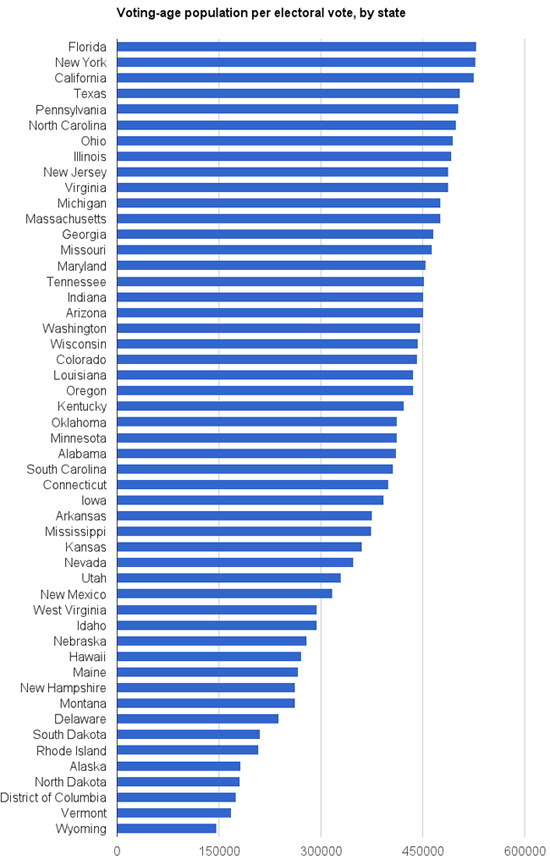
Ryan Cooper looks at which states get screwed over the most by the Electoral College:

ec_chart3_550

It turns out that many states have huge populations of people who are ineligible to vote. California and Texas, for example, have 5.1 million and 2.6 million non-citizens, respectively, which cuts down their voting-eligible populations significantly. Florida, meanwhile, has slashed its voting population by over 10 percent through the disenfranchisement of felons. (Ironically, this makes its position in the Electoral College look “fairer,” since by raw population the Sunshine State comes out the worst.)

Dick Morris is sure this is all a Democratic conspiracy:

Democrats usually see a smaller percentage of their people go to the polls than Republicans do. Under the electoral vote system, they figure why beat the drums to get a high turnout in New York City when the state will go Democratic anyway? But if it’s the popular vote that matters, the big-city machines can do their thing — with devastating impact.

And think of the chances for voter fraud! Right now, the biggest cities, the ones most firmly in Democratic control — Washington, D.C., New York City, Detroit, Chicago, San Francisco — are all solidly in blue states. Not only does this make it unnecessary to maximize turnouts there, but it also makes it unnecessary to promote double voting, fraudulent voting, and all the other tricks of the trade at which Democrats excel.

Kilgore mocks:

Morris seems to think Republicans absolutely have to have a thumb on the scales via the distorting effect of the Electoral College. That’s perfectly in line with the sense you get from many Republicans that it’s only fair they get other thumbs on the scales through restrictions on voting or the Senate filibuster or limitless corporate campaign contributions—or ideally, from courts that rule progressive legislation as unconstitutional. As is often the case, Morris provides a caricature—but still a reflection—of arguments other conservatives are embarrassed to make.

Nate Silver, however, doubts the NPV movement has a chance as long as red-state politicians appear to share Morris’ fears:

Republican voters are nearly as likely to support ending the Electoral College (61 percent of them would vote to do away with it as compared to 66 percent of Democrats, according to a Gallup poll last year). But Republican legislators in those states evidently feel differently, or perhaps have calculated that the Democrats’ Electoral College advantage in 2008 and 2012 was an anomaly that will soon fade.

If Utah, Texas and similar states do begin signing onto the compact, what signal might that send to the blue states? Might legislators in Vermont and Maryland suddenly decide they agree with Alexander Hamilton’s position on the Electoral College after all?

My personal view is that the Electoral College should be abolished (even if that means we’d have to change the name of this website). But based on the signatories to the compact, blue and red states seem to think of it as a zero-sum game.

The View From Your Obamacare

A reader writes:

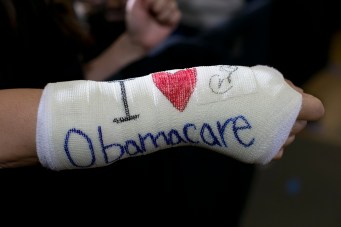
Thank you so much for giving me a platform to share my Obamacare success story! Well, actually, it’s my brother’s story and it starts about a year ago. He was 25 and working for a small radio group in President Obama Visits Boston To Talk About Health CareIthaca, NY. He got into a PhD program at IUP, and since he was barely making any money, he decided to quit his job and spend the summer relaxing and traveling and visiting friends before starting school.

Those plans got thwarted when he was diagnosed with thyroid cancer in June. Three surgeries later, I am happy to say that he is in recovery and doing great, but damn, my family would’ve been fucked without Obamacare. It let my brother stay on my parents’ insurance, so he was covered when he got his diagnosis. I’m not sure what the costs of his treatment have been exactly, but the bill for just administering the radioactive iodine pill he had to take was almost $200,000.  When you add to that all the tests and the three surgeries, the costs have got to be close to a million, if not more. My family would likely be considered well-off, but those costs would’ve bankrupted us.

It’s possible that he would’ve been on Cobra without Obamacare, but I think it’s at least equally likely that he would’ve decided to just wait until he could join the school plan because Cobra is so expensive. At the very least, Obamacare has saved my family from significants costs. And, because he now has a pre-existing condition, it’s the only reason he can buy health insurance and will be able to for the rest of his life.

A reader in Georgia:

My ex and I are splitting soon. I’m leaving my job in a few weeks and moving to another state across the country and will be unemployed for a few months as I switch careers. He’s staying here and working his way through his last couple of semesters of college. He has a pre-existing condition that requires medical oversight and expensive prescriptions. Until I leave my employer in a few weeks, I pay for his insurance through my employer-provided domestic partner coverage. Now that I’m leaving my job and moving to another state, he will have to purchase insurance on his own, something that was impossible before Obamacare due to pre-existing exclusions from the individual health insurance market.

Because we live in a GOP state, thanks to Obamacare, he can buy insurance (yay!) but doesn’t make enough to qualify for subsidies (boo!).

Instead of something affordable, he has the option to pay full-cost for ACA medical coverage ($200 to $250/month) in addition to the deductibles for medical visits and prescriptions needed for his medical condition. He doesn’t make enough annually to qualify for subsidies because he is a full-time student and part-time employee. If Georgia had opted into the ACA Medicaid expansion, he would have qualified for that, saving the monthly premium altogether.

There couldn’t be a starker contrast between the two parties on healthcare. The Democrats want to make it available to millions of Americans like him and the Republicans are doing everything in their power to prevent that from happening. As a bonus, they are also fighting against raising the minimum wage, which would be a huge boost for all the students out there who have to support themselves and go to school. More and more, the GOP seems to be working against hard-working Americans and not for them. I don’t understand why more people don’t see this.

Another reader in a red state:

I am a physician working in Indianapolis. Much of my work is at a county hospital system that supports the poor of the city by providing healthcare to any citizen in the county regardless of their income. Obamacare has allowed many of these patients to come off the county system’s rolls.

Indiana sadly has not fully expanded Medicaid because our governor, uber Republican Mike Pence, refuses to do so. Even without expanded Medicaid, many of my patients have been able to sign up and all are incredibly appreciative. One interesting effect is that many of them now have the ability to get a second opinion and different care options because they are no longer tied to the county system. I started to get worried about our system (and myself) when after the first of the year, I had about five patients leave for second opinions but was rewarded by all of them returning to our practice. Obamacare has allowed these patients to both not be tied down to a system strapped for funding and also gain confidence in the care they receive when they note that we are caring for them just as well as they can get elsewhere.

Our system has its limits and we can’t provide some very expensive care, like radiation, but Obamacare allows these patients to find providers that can give this care. This effect will reduce suffering and prolong lives. I have always been a big supporter of this legislation but the benefits I am seeing are remarkable and under reported.

Another in the medical field:

I have a lifelong chronic disease, Crohn’s, for which I take a biologic that costs about $130,000 per year. These meds keep me and many other people healthy, and out of the surgical OR and off emergency room beds. It also saves me from debilitating pain and allows me to be a productive member of society. Before the ACA, I was stuck paying incredibly high premiums (>$1300/mo) through COBRA and then a HIPPA conversion plan.

Unfortunately for me, I live in a state that did not (yet) expand Medicaid, and since I am a no-income student, I do not qualify for subsidies on the exchanges. So instead, I use my school’s health insurance plan, which is better than nothing, but not excellent. With no out-of-pocket-maximum, I end up with about $10,000 of out of pocket costs every year.

While the ACA hasn’t given me cheaper insurance, it has given me immense security knowing that if my circumstances change, my medical care won’t suffer. As you wrote of your own experience, “It gave me a baseline of security that simply didn’t exist before.”

Finally, and perhaps most interestingly, as a medical student, the ACA has changed the landscape for medical providers. I anticipate that it will pump money into the medical establishment’s pockets much like Medicare made physicians rich several generations ago (and continues to do so today). Whether that is a good, bad, or neutral thing, I can’t say. But for those people who now newly have access to a lifesaving service, it is of incalculable value.

(Photo by Yoon S. Byun/The Boston Globe via Getty Images)

Malkin Award Nominee

“In the last few days in terms of the people who have been yelling the loudest about [Truvada], they’ve all been associated with bareback porn. They’re all associated with bareback porn, which kind of makes my point that it’s a party drug,” – Michael Weinstein, president of the Los Angeles-based AIDS Healthcare Foundation, the largest HIV/AIDS medical care provider in the U.S.

Nobody Is Rounding Up Jews In Ukraine

Yesterday, a troubling report that Jews in Donetsk were being ordered to report to the local authorities and register their property made the rounds in the press and on the Internet. Ioffe explains that the story is overblown:

Today, the Western press caught up with the Ukrainian rumor mill: apparently, the People’s Republic of Donetsk had ordered all Jews over the age of 16 to pay a fee of $50 U.S. and register with the new “authorities,” or face loss of citizenship or expulsion. This was laid out in officious-looking fliers pasted on the local synagogue. One local snapped a photo of the fliers and sent it to a friend in Israel, who then took it to the Israeli press and, voila, an international scandal: American Twitter is abuzz with it, Drudge is hawking it, and, today in Geneva, U.S. Secretary of State John Kerry slammed the fliers as “grotesque.”

The Donetsk Jewish community dismissed this as “a provocation,” which it clearly is. “It’s an obvious provocation designed to get this exact response, going all the way up to Kerry,” says Fyodr Lukyanov, editor of Russia in Global Affairs. ”I have no doubt that there is a sizeable community of anti-Semites on both sides of the barricades, but for one of them to do something this stupid—this is done to compromise the pro-Russian groups in the east.”

But Anna Nemtsova talks to a local Jewish leader who points out that there are prominent anti-Semites within the pro-Russian camp and worries that nobody is looking out for his community:

According to Rabbi [Pinhas] Vyshedski, the press secretary of the self-proclaimed republic, Aleksander Kriakov, is “the most famous anti-Semite in the region.” Vyshedski wondered how separatists who are trying to position themselves as “anti-fascist” and claiming it’s Kiev that’s run by neo-Nazis could pick Kriakov as their spokesman. The sense of insecurity is heightened by the uncertainty and a feeling of abandonment. “I want to know why in two days of these threats, the Jewish community has not heard a single comment from either Donetsk—or from the Kiev authorities,” said the rabbi. … But the problem is, precisely, that there are no authorities who really control the situation in Donetsk Oblast just now.

Zack Beauchamp explains why this leaflet popped up:

Part of the reason this flier is such a big deal is that Russia and Ukraine are both using accusations of anti-Semitism as part of their attempt to portray the other side as in the wrong. The memory of World War Two, and of the devastation Nazi Germany caused their countries, is still fresh in both. Russia alleges that fascist supporters of the new Ukrainian government are threatening Jews, while the Ukrainians say the same about pro-Russian separatists.

So far, there’s very little evidence that the Ukrainian side is persecuting Jews. As Igor Volsky and Hayes Brown at ThinkProgress note, a recent UN report found could not find much evidence substantiating the Russian charges.

“Nobody is afraid of fascists,” east Ukrainian rabbi Shmuel Kaminezki told the New York Times. “But everyone is afraid of war with Russia.”

Freddie chides the US media for their credulity:

American media will believe literally anything you tell them about governments our own government doesn’t like, and the supposedly liberal, supposedly savvy, supposedly hip set are worse than anyone. Maybe every word of this story is true, and all the fevered panic about it is justified. But the broader point would remain the same: when it comes to “the bad guys,” American journalists will print anything, so long as it makes us look better and them worse.

American journos, pundits, writers, and internet obsessives: you are very, very bad at assessing evidence about regimes that your government does not like. You should not trust your own instincts when assessing the likelihood and legitimacy of stories about governments that are antagonistic to your own. Continuing to do the same thing over and over again, and then realizing the bad results after, is not an effective way to go about doing your job. Maybe try, you know, learning.

And Rosie Gray and Max Seddon frame the incident as a propaganda battle:

Ukraine’s Jewish community has become a flashpoint of the media war between Russia and Ukraine. Moscow and the Russian state-controlled media have revived old claims that Ukrainian nationalism is tantamount to Nazism and have amplified the voices of the existing Ukrainian far right, which is intensely anti-Russian. Russian President Vladimir Putin in March described the new Kiev government as “neo-Nazis, nationalists, and anti-Semites on the rampage.”

Pushilin, the pro-Russian local figure, has denied that his group put out the leaflets. And Kirill Rudenko, a spokesperson for the Donetsk Republic, also denied the group had anything to do with the flier. “This is a total lie. We haven’t handed out any fliers. Our only tasks are defending the occupier buildings and preparing for the referendum,” he told BuzzFeed. “This is an American Secret Services provocation to discredit us.”

But even as the source of the fliers remains unclear, the U.S. government Thursday mounted a coordinated campaign to tie the flier to the separatists.