Resegregation In The South

This embed is invalid


Nikole Hannah-Jones reports on it:

[Tuscaloosa, Alabama’s] school resegregation—among the most extensive in the country—is a story of city financial interests, secret meetings, and angry public votes. It is a story shaped by racial politics and a consuming fear of white flight. It was facilitated, to some extent, by the city’s black elites. And it was blessed by a U.S. Department of Justice no longer committed to fighting for the civil-rights aims it had once championed.

Certainly what happened in Tuscaloosa was no accident. Nor was it isolated. Schools in the South, once the most segregated in the country, had by the 1970s become the most integrated, typically as a result of federal court orders. But since 2000, judges have released hundreds of school districts, from Mississippi to Virginia, from court-enforced integration, and many of these districts have followed the same path as Tuscaloosa’s—back toward segregation. Black children across the South now attend majority-black schools at levels not seen in four decades. Nationally, the achievement gap between black and white students, which greatly narrowed during the era in which schools grew more integrated, widened as they became less so.

Pollution Is For Poor People

Emily Badger flags a new study adding to the large body of evidence that environmental problems disproportionately affect poor and minority communities:

[R]esearchers at the University of Minnesota, writing in the journal PLOS ONE, have created a sweeping picture of unequal exposure to one key pollutant — nitrogen dioxide, produced by cars, construction equipment and industrial sources — that’s been linked to higher risks of asthma and heart attack. They’ve found, all over the country, in even the most rural states and the cleanest cities, that minorities are exposed to more of the pollution than whites. …

Specifically, they found that minorities are on average exposed to 38 percent higher levels of outdoor NO2 than whites in the communities where they live, based on demographic data from the 2000 census. That gap varies across the country, though, and it’s substantially wider in the biggest cities. Nationwide, the difference in exposure is akin to approximately 7,000 deaths a year from heart disease.

Meanwhile, John Upton flags research connecting pollution and suicide:

“We found an association between air pollution exposure and suicide risk,” says Amanda Bakian, an assistant professor in the university’s psychiatry department who was involved with the research. “Our study wasn’t designed to test for causality. It was designed to assess whether or not there is a correlation.”

Bakian and her colleagues found that the odds of committing suicide in the county spiked 20 percent following three days of high nitrogen dioxide pollution—which is produced when fossil fuels are burned and after fertilizer is applied to fields.

Seeing Blue

Rosie Blau (as our German readers chuckle) looks at how light affects our health:

In the morning, high concentrations of blue occur naturally; by dusk we are left mostly with green and bluered. The blue light has the greatest impact on our circadian system, telling the brain that it’s morning and time to be alert, and setting our clock for the day. That is important because we sleep soundly, and our brain and body function better, when the internal signals of the body clock are in sync with external cues of day and night.

The problem is that artificial light does not replicate the colours of the natural world. Much electric light has high intensities of blue, so it deceives our brains into thinking that it’s daytime even when it isn’t. Just ten minutes of regular electric light can make some changes to our internal clock. “We evolved to be blue-sensitive, we need it,” says [professor Satchin] Panda. But many of us get an awful lot of it, particularly in the evening: when we get home we spotlight the kitchen so we can make the dinner, and then plug into our laptops, tablets or smartphones, which beam blue light into our eyes at close range. So we … lessen the contrast between light and dark that our circadian system relies on to work well. All of which makes us more prone to insomnia or disturbed sleep in some way.

But artificial light isn’t all bad:

Teenagers the world over should be cheering on the work of Mariana Figueiro, an expert on light and health at Rensselaer Polytechnic Institute in upstate New York. In 2012 she found that when a group of young adults used an iPad for two hours before bedtime, they suppressed their production of melatonin, a sleep-promoting hormone. The media focused on the obvious conclusion: that using such backlit devices ruins our sleep.

But Figueiro draws another inference too. Because they blast us with blue light, these same backlit items could act as light therapy by day to help invigorate us and reset our clock. She may be the first person to prescribe an hour playing “Angry Birds” each morning as a solution to our ills.

(Photo by Gisela Giardino)

The War Over The Core, Ctd

With Indiana recently becoming the first state to repeal the Common Core State Standards – and opposition to the standards rising in Louisiana, Oklahoma, and several other states – Jay Greene worries that Core supporters “made some of the same political mistakes that opponents of gay marriage did”:

They figured if they could get the US Department of Education, DC-based organizations, and state school chiefs on board, they would have a direct and definitive victory. And at first blush it looked like they had achieved it, with about 45 states committing to adopt the new set of standards and federally-sponsored standardized tests aligned to those standards. Like opponents of gay marriage, the Common Core victory seemed so overwhelming that they hardly felt the need to engage in debates to defend it. But in the rush to a clear and total victory, supporters of Common Core failed to consider how the more than 10,000 school districts, more than 3 million teachers, and the parents of almost 50 million students would react. For standards to actually change practice, you need a lot of these folks on board.

And he doesn’t see that happening anytime soon:

Supporters of Common Core may draw the wrong lesson from this post and increase efforts to convince the public and train educators to love the Common Core. Not only will these re-education efforts be too little, too late, but they fail to grasp the inherent flaw in reforms like Common Core. Trying to change the content and practice of the entire nation’s school system requires a top-down, direct, and definitive victory to get adopted. If input and deliberation are sought, or decisions are truly decentralized, then it is too easy to block standards reforms, like Common Core. Supporters of CC learned this much from the numerous failed efforts to adopt national standards in the past. But the brute force and directness required for adopting national standards makes its effective implementation in a diverse, decentralized, and democratic country impossible.

Meanwhile, Rick Hess and Michael Q. McShane see a parallel to the Obamacare debate, arguing that “[ACA] critics have recognized that it’s important to offer solutions, not just complaints. Common Core critics in each state need to devise their own version of ‘repeal and replace’”:

Common Core critics must keep in mind that policy debates are won by proposing better solutions. The Core standards were adopted with a big federal boost and little public debate, but adopted they were. Teachers and school leaders have been implementing the standards since 2010, and opponents can’t wish this away any more than Obamacare critics can wish away the new landscape produced by the Affordable Care Act. … The ixmpulse to undo an ambitious reform that was adopted with little scrutiny or debate is a healthy and understandable one. But criticism unaccompanied by solutions is a self-defeating strategy. Common Core critics need to make sure they’re saying more than just “no.”

Previous Dish on the Common Core here and here. Update from a reader:

There seems to be a lot of misunderstanding around Common Core. I’ve noticed that even pundits who support it often call it a curriculum and it is not a curriculum; it is a set of standards around which states and local school build a curriculum. The other thing I hear and read often is, “Common Core standards are not rigorous AND too many students fail the tests”. What? They are saying students are failing non rigorous tests?? If the standards lack rigor, shouldn’t everyone be passing the tests?

If students are failing the tests for Common Core, either:

1. The standards are too rigorous; perhaps not developmentally appropriate for a particular grade, asking too much too soon.

2. The curriculum implemented to prepare students to meet the standards is not effective

3. Our little angels are not all the gifted geniuses we thought they were.

Some states, including my own (GA) are just testing against the new standards this year. Maybe as there is more data it will become clear why students scores are going down, or if that is even true over all the participating states.

Common Core advocates did a lousy job of rolling out the standards, but Indiana is unique in that they have robust state standards to go back to. Many states had less rigorous standards prior to common core so they should at least wait for some data before drafting more new standards. The most useful data point may be how kids who have been taught under the new standards since kindergarten perform on their first round of testing in 3rd grade. In our district, that does not occur until next year.

Another:

State assessments, including any created for the Common Core, aren’t pass/fail. Students receive a score on a scale. States divide scale scores into categories of achievement, such as advanced, proficient, basic, below basic. Each category of achievement represents a band of scale scores. The scores that constitute a band are set subjectively. Because proficiency is desirable, and because No Child Left Behind expects students to be proficient, some people say that any score below proficiency is “failing.” It is not, any more than a “C” grade in a class is failing.

Now, here’s the thing. Under NCLB originally, each state set its own standards, commissioned its own tests, and decided upon the scores that constitute each category of achievement. As a result, NCLB created a perverse incentive for states to have low standards, easy tests, and a low score for proficiency. States are free to continue to do this.

NCLB came up for reauthorization in 2007, long after it was much reviled, but Congress has been unable to agree whether to kill it or change it. NCLB contains a provision allowing for waivers. In the absence of Congressional action, the U.S. Department of Education has created a comprehensive waiver that amounts to its own version of NCLB. Many states wanted these waivers because the waiver allowed them to set up a more sensible accountability system for schools.

Conditions for receiving a waiver included adopting rigorous standards and assessments. The standards and assessments do not have to be Common Core-related. But states with a waiver must still categorize students as proficient or not, and still deal with low-performing schools.

The Common Core and its assessments are more rigorous than most previous state tests. The new standards require closer reading of texts in all subjects , better writing and speaking skills, ready knowledge of math facts, understanding of math principles, and application of math to real-life problems. The assessments will require students to think.

With teachers and students just gearing up for this, we can expect that fewer students will score proficient on the new tests, for at least a few years — probably longer. Unfortunately, people categorize this as failing the test. Imagine that you used to require students to jump two feet high and now students must jump four feet high. They will need to be trained to work up to this. America is not a patient culture.

Hathos Alert

It’s an independent Tea Party commercial designed to oust Thad Cochran from the Senate. Brace yourself, Thad.

Update from a reader:

Well, it says something that Abraham Lincoln is being used an appeal to conservative Mississipians. You wouldn’t have seen that very long ago.

Another:

The very best part about the video is that they used a picture of Daniel Day-Lewis as Lincoln in place of a picture of the real Lincoln.

John Roberts And White Supremacy

A potent read from Tom Levenson, in the wake of Ta-Nehisi’s powerful writing on the subject. Money quote:

Political money and hence influence at the top levels is disproportionately white, male, and with almost no social context that includes significant numbers of African Americans and other people of color.

This is why money isn’t speech. Freedom of speech as a functional element in democratic life assumes that such freedom can be meaningfully deployed. But the unleashing of yet more money into politics allows a very limited class of people to drown out the money “speech” of everyone else—but especially those with a deep, overwhelmingly well documented history of being denied voice and presence in American political life.

Will The NYPD Finally Stop Spying On Muslims?

Making good on one of his campaign promises, Mayor de Blasio has shuttered an infamous police unit:

Referred to as the “Demographics Unit,” the unit, advised by an official from the Central Intelligence Agency, had engaged in broad surveillance of Muslim communities, such as neighborhoods, mosques, businesses in New York and New Jersey, without specific evidence of criminal behavior. Testifying under oath, an NYPD official admitted that the program had not lead to a single terrorism investigation. Nevertheless, former New York City Mayor Michael Bloomberg had defended the unit’s operations, saying, “We have to keep this country safe.” The unit was first revealed as part of a Pulitzer prize-winning investigation by the Associated Press.

As a candidate, de Blasio had said that “we need to do a full review of all surveillance efforts, and anything that is not based on specific leads should not continue.” Yet the Center for Constitutional Rights and the Muslim civil rights group Muslim Advocates said they were uncertain whether the end of the Demographics Unit means the end of what they called “the practice of suspicionless surveillance of Muslim communities.”

Cue Pamela Geller, with the headline “De Blasio Surrenders New York To The Jihad.” But Rachel Gillum, the principal investigator of the Muslim American National Opinion Survey, explains how closing the unit might actually help anti-terrorism efforts:

The Muslim-American community has served as a major resource for law enforcement since 9/11, with some scholars citing Muslim-Americans as the single largest source of initial information leading to disrupted terrorism plots since 2001. Such community assistance is particularly important in stopping homegrown attacks which tend to involve more “lone wolf” actors, making them more difficult to detect by law enforcement. Indeed, it was a Muslim immigrant who first reported suspicious activity in the 2010 case of Faisal Shazad, convicted in the Times Square bombing attempt.

The NYPD’s spying tactics, guided by a former CIA official, stirred debate over whether the NYPD was infringing on the civil rights of Muslims and illegally engaging in religious and ethnic profiling. Findings from recent studies based on MANOS data– a nationally representative survey of 500 Muslim-American respondents collected online by YouGov in March 2013 –suggest that such programs that unfairly target Muslim communities can create feelings of cynicism and reduce Muslims’ willingness to voluntarily assist police in criminal investigations.

But Matt Taylor warns that this doesn’t mean the NYPD is going to stop spying on Muslims altogether:

The fear is that the dissolution of the most infamous piece of the spying apparatus might serve as a pretext for [Police Commissioner Bill] Bratton’s NYPD to continue some of [former commissioner Ray] Kelly’s worst policies, like designating entire mosques as terrorist organizations (and using that as an excuse for spying on everyone who frequents them) as well as infiltrating Muslim student groups on college campuses. After all, the NYPD’s budget for counterterrorism and intelligence in 2010 was over $100 million, and the two divisions employed about 1,000 officers. The Zone Assessment unit itself never included more than about 16 detectives at any given time, meaning tens of millions of dollars and hundreds of bodies are still available to spy on targeted ethnic groups, Muslim or otherwise.

Jo Becker Responds – By Lying About Her Own Book

Politico’s Dylan Byers managed to get an email from Jo Becker on her book. Here’s what she sent back (and it’s the same response she gave to HuffPo):

Many people have contributed to the success the movement has experienced. I have the upmost [sic] respect for all the people who contributed to that success. My book was not meant to be a beginning-to-end-history of the movement. It’s about a particular group of people at an extraordinary moment in time, and I hope that people will be moved by their stories.

My italics. It’s interesting that rather than defend her insane core thesis, she just lies about it. She claims that her book never pretends to be a beginning-to-end history of the marriage equality movement. And yet the book starts thus:

This is how a revolution begins … It begins with a handsome bespectacled thirty-five year old political consultant named Chad Griffin … on election night 2008.

Does she think we cannot read? The title of the book is “Forcing The Spring.” Not plucking the fruits of autumn. And if you think I’m just grabbing a few sentences, here’s how Becker introduces Evan Wolfson, the architect of the entire movement, just pages after she begins her cringe-inducing hagiography of Griffin. She frames him as an old, out-of-touch obstructionist who just never got it, unlike Hollywood’s Dustin Lance Black (!):

Hours earlier, Black had been confronted in the hotel’s courtyard by Evan Wolfson, the fifty-two-year-old founder of a group called Freedom to Marry and the primary author of the cautious state-by-state strategy that the gay rights movement had been pursuing. Wolfson had berated the younger man over his Oscar speech, explaining as though to a willful but ignorant child his on-going twenty-five year plan to build support for marriage equality nationwide. Twenty-five years? Black had practically gasped.

Get the picture? Black had to shove the cautious, delaying, hide-bound oldie, Wolfson, out of the way for the “revolution” to “begin”.  And look at the contempt in the notion that he had spent a quarter century building support and winning equality in several states by 2008. The movement before then – which had achieved extraordinary results against enormous odds – was marked, Becker has a colleague of Griffin say, by “political ineptitude and dysfunction. It was filled with impassioned activists, but what it needed, she believed, was skilled political operators like Chad.” If that’s respecting those who contributed to the success of the movement, what would be disrespect? And if she truly respects those who contributed to the movement’s success, why did she not call us and ask for our perspectives? Evan Wolfson and Mary Bonauto – critical figures in this struggle – got one brief call each. I got none.

And as the book continues, this framework of dissing the people who did the real work only deepens:

Wolfson was quietly seething. The idea that this newcomer thought his strategy timid and incremental infuriated him … “Chad was saying ‘Oh my God, we are going to be loathed and hated.” … If Griffin and Black proceeded, they would do so in the face of the full-throated opposition of the gay rights community. It was not the best of outcomes, but neither was it a real deterrent. They did not need the gay establishment. They had already put in place an organization with the wherewithal to go it alone.

If you don’t recall the “full-throated opposition of the gay rights community” to the Perry case, you aren’t alone. I don’t either.

They got $3 million via David Geffen in an afternoon, after all. Is David not part of the gay rights establishment? Yes, there were divisions about the timing of such a move. But there always were with every legal case. Picking the right one in the right state with the right plaintiffs is a very difficult thing to get right in a moving landscape. Personally, I was thrilled by the case and said so at the time. But again, those who believed that Perry was not a panacea turned out to be correct, which guts the entire premise of Becker’s argument. The Perry case only affected California, and did not give us the federal breakthrough Griffin had promised. But for Becker, there was no marriage movement until Perry and Griffin.

She then ascribes to Griffin the idea that the marriage movement had to be bipartisan. Seriously. Griffin is quoted in the book as saying that Olson would go a long way “in terms of recasting same-sex marriage as a civil rights issue, rather than a partisan one.” Griffin and Becker seem utterly unaware that one of the remarkable features of the movement from the late 1980s onward was its bipartisan cast and its insistence on the civil rights rubric. Among the most aggressive advocates from the get-go were conservatives like me, Bawer, Rauch, or Log Cabin. And throughout the 1990s and 2000s, gay and straight Republicans and conservatives had risked careers and obloquy to make the conservative case. We were ridiculed as “Homocons” for our efforts. Yet again, in Becker’s telling, we didn’t exist. In fact, it was only after Griffin hired Olson, in Becker’s account, that the movement, including Evan, started “to borrow from Chad’s bipartisan playbook:”

Chad’s unique ability to leverage the legal proceedings into front-page attention and rebrand a cause that for years had largely languished in obscurity … had gone a long way to bringing the establishment gay rights community around.”

If you really believe that the marriage equality movement had languished in obscurity for years by 2008, then you might appreciate this book. If you woke up after a long sleep in 2009, and suffer from total memory loss, it makes some sort of sense. But if you know anything about the subject or any history before 2008 or know anyone in the movement before then or even now, this book is as absurd as it is stupid. And no lies and spin from Becker about what she actually wrote will change that.

A French Stereotype That’s True

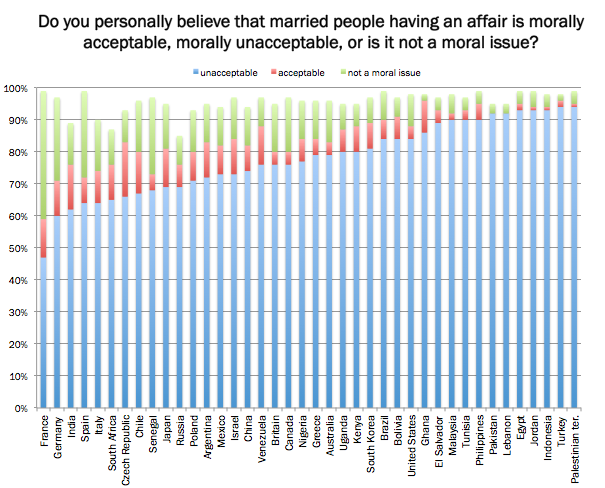
Catherine Rampell charts a finding from Pew’s report on morality around the globe:

France Affairs

Dylan Matthews captions:

Basically everyone thinks it’s not cool to cheat on your wife. The only country surveyed where a majority did say cheating is acceptable was France; there, about 47 percent disapproved, 12 percent approved, and 40 percent said it’s not a moral issue at all.

The Economist highlights the same report:

Americans are far more likely to disapprove of adultery than people in other rich nations, especially the French. They have grown more likely to frown at cheaters over the years—in contrast to their attitudes to gay sex, which have softened enormously. The data on international attitudes come from an interactive report released this week by the Pew Research Centre. It looks at how 40 countries judge the morality of controversial issues from abortion and premarital sex to contraception and divorce.

Jesus Became God, Or God Became Jesus?

A Book Clubber writes:

I just want to say how fascinating I’m finding Ehrman’s book. Can hardly wait for the discussion!

Another:

Dear Professor: The book is great. I love it. But I haven’t had much time to read, what with work and house hunting and 420 coming up here in Denver. I bet we’d all appreciate one more week to read about the Jesus transformation. It will make a more lively debate and we’d all be so impressed by your leniency.

with 41% of the book read …

Heh. Well I just had to absorb the Becker book in around 24 hours … so I’m a little behind myself. I plan to post my review of How Jesus Became God next week, and start the discussion with readers thereafter, so buy the book here if you still want to join. There’s still time. Another reader:

I don’t have an e-reader, so I bought the hardbound book1/2 finished – a good read. How do I join the book club? I want to play too!

You join simply by reading the book, in any form, and participating in the reader thread next week, if you like. Another:

I suggest you refer your readers to Harper Collins’ companion/response book, How God Became Jesus. bookclub-beagle-tr It sounds like you could benefit from reading it yourself, after your somewhat surprising admission that Ehrman’s book “may not be the most spiritually sustaining text for Holy Week.” Seeing that the only reason Ehrman has been noticed in the popular realm is for his (somewhat tired yet passed off as something new) arguments denying the truth of traditional Christianity, I wonder exactly what you thought the book would offer. That’s not to say that Ehrman’s work shouldn’t be recommended or discussed, only that a more interesting conversation might come from providing your audience with a more comprehensive understanding of the subject and the arguments on both sides.  After all, I imagine that for many of your readers, the assumption is that Ehrman, like Reza Aslan most recently, is offering some fresh insight, when in reality, as Father Robert Barron notes here, it’s a more of the same old same old.

We actually made a quick mention of the response book in a previous post, but many readers may have missed it, so here’s the link to purchase that book as well, if you’re interested. Its counterpoints will certainly come up in the discussion thread, but the primary focus will be Ehrman’s book.

Update from a reader, who gets into the Book Club spirit already:

You quote a reader: “his (somewhat tired yet passed off as something new) arguments denying the truth of traditional Christianity.” I think you should encourage such responders (on both sides, of course) to cite specific instances from the book that support their charges.

I myself did not get the impression that there was much if anything new in the book, but rather that the author learned much of what he presents from others in his undergraduate and graduate studies, twenty and thirty years ago, and well-known in historical circles for much longer, although bolstered in living memory by the discovery of the Dead Sea Scrolls and other artifacts. What did he pass off as something new?

That is, new to experts in the field. Your readers can speak for themselves as to whether the material is new to them or not. Speaking for myself, in 19 years of Sunday School classes, Sunday morning sermons, evening “Youth Services”, summertime Daily Vacation Bible School, and Thursday Release-Time Religious Education (one class for Protestants and one for Catholics – probably not done anymore since it seems illegal, but done in my high-school years), I had not heard a word of it. However, I had noticed some of the rather glaring biblical inconsistencies for myself, and reached the same general conclusion.

It seems to me that rarely does a year go by without some “new” book of religious apologetics/proselytism/propaganda. I wonder does the quoted reader apply the same criticism to them? I often walk past a church which has a signboard out front. A few days ago it carried this message:

DON’T BE FOOLED BY THE WORLD
JESUS IS THE ONLY TRUTH

That sums up religion in general to me. Adherence to it demands a rejection of objectivity and ignoring conflicting evidence. After all, such evidence is not new.

Another:

Some of your readers seem to assume that Ehrman is making the case against religion. I disagree. The question he is trying to answer is one I have puzzled over for a long time, and one that I assume that the most religious of people might puzzle over. Because the question is NOT how Jesus became God. The question is how his followers, and those who followed them, came to BELIEVE (a believer would say “came to REALIZE”) that he was God.

Of course, some will insist that God simply put the truth into their heads. But many will think that God does not work that way, and that he let the early Christians work it out for themselves – just as he did not create the world in seven earth-days, but enlisted the Big Bang to take care of part of it, and evolution to work out the part most relevant to us. I’m grateful to Ehrman for making the work of scholars on this question accessible to the rest of us.

My one, mild complaint is that it would have been useful to have seen the various steps in the progression tied to things that we’re going on in the world outside the Church. He does some but not much. Of course he can reasonably reply that it wasn’t his intention to write THAT book.

Another:

This reminds me of “Is an object holy because God loves it, or does God love it because it’s holy?” from your “Lecture FAIL” post, perhaps my favorite Dish video of all time …