Throwing The Pigskin In China

Christopher Beam spent time with a Chinese football team, the Dockers, and their American coach, Chris McLaurin:

[T]he greatest cultural gap between McLaurin and the team seemed to be the willingness to draw up every last bit of oneself and smash the person opposite. Size wasn’t a problem; the Dockers were a strapping bunch. They just weren’t willing to usetheir size. Part of it was fear of injury: In the Dockers’ first six months, seven players had been hurt, including Bobo, who had broken his leg at practice. But habit played a role, too. Life in China is plenty physical—just try riding the subway during rush hour—but you don’t often see kids rough-housing in the park. Figo had to get used to the idea of crushing another man. “The first time, I didn’t dare tackle,” he said. Fat Baby, too, was no natural destroyer. “You have to imagine the other guy is your enemy,” he told me. “It’s like in The Waterboy [the 1998 Adam Sandler movie], where you pretend they’re the person who bullied you.”

The Myth Of The Oversharing Parent

Researcher Meredith Ringel Morris found that new parents are too busy to post to Facebook:

After a child is born, Morris discovered, new mothers post less than half as often. When they do post, Screen Shot 2014-04-14 at 3.12.19 PM
fewer than 30 percent of the updates mention the baby by name early on, plummeting to not quite 10 percent by the end of the first year. Photos grow as a chunk of all postings, sure – but since new moms are so much less active on Facebook, it hardly matters. … If new moms don’t actually deluge the Internet with baby talk, why does it seem to so many of us that they do? Morris thinks algorithms explain some of it. Her research also found that viewers disproportionately “like” postings that mention new babies. This, she says, could result in Facebook ranking those postings more prominently in the News Feed, making mothers look more baby-obsessed.

I have another theory: It’s a perceptual quirk called a frequency illusion. Once we notice something that annoys or surprises or pleases us – or something that’s just novel – we tend to suddenly notice it more. We overweight its frequency in everyday life. For instance, if you’ve decided that fedoras are a ridiculous hipster fashion choice, even if they’re comparatively rare in everyday life, you’re more likely to notice them. And pretty soon you’re wondering, why is everyone wearing fedoras now?

(Photo by Sage Ross)

The Aftermath Of Iran’s Blog Crackdown

Iranian Blogs

A group of researchers studied the decline of “Blogestan,” the Iranian blogosphere:

Filtering hit Blogestan hard, modifying the diversity of voices within the Persian blogosphere. As one writer explained: “They showed me a stack of papers, each one a blog post that I had written, and they had highlighted portions and sections. After I was released, my blog in effect became my case file.” Reformist blogs are 17 times more likely to be filtered or removed than conservative blogs. In our sample, nearly half of the reformist blogs were filtered or removed in comparison to only 2.8 percent of conservative blogs. In addition, nearly all blogs hosted on the two popular platforms operating outside Iran, WordPress and Blogspot, are blocked. These conditions drove many prominent bloggers to alter or cease blogging, which transformed the blogging landscape. The closure of popular services such as BlogRolling and Google Reader disrupted the connections between bloggers. The loss of Google Reader was particularly significant because it had been a vital tool for circumventing the censorship of filtered blogs.

But there is another side to the story: The emergence of social networking sites (SNS) like Facebook is among  the most important causes for the erosion of Blogestan. Just because blogs have declined does not mean that online public expression has withered alongside it.

There Were Red Flags

The alleged Kansas shooter made no effort to conceal his hatred of Jews:

In a 2010 radio interview, Frazier Glenn Miller, the man suspected of killing three people Sunday at a Jewish community center and a Jewish retirement center in Kansas, said he was interested in the tea party, voiced support for then-Iranian President Mahmoud Ahmadinejad, and spoke approvingly of Ron Paul, the Texas Republican congressman and presidential candidate. In late April 2010, Miller, a former Ku Klux Klan Grand Dragon, was a guest on The David Pakman Show, a nationally syndicated left-of-center radio and television program. At the time, Miller was running for US Senate as an independent in his home state of Missouri with the slogan “It’s the Jews, Stupid,” and Pakman pressed Miller on his extreme views.

During the interview, Miller was unabashed about his anti-Semitic positions. When asked whether he thought the United States would be better off if Hitler had succeeded, Miller responded, “Absolutely, the whole world would…Hitler would have created a paradise on Earth, particularly for white people. But he would have been fair to other people as well.” He added, “Germans are blamed collectively because of the alleged so-called Holocaust.”

His views on gays were equally charming:

Miller regularly railed against the LGBT community. He told one interviewer that he sought “the creation of an all-white nation within the one million square miles of mother Dixie. We have no hope for Jew York City or San Fran-sissy-co and other areas that are dominated by Jews, perverts, and communists and non-white minorities and rectum-loving queers.”

In another interview, Miller was asked if he was “gay-friendly.” Wrong question, he told the interviewer. “If you think about what homosexuals do, if that doesn’t make you sick, you’re just as sick as they are,” Miller replied.

Mark Guarino notes that anti-Semitic violence has been on the decline in the US for some time:

The shooting comes at a time when incidents against Jews in the United States are dropping significantly. In a study released earlier this month, the Anti-Defamation League (ADL) reported a 19 percent decline in 2013 compared with the year before. This continues “a decade-long downward slide and [marks] one of the lowest levels of incidents reported by the Anti-Defamation League since it started keeping records in 1979,” the report says.

“The falling number of incidents targeting Jews is another indication of just how far we have come in finding full acceptance in society, and it is a reflection of how much progress our country has made in shunning bigotry and hatred,” added ADL National Director Abraham Foxman in the report.

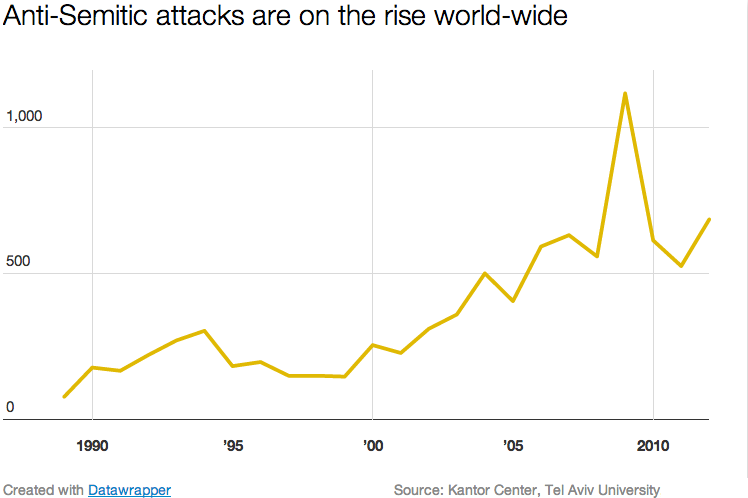
But Zack Beauchamp examines the global data, which paints a very different picture:

Screen_Shot_2014-04-14_at_11.42.56_AMThe most comprehensive data on worldwide anti-Semitism comes from Tel Aviv University. Its Kantor Center for the Study of Modern European Jewry annually tallies official reports of anti-Semitic violence, death threats, and vandalism, which it publishes in an annual report. From 1989 to 2012, when the last report was published, the data shows a clear and consistent rise in anti-Semitic violence.

Most of the violence was, unsurprisingly, recorded in places with high Jewish populations. Thirty percent of the attacks Kantor recorded in 2012 took place in France, which houses the world’s third-largest Jewish population after Israel and the United States. Europe also has large Muslim immigrant populations, many of whom are poor and socially isolated. This “globalization of populations,” according to Ohio State sociologist William Brustein, explains the recent upsurge in European anti-Semitic violence.

Seinfeld Now: A Comedy About Caste

I have to say that the brutal honesty of this review of Jerry Seinfeld’s new comedy schtick – talking to fellow celebrities over coffee – took my breath away. Money quote:

Vanished is the “Seinfeld” that applied everyman scrutiny to everyday subjects: Can gifts be “regifted”? Why do dentists talk to you while opening your mouth? Instead, we watch pairs of rich guys chatting about the gilded joys of their lives and careers and cars, about the sealed-off world they inhabit and we don’t. As with watching royal weddings, we are supposed to bask in the reflected glow, not covet what they have.

The Alec Baldwin episode has major hathos all over it:

In that episode, the two men debate who worked harder to get where they are; speak of how much Mr. Baldwin admires Mr. Seinfeld’s home; make plans that if one of them produces the Oscars, the other should host it. But the spell of self-congratulation is briefly broken when the server offers Mr. Baldwin a sandwich with bread he doesn’t like.

Under taunting from Mr. Baldwin, the server relents: “What do you want? We’ll give you what we have.” And this Mr. Baldwin repeats with a snicker, speaking not to the server but to Mr. Seinfeld and us, mocking the help, laughing at and not with. Later, Mr. Baldwin condescends to the woman some more: “You know what I need from you if you don’t mind, if it’s O.K.? May I have a fork, and some napkins?”

That moment would have been almost unimaginable 20 years ago on “Seinfeld,” where the characters were self-absorbed more than entitled. As the men prepare to go, Mr. Baldwin says, “You realize we have to leave Rebecca a $1,000 tip.” This is what can pass for politeness among masters of the universe: humiliate, then compensate.

Ouch.

Update from several readers:

That NYT review is terrible. I hate defending anything involving Alec Baldwin, but watch his exchange with that waitress. He’s being playful. He’s also the one quickly relenting to the restaurant’s silly “no substituting bread rule.” Other edited-in comments are clearly after she’s left.

As for the current Seinfeld not reminding the reviewer of 90’s sitcom Seinfeld, the current Seinfeld is a 1) real human and 2) celebrity worth hundreds of millions of dollars. The everyday annoyances Real Jerry deals with are exactly the ones that are pissing of the reviewer, since Real Jerry’s annoyances come mainly from his real life. She’d rather see Fake Jerry talk about shoelaces with Chris Rock?

Another:

Admittedly, boorish behavior is in the eyes and ears of the beholder and you folks are free to call Mr. Baldwin an asshole. And maybe you’re right. But I saw the clip in question, and IMO he was hardly disrespectful to the waitress. I think you’re being unfair, but it’s a perception thing, I guess.

I’ll agree that the whole concept of Seinfeld’s new “program” leaves a lot to be desired. I’ve seen most of them and, frankly, the only one that doesn’t seem forced – the only one that seems authentic and “real” – is the one with Mr. Baldwin. The rest are cloying and stagey. But the one with Mr. Baldwin is genuinely funny and I implore you to take a look at him doing Burt Lancaster and Kirk Douglas. It’s funny. The man is charming – you can’t take that away from him.

Another recommends something else to download:

I have to say I was pretty bemused to see Seinfeld start up this little show.  In his own words the show is just him talking with comedians. But compare his highly produced show oozing with wealth and privilege to Marc Maron’s WTF podcast. Marc is able to get into deep, real conversations with comedians that blow one’s mind. I started listening to it because I wanted to hear some of the people that he speaks to. Now I listen because of the conversation itself. He is a master of openness and of getting other people to open up to him.  No matter how many fancy cars Seinfeld drives around, he will never be able to match this.

Why Aren’t Gay Men On The Pill? Ctd

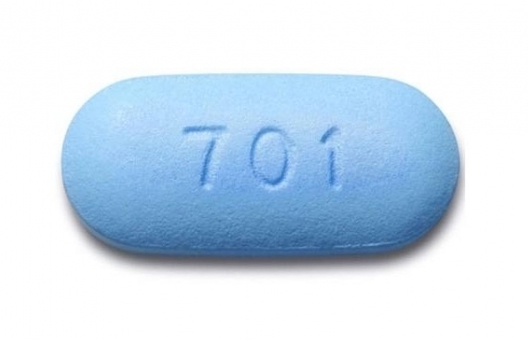
When asked about the risks of Truvada, Dave Cullen answered in three quick parts: healthcare costs (discussed by readers here), side effects, and people not taking the drug consistently:

A New Yorker piece backs up Cullen on the side effects:

Taking Truvada to prevent H.I.V. comes with very few risks. In the N.I.H. study, one in two hundred people had to temporarily go off the pill owing to kidney issues, but even those people were able to resume treatment after a couple of weeks. While bone-density loss occasionally occurs in Truvada takers who are already infected with the virus, no significant bone issues have emerged in the PrEP studies. And though about one in ten PrEP takers suffer from nausea at the onset of treatment, it usually dissipates after a couple of weeks. According to the U.N. panel’s Karim, Truvada’s side-effects profile is “terrific,” and Grant said that common daily medications like aspirin and birth control, as well as drugs to control blood pressure and cholesterol, are all arguably more toxic than Truvada.

A reader is still worried about the indirect risks of PrEP:

I’m sympathetic to your position; I will probably take Truvada when I’m at Bear Pride in Chicago. I truvadaplan on using condoms anyway, but … you know. Alcohol and all that. Sometimes you don’t pay attention.

But for the record, I do think the points that those concerned about Truvada raise regarding substituting it for a general sexual health strategy are reasonable in some ways. Case-in-point: gonorrhea. I can tell you right now, I am much, much more afraid of drug-resistant gonorrhea than I am of HIV.

Another asks:

One criticism I’ve read of Truvada is that if lots of gay men start taking it, but even a small subset of them do not take it as directed, i.e. once a day, that it could lead to different resistant strains and a strengthening of the virus? Is that at all true?

Not really, as Rich Juzwiak recently reported:

[Jim Pickett, the director of advocacy for the AIDS Foundation of Chicago] told me he believes drug resistance is “something to be watchful for,” but not a huge concern of his for a few reasons.

One is that resistance is common in the world of HIV medications. He said he’s HIV positive himself, and has been on various meds since 1997, building up resistance to “a whole bunch of drugs over the years.” And because maintaining a Truvada prescription requires a comprehensive HIV test every three months, Pickett suggested that there would be opportunity to keep a mutant strain of the virus contained:

And if you were going in for your refill and it was found out that you were actually positive, they could immediately determine what kind of strain of HIV you have. If it has any kind of genetic alterations due to it being exposed to a certain drug, suboptimal levels of drug, that could be determined. It could also be determined that you don’t have any drug in your system. And if you don’t have drug in your system, you can’t be resistant.

You also can’t be resistant if you don’t become HIV positive. People get confused about that a little bit, like the drug itself can create resistance. Well, the drug has to be at suboptimal levels and come into contact with HIV. If you don’t come into contact with HIV, no resistance. If you come into contact with HIV and you don’t have any drug in your system, no resistance. It’s just that suboptimal part. But it’s a harder thing to happen than I think people think about.

Another reader notes an obvious way to lower such risks:

I wish the discussion would remember that many gay guys – I think I once heard Dan Savage say as many as 30 percent – spend their entire lives without having anal sex, and that a lot are also in situations where they’re already at extremely low risk of contracting HIV, such as men who aren’t as active sexually or prefer practices that don’t involve intercourse. While the current safe sex rhetoric is obsessed around condoms, it is so because it is also obsessed around equating male homosexuality with anal intercourse, and sexual expression shouldn’t just be about one act.

Another risk-averse reader wrings his hands:

I’m a 38-year-old gay man, young enough that none of my friends died of AIDS but old enough that I have spent virtually my entire conscious life worrying that I would die from it. I’m a rarity: a fully condom-compliant gay man. I’ve never had difficulty using them and have never had sex without them, except with my husband.

Plus, I’ve always tried to avoid having sex with guys who don’t use condoms regularly for casual sex. Avoiding barebackers is a rule that has served me well; I’ve never had an STD, despite a huge number of partners.

PrEP – while undeniably a good thing – is very disorienting. Do I avoid barebackers who use PrEP? Just continue using condoms with them? Start taking PreP myself and forgo condoms altogether? What a wonderful, frightening thought that is.

I know I should be celebrating. Instead I’m still worrying … about a new set of issues.

Those two adjectives – “wonderful” and “frightening” – say it all. Fear is a terribly difficult thing to leave behind, especially when you have lived your entire life in its shadow.

Your Tuesday Cry

A far-too-poignant detail from the NYT this morning on the victims of an anti-Semitic hate-monger:

William L. Corporon was a longtime family doctor, but to his family, he was Popeye, a nickname bestowed by a grandson, Reat Underwood. On Sunday, it was Popeye who was drafted to take Reat to audition for KC SuperStar, a singing competition for high school students in the Kansas City area. A member of church and school choirs and an actor in summer theater productions in the park, Reat had wanted to try out for years. Now, as a 14-year-old high school freshman, he was finally old enough.

Dressed in a coat and tie, he had prepared a song called “You’re Going to Miss Me When I’m Gone,” which he sang for his mother on Sunday. She kissed him goodbye. Then he jumped into his grandfather’s truck.

The View From Your Window Contest: Winner #200

vfyw_4-12

A reader writes:

I knew immediately upon seeing this image that it was not Seattle … that is all I know.

Another:

Reminds me of Taxco, Mexico – a great town with real Old World atmosphere, in the mountains southwest of Mexico City.

Another gets the right continent:

Eleusina, Greece. Shot in the dark, based on the Mediterranean look and Greek letters in the bottom of the picture, but no sleuthing beyond that.

Another:

Ruling out Modica, Sicily because you’ve already done that for the contest (I sent it in), so going with Scicli – but it could be Ragusa, or almost any town in the Val di Noto region.

Another:

The landscape and architecture in the photo looks Sicilian to me, but I can’t nail down the exact combination of mountains, palm trees and buildings in the photo. I hope Palermo, Italy is close.

Another:

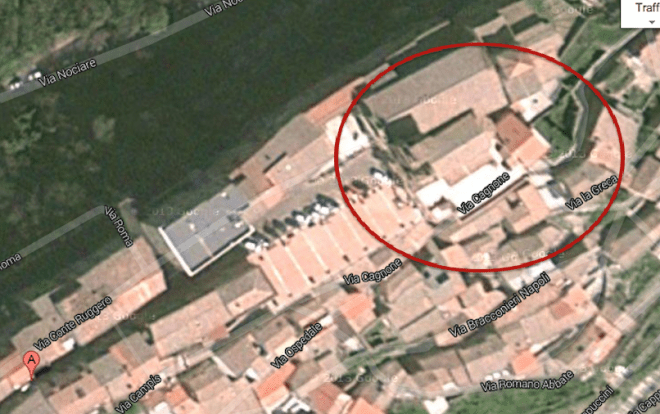
This week I’m going with my first reaction, which was “Antonioni, L’Avventura.” Which means Sicily. It reminds me of the town in that movie, Troina. As for the window, I’m going to guess some window in the churchy complex at the Piazza at the end of Via Conte Ruggero, looking at another part of the churchy complex. Somewhere in here maybe:
sicily

Another thought Noto, and another the Piazza Spadaro. Another reader:

Wow, this was a toughie and I’m sure I am not even close, but I’d gather that the building are Italian, as is the church (I recognize St. John, Mark (?)) but there’s no other identification other than the granite hillside. I spent some time looking around various places – Cinque Terra, Piemonte, etc. but to no avail. It’s tax-time crunch and I’m close to finishing mine up but instead took a mental health break instead. Did I get close?

Italy is close, but other readers got closer:

This looks a whole hell of a lot like Montenegro. I can’t pinpoint where it is, but I’ll go with Petrovac, based upon nothing more than a hunch.

Another inches north:

OK, it might not be Budva, Montenegro, but I visited Budva & Cotor in 2001 and the architecture and the dry steep hills of this week’s contest really do remind me of the Dalmatian coast. So since Budva is bigger than Cotor, I’m going with Budva.

Another nails the right country:

Looks like somewhere in the Mediterranean. Our SWAG [scientific wild-ass guess] is Split, Croatia.

Another:

I honeymooned through the islands of Croatia (absolutely beautiful). This looks vaguely familiar. I’m going with the island of Hvar.

Almost. The very first entry we received on Saturday got the right city:

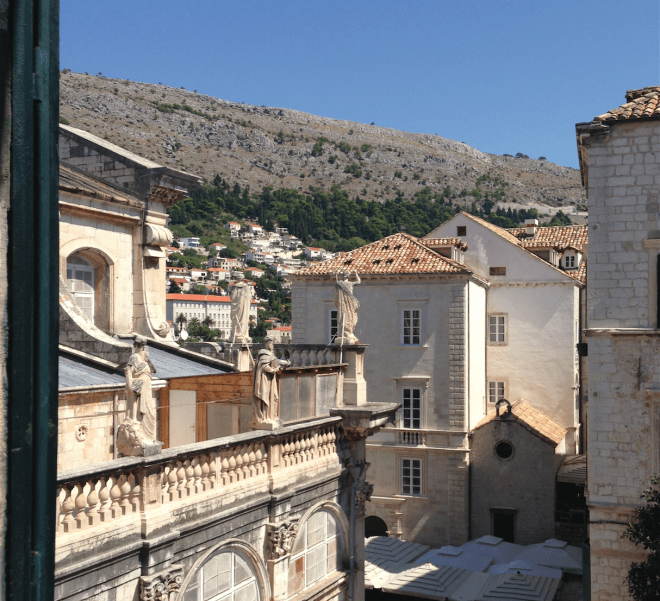
The honey colored tiles give it away: Dubrovnik, Croatia.

More than 80 readers correctly guessed Dubrovnik. To put those in context, here is a map – from OpenHeatMap, developed by Dishhead Pete Warden – plotting all of the entries this week (zoom in by double-clicking an area of interest, or drag your cursor up and down the slide):

This embed is invalid

One reader’s quest for a VFYWC victory:

GODDAMN YOU GOOGLE MAPS FOR PICKING TODAY TO DO SOME ASSHOLE UPGRADE!!

It’s a building facing the St. Blasius Church in Dubrovnik, Croatia. If Google Maps wasn’t being SUCH A DICK I’d have an exact address for you. Please stand by.

@($*&^!%%## GOOGLE MAPS!!

9 minutes later:

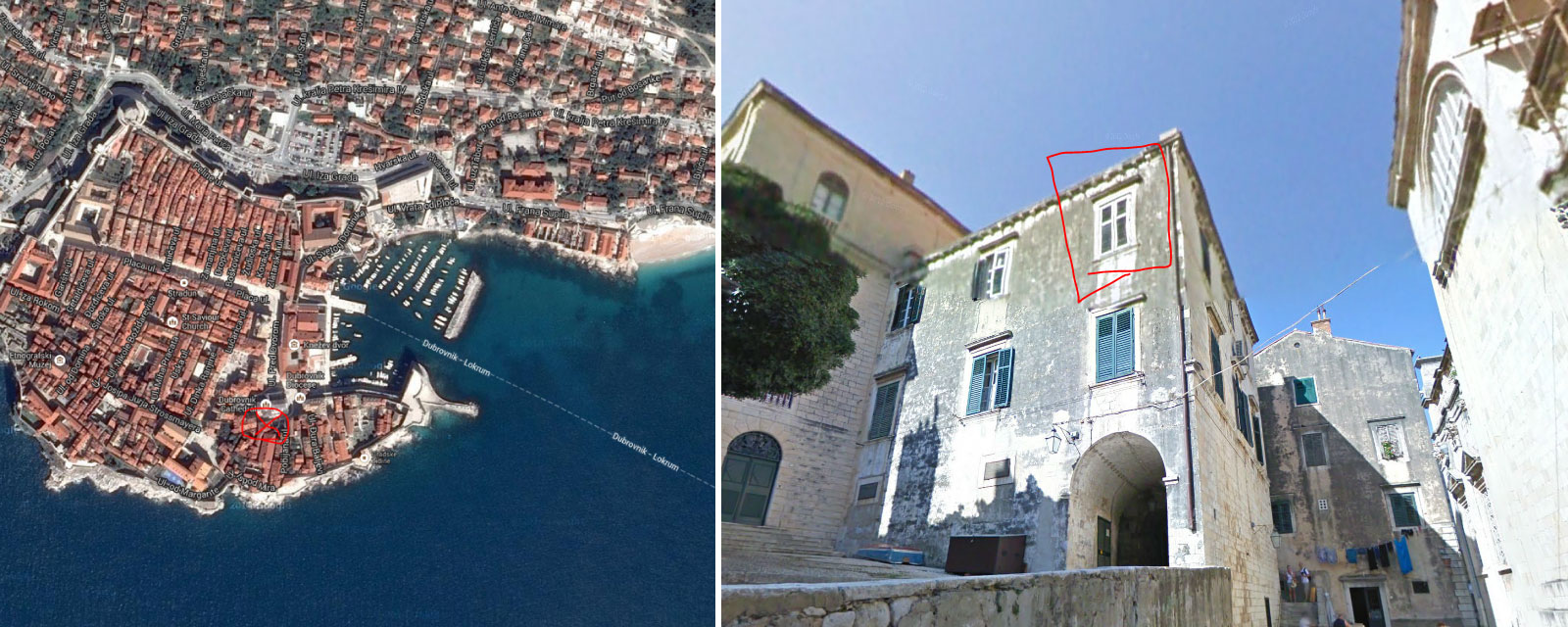
Ul. od Pustijerne, second floor with the long shutters, facing Dubrovnik Cathedral, Dubrovnik, Croatia. Google hates this place.  That’s as close as I can get.

17 minutes later, the right building:

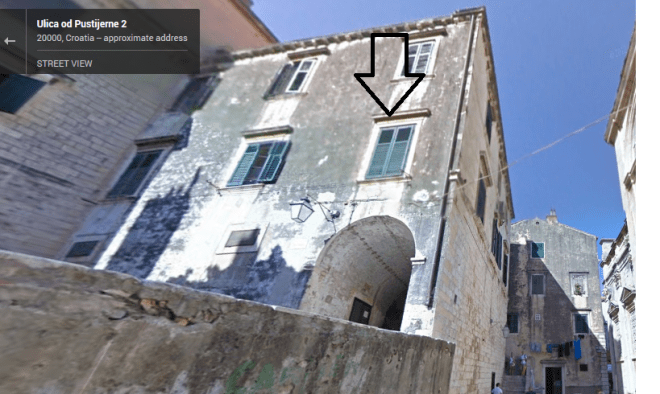
Based on the reciprocal street view, I think this is the window:
VFYW

Or maybe the one above it. But I think it’s the one with the blue shutters, based on the photo itself with the edge of blue shutter and the height relative to the building across the street.

Google Maps doesn’t want to give this place an exact street number (thought it best-guesstimates “Ulica od Pustijerne 2,” where there’s apparently a bed-and-breakfasty sort of place called “Bedroom in the Centre of Old Town,” but I don’t think that’s this room. It’s close, but not it. But that’s as close as I can get right now: East-facing window on Ulica od Pustijerne 2, just across the street from Dubrovnik Cathedral.

VFYW2

Oh. And I found it by Googling the ass out of St. Jerome Statues. Because Catholic Saint Fetish. Zing!

Six hours and 46 minutes later, the right address:

Okay, well, I had to actually go outside and breathe some fresh air and not obsess about this any more, but having finally ducked back inside to avoid a calamitous thunderstorm I was able to finally put a name on this place. Old Palace Apartments, Ulica Ilije Sarake 2 20000, Dubrovnik. Here’s a Google Image I’m assuming was taken from the apartment just south of the one the VFYW was taken from. I’m sure I’m way, way too late, but this is the exact spot, huzzah!

Missed the window though. Another had less difficulty:

I just put “european roof statues” in Google and it came up pretty quickly.

A different detail proved important for this reader:

While Dubrovnik is a striking city, what really clued me in was the hills in the background.  Nothing else looks quite like them anywhere else I’ve been, and they tower over the town.

Nearly every contestant who’s been to Dubrovnik made note of how much they enjoyed it, including several who honeymooned there. This one savors a memory:

We went last year, after a stressful season when we needed to flee the country and chill out. Amazing place. I’m 99% sure that this was taken inside the Old City near the gate where we entered every day to wander and stare and eventually end up at Cafe Buza. We would prop up our feet on the rails and drink over priced bottles of beer while staring at the Adriatic. That place baked a lot of the anxiety out of both of us. Sadly I could not find any photos from this angle, but here’s a pic (I think) of the building in the left foreground, from another angle:
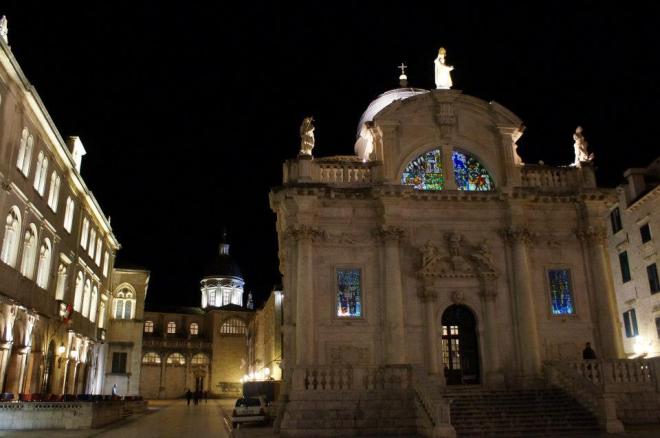
old_town_at_night

Thank you for making me review my pics from the trip! It was never a place on my “to do” list, but I left part of my heart there. The people are lovely, the landscape is amazing. Nerdy points of interest: Game of Thrones is partly shot here, as was some Dr Who (11th Dr).

Many readers noted the Game Of Thrones connection:

Ohh, I know this one: King’s Landing, Westeros, the new top destination for weddings! Or maybe just the location that stands for it in filming. The distinctive statues on top the Cathedral, marked in the contest picture as well as in the Dubrovnik panorama attached, give it away.
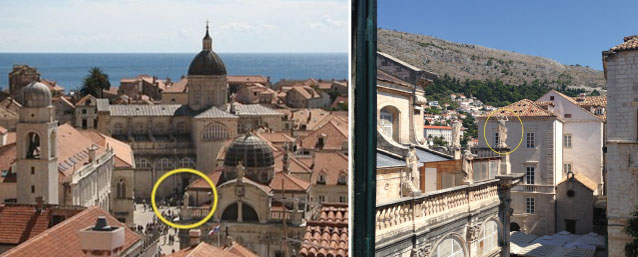
22079-dubrovnik-cathedral

I do not have the patience to look for the exact window, so I will doubtlessly lose to the hundreds of other Game of Thrones fans who take the trouble to identify it.

Here’s Dubrovnik in its Thrones CGI disguise:
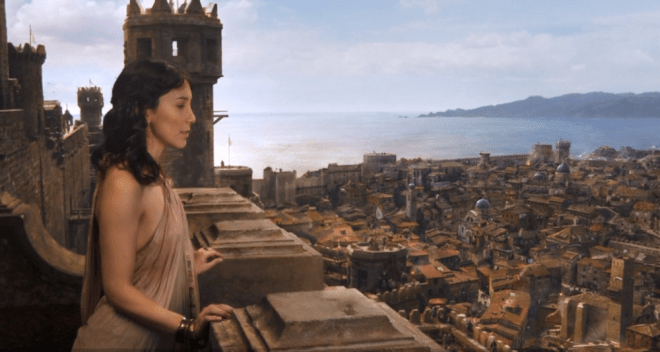
kings-landing

The city has seen real conflict as well:

I have never been Croatia but my parents were there many years ago, just after the war and things had settled down. They have many photos of bombed-out hotels along the waterfront. Thankfully both sides involved in the war were smart enough to spare Dubrovnik. My parents proclaimed it the most beautiful place they had ever visited. Hopefully I will have the opportunity to visit some day myself. Thanks for another great contest.

Another reader, like many this week, nails the right window:
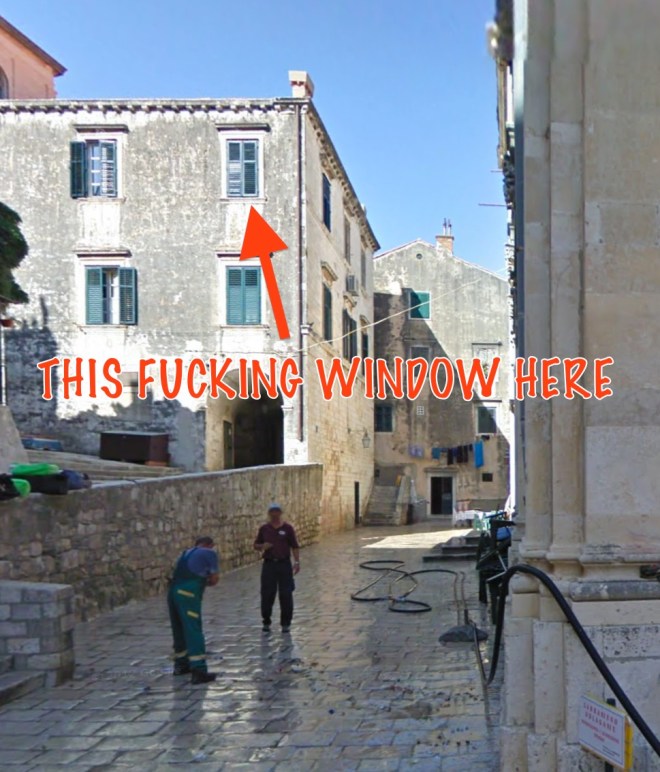
DubrovnikVFYW

It took me six hours to get this, using old-fashioned cyber elbow grease and shoe leather, and it is only now, as I primp my entry for the judges’ eyes, that I notice the “Konoba Amoret” written on those umbrellas. This means that you’ll again be deluged by typo-ridden winning entries from casual viffywers, and that the most I can reasonably expect to gain from my efforts is to see another bean slide across on The Great Abacus Of Whose Turn It Is To Win.

The Great Doug Chini chimes in:
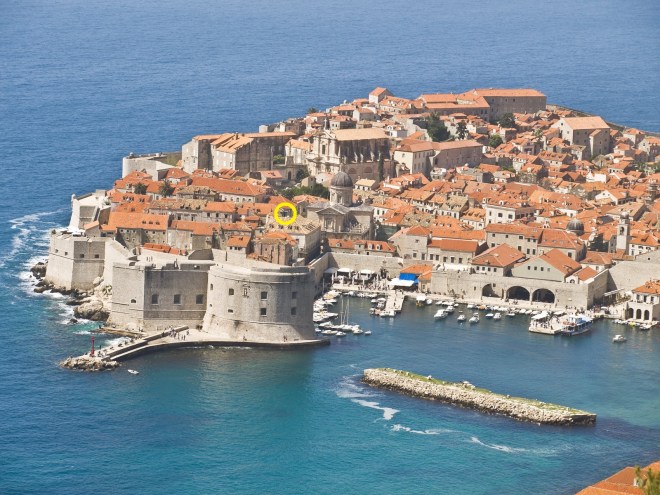
VFYW Dubrovnik Actual Window Aerial Marked - Copy

This 200th view may not be the hardest, but it sure is a pretty one. Based on the Mediterranean architecture and tight field of view I thought that it might produce only a handful of winning entries. But when I found the location I realized that, as with VFYW #170, the town’s fame means that there will be a ton of readers who got there far faster than I did. Serves me right, I suppose, for never hopping across the Adriatic when I lived in Italy.

This week’s view was shot inside the walls of the old city of Dubrovnik, Croatia. More precisely, it was shot from inside a room on the top floor of the Old Palace Apartments adjacent to the Cathedral of the Assumption and looks east, northeast along a heading of 58.60 degrees.

VFYW-Dubrovnik-Actual-Window-Close-Marked---Copy

Many first-time contestants guessed the same window, including:

I did it! IdiditIdiditIdidit!

Another first-timer:

I am 100% sure this is from the old city of Dubrovnik, Croatia. The jewel of the Adriatic. My wife and I spent some of our honeymoon to this lovely city, and even named our son after it’s patron saint (Saint Blaise, patron saint of throat maladies and wild animals). Here’s a VFYW from our honeymoon:

CIMG0583

The view is looking east, with the Cathedral on the left. I don’t know the name of the building, or what it’s purpose is. I assume it is a sobe, which is a room in a private residence rented out to tourists (this is a far better experience than hotels). My wife and I ate octopus salad under the tents in the square at the bottom center of your picture.

I’m pretty excited.  This is the first time I have even guessed the correct area of the world, let alone gotten close.  And this is the first time sending anything to you.  I have been a reader and subscriber for a couple of months now. Thank you for bringing back some lovely memories.

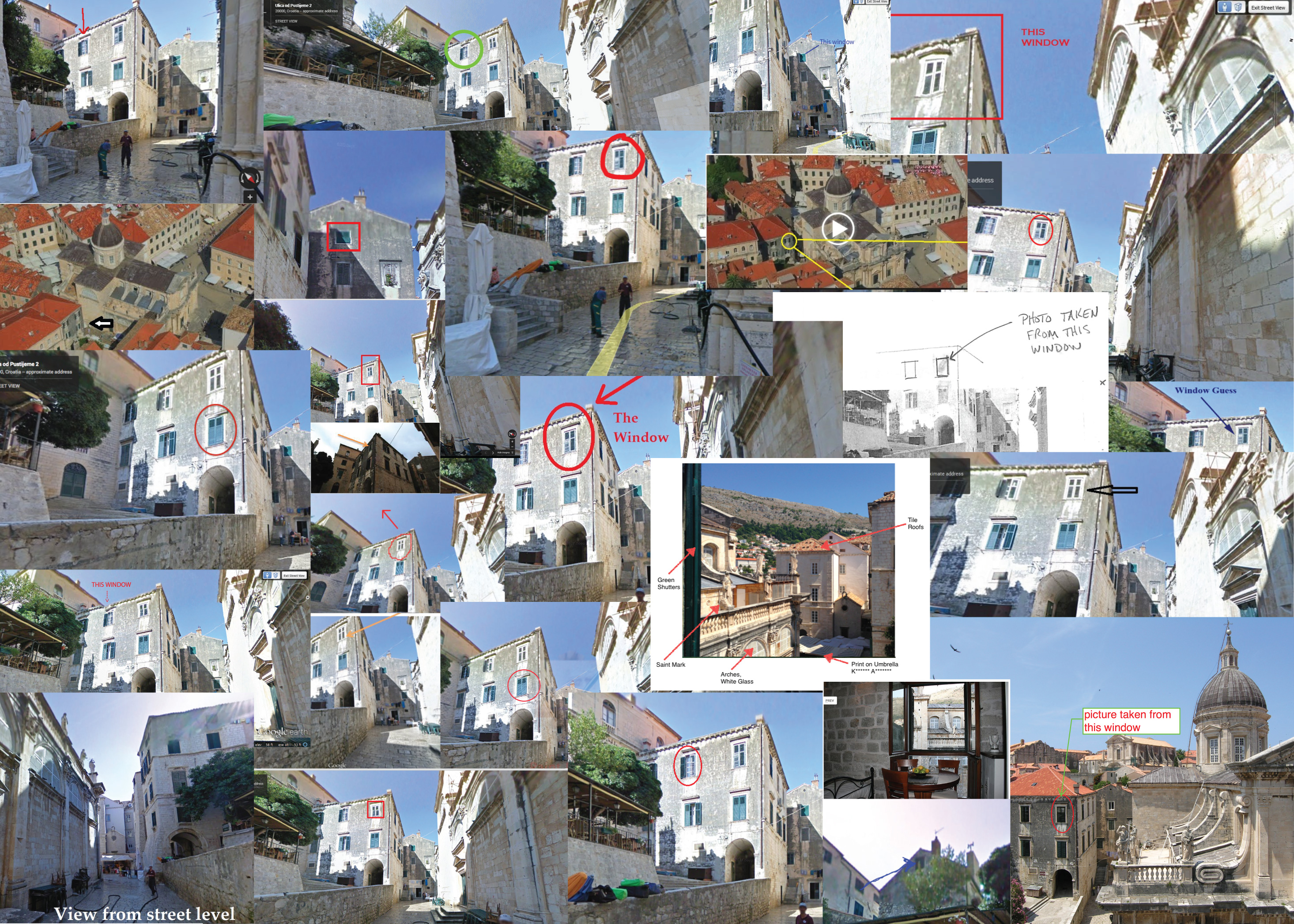
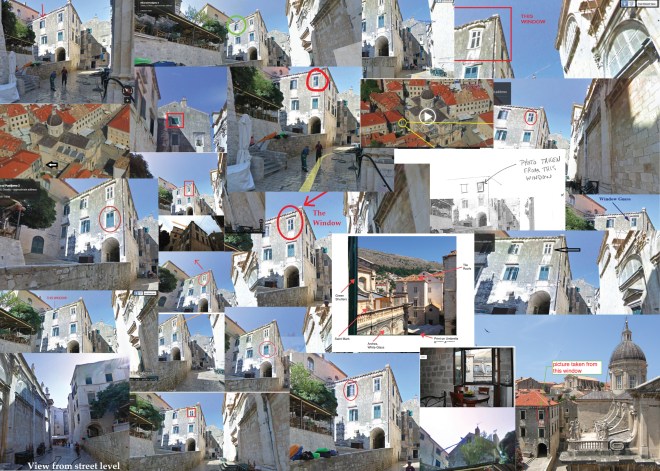
That reader, along with the many readers represented in this composite image, got the right window:
VFYWC-200-Guess-Collage

But how to determine the winner? One contestant stood out this week: a veteran of 17 contests who has correctly guessed multiple times, including some difficult views, without yet winning:

This week’s contest is brought to you by Dubrovnik Croatia. Starting with the satellite dish, we narrowed it down by the Mediterranean setting and the church and eventually ended up with Dubrovnik.  From there a quick Google Map search led to the Dubrovnik Cathedral and the correct building:

dubrovnik1

Thanks for sticking with the contest and congrats! From the photo’s owner, for the record:

Wow that’s so cool, what an honor to be chosen for the contest! I’m a long-time Dishhead, quit my job and moved to Europe last spring. Croatia is beautiful, Dubrovnik especially so. This is from the window of the apartment we were living in at the time in old town Dubrovnik behind the old cathedral. The address is: Ilije Sarake 2, 20000 Dubrovnik, Croatia. It was taken on Sunday, September 1st at 12:27 pm.

The apartment is on the second (top) floor of the building, just behind the Old Cathedral which is a big landmark in Dubrovnik. The window faces out toward the East, and the direction of the photo is pointing sort of North East, toward the harbor (which you can’t see in my photo since there’s a building in the way), with the hills in the background. Here’s a marked up screen shot of the Google Maps satellite view:

Dubrovnik_Zabriskie

(Archive: Text|Gallery)

Is A Russian Annexation Now Inevitable?

Well: it doesn’t take a genius to observe the ballet now being orchestrated by the Kremlin to justify an invasion in Eastern Ukraine, does it? The parallels with Crimea are almost perfect. Along with the cynicism behind them. Bershidsky observes the brazenness with which the Russian government is now openly meddling in the region, with sinister masked men strutting around with impunity. In this war of nerves, Putin is obviously winning, and Kiev is badly behind the ball:

The anti-Kiev forces include heavily armed paramilitaries. Their unmarked uniforms are different from those worn by Russian occupying troops in Crimea last month, but the forces appear well-organized, and in numerous videos of the attacks they do not sound Ukrainian. In fact, they often freely admit that they are Russian. In one video, the man assuming command of local policemen in Gorlovka says he is a lieutenant colonel in the Russian army, and in Slavyansk, the commander of the group that seized the mayor’s office told a reporter for Echo Moskvy radio that he was an entrepreneur from a Moscow suburb.

Although Moscow has not openly admitted that Russians are taking part in inciting the eastern Ukraine protests, they clearly are, whether in an official capacity or as volunteers. And they haven’t been ordered to keep their mouths shut, or have been lax about following their orders.

Putin is huffing his own chauvinism, and you don’t unleash that force in Russia and maintain control over it for long. David Patrikarakos is on the scene in Sloviansk:

These people were entirely different to those I had met in Donetsk and Luhansk, the other Ukranian cities that have recently become sites of pro-Russian violence.

The armed men that form the “self-defense” units here are not just militia carrying bats; they are undoubtedly professionally trained, and though they wear no military insignias, they are clearly soldiers. They carry automatic weapons and wear full army fatigues. They are professional, organized, and ready to fight. …

We are now in a new, and dangerous, phase in this crisis. The previous trouble spots of Luhansk and Donetesk are major cities in Eastern Ukraine, with more organized pro-Russia factions. That the conflict is spreading to small, unimportant towns like Sloviansk is indicative that pro-Russia activism has taken root in the heartlands of the region.

Maria Snegovaya looks at polling contradicting the claim that these uprisings enjoy significant popular support:

According to a survey by the Kyiv International Institute of Sociology, a majority of Ukrainians—in all regions—condemn the deployment of Russian troops in Ukraine (93 percent of people in the west and center held this opinion, 73 percent in the South, and 68 percent in the East). A study by the International Republican Institute (IRI) found that Russian-speaking Ukrainians in all regions do not experience significant infringement of their rights and actively oppose Russia sending troops to Ukraine to protect them (67 percent in the south and 61 percent in east of Ukraine). Similarly, the majority of respondents in all regions believe the Crimean referendum was a threat to Ukraine’s integrity, support Ukraine’s independence, and the autonomous status of Crimea within Ukrainian borders; 64 percent of Ukrainians support a unitary Ukrainian state, and only 14 percent prefer federalization—a plan to give greater authority to the regions of Ukraine. (Russian media presents a very different picture.) …

Moreover, Putin has fostered pro-European sentiment across all of Ukraine. As a result of Russian aggression, the support for European integration rose by 10 percent to 52 percent from February to March 2014. (It remained constant at 40 percent throughout all of 2013.) Likewise, the number of people supporting participation in Russia’s Custom Union dramatically decreased.

Finally, Motyl points out that Russia’s meddling in Ukraine makes it a state sponsor of terrorism according to US law:

There is overwhelming evidence of Russia’s direct and indirect involvement in the violence that rocked several eastern Ukrainian cities on April 12–13. Russian intelligence agents and spetsnaz special forces are directly involved; the weapons and uniforms worn by the terrorists are of Russian origin (a point made by the US ambassador to Kyiv, Geoffrey Pyatt); and the assaults on government buildings in Slavyansk, Mariupol, Makiivka, Kharkiv, Yenakievo, Druzhkivka, Horlivka, Krasny Lyman, and Kramatorsk were clearly coordinated by Russian intelligence. …

Does the behavior of the pro-Russian forces in eastern Ukraine involve “premeditated, politically motivated violence perpetrated against non-combatant targets”? Obviously. Does this violence involve “citizens or the territory of more than one country”? Yes, it does. The violence therefore qualifies as international terrorism, and its perpetrators are obviously “terrorist groups.” QED.

The latest Dish on eastern Ukraine here.

Muscle Beyond Russia’s Means?

Daniel Gross points out that Putin’s Ukraine adventure could end up being very costly for Russia:

In 2013, Russia’s economy grew at a meager 1.3 percent rate, down sharply from 3.4 percent in 2012. This year is likely to be no better. In its world Outlook issued [last] week, the International Monetary Fund downgraded its projection for Russian economic growth in 2014, blaming “the lack of more comprehensive structural reforms [that] has led to the erosion in businesses’ and consumers’ confidence.”

But the Crimea situation is making matters much worse.

The World Bank now projects that given a “limited and short-lived impact of the Crimea crisis,” growth could fall to 1.1 percent in 2014. Should things get messier, however, the World Bank warns that Russia’s economy could shrink by 1.8 percent in 2014. Russian officials, the designated cheerleaders for Putin, are even more pessimistic. According to Reuters, Andrei Klepach, the deputy economy minister, now says Russia’s economy could grow at a rate as low as .5 percent in 2014—perilously close to flatlining. “The sheer market uncertainty has brought down Russian expected growth this year from 2.5 percent to .5 percent,” said Anders Aslund, senior fellow at the Peterson Institute for International Economics in Washington, D.C. “That is, the Putin aggression against Crimea and Ukraine cost two percent of Gross Domestic Product. (And with a GDP of about $2 trillion, that two percent adds up to $40 billion.)

I wish I could feel confident that the obvious economic disadvantages of re-starting the Russian empire would outweigh the psychic and political boon the new chauvinism must be for Putin. Maybe it will. But what’s motivating the Russian government right now is obviously not a cold-blooded assessment of national economic interests. And there is nothing ever cold-blooded about Russian nationalism.