“This Is God’s Plant”

Matt Melema finds that evangelicals are starting to come around on marijuana:

No one has done a poll of where evangelicals in particular stand on pot, but talking to a dozen or so of them makes me think that the feelings of young evangelicals are shifting as fast as many others of their generation. Given the history of churches decrying marijuana as a “demon weed” which could threaten society, the new attitude represents a generational divide.

weeed1.jpgAnd, increasingly, churches and leading Christian groups aren’t trying to stop this. In the 2006 election, Focus on the Family, then led by culture war veteran James Dobson, was a major force in the anti-marijuana campaign, making large donations and publicly opposing it. By 2012, the younger Jim Daly had replaced Dobson, and Focus mostly stood to the side during the election, contributing a mere $25,000.

Daly has started building relationships with everyone from progressive newspapers to gay activists to Bono. This new approach is reflected in his attitude toward marijuana. He is against legalizing recreational marijuana. But he may be more open toward medical marijuana, remarking that there could be “some medical benefits derived from it.”

What I found most striking in the piece was this from a profile of the Stanleys in OnFaith:

“Satan didn’t create this plant,” says Jesse [Stanley]. “Satan doesn’t create anything. This is God’s plant. And God is moving in the hearts of men and women and children around the world about this plant in ways that I never would’ve imagined five years ago.”

What Stanley is referring to is the potential of the plant to alleviate pain and suffering in ways no prescription drug can. And I do think that the experience of medical marijuana has shifted this debate perhaps more deeply than we truly understand. If you have watched marijuana keep another human being alive and nourished in the worst throes of AIDS, as I have, and then watched them get their life back, it changes you. If you have ever met a child with seizures who, thanks to this plant, can begin to construct a calmer, saner life, it will affect you deeply. To call a plant that can do this a “demon weed” simply becomes nonsensical.

But what’s interesting is how this discovery also leads inexorably to a different approach to responsible, recreational marijuana use.

There is a reason the plant has, throughout the aeons of human history, been related to religion and spirituality. There’s a reason that it’s a sacrament in Rastafarianism. Countless people testify to spiritual insights, intellectual breakthroughs and emotional healing through use of the plant. For many, it works on the human brain very differently than alcohol. For some, it allows for calmer thought, or a heightened aesthetic sense, or just relief from the ordeal of consciousness that speaks to the soul more deeply than many other drugs, barring, of course, other psychotropic, like psilocybin or Ketamine. Of course, this is not a substitute for prayer, or meditation, or doctrine. But it can jog people toward a deeper appreciation of the world, its beauty and its goodness. It acts as a cultural check on the frantic, over-sharing, constantly-updating, overwhelmed life so many of us now share. It has a religious and spiritual aspect that cannot be denied – even as it has been smothered by Cheech and Chong and Seth Rogen (peace be upon him).

It will indeed be a marvel if members of organized religion begin to shift their attitudes to this drug. But, the more you think about it, it shouldn’t surprise. We may well be under-estimating the cultural impact of widespread and legal marijuana use. The human mind is a beautiful thing. And when it unfolds a little, a little more may be possible for the enrichment of our lives

The Sticker-Price On Obamacare Goes Down

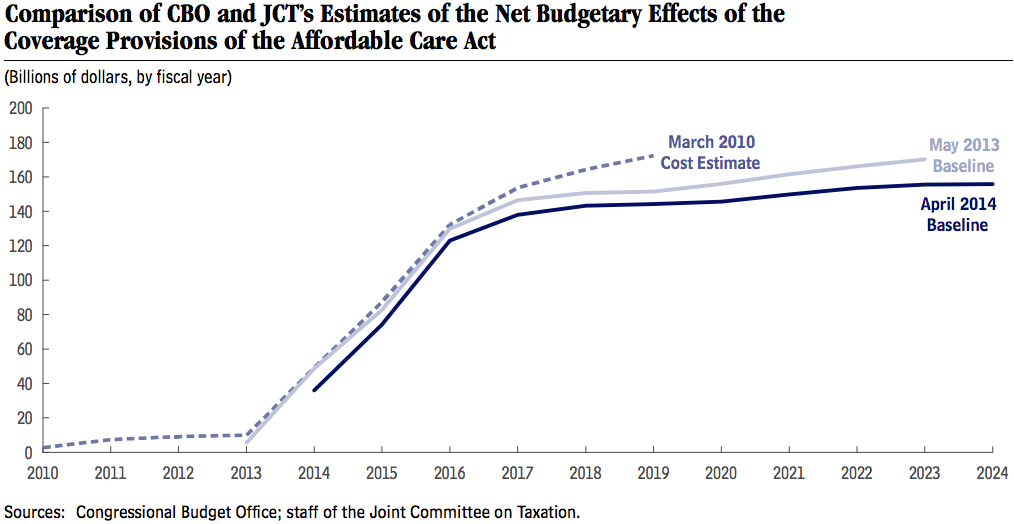
Yesterday, the CBO estimated (pdf) that the ACA will be cheaper than originally projected:

Obamacare Cost

Cohn explains why costs have decreased:

The higher the premiums, the more expensive the subsidies. And that’s where the law has, so far, outperformed expectations. Insurers are offering plans with lower premiums than CBO and other experts had predicted. As a result, the federal government is on the hook for less financial assistance.

Better still, the CBO says that it doesn’t expect across-the-board premium spikes next year, as the law’s critics and even some insurance company officials have speculated would happen. Of course, the CBO could be totally wrong about that. And even if it’s not wrong about what’s likely to happen to premiums overall, it’s possible—I’d say likely—that prices in some parts of the country will go up significantly next year. But CBO’s new projections would put such rate increases into better, more favorable perspective. Premiums are already lower than expected. The law is already reducing the deficit by more than expected. So even if premiums rise next year or beyond, the law could still end up calling for lower spending—and more deficit reduction—than the original projections suggested.

Drum makes an important counterpoint:

The bad news: the lower cost of premiums is primarily because the quality of the plans coming from insurers is lower than CBO originally estimated: “The plans being offered through exchanges in 2014 appear to have, in general, lower payment rates for providers, narrower networks of providers, and tighter management of their subscribers’ use of health care than employment-based plans do. Those features allow insurers that offer plans through the exchanges to charge lower premiums (although they also make plans somewhat less attractive to potential enrollees).”

McArdle weighs in:

The good news is that [shrinking provider networks] keeps premiums low. The bad news is that, over time, the CBO doesn’t think this will be sustainable. As more people exit the employer-based market for the exchanges, insurers will have to broaden their networks; they just can’t serve that number of customers with the networks they have, and if they try to keep the networks small, regulators will probably have something to say.

It’s worth noting, as I always do, that the CBO is required to assume that the current law will go into effect: that the employer mandate and the individual mandate are enforced, all the delayed provisions are allowed to take effect, the grandfathering ends. It’s also worth noting, as I always do, that the CBO does not have a crystal ball: We’ve never done anything like this before, so it is necessarily trying to reason from situations that aren’t necessarily great analogies for what we’re doing now. This is no slam on the office; it’s doing the best it can. But its projections may differ significantly from what actually happens.

Is Camp 7 Camp No?

Yesterday, I assumed that the top-secret camp at Gitmo called Camp 7 was the same as the top-secret Camp No or “Penny Lane”, of the Gitmo “suicides” infamy. And that conflation is floating around the Interwebs. But it’s almost certainly wrong. Camp No is widely believed to be run by the CIA, and to have ceased major operations around 2006, while Camp 7 is run by the Pentagon, and used to house some of the most infamous terror suspects. There’s so much secrecy about both camps it can get confusing. I hope this clears it up.

Quote For The Day

“When I first transitioned, I proudly identified as a “tranny” until people within the trans community told me the word was offensive to them. I complied but quickly realized that while striving to be accepted by the hetero-dominated world, the upper echelons of the trans community were trying to sweep the fringe under the rug by censoring the language with which they identify. In addition to banishing “tranny,” “sissy,” “sex change,” and “she-male” as slander, they insisted that the users of these words were the oppressors, making themselves the victims — a well-worn tool of manipulation and control.

As an artist, I love language, and I cherish free speech. RuPaul has been the number-one defender of these, and at the same time he continues to support every shade of queerness within our community, no matter the class. Drag is punk and should never be subjected to politically correct ideals. The moment it stops provoking is the moment it fails as an art form. …

Perhaps we might be better off acknowledging that controlling the people around us only gives us the illusion of control, a fleeting distraction from the core of our empowerment: the realization that we are only victims if we allow ourselves to be. Yes, we all have wounds, but let’s stop projecting them onto our allies,” – Our Lady J, singer/songwriter.

Late Show Nation, Ctd

This embed is invalid


A reader has an inspired idea about who could replace Colbert:

My heart just jumped at your “Samantha!” comment. I’ve been telling my friends for a couple of years that my dream Colbert replacement, or replacement for Stewart if he ever left Daily Show for that matter, would be: The husband and wife co-anchor team of Samantha Bee and Jason Jones.

The Daily Show is a fake news show. The Colbert Report is a fake pundit show. The Bee-Jones Factor Cycle or something like that could be the co-anchor news show send-up, sort of satirizing co-anchor news classics like Barbara Walters/Hugh Downs on 20/20. Maybe make the show Samantha Bee’s with Jason Jones as her chief field correspondent. But they are both so good in the studio and in the field that I think co-anchor would be the best set-up.

If you like this idea, spread this shit: The Bee-Jones Factor Cycle!

Or Jamantha Bones:

Another reader has a very different take on the news:

I enjoyed reading your post on Stephen Colbert just now. I, too, have mixed emotions about this news. Mostly, I’m really happy for him and really excited to see how the whole thing unfolds.  I can’t watch Colbert all the time, but I frequently do, and I am in constant awe of how he can be so creative and innovative, and at the same time be so damned funny.

Beyond appreciating his performance, I admire the man.  He is courageous (the White House Correspondents Dinner) and honorable (his congressional testimony when he came out of character was profoundly memorable).  And yes, as someone in your post said, he is authentic (in some weird way). I have no idea what he will do with his new show, but I believe the man is so talented that whatever it is will be brilliant.

But I will miss the character he has created.  Things change.  I think Colbert will leave that character behind and we’ll never see him again.  And that makes me a little sad.

But there’s a little more to it than that.  I first started watching The Daily Show right before The Colbert Report got started, and I remember Colbert appearing as a contributor on The Daily Show.  I started watching the show because my then late-teenager son would mention it.  Jeffrey was struggling with depression, and it could difficult to find topics to connect with him on … but these two late night shows were a topic we could discuss and enjoy together.  When my wife heard that John Oliver was coming to a club in Boston to perform, she suggested that Jeff and I go to see him.  And we did.  Another connection.

It was about a year after that Oliver show that Jeffrey died by suicide.  Recovering from our grief, my wife and I found that our sleep patterns changed: I sleep much less than I did (and Jeff died 4 1/2 years ago) and my wife, who used to be asleep between 9:00 and 10:00, is now frequently still awake at 11:00.  And so she started watching The Daily Show and The Colbert Report.  We don’t always watch it live – but we record each show, and sometimes we’ll watch 2 or 3 nights in a single sitting.

My wife considers these shows a connection to our son, especially Colbert, because it’s not really her type of humor, but it was Jeff’s type of humor.  She feels that when she enjoys Colbert, she is getting a little piece of Jeff.

Surviving the loss of a loved one is a journey.  Over time, the intensity of the pain decreases, but the memory fades too.  (I don’t believe one leads to the other, however.)  At first, we could smell Jeffrey’s scent in his clothing, but that goes away in time.  We re-arranged his room.  Things change and his memory becomes more distant. When The Colbert Report ends its fabulous run, we will feel that we’ve lost another connection with Jeff.

Update from a reader:

Earlier this year a friend’s daughter came down with a mysterious nerve affliction that caused her such pain when moving her limbs that she willed herself into near-paralysis. She’s largely better now, but she spent a lengthy time in hospital, bedridden.

Though only 11 years old, she is seriously precocious, and already a committed progressive. The Colbert Show was and is her favorite program. While she was in hospital, her mom got the idea that a call from Colbert might cheer her. This being New York, everyone knows someone, so friends got to work and within 48 hours the request was on his desk. Without hesitation he called and spent half an hour on the phone, just chatting and encouraging her. And it did cheer her, tremendously.

Again, she’s on the mend; the crisis is thankfully mostly a memory now. She’s delighted for Colbert, the man and mensch, regarding Late Night. But she’s sad that her favorite character is saying goodbye.

Walmart Goes Granola?

The big-box behemoth plans to start selling a line of organic foods:

The world’s largest retailer announced Thursday that it would be partnering with Wild Oats, a prominent health food label, to expand the organic offerings in its grocery section and drive down the price of organic foods across the country. … Starting later this month, the Wild Oats label will begin to appear in the retailer’s grocery sections on approximately 100 USDA certified-organic products, including canned goods, salsa, and spices, among others. On average, those offerings will be 25 percent cheaper than organics sold by competitors, according to the company. Prices on Walmart’s existing organic offerings apart from the Wild Oats products, including produce and milk, will not be reduced.

In light of this news and a similar announcement by Target, Jenny Hopkinson wonders how the country’s organic farmers will cope with the demand shock:

The expansion of organic offerings by both companies are “a validation of what we know, which is that organic foods are attractive to consumers and they are attractive to young consumers and consumers from all walks of life,” said Laura Batcha, CEO and executive director of the Organic Trade Association, the industry’s leading lobbying organization.

However, “there are issues with supply currently in the U.S. — we see it particularly in the livestock and dairy production” side, though there also are problems in other commodities as well, she said. “The growth in the demand is outpacing the acreage.”

If that’s a problem now, the recent announced moves by Wal-Mart and Target look to make matters worse.

And Eve Andrews relays concerns that Walmart can’t turn a profit on organic food without damaging the industry:

[Coach Mark Smallwood, executive director of The Rodale Institute,] explains that the concept of a “premium” associated with organic food is misleading, because the price of an organic good reflects the true cost of its production.

“The issue is that there aren’t the subsidies available to organic farmers that there are [for conventional farmers.] So there’s a question in my mind about how Walmart is going to pull this off and be able to make profit,” Smallwood said. “And for them to even come out and make that statement before they’ve started is a huge question mark. Somebody’s going to have to pay, and my hope is that it’s not the organic farmer.”

Smallwood also shared his concern that if Walmart were to incentivize large-scale organic production, industrial organic practices would become more widespread. In this model, farmers adhere to just the bare minimum of organic standards and ultimately end up depleting soil health on a piece of land, abandoning it, and moving on to another.

The View From Your Window

New Castle, Pennsylvania, 7-50 AM

New Castle, Pennsylvania, 7.50 am. Update from the photo’s owner, sparked by a few readers scratching their heads:

That’s a 10″ f/6 homemade astronomical telescope that I built in 1992, and used mostly at dark, rural sites. I am currently building a semi-permanent shelter here in my backyard (to replace the crude light-pollution shield you see in the picture) to use the telescope for a program of urban astronomy, which means astronomy under less than ideal, light polluted conditions. Note the small finder scope visible on the side of the tube. This is a 2″ department store refractor my parents bought me in 1958 which I decided to use as an auxiliary some years ago. It has gotten more use than my parents ever would have imagined.

Interestingly, I submitted a view from this window some years ago (minus the telescope) that was published already in your book of window views, so this is the second time a view from THIS window has appeared on The Dish. Not bad for a nondescript urban backyard in western Pennsylvania, huh?

It was the shadow of the picket fence that sealed today’s pick.

A Hairbrained Regulation, Ctd

A reader quotes Elizabeth Nolan Brown on the controversy over the Army’s new hairstyle guidelines, which critics say are biased against black women:

“Why not start from a place of allowing women and their immediate supervisors to make those determinations?” Yeah, because if there are two things a military is about, they are decentralized management and individual decision-making. And there will absolutely be no possibility of problems arising when soldiers whose immediate “supervisors”- what is this, WalMart? – have vastly different concepts for what is appropriate hair, or if one of them just doesn’t like African-American hair. What a great idea. And whose says libertarian publications are out of touch with reality?

Another is less sarcastic:

You have to start with the value that the military, both for practical reasons and from tradition, places on “uniform.”

The practical reasons involve both ease of figuring out who is part of your side and promotion of group identity, especially when members come from very different economic situations and cultural backgrounds.

But in some cases, the military makes adjustments.  Physical reality means that you can’t put women into blouses (yes, the military term means the jackets worn by both men and women) without darts.  So the military allows that much variation.  The color, material, and cut of the uniform is still mandated, but that much difference in cut is allowed.  (And you might be amazed at the detail with which the uniform regulations specify how darts must be configured, in order to deal with “underarm fullness”.)

And with hair, the military admits that the broader culture expects women to wear their hair longer than men and allows that.  Women, at least while on duty, have to wear their hair in a style that is tightly constrained, but they can wear it far longer than any man would be allowed.  Similarly, women’s uniforms include the option of wearing a skirt – don’t try that if you are a guy!

So the issue here, and one the military is apparently only belatedly addressing, is how to deal with a situation where they have already made a cultural allowance but have not addressed a physical reality (that black people’s hair is simply not mechanically identical to white or East Asian people’s hair).  I expect that, eventually, they will get it right. But it will be messy.

Another:

This is an ancient story.  During my time in the Air Force, in the early 1970s, when dissent against the Vietnam war was at its maximum and the draft was a burning issue, the hairstyle controversy raged with regard to men’s hair.  It took the form of an eternal conflict between draft-motivated volunteers who wanted to look like rock stars and lifers who wanted to wage war on hippies.  The regulations were ridiculously complicated.  At times, the conflict became racial when the bigots became outraged at big Afros.

Elizabeth Nolan Brown’s proposal would create trouble.  Commanding officers and supervising sergeants would act capriciously.  Bigotry would ooze out of the slime.

The rules for men and women are still ridiculously complicated and absolutely without practical utility.  A simple solution would be a one-sentence regulation: Hair on the head will be styled to avoid a clearly observable physical impediment to the performance of military duties, to the wearing of military headgear, or to health and safety.

Update from a reader:

I’m glad this topic is getting some traction. It’s getting a lot of talk in Army circles, more over the tattoo policy changes, but the general resentment is there all the same. If you talk to soldiers about the revisions to AR 670-1 (the service-wide uniform and appearance regulations) you’ll probably get an eye roll with a “here we go again” from the older NCOs who remember what it was like in the pre-Iraq Army. The move is perceived as an institutional move from the Army at war we’ve had for over a decade, and in which almost all of our leadership is derived from, to a garrison Army that focuses on stupid shit like shining boots and ironing uniforms.

Just as an aside, the last major uniform revision we had in 2007, when the Army introduced the Army Combat Uniform, got rid of leather boots specifically, though of course unofficially, because soldiers were wasting too much time in garrison being made to shine boots – we’ve worn suede boots since, pretty much only to avoid Sergeants Major with too much time on their hands going around bothering privates about the proper amount of shine.

Of course, people forget that the ACU itself is still a hotly contentious issue in the military. It suffers from an acute problem of blending in to absolutely nothing except light grey gravel pits, and it actually makes soldiers stand out more against natural backdrops. This has been known since at least 2006 when the Army began introducing the “Universal Camouflage Pattern” as a kind of jealous response to the effective MARPAT digital camouflage uniform worn by the Marine Corps since 2003. That’s why when we send soldiers on a deployment to Afghanistan, we send them in special uniforms designed for Afghanistan which are essentially ACUs, but the camouflage pattern is the more sensible MultiCam pattern. Congress is actually ticked at the military for not addressing the camouflage problem, but because of interservice rivalry (the Marine Corps fiercely protects its camouflage pattern and doesn’t want other services adopting it, lest they feel less special) the Army is stuck with the gray gravel camouflage that literally blends into nothing.  (Here’s an Economist article from this month that gives background on the whole camouflage debacle.)

But instead of fixing the nearly eight year-old camouflage problem, a real uniform issue, we have a transitioning peacetime Army that is focussing on making black females’ hair impossible to comply with regulations, making males cut their hair once every 3-4 days in order to comply with asinine length requirements, and chaptering out experienced soldiers because of their sleeve tattoos. Priorities, right?

The Mafia Mind

A recent study out of Sicily suggests that, contrary to popular perception, mafia members may be less psychopathic than other criminals:

To measure psychopathic traits, the researchers administered the Italian version of the Hare Psychopathy Checklist Revised (PCL-R). This is an interview in which the assessor rates whether the subject displays each of 20 specific features characteristic of psychopathy, such as pathological lying; impulsivity; and callous lack of empathy. The scores are added up to give a total, with 30+ being the conventional cutoff for being ‘a psychopath’.

It turned that none of the Mafia scored above cutoff on the PCL-R, while 10% of the comparison group did. Overall, scores were significantly lower among mob members than in the ‘other’ criminals. The difference was quite pronounced.

Neuroskeptic has doubts about the study:

[I]t’s hard to know whether these Mafia members are a representative sample of their kind. They were all in prison: it might be that the ones on the outside are a different breed. The authors also noted that they could only interview low-ranking mafiosi, since Italian law forbids any contact with jailed Mafia bosses, even for research.

But a bigger problem, in my view is with the control group. These non-Mafia criminals are not a representative sample of all Italian criminals because most criminals don’t go to jail. Jail is reserved for serious and persistent cases. … In other words, maybe ‘ordinary’ criminals need to be especially horrible to end up in the same jail as the Mafia – and in the comparison group of this study. In which case, the Mafia might be just as psychopathic as those who commit similar crimes outside of the organization.

(Video: Michael and Kay discuss family business in The Godfather)

Hyperactive Prescribing? Ctd

Another round of emails, which get more and more nuanced:

Thank you so much for featuring this discussion about ADHD. It has been wonderful reading the experiences of others in similar circumstances and I’ve taken away a real sense of solidarity from your other readers who have written in.

I was diagnosed with ADHD inattentive type last year. I had never been diagnosed before, because I did well in school and went to an elite university (although, tellingly, I was a mediocre standardized test taker). Upon graduating from school and entering the workforce, I collapsed. I didn’t have the structure of academics to keep me in check and I flubbed it. For several years I was stuck in the entry level, totally flummoxed at the apparently effortless advancement of my peers while I was spinning my wheels. I became depressed and indifferent, and I withdrew from any hope of a real and meaningful career. For several years I was treated with antidepressants and anti-anxiety medication, which did eventually help the depression and enabled me to do enough to get a foot in the door at my dream job.

The efficacy of the antidepressants promptly waned; I was mortified at the prospect of blowing what I felt was my last real chance to start a proper career.

In one session with my psychiatrist, I related the power this profound fear of failure had over my internal monologue and how I couldn’t tune it out (amplified by the persistent presence of very talented and pedigreed professionals several years my junior). It was suggested that the depressive issues were caused by attention problems, and I was prescribed an amphetamine-based psychostimulant regime.

It was like turning on a light switch. I feel good about myself for the first time in a long time, and I feel like I can finally get on with my life instead of gazing at my navel and wondering why I can’t make it work. I’ve been promoted, twice, in the time since my diagnosis. To this day, I’m still drunk on the sensation of possibility.

Despite this, every time I go to the pharmacy I’m given looks like I’m a faker who’s chomping pills to get ahead. Persistent over-diagnosis for troublemakers in middle school and casual pill-sharing in college has undermined the notion that ADHD is a legitimate problem. I’m infuriated when I see authors asserting that it’s not a thing, and that if I were only diligent enough to eat well, exercise, and sleep properly that all of my problems would be solved.

Another argues that “drugs are helpful, but even just the knowledge that you have an ADHD brain can be empowering”:

I’m in the under-diagnosed population of non-hyper girls who did phenomenally on tests. I did well in school even though I would procrastinate and lose my homework before I could turn it in. My struggles really began after law school when I was unable to perform the many administrative tasks and planning duties necessary to be a good junior attorney. I could understand complicated legal issues, but I’d forget to book a court reporter for a deposition or even forget the deadline to file a motion. I wasn’t even learning from my mistakes, forgetting once again to book a court reporter on the same case.

My diagnosis of ADHD was a breakthrough. The knowledge that I just wasn’t good at certain things, like organization, planning ahead, time management, and other things that some people take for granted, was a great relief. I read Delivered From Distraction and learned strategies to help me function better. Knowing how my brain works, along with methylphenidate, has helped me compensate for my tendencies.

Another blurs the line between needing and wanting:

The issue of under- and over-prescription of stimulant drugs has two main problems which cause the controversy. First, ADHD, like most psychiatric illnesses, falls along a continuum. Second, the stimulant drugs are effective for increasing focus in everyone. The result is you have a large number of people who are right along the line between really needing the treatment and being able to get by without it, and a huge number of other people who would like to use it anyway.

My personal perspective is as a final-year medical student who has gotten through without using these drugs. I am also one of those people who falls along the borderline. Could I have gotten a prescription? Absolutely! My parents even mentioned that a few teachers brought up the possibility while I was in grade school, though my physician father disagreed and no action was ever taken. I have actually been driving one of the medical tutors at school a little crazy this year because I have difficulty sitting still when nothing is happening, and he seems to think I have ADHD.

However, I function pretty well, and it hasn’t caused any problems which I couldn’t overcome. Would being diagnosed and getting a prescription make work easier? Yeah, almost undoubtedly. Am I going to get one? No, I don’t think the side effects are worth it. Of course, if their use became incredibly widespread and I found I was at a significant competitive disadvantage by not using them … well … that might be a discussion for another day.

Another wants it now:

I think that all this discussion about how many people really have ADD or ADHD misses the point. The real question is: How many people could benefit from regular or occasional use of ADD meds? If I’m an adult who doesn’t have ADD, but I’m 40-percent more productive on a day when I take Adderall, why shouldn’t I be allowed to make that choice when I’m behind on work?