Quote For The Day

New York City Clerks Offices Open Sunday For First Day Of Gay Marriages

“The predisposition to slowly savor visions of your own defeat, even at the moment of total victory, seems like an essential component of ressentiment. If you feel too much like a victor, it’s sure hard to keep hating those rotten Krauts and Japs enough to demonize them, and then there’s a risk of dismantling the powerful military infrastructure you constructed to wage war against their perfidy. Victory contains the seeds of a more magnanimous future for the victors, even as it infuriates the vanquished. So the Left can only maintain the energy it needs to harness the culture wars as a tool for electoral victory if it constantly denies that it’s winning, by weaving itself a new narrative of encroaching right-wing radicalism that’s eroding the remnants of some Eisenhowerian golden age of nonpartisan unity and cooperation.

Have any of history’s other revolutionaries been so reluctant to celebrate their own revolution” – Edward Hamilton.

Meanwhile, McKay Coppins goes to New Hampshire in search of Christianism. He’s still looking:

Throughout the event, speakers repeatedly referred to protecting and championing “values” — but they weren’t talking about traditional marriage or unborn babies. Paul used the word in relation to the Bill of Rights, particularly privacy, as he railed against the NSA. Cruz employed the term in a lengthy lecture about Obamacare. And Greg Moore, AFP’s New Hampshire director, drew applause when he said, “We know that New Hampshire values are summed up in four words: Live free or die.”

And now in Nevada, the GOP platform has removed mentions of abortion and marriage. Maybe it’s time some of us took yes for an answer.

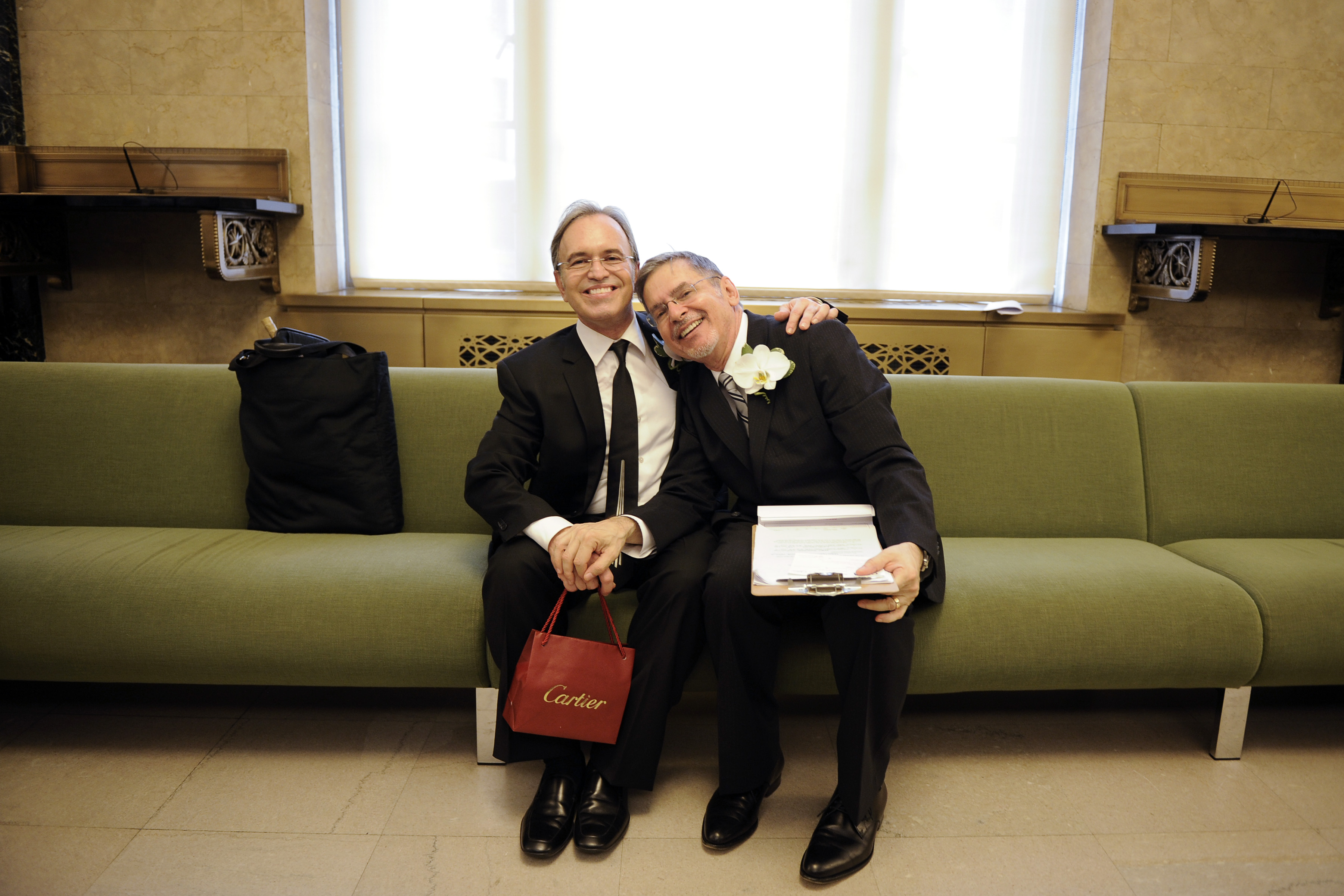
(Photo: Same-sex couple Joseph and Jim pose for a photo as they wait to be officially married at the Manhattan City Clerk’s Office on the first day New York State’s Marriage Equality Act went into effect on July 24, 2011. By Anthony Behar-Pool/Getty Images.)

Do They Still Call It “Geopolitics” In Space?

Joan Johnson-Freese expects that NASA cutting ties with Russia will prove counterproductive:

Space has a long history of serving as a surrogate for demonstrating U.S. displeasure about foreign or domestic policy actions in other countries. Though examples date back to the Cold War, the most recent case relates to China. China has been banned for years from participating in the [International Space Station (ISS)] because select members of the U.S. Congress consider it inappropriate to work with a communist government. In addition, NASA has been legislatively banned from having bilateral relations with China since 2011.

While ostensibly that ban relates to concerns about technology transfer, the underlying reason has as much or more to do with Chinese restrictions on religious freedom.

But China has neither changed its type of government nor its policies on religious freedom based on exclusion from the ISS or its relative isolation from meeting with NASA officials, nor is it likely to. In fact, China has pushed ahead with its own robotic lunar program and human space-flight program, and it works with many other countries, including Russia, in space.

Also, as Katie Zezima explains, the US space program now depends on Russia too much to cut ties completely:

Yes, NASA will stop certain contact with Russia. Russian officials won’t be able to visit the United States, and many meetings and teleconferences will be cancelled. (Wait ’til next year, boreal forest research conferences). But a number of large ties will remain intact, despite the White House directive. Cutting them just isn’t possible when, for example, the United States is wholly dependent on Russia to ferry astronauts to and from space. And, naturally, there is a U.S. astronaut in space right now who will eventually need to hitch a ride home.

Looking Back On Leaning Out

Contra Sheryl Sandberg, Alice Dreger leaned out of her career, which she estimates has cost her family $750,000. What she gained:

I have a fantastic relationship with the guy who has let me cost us $750,000, and I have an ability to support his work as a medical educator and physician. I have a libido. I have a strong relationship with my extended family. I have friends and neighbors who call me when they need me and help me when I call them. I have two triathlon “completion” medals and serious plans to do an Olympic-length triathlon this year. I have a contractor who enjoys muddling with me over lunch with a new plan for hours. I live in a neighborhood full of rainbow flags I helped put up, in a house now known as “the flower house” in town, because I’ve worked the garden so long with the mate. I have a friendship with a squirrel named Fred, and the other day, I had a northern flicker at my suet feeder, because I keep the feeders stocked every day, the birdbath cleaned and watered every day. Best of all, I’ve got a kid who feels like he can tell me, as he did last year, “Maybe don’t go away so much?” to whom I can listen. …

I also have a dream that some day men will think, agonize, write, read, and talk about the work-life balance as much as we women do. But I’m not going to struggle to live their vision of “success” while I wait for them to try and understand mine.

Previous Dish on the Lean In phenomenon here and here.

In Search Of A Well-Credentialed Egg

https://twitter.com/Oh_LivaLittle/status/306601889728974849

Moira Donegan considers why Ivy League graduates are so in-demand:

Like many of the jobs that young women are recruited for, the egg retrieval process, though undeniably strenuous, is not a task that requires a college degree to perform. Following a doctor’s orders to inject themselves with hormones every night and enduring the pain and discomfort of the donation process does not draw upon the skills that donors went to school to cultivate. That educated women are in demand for this service is one thing. That they are willing to provide it is another.

But the job market, after all, is sluggish, even for those who have invested heavily in their own credentials, and the combination of climbing costs of living with stagnant wages and substantial debt liabilities means that smart young women settle for opportunities that do not call upon the full scope of their talents. It is not hard to understand that having a degree is no longer any guarantee of a livable income, and that for many it has instead provided a debt obligation that precludes much material comfort.

What’s more confounding is the way that the student debt burdens that lead many women to egg donation are the result of the same elite educations that make their eggs desirable, and the way that many egg donors, in their aspirations and experiences, so closely resemble the people who are purchasing their services.

Update from a reader:

As a potential buyer of such eggs, it seems blindly obvious why Ivy League eggs are in demand:

1) Getting into an Ivy League school requires brains and dedication. While genetics alone do not determine intelligence, it is a significant factor, so if you want a smart kid you try to get smart genetics. Nothing is guaranteed, but you want the best shot you can reasonably get at the moment. Given that my wife went to high end school (a PhD in STEM field from Wesleyan) means that we are also seeking to replace her eggs with at least comparable ones, if not better.

2) The dedication needed to get into and stay in an Ivy League school means that you are more likely to take the hormone shots when you are supposed to, show up on time and generally carry out what is required of an egg donor.

3) Getting and staying in an Ivy League school means you cannot be indulging into too many drugs. Once again, not guarantee, but you assume better than average.

4) If you are in an Ivy League school that means you are young. When it comes to eggs, young is good. The people like my wife and me need eggs because we (she) are past our reproductive prime to the point that we are not able to reproduce not only on our own but with the help of hormone shots. Our friends are mostly in the same boat, though even if they are still able to get pregnant on their own their eggs are past their prime leading into increased health risks.

5) The general pool of donor eggs consists of a lot of young women with less than stellar educational backgrounds, or at least it did five years ago, so it’s not like you are saying I want Harvard instead of the University of Michigan.

BTW – I’ve also seen a premium on models and actresses as well.

Previous Dish on egg donation here, here, and here.

Why Do So Many Germans Support Putin?

With one prominent journalist fretting that Germany has become “a country of Russia apologists,” Christiane Hoffmann considers why so many of her countrymen feel drawn to the east:

There are some obvious explanations for the bond between Germans and Russians: economic interests, a deeply rooted anti-Americanism in both countries on both the left and the right of the political spectrum. But those are only superficial answers – dig a little deeper, and you’ll find two other explanations: Romanticism and the war.

The war explanation is inextricably linked to German guilt. As a country that committed monstrous crimes against the Russians, we sometimes feel the need to be especially generous, even in dealing with Russia’s human rights violations. As a result, many Germans feel that Berlin should temper its criticism of Russia and take a moderate position in the Ukraine crisis. It was Germany, after all, that invaded the Soviet Union, killing 25 million people with its racist war of extermination. Hans-Henning Schröder, a Russia expert at the German Institute for International and Security Affairs describes this as Russophilia and says it is a way of compensating for Germany’s Nazi past. …

Then, of course, there are Germans’ romantic ideas about Russia. … “The east is a place of longing for the Germans,” says [political theorist Herfried] Münkler. The expanse and seeming infinity of Russian space has always been the subject of a German obsession for a simpler life, closer to nature and liberated from the constraints of civilization. The millions of Germans that were expelled from Eastern Europe and forced to move to the West after 1945 fostered that feeling. To them, it represented unspoiled nature and their lost homeland.

Update from a reader:

Oh my god this is such terrible horseshit. This article is full of distortions and prejudiced cliches about Germans. The fact it’s written by a German doesn’t mean anything. We are masters of self flagellation.

I am a German who’s lived in the UK for many years, but I still follow politics in my home country religiously. What has happened with regards to Ukraine and German media coverage and the reaction of the general population has been deeply divided. The neoconservative transatlantic aligned media (mostly Springer) created a Term “Putinversteher” (a person that understands Putin) to discredit everybody with a nuanced view on the subject matter.

Do you know when was the last time that happened? The same media elements in Germany did the same thing during the run up to the Iraq War. They accused every opponent (and the vast majority of Germans was opposed to that disastrous adventure for very good reasons) of being deeply anti-American, if not anti-Semitic, and deeply troubled by WWII defeat, which is why they all secretly wanted to stick it to the Yanks out of spite yadda yadda yadda.

Yes, that is exactly how Germans were maligned back then. The same people who did the smearing back then are unapologetically doing the smearing now. But luckily the German majority again doesn’t buy into the bullshit explanations that are being offered. What those Germans I talked to think can be summarized in few bullet points, and none of them are anywhere near of being pro-Putin:

– They want Germany to do politics purely based in Germany’s and not in John McCain’s or Victoria “Fuck the EU” Nuland’s (and all the other Western clowns handing out cookies on Maidan square).

– They don’t understand what on earth the Ukraine has to do with the EU at a time that the EU is in deep crisis. Who are these incompetent politicians engaging in these terribly shortsighted idealistic adventures and who authorized them to act in such way in our name?

– They see the hypocrisy of the West when for example John Kerry says “in the 21st Century you cannot simply invade another country on trumped up charges.” Hello?

Actually the sentiment is best described by this phenomenal analysis of Western foreign policy bluster by Stephen Walt.

I quarrel with my countrymen and -women over many issues all the time. But we can’t be reduced to this simplistic explaining of the “romantic German mind longing for the east” “stockholm syndrome” and similar crap that Spiegel Online seems to offer to interested foreigners.

Why Aren’t Gay Men On The Pill? Ctd

Another round of emails focuses on the high cost of PrEP drugs like Truvada:

I was just turning 30 when the AIDS epidemic struck. I spent the next 13 or so years caring for, then burying, my friends and loved ones. Somehow a few friends and I escaped infection; I don’t know how.truvada

In the intervening years, I’ve gone through periods of promiscuity (10 years) and celibacy (another 10). Now, at 62 years of age, I’m still HIV-negative and “back out there” seeing a couple of guys regularly. I’m not sure of their HIV status. We do not practice safe sex. I’m not proud of that, but just being truthful here.

My internist is part of New York’s main gay health clinic. He also knows that I’m sexually active and “at risk.” I request twice-yearly HIV testing and have been treated for other STDs. Truvada has never been mentioned as an option.

I don’t ask for it because of the expense. What is it, ten grand a year? I work for a small law firm and the heavy users of the health insurance plan seem to get laid off (read: fired) at much higher rates. Perhaps I am immune to the HIV virus. I hope so. But I wish my health insurance wasn’t handled by my employer.

To my knowledge, most health insurance covers Truvada – as well it should. It could save insurance companies a small fortune if it cuts down on the need for far more expensive anti-retrovirals. Here’s a site that monitors insurance coverage of PrEP. Money quote:

We have not heard of any insurance company or any Medicaid program outright denying coverage of Truvada as PrEP. Some companies and programs are requiring prior-authorization, however, which requires paperwork to be filled out. And the type of insurance coverage you have, including prescription drug benefits, will determine the cost to you as the consumer. To date, we have seen the biggest barrier to obtaining PrEP from providers who are unwilling to write a prescription.

Let them know if your insurance is denying coverage. Another reader:

You ask why aren’t gay men on Truvada?  Uh, cost???  I have a gold-level insurance plan and the Truvada manufacturer’s coupon (good for up to $200 per month), but it’s still costing me $469 per month. Truvada, like every other anti-retroviral, is a “non-preferred” drug on the formulary of every insurance plan that I could find in my state. I guess they’d “prefer” that we just drop dead. I’m starting to wonder if I shouldn’t fly to India and try to arrange a generic supply. How many gay men are going to go ask their doctors for prescriptions if they’ll still have to fork over almost $500 per month to get it?

Is it being prescribed as preventative medicine? Several more readers sound off:

I am a sexually active HIV-negative gay man who started taking Truvada as a preventative four months ago. I’m in my mid-40s, and during my 25 years of sexual activity I have been a spotty practitioner of safer sex. That I have remained HIV-neg is probably a combination of luck and the fact that I am an exclusive top. (I am also circumcised – no idea if that is a factor).

So am I a Truvada whore? I have no idea. In the gay community, a whore is anyone who gets laid more than you do

I have great health insurance, and when I heard about research showing Truvada’s efficacy as an HIV preventative, I thought, “Why the hell not?” My luck could run out one day, and if Truvada boosts my chances of remaining negative with minimal cost to me, why wouldn’t I take it? I also thought about my partners, many of whom I care about beyond their heavenly posteriors. Testing positive for HIV would be bad enough; knowing that I might have unwittingly spread the bug to someone else would be too much to handle.

Getting the drug is not without hassle. I asked my primary care physician for a prescription when I went for my annual physical. She seemed unaware of the Truvada-as-preventative research. Even after I showed her CDC/NIH recommendations (which I had printed out and brought with me), she was uneasy about giving me a prescription and referred me to an infectious disease specialist. I finally got the drug, but only after seeing the other doctor and subjecting myself to another round of blood work.

Also, it is my understanding that not all health insurers cover Truvada for the HIV-negative. If mine didn’t, there is no way I could afford the medication on my own.

Another:

The optimist in me hopes that once other drug companies develop similar PrEP drugs, prices will come down. I’ve also read they are looking into a long-term injection method that would last three months which would help with any “taking it daily” problems. And perhaps way down the road generics will be made available. Let’s hope.

This reader could use some:

I found your post regarding Truvada so timely – as in today, when I went to a NYC pharmacy to fill my own prescription to start PreP, an HIV-negative guy of no particularly promiscuous lifestyle, deciding the medical benefits of Truvada for PreP were unassailable.

Last year, before news of its efficacy for for PreP really began hitting the mainstream press, I’d learned about it from Facebook posts about the FDA’s then-new guidance posted by more informed gay pals, some of whom were health advocates. Learning quickly of the controversy and so-called shaming from some gays didn’t faze me in the slightest; I’m not a peer pressure guy and rationally considering the medical science made it a no-brainer: I wanted this drug in my arsenal.

Still, it took several months from thinking about it to acting on this knowledge at my annual physical exam. My doctor was 100% supportive, explained how I would need to strictly adhere to daily use and regular monitoring in his office, wrote me a prescription and, warning that my insurance company probably wouldn’t cover it, gave me a manufacturer’s “co-pay assistance program” card, essentially a discount club, with which I duly registered. (The Gilead program’s customer support person, who had not yet encountered anyone calling to register for the assistance intending to use it for PreP, had to check with her supervisor that their program would apply, but it turned out this was ok.)

So far so good. Until I reached the drugstore counter though, just today here in NYC. At $1,320 for a month’s supply, the cost was breathtaking, at least to one who has never faced the bills of someone with a chronic disease. Just as my doctor suspected, my AETNA plan won’t cover PreP, everyone knows there is no generic alternative, and Gilead Sciences, the manufacturer, is selling it at at what they are selling it for. Were I already HIV positive, my insurance company would cover Truvada much more cheaply, but AETNA knows I am not trying to get it for HIV, because my doctor prescribed it alone, not in a three-drug combination “cocktail” that signifies an HIV prescription.

The pharmacist helpfully gave me the printout explaining the cost breakdown from ATENA’ drugs formulary. The cost for a 30-day supply was $1,539, the fact I was an AETNA member got me a contracted discount price of $218.96 off (14.22%), but there was no coverage or partial coverage by AETNA, no manageable co-pay for me. Rather, it was all-pay. I walked out of the drugstore and realized I will need to reassess. And then I got home to see your Dish post, which only strengthened my conviction this drug should be available widely as a prudent personal and public health measure.

It took me a couple of minutes to discover that Aetna does indeed cover Truvada. Money quote:

For Truvada

A documented diagnosis of human immunodeficiency virus (HIV) OR

A documented diagnosis of initiating therapy for pre-exposure prophylaxis (PrEP) to reduce the risk of sexually acquired HIV-1 in adults at high risk AND documentation of all of the following:

A negative HIV antibody test taken:
Immediately before starting Truvada for PrEP AND
Every 3 months thereafter while on therapy
Confirmation that creatinine clearance value >/=60 mL/min before initiating Truvada for PrEP AND
Serum creatinine and calculate creatinine clearance checks performed at 3 months after initiation and then every 6 months thereafter

NOTE: Members may receive a 30 days’ supply of medication upon initial request of Truvada for PrEP diagnosis. After 30 days, above criteria must be met.

Update from a reader:

You might be interested to know that, at least in Illinois, many ACA plans have very poor coverage for Truvada.  In fact, Illinois ACA plans generally have poor coverage for all HIV drugs.  I’d highly recommend taking a look at this study [pdf] done by the AIDS Foundation of Chicago on coverage for HIV drugs by ACA plans in Illinois.  For example, under Aetna’s Illinois plan, Truvada is a “non-preferred” drug that usually requires out-of-pocket costs of $733.99 a month, effectively putting it out of any normal person’s reach.

Another:

Of course this reader focuses on The Horror! of paying $734/month for Truvada – instead of doing us the service of pointing out that in the very same PDF we learn that BCBS has it available at a $50 copay for silver plans; $35 for gold. Likewise, even at $734, the cost is still subject to the plan’s deductible and out-of-pocket max, meaning almost exactly nobody is going to be paying $734/month for the entire year on these plans.
Convicted Of Being A Minor

Balko highlights a report on “status offenses”:

The Texas Public Policy Foundation (TPPF) has an interesting report out on the detainment and incarceration of juveniles for “status offenses,” or offenses that wouldn’t be crimes if the juveniles were adults. (TPPF is a right-leaning think tank that has been pushing conservatives to embrace criminal justice reform.)

Status offenses could include things like truancy, curfew violations, or vaguer offenses such as “incorrigibility.” These offenses don’t directly harm anyone. Instead, they’re generally discouraged because they’re believed to lead to criminal behavior. But treating them as criminal conduct has costs, both economic costs, and the risk that introducing a kid to the “system” can inflict irreversible harm.

A key part of the report:

Incarcerating or otherwise removing these youth from their homes increases the likelihood that they will be converted from today’s status offenders to tomorrow’s serious offenders, instead of being shepherded toward productive lives as young adults.

Among other things, research shows that status offenders, as a result of being exposed to seriously delinquent youth in close quarters, are in jeopardy of developing the more deviant attitudes and behaviors of higher-risk youth, such as anti-social perspectives and gang affiliation. While many of the causes underlying a status offenders’ behavior and the effects of incarceration has on their futures are also common to more serious offenders, the stakes are obviously higher for status offenders who have not committed property or person offenses and may be less likely to have previously been associated with seriously delinquent peers. In addition, the confinement of status offenders is expected to increase barriers to reentry into community, home, and school settings, and increase the likelihood that they will be rearrested, re-adjudicated, and re-incarcerated.

In short, there are very compelling reasons to avoid confinement of status offenders. The punishment fails to fit the “crime” since status offenses are simply behaviors that would be legal if committed by adult; alternative approaches are more effective and far less costly; and, as described in the previous paragraph, the futures of these youth would not be jeopardized by the negative impacts of exposure to serious offenders during placement.

What Happened In Camp 7?

6a00d83451c45669e20120a7e84fa1970b-500wi

It’s the now infamous Gitmo camp (aka Camp No) – only visible on Google Maps, but denied by the Pentagon – “‘I’m not even functionally allowed to discuss the place,’ said Army Lt. Col. Todd Breasseale, a Pentagon spokesman.” It’s the place where, on one fateful night, paddy wagons came and went, whence screams could be heard during “aggressive questioning”, and whence three corpses are believed to have emerged. It’s where KSM is kept. And it’s the location of some of the worst excesses of the torture program under Bush and Cheney, according to the forthcoming Senate Intelligence Committee report. And today, we have an insanity case there that further troubles the conscience:

Prisoner Ramzi Binalshibh has accused the government of making noises and vibrations inside Camp 7 to deliberately keep him awake, reminiscent of the intentional sleep deprivation, along with other forms of abuse, that his lawyers say he endured at the hands of the CIA from the time he was captured in Pakistan in September 2002 to when he was brought to Guantanamo four years later. Military officials deny doing anything intentional to disrupt his sleep. Prosecutors say his accusations are delusions, though they still believe he is mentally competent to stand trial. His lawyers say he is competent, but are not convinced officials have adequately investigated his complaints…

His mental state is somewhat murky. Court records show Binalshibh has been treated while in Guantanamo with medications that are used for bipolar disorder and schizophrenia, but he did not participate in a court-ordered mental evaluation in January … Another possibility is that his inability to sleep and his fevered outbursts in court, which prompted the judge to order him removed from the courtroom in December, are a result of post-traumatic stress from his treatment at secret CIA interrogation centers known as black sites, said Anne Fitzgerald, director of the research and crisis response program for Amnesty International.

So he is either being tortured or is suffering PTSD from previous torture. Ladies and gentlemen, this is what America has become.

Update: I clarify the distinction between Camp 7 and Camp No here.

Iran’s “Terrorist” UN Envoy

Iran’s new ambassador to the UN, Hamid Aboutalebi, served as a translator for the students who stormed the US embassy in Tehran in 1979. Ted Cruz and Chuck Schumer’s bill barring Aboutalebi from entering the country passed both houses unanimously last week. On Friday, the White House announced that Aboutalebi would not receive a visa. Scott McConnell sees through Cruz and Schumer’s concern trolling:

Of course the target here is not Iran’s ambassador to the UN. Cruz and Schumer aim to destroy the Obama/ P5+1 negotiation with Iran, which aim for a reduction and monitoring of Iran’s nuclear energy program in return for lifting of Iran sanctions. I presume Schumer does this because he wants Israel to be the only state in the Middle East permitted to enrich uranium—the senator often vows that his main purpose is to serve as Israel’s “guardian.” Cruz is implementing the current Republican campaign to depict Obama as a weak “Jimmy Carter like” figure in foreign affairs. Introducing a bill which evokes the frustrated emotions of the long ago hostage crisis while tossing rocks into the gears of American diplomacy thus serves as a kind of twofer. Both senators know well that there are hard-liners in Iran who oppose a successful nuclear negotiation with the United States as much as they do. Cruz and Schumer are thus playing to a dual audience, Americans immersed in Iran hatred and their Iranian counterparts.

Elias Groll and Colum Lynch explain the controversy in more detail and preview the legal battle to come:

The decision sets up a potential clash with the United Nations, whose 1947 agreement with the United States governing the body’s New York headquarters clearly forbids Washington from prohibiting the entry of U.N. ambassadors.

“The federal, state or local authorities of the United States shall not impose any impediments to transit to or from the headquarters district of representatives of Members,” the agreement reads. Under the terms of that agreement, disputes between the United States and the body are to be settled through arbitration. … Though the United States has previously attempted to bar the participation of certain groups at the U.N, this is the first time Washington has prevented a U.N. ambassador from taking up his position, according to Julian Ku, a law professor at Hofstra University and an expert on international law. In 1988, the United States barred Yasser Arafat, the chairman of the Palestinian Liberation Organization, from addressing the U.N. General Assembly. In response, the U.N. temporarily relocated its proceedings to Geneva. A year earlier, Congress attempted to force the PLO to close its offices at U.N. headquarters, an effort that ultimately failed.

John Bellinger argues that America’s agreement with the UN carved out an exception that allows us to deny Aboutalebi a visa:

[U]nder this so-called “security reservation,” Congress limited the U.S. obligation to allow representatives of other U.N. members to enter the U.S. if necessary to “safeguard its own security.”  Some observers, including my friend Kevin Heller over at Opinio Juris, have read Section 6 as reserving the authority of the Executive branch only to control the travel of foreign nationals into areas of the United States outside the U.N. “headquarters district” and not to deny absolutely the entrance of foreign nationals into the United States. Although this is one possible reading of Section 6, an equally plausible reading of Section 6 is that it reserves a general and absolute right for the U.S. to “safeguard its own security” as well as a more specific right to limit travel outside the U.N. district. It is hard for me to believe that Congress in 1947 would have acceded to an unfettered obligation to allow any foreign national to come to the U.N. headquarters district, as long as they did not travel outside that district.

But Heller contends that Bellinger is misreading the law:

Section 6 contains two separate provisions. Provision 1 permits the US to prohibit individuals who have a right of entry under the Headquarters Agreement but are considered a security threat from traveling anywhere other than other than “the [UN] headquarters district and its immediate vicinity.” Provision 2 then permits the US to deny entry completely to anyone who does not have a right of entry under the Headquarters Agreement. Section 6 thus does not permit the US to deny entry completely to someone who has a right of entry.