A New String Theory

The violins Antonio Stradivari crafted at the turn of the 18th century are famously superior to newer models – or are they? A new study presents “a striking challenge to near-canonical beliefs about old Italian violins”:

[Researchers] decided to restrict participation to 10 world-class violinists, all award winners and experienced soloists. During two 75-minute sessions—one in a rehearsal room, the other in a 300-seat concert hall renowned for its acoustics—they played six Old Italian violins (including five by Stradivari) and six new ones. … “Among these players (seven of whom regularly play Old Italian violins) and these instruments (five of which were made by Stradivari), there is an overall preference for the new,” the researchers write. “Ratings for individual quality criteria suggest that this preference is related mainly to better articulation, playability, and estimated projection (in the new instruments)—but without tradeoffs in timbre.”

That last point may be the key. Seven of the soloists said in an interview that they find general differences between old and new violins, including “new violins are easier to play,” and old ones “have more colors, personality, character, and refinement, and are sweeter and mellower than new ones.” That latter belief appears to be inaccurate, [researcher Claudia] Fritz and her colleagues write—at least if those characteristics “can be considered aspects of timbre.”

(Video: Performance on Stradivari’s “The Francesca” violin, dated 1694)

Maps Of The Day

dish_nycmap

dish_nycmap2

The New York Public Library has digitally released more than 20,000 historic maps for free use:

Containing maps from the 16th through to the early 20th century, the collection focuses mainly on the United States, particularly New York, but also features maps from other countries. The images of Manhattan and surrounding boroughs offer a fascinating snapshot of the development of one of the most densely populated areas in the world. The maps can be viewed through the New York Public Library’s Digital Collections page, and downloaded, through the Map Warper – a wonderful project which aims to make historic maps viewable as overlays on modern maps.

Aaron Reiss elaborates:

Maps like these can be used to help historians visualize phenomena that have shaped the city. For example, they show how ethnic enclaves shifted as Italian, Jewish, and Chinese immigrants traded places in lower Manhattan or how Manhattan’s shoreline has grown outward, as a result of infill and real-estate speculation, creating new parts of the city where before there was only water.

(Images: New York City, Zoning, 1915; and Map of the City of New York, showing its political divisions and subdivisions, 1870)

Cottoning To A New Global Industry

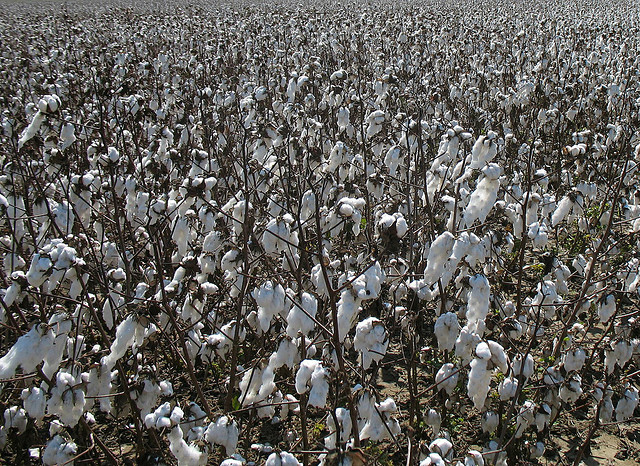
dish_deltacotton

High Cotton author Gerard Helferich visited farms in Mississippi to examine “the forces that have exiled cotton from its historic homeland and to ponder what its loss means for farmers, for others in the industry, and for the rest of us”:

In the end, what is gained and what is lost by the Delta’s shift away from cotton? It’s clear that if Mississippi farmers never harvested another boll, the world would still have plenty of the fiber to meet its needs. The region’s residents may miss the sight of cotton nodding in the fields and the evocative scent of fresh-​picked lint. Those whose livelihood depends on the crop, such as brokers and gin workers, have already suffered from cotton’s retreat. The local economy has been pinched, as cotton’s greater capital investment and higher employment needs have drained away. … Excluding [Quito Gin owner David] Grossman, every farmer I spoke with believes that he is better off for diversifying his crops. In fact, as I’ve talked to growers large and small over the past few months, I’ve heard very little nostalgia for cotton.

Yet “even as the creation of the finished product disappeared from the US economy,” observes Matthew MacFarland, “demand for American cotton in the global textile sector has only grown: Exports’ share of domestic cotton production has expanded from 32 percent in 1948 to 74 percent in 2012.” He examines the bottom line as the product moves to cheaper labor markets:

Enter Bangladesh, a country whose garment exports have skyrocketed from a mere $6.4 million in 1983 to $21.5 billion in 2012. Bangladesh’s ready-​made garment (RMG) industry has been the sole force behind the country’s rapid industrialization, shifting its economy away from agriculture and toward manufacturing and drawing a rural population into the churning city of Dhaka. … The Bangladesh RMG industry gets most of its cotton from India and Uzbekistan, countries that trail the US in terms of sheer cotton exports but whose proximity makes for cheaper and easier trade. But while the likelihood of an American farmer’s cotton ending up in Bangladesh is low, a piece of clothing made in a Bangladeshi factory has a one in four chance of ending up in the US and a 50 percent chance of ending up in the European Union. In other words, on the supply side, American cotton and Dhaka factories are cousins several steps removed. In terms of demand, the relationship between Western retailers—​and consumers—​and the RMG industry is more directly causal. Including the Pacific Ocean, 8,500 miles lie between Yazoo City and Dhaka—​but that distance vanishes between here and any local mall.

Previous Dish on the costs of clothing here, here, and here.

(Photo of “September in the Delta” in Leflore County, Mississippi, 2006, by Natalie Maynor)

What War Is Good For

David Crane reviews Ian Morris’s new book War: What is it Good For? The Role of Conflict in Civilisation, from Primates to Robots, which posits that “in the long run, the very, very long run, ‘productive war’ has always made the world a safer and richer place for the losers as well as the winners”:

It is conceivable, in theory, that there are other ways of taming man’s capacity for violence, but if the European Union (hiding behind the American Leviathan) has at least temporarily succeeded in boring and regulating a continent into relative docility, pretty well the only force through history capable of creating the Leviathans big and strong enough to cage William Golding’s ‘beast within’ and bully, bribe and coerce the levels of violence down is, paradoxically, war. ‘Lord knows there’s got to be a better way,’ Morris quotes the song,

but apparently there isn’t. If the Roman empire could have been created without killing millions of Gauls, if the United States could have been built without killing millions of Native Americans … if conflicts could have been resolved by discussion instead of force, humanity would have had the benefit  of larger societies. But that did not happen … People hardly ever give up their freedom, including their rights to kill and impoverish each other, unless forced to do so, and virtually the only force strong enough to bring this about has been defeat in war, or fear that such a defeat is imminent.

This winter, The American Scholar asked Morris to pose questions about the future of conflict. One of his open queries:

Late in the 20th century, anthropologists learned that feuding and war were extremely common among the world’s last surviving Stone Age societies. On average, something like 10 to 20 percent of people in these societies died violently, and archaeologists suggest that similar rates applied in prehistoric Stone Age societies. In 20th-century industrialized societies, by contrast—despite two world wars, the use of atom bombs, and multiple genocides—just one to two percent of people died violently. And as Steven Pinker pointed out in his recent book, The Better Angels of Our Nature, in the 21st century the rate is, so far, well below one percent. Why, even though our weapons keep getting more destructive, has the risk that anyone among us might die violently fallen so much? Can that trend continue?

The Best Of The Dish Today

One: A Story of Love and Equality – OFFICIAL TRAILER from Becca Roth on Vimeo.

The most trafficked post continued to be “Why Aren’t Gay Men On The Pill?”, and many more reader emails are on tap for Monday. The runner-up post was still my defense of Ayaan Hirsi Ali against her hard-left critics at Brandeis (reader dissents here). Other popular posts included reaxes to Sebelius’ exit and Colbert’s exit, a sober look at AIDS in the South, and a super-excited ode to social media. If you share that excitement, comment on our Facebook page or throw your invective at @sullydish.

Today we also updated our reader poll on merch options – check it out and vote. Meanwhile, 26 more readers became subscribers today:

This is my first time writing to you. I read your blog daily, even though I often disagree with you. But you changed my mind this week. I had read all of your arguments about the Mozilla-Eich affair and still respectfully disagreed. But then I saw your Colbert appearance. The cheerful demeanor you presented your arguments reminded me that this is an issue of kindness and respect for other humans – humans who have faults and make mistakes just like me.

Sometimes when I read your posts, I imagine you screaming them in frustration (this probably started after I read your Obama-Romney debate live-blog). Seeing you speak in person made all the difference. Thanks for changing my mind. That is why I love The Dish.

Another new subscriber:

The socks kinda made my day – so sweet, sad, self-mocking and fucking hilarious!

I have been a reader since the 2008 election, addicted through the Iranian elections (I sent a Hafiz poem that was posted).  The Dish was my main connection to news back home when I quit my NYC job in 2011 to travel through Nepal and India, followed by a return to my childhood home in Ohio (from which I sent a view from the bedroom window that was also posted). Last May, I found a job, moved back to Brooklyn, lots of travel to London for work, overall decline in desire to engage/read political debate, financially challenged, but still regularly scanning the Dish but not subscribing … until the socks.

Another like-minded subscriber:

It worked. I watched the Colbert video and re-upped for $50. Now please buy socks.

Heh. Cheers. And see you in the morning. Don’t let this baboon face haunt your dreams.

Storytelling 2.0

Fruszina Eördögh marks the rise of “transmedia” shows, which use multiple social media platforms to tell fictional stories:

It’s taken years of failure amidst the hype and vomitable PR speak for a clear expert on the genre to emerge and make it financially viable, and that expert is Bernie Su, a YouTube storyteller with a forte for adapting 200-year-old novels for the web. What makes Su an expert at transmedia storytelling, exactly? Well, besides drawing large audiences (mainly women under 25), generating hundreds of hours of content, and winning a prime-time Emmy for interactive storytelling in 2013, Su’s transmedia properties are actually profitable. Like, waaaay in the black.

The Lizzie Bennet Diaries, Su’s show that won an Emmy, is the longest adaptation of Jane Austen’s Pride and Prejudice in history, at nine and a half hours. The show’s fans don’t care about the length, and raised just shy of half a million dollars on Kickstarter to put it on DVDs. The story can be watched just by going to the main YouTube channel, or you can check out the ancillary material spanning five YouTube channels and across a total of 35 social media profiles on Tumblr, Twitter, Facebook, and Pinterest, depending on the personalities of its 13 different characters, with each digital platform adding an additional layer to the original story.

(Video: Episode 1 of The Lizzie Bennet Diaries)

The Resources To Prevent Democracy

Zack Beauchamp examines the connection between oil and authoritarianism:

Study after study has found that, while discovering big oil deposits doesn’t turn democratic countries with a lot of oil like Norway and Oil And DemocracyCanada authoritarian, authoritarian countries are more likely to stay that way if they’ve got a ton of oil. Of all the bad things that oil does for countries, this is probably the worst and most robustly demonstrated. Think about how long the Saudi monarchy has stuck around, or Russia’s failed attempt to transition to democracy in the 1990s.

“No country with high levels of oil and gas income has successfully become democratic since 1960,” writes Michael Ross, one of the premier scholars of the oil curse. As you can see in his graph on the right, countries that make a lot of money from oil per capita (the bottom-right group of dots) have spent approximately zero time under democratic rule in the past 50 years.

The main reason for the link between oil and authoritarianism, according to Ross and others, is straightforward: oil gives dictatorships money to buy off their citizens, so they don’t have to democratize.

Playing With Plato’s Fire

Lizzie Wade questions the practice of raising endangered birds with puppets before releasing them into the wild:

These animals don’t cause as much trouble as marauding gangs of adolescent condors, but they can wind up with their own mysterious behavioural issues. Puppet-reared whooping cranes, for example, have trouble incubating their eggs in the wild; they will often abandon their nests mere days before the eggs are due to hatch.

John French, Patuxent’s research manager and head of the crane programme, has a couple of different theories about the crane’s parenting problems.

In the wild, nesting cranes are often swarmed by black flies; perhaps the puppet-reared cranes, raised in relative comfort, can’t tolerate the parasites and are driven off their nests. Or perhaps their own puppet parents failed to pass along a crucial piece of information about the breeding process. What the missing piece might be, French told me, ‘I have no idea.’ Meanwhile, the cranes’ failure to raise the next generation on their own guarantees, somewhat ironically, the need for more puppet-rearing.

It’s tempting to see puppet-reared California condors and whooping cranes as victims of a horrific real-life version of Plato’s cave: after living in a shadow world since birth, they are suddenly dragged out into the blinding sunlight and forced to cope with an incomprehensibly rich and complex reality. Ill-equipped to live in anything but a carefully managed simulacrum of nature, they crack under the pressure. When viewed from this angle, it is hard to imagine why keepers thought puppet-rearing would produce psychologically healthy animals.

[L]ike all intensive, hands-on conservation programmes, puppet-rearing was never really about the animals. While the stated goal of any captive breeding programme is to create self-sustaining populations of wild animals that can survive and thrive without human intervention, the true reason for their existence is guilt of a very human variety.

The Pharaoh’s Empty Treasury

Steven Cook worries that Egypt is dangerously close to defaulting on its debt:

This might sound surprising to the casual observer of Egypt.  The economy was a subject of intense coverage in the months preceding the July 3, 2013 coup, but has receded from view as Saudi Arabia, the United Arab Emirates, and Kuwait stepped in with an initial $12 billion infusion of aid that was followed recently with another $8 billion.  The money from the Gulfies was supposed to stabilize the Egyptian economy, but the numbers do not lie.  The country’s foreign currency reserves—between $16-$17 billion—are close to where they were in late 2012 and the first half of 2013, which means Egypt is hovering just above the critical minimum threshold defined as three months of reserves to purchase critical goods.  A portion of those reserves are not liquid and with a burn rate estimated to be $1.5 billion per month, it is easy to understand why Egypt is one exogenous shock—think Ukraine, which is a major producer of wheat and Egypt is the world’s largest importer of it—or political crisis away from default.

What this would mean:

An economic problem the magnitude of a solvency crisis will only intensify the pathologies that Egypt is already experiencing—violence, political tumult, and general uncertainty.  Economic decline would create a debilitating feedback loop of more political instability, violence, and further economic deterioration. It’s a scary scenario that deserves attention and preparedness, but there does not seem to be much urgency to try to address it anywhere.  Gulf money appears to have lulled people into the sense that the Saudis, Emiratis, and Kuwaitis will stave off disaster.  It’s a false sense of security.