Where The Hard Left Says No, Ctd

A few readers add some perspective to this controversy:

I am sure I won’t be the first to point out the brutal irony that a university named after Justice Louis Brandeis would seek to limit “insensitive” discourse.  Perhaps Brandeis’ most famous opinion was his concurrence in Whitney v. California (1927), wherein he emphasized that disturbing debates epitomized American democracy:

Those who won our independence believed that the final end of the state was to make men free to develop their faculties, and that in its government the deliberative forces should prevail over the arbitrary. They valued liberty both as an end and as a means… They believed that freedom to think as you will and to speak as you think are means indispensable to the discovery and spread of political truth; that without free speech and assembly discussion would be futile; that with them, discussion affords ordinarily adequate protection against the dissemination of noxious doctrine; that the greatest menace to freedom is an inert people; that public discussion is a political duty; and that this should be a fundamental principle of the American government.

Ultimately, Brandeis stressed that “[T]he fitting remedy for evil counsels is good ones.”

Another reader:

To put this in some perspective, when I was an underclassman at Brandeis in the mid-’70s, the university awarded an honorary degree to Bob Guccione, the publisher of Penthouse Magazine.

Rumor was that he had given $1 or $2 million to the university which, in those days, was a lot of money, and that was why they were doing it.  The student body and faculty, especially feminists (who were numerous), were outraged, and many noted the irony of a university whose seal, translated into English, meant “Truth unto its innermost parts,” giving an honorary doctorate to the publisher of a sexually oriented magazine featuring naked women.  The protests did nothing.  Guccione got his honorary degree.

The Internet is a blessing and a curse.  Forty years ago, a loser like Bob Guccione got his honorary degree at Brandeis over the loud protests of students and faculty because nobody beyond the university could hear them.  The critics of Ms. Ali were able to twist a single interview into a major controversy using the Internet.  I think the Internet is as much to blame as the “hard left'” as such.

Political correctness and orthodoxy cut both ways.  Just ask “moderate” Republicans.  One of the prime organizing elements of the Tea Party and the hard right has been the Internet.  Like it or not, that’s where future battles over our intellectual future will be waged.  Scares the shit out of me.
Our Heart Isn’t Bleeding

A reader writes:

I’m wondering if you know if Tinypass has updated their SSL since the news of the “catastrophic” vulnerability. I’m concerned that logging in (or changing my password prematurely) could put my Paypal info at risk, and I can’t read any further because of the meter. If they haven’t updated yet, any chance you could run a meter amnesty until they do, and if they have, can you maybe post an update to let us know it’s safe?

It’s safe. Tinypass has informed us that subscribers have not been put at risk by the Heartbleed bug. If you want to check what websites have been affected, Mashable has published a helpful guide here.

Chart Of The Day

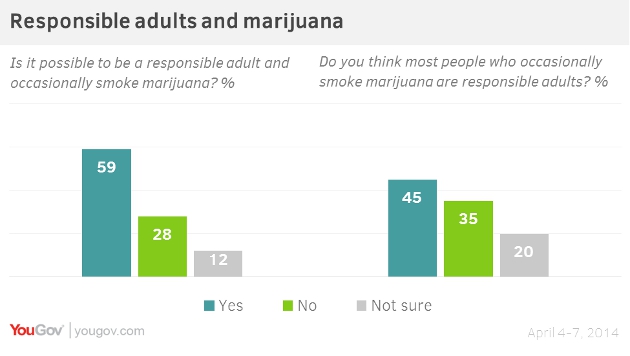
Most Americans realize that pot smokers can be responsible adults:

Marijuana Respectable

Another finding from the poll:

Asked whether occasionally smoking marijuana makes it harder to be a responsible adult, attitudes are mixed. Nearly half the public (47%) say that it makes no difference whether you occasionally smoke, but 38% say that it does make it harder to live up to adult responsibilities. Unsurprisingly, only 5% say that occasionaly marijuana use makes it easier to be a responsible adult.

Can Data Make Medicare Healthier?

Yesterday, the Centers for Medicare & Medicaid Services (CMS) made public a huge amount of Medicare payment data. Prior to the release, Nicholas Bagley explained what the information entails:

CMS will publicly release comprehensive data on physician billing practices in Medicare, including information about specific, identifiable doctors. The move is controversial: the AMA, for one, is “concerned” that the data “will mislead the public into making inappropriate and potentially harmful treatment decisions and will result in unwarranted bias against physicians that can destroy careers.” And I’ll bet a few doctors in Miami, with its extraordinary rate of Medicare spending, are sweating bullets.

Darius Tahir considers the impact of the release:

One possibility is that releasing the data shames some providers into more responsible behavior.

As Amitabh Chandra, an economist and professor of public health at Harvard, suggested, fear of bad publicity might cause some higher-charging doctors to cut back on their reimbursements. And while individual consumers are unlikely to spend much time investigating doctors, professional researchers in the media and in academia will.

In fact, they already are. Initial reporting from the Wall Street Journal indicated that the top 1% of providers accounted for 14% of Medicare billing, with ophthalmologists making up roughly one-third of the top 1,000 billers. A report from the Department of Health and Human Services’ inspector general argued that the agency should scrutinize that specialty more closely, and this data shows why.) The New York Times on Wednesday reported that two Florida physicians who had the highest Medicare reimbursements in the country were also generous donors to the Democratic Party.  CMS hopes to encourage more such investigating, and not just from professional reporters. It has sponsored a contest for coders, calling on them to take the data and render it in a form that’s usable and interesting. The winner gets $20,000.

Suderman digs into the data:

It’s going to take a while to fully process all this information, but a couple things stand out already from the stories that have been written so far. One is the sheer scale of the payments involved. The data set doesn’t cover anywhere close to the entire Medicare program, but it offers a look at $77 billion worth of payments to 880,000 medical professionals in the year 2012. From that group, The Washington Post notes, about 4,000 physicians billed the program more than $1 million. And a handful billed in excess of $10 million.

It won’t surprise many people that the highest billers are concentrated in the sunny state of Florida. The state has a heavy concentration of seniors. It’s also a haven for Medicare fraud. And the data suggests a possible correlation between unusually high billing and payment funny business.

Max Ehrenfreund focuses on how drug prescribing jacks up Medicare spending:

A dose of Avastin costs only $50. A dose of Lucentis costs $2,000. Both Avastin and Lucentis are made by the same company, and they’re remarkably effective in treating a form of macular degeneration that was long the leading cause of blindness among the elderly, The Post reported. They are very similar on a molecular level and probably cost about the same amount to manufacture.

Nonetheless, doctors prescribe Lucentis almost as often as Avastin. They also make more money doing so. Medicare is legally obliged to pay for any drug a doctor prescribes, and doctors also receive commissions of 6 percent to cover their own expenses. The commission a doctor collects on each dose of Avastin would be only about $3, as opposed to $120 on each dose of Lucentis. Congress and the courts have refused to allow Medicare to save money by scrutinizing doctors’ decisions.

As a result, taxpayers spent about $1 billion in 2012 more than they would have if doctors had been prescribing Avastin. Avastin, for all intents and purposes, has been shown to be equivalent to Lucentis in six studies and one massive review of Medicare records.

Jason Millman asked the top 10 Medicare billers why they were paid so much money. One explaination:

Jean Malouin, a family practitioner in Ann Arbor, Mich., and the highest-ranking woman on the list, suggested her perch at No. 17 is misleading. “I am most definitely not a high volume Medicare biller!” she wrote in a email.

Malouin said that she has a small private practice but is also the medical director of an experimental University of Michigan project trying to improve care and cost-efficiency at nearly 400 clinics across the state. All the project’s claims are paid in her name, which probably explains why the data show she treated more that 200,000 patients and collected about $7.6 million from Medicare.

Where The Hard Left Says No

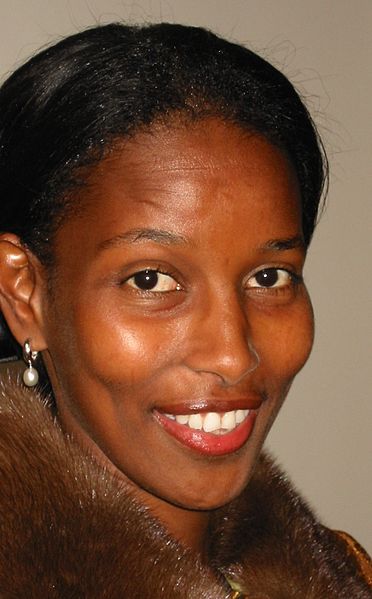
The rescinding of an honorary degree to Ayaan Hirsi Ali is not exactly an act of punishment. No one has a right to any such degree and Brandeis is fully within its rights to breach basic manners and fail to do basic research about an 372px-Ayaan-Hirsi-Ali-VVD.NL-1200x1600honoree’s past work. And Ayaan has indeed said some intemperate and extreme things at times about Islam as a whole. But to judge Ayaan’s enormous body of work and her terrifying, pioneering life as a Somali refugee by a few quotes is, I’m afraid to say, all-too-familiar as an exercise in the public shaming of an intellectual for having provocative ideas. There seems to be an assumption that public speech must seek above all else to be “sensitive” rather than provocative, and must never hurt any feelings rather than tell uncomfortable truths. This is a terrible thing for liberal society as a whole and particularly terrible for a university campus, where freedom of thought should be paramount (although, of course, the hard academic left every day attempts to restrict that freedom).

The “outrage” at heterodoxy applies particularly to any members of an “oppressed” group who try and challenge the smelly little orthodoxies they are supposed to uphold. The venom and hatred seems to ramp up if the heretic is also a woman or African-American or gay or Latino or Jewish. For a woman of color like Hirsi Ali to challenge the religion of Islam is far more threatening to the p.c. left than, say, a Sam Harris or a Christopher Hitchens. The latter can be dismissed as white males (there’s no prejudice like p.c. prejudice); Hirsi Ali not so much.

Here, after all, is the biography of a woman the left wanted Brandeis to dishonor: a young Somali girl forced to endure genital mutilation at the age of five and who was going to be forced into an arranged marriage if she did not flee her country; a refugee from brutal misogyny whose attempts to expose Islam’s treatment of girls and women led to death threats because of a documentary she wrote, and whose director was subsequently murdered. She runs a foundation that aims to protect girls and women in America from being abused at the hands of Islamic traditionalists. It’s worth noting that for the hard left, none of this really matters. Or perhaps it matters more. Because her credentials are so strong, the attempt to mark her as a bigot is that much more strenuous.

This double standard goes both ways, of course.

The Fox News right is always desperate to get a member of a minority to challenge p.c. orthodoxy just because they’re a minority – giving some individuals far more weight than the cogency of their arguments might otherwise deserve. It is as if both sides cannot acknowledge that ideas are ideas – and that the human mind can entertain them, regardless of gender or skin color or sexual orientation.

So, unlike Bill Kristol, I have no objection to Brandeis’ awarding Tony Kushner an honorary degree. I find Kushner’s politics drearily socialist and some of his work agitprop. But he provokes; he’s a really gifted playwright; he makes enemies; and engages the world of ideas forthrightly from the farthest reaches of the left. Why can we not debate if establishing the state of Israel was a mistake, for example? Why, for Kristol, is that topic out of bounds? Why on earth would a university choose not to give a man an honor just because he once dared to make that argument? Kushner was challenging his own ethnic group just as powerfully as Hirsi Ali is challenging her own. But here is the question: why is he lionized and Hirsi Ali disinvited? Why are provocative ideas on the “right” less legitimate than provocative ideas on the left?

That’s why this is dismaying. Not just because Brandeis has, within its rights, behaved shabbily; but because it wants to rig the public debate in favor of one set of arguments over another. There are many places that one might expect that to happen – but not a university.

[Update: as I disclosed last night, Ayaan is a friend of mine; and also the wife of a dear and old friend of mine, Niall Ferguson. So, as always, I have a bias. Sorry not to have disclosed it a second time for those just coming to the controversy.]

[Update: dissents from readers here]

Attacking With Natural Gas

20140405_gdm952

Keith Johnson outlines how Russia has used energy as a weapon in its conflict with Ukraine:

Russian President Vladimir Putin raised the prospect Wednesday of making Ukraine pay in advance for the natural gas that it buys from Russia, a potentially ruinous move for the credit-challenged Ukrainian government. Ukraine’s total gas debt to Russia now totals more than $16 billion, Russian officials said. … Moscow has jacked up the price it charges Ukraine twice in recent days by a total of more than 80 percent, making gas sold to Ukraine among the priciest in Europe.

In a brazen display of chutzpah, Moscow justified the second price hike after abrogating a 2010 treaty between the two countries. Under the terms of that so-called Kharkiv accord, Moscow offered price discounts to Ukraine as a lease payment for the Russian naval base in Sevastopol, on the Crimean Peninsula. Now that Russia has forcibly annexed Crimea and taken over the naval base, it argues that discount no longer applies.

Putin is also threatening European countries with gas shortages if Ukraine doesn’t pay its bill:

Russian President Vladimir Putin sent a letter to 18 European leaders Thursday saying that a dispute over Ukraine’s gas debt to Russia could impact gas distribution throughout the continent, urging them to offer financial assistance to the indebted country. … Although the International Monetary Fund has already agreed to provide Ukraine with between $14 and $18 billion to avoid a default,that figure is far smaller than what Putin claims the country owes. In his letter, Putin says that Ukraine owes Russia $17 billion in gas discounts on top of a potential $18.4 billion debt due to a 2009 fine. He said that this debt grows by billions every day.

Meanwhile, as Matt Ford explains, losing Crimea has dealt a severe blow to Ukraine’s goal of energy independence:

The loss of Crimea only further weakened Ukraine’s already-tenuous energy security. Almost all of the fuel for Ukraine’s 15 state-owned nuclear reactors, which accounts for almost half of the electricity the country generates, comes from Russia. Ukraine’s domestic reserves of uranium are paltry, and it lacks the enrichment capacity to turn what it does have into usable fuel. Russia, by comparison, is a net uranium exporter to Europe and owns nearly half of the world’s enrichment capacity.

Ukraine still has some domestic-energy alternatives in the long term, but these require significant investment. The country possesses the third-largest shale gas reserves in Europe, estimated to hold nearly 1.2 trillion cubic meters, but commercial extraction isn’t slated to begin until 2020 at the earliest. That timeline might have been overly optimistic even before the revolution, considering the environmental impact of hydraulic fracturing (“fracking”) and the public resistance that comes with it. Another complicating factor is location: one of the two large fields, the Yuzivska field, falls almost entirely within the Donetsk and Kharkiv oblasts, two of the eastern regions in which Ukraine has accused Russia of fomenting revolts.

The Economist expects that, over time, Europe will decrease its dependence on Russian gas:

The shock of the Crimean annexation should speed up sluggish European decision-making on storage, interconnection, diversification, liberalisation, shale gas and efficiency. And though the decision-makers may detest Mr Putin, in private they will admit that he may thus have done them a favour. They already knew what to do. They just didn’t want to do it.

(Graphic from The Economist)

Colbert To Take Over For Letterman!

I wondered why there was so much excitement on the set last night. Some details:

Colbert is expected to shed his ultra-conservative character for Late Show, which is perhaps the biggest question mark surrounding his hiring. Though he’s been going through the broad motions of being a late-night host since 2005, he hasn’t been “himself” on the air. Yet Colbert’s fellow Comedy Central host Jon Stewart assured Vulture: “He’s got a lot more he can show. He’s got some skill sets that are really applicable, interviewing-wise, but also he’s a really, really good actor and also an excellent improvisational comedian. He’s also got great writing skills. He’s got a lot of the different capacities. Being able to expand upon [those] would be exciting.”

Many more of the best videos of Colbert out of character here.

Will Democrats Pull The Lever For Paul?

In the primaries, Beinart suspects liberals will flock to Rand:

While things could always change, the 2016 Democratic nomination is so far shaping up as the least competitive, non-incumbent presidential primary contest in memory. It looks increasingly likely that if Clinton faces any opposition at all, it will be from a Don Quixote like Bernie Sanders or Brian Schweitzer, not a challenger with any genuine political base or ability to raise substantial money.

For Rand Paul, that’s fabulous. It means lots of Democrats and independents will cross over to vote in Republican primaries, where the action is. And most of them will vote for him.

Allahpundit thinks “Beinart’s theory is likelier to play out as a true Operation Chaos, with Dems voting strategically, than them voting for Paul in earnest”:

[I]t’ll be conventional wisdom among both Democrats and many Republicans come 2016 that Paul, if nominated, simply cannot win. Beinart himself describes Paul as a right-wing McGovern in the making. If you’re a Democrat voting in an open GOP primary, you might vote for him for that reason, that he’s a patsy.