The Best Of The Dish Today

The Duke And Duchess Of Cambridge Tour Australia And New Zealand - Day 1

The Eich affair wound down a little, but I had one last post on it here. Plus: resurgent Russian chauvinism; the benefits of female leaders; a huge paper elephant; and the foul, ugly extremism of Sheldon Adelson, king-maker for Republican candidates. And this trippy trippy rabbit hole. Plus: Octoblogging!

The most popular post of the day was The Quality Of Mercy; followed by The Hounding of a Heretic.

See you in the morning, which, as the super-exciting Vox explains, is what happens when the sun comes up.

(Photo: you really need to caption this yourself. But it’s by Samir Hussein/Getty.)

Remembering Rwanda

Rwanda Prepares For 20th Commemoration Of 1994 Genocide

Marking the 20th anniversary of the genocide, Lauren Wolfe considers how far the country has come and how it still struggles to cope with its past:

Today, 20 years after an ethnically motivated genocide in which nearly 1 million Rwandans died and up to half a million women were raped, the government forbids certain kinds of public discussion about Hutus and Tutsis. When I visited the country in February, I heard a lot of chatter about something called “Vision 2020,” which is supposed to transform the country into a thriving state marked by good governance and a healthy economy. Construction is booming in the capital, Kigali, and President Paul Kagame has expressed a desire to make his country more like Singapore—a sort of authoritarian democracy. There is a robust effort, in other words, to deliberately “move on” from the tragedy—a determination to never lose control again.

Katy Migiro examines how the memory of the genocide is politicized:

Some argue that the government, led by Kagame, a Tutsi, constantly evokes the horrors of the genocide to justify its tight grip on power. Last year, it launched a campaign called “I am Rwandan,” which has seen Hutus born after the genocide apologize in the name of their ethnic group.

“[Kagame] wants the blood to keep flowing symbolically,” said Gérard Prunier, a French academic who has moved from being a Kagame sympathizer to a fierce opponent. “He wants the survivors to be full of hatred and pain because that’s the basis of his legitimacy.”

The one-sided nature of the government’s genocide narrative is making it difficult for many to bury the past, analysts say. There is no official recognition of Hutu who were killed either during the genocide or in revenge massacres by the RPF, in which up to 30,000 Hutu died, according to a leaked United Nations report.

James Hamblin praises the country’s progress in improving public health since the genocide:

Rwanda was left with the world’s highest child mortality and lowest life expectancy at birth. Fewer than one in four children were vaccinated against measles and polio. … Few imagined that Rwanda, a country the size of Maryland, would so soon—if ever—serve as an international model for health equity.

Just two decades later, that life expectancy has doubled. Vaccination rates for many diseases are now higher than those registered in the United States—more than 97 percent of Rwandan infants are immunized against ten different diseases. Child mortality has fallen by more than two thirds since 2000. New HIV infection rates fell by 60 percent between 2000 and 2012, and AIDS-related mortality fell by 82 percent. HIV treatment is free.

But Marie Berry argues that Rwanda’s rapid development has not benefited everyone:

Outside of the modern Kigali neighborhoods and beneath the country’s orderly surface, things look quite different. Armed security officers stationed at regular intervals around Kigali ensure the city is secure, but also reflect the repression needed to maintain this security — a repression with other dimensions, found in tight (and at times bizarre) regulations on people’s everyday lives. Groups of young men stand idle in front of storefronts, seemingly socializing but really just killing time — they have no work to do. In crowded markets or bus stations, these unemployed youth beg desperately for jobs.

As for Rwanda’s women, many of them sell fruit and vegetables from baskets by the side of the road, but their work is illegal, and they flee at the first sign of police. Others line the dimly lit streets at night in Kigali’s seedier neighborhoods, selling sex — sometimes for next to nothing — to keep their children fed and their rent paid.

On the other hand, Swanee Hunt shows how the country has made great strides in gender equality:

Half of the country’s 14 Supreme Court justices are women. Boys and girls now attend compulsory primary and secondary school in equal numbers. New, far-reaching laws enable women to own and inherit property and to pass citizenship to their children. Women are now permitted to use their husbands’ assets as collateral for loans, and government-backed funds aimed at encouraging entrepreneurship offer help to women without familial resources. Established businesswomen are leading members of Rwanda’s private-sector elite. And the advance of women in the political sphere has received global attention. In 2000, the country ranked 37th in the world for women’s representation in an elected lower house of parliament. Today, it ranks first.

Meanwhile, J.J. Carney notes that spillover from the genocide continues to affect the region:

Not only did Rwanda suffer more massacres (some directed at Hutu) between 1995 and 1998, but Burundi’s civil war continued until 2006. Perhaps worst of all, Eastern Congo after 1996 became the epicenter of what many scholars have dubbed “Africa’s World War.” The precipitous cause of the conflict was Rwanda’s invasion of Congo in October 1996, ostensibly to clear Hutu refugee camps that were serving as staging grounds for cross-border raids into Rwanda. Upwards of four million Congolese died from war-related causes over the next six years. Over a decade later, Rwandan-backed militias continue to dominate Congo’s Kivu provinces. The “afterlife” of the Rwanda genocide thus continues even in 2014.

James Traub worries that a more risk-averse United States is less likely to step in and prevent or stop tragedies like the 1994 genocide:

What, then, is the legacy of Rwanda? First, that reconciliation is possible even after the most horrific violence. Second, that the world has now developed mechanisms, and diplomatic reflexes, that may be deployed to prevent violence from exploding into mass killing. Regional organizations like the African Union are now prepared in some cases to send troops to quell such violence.

But when the killing can be curbed only by the kind of force the West can bring to bear, the world will look to the United States, which means, to the president. And a sad legacy of Rwanda that we witness now in Washington is a president that looks at his options much more skeptically than advocates of action, including those in the White House — both because he is fully aware of the kinks and weak spots of every plan, and because he fears the costs of failure. He will act only when the probability of success is very high.

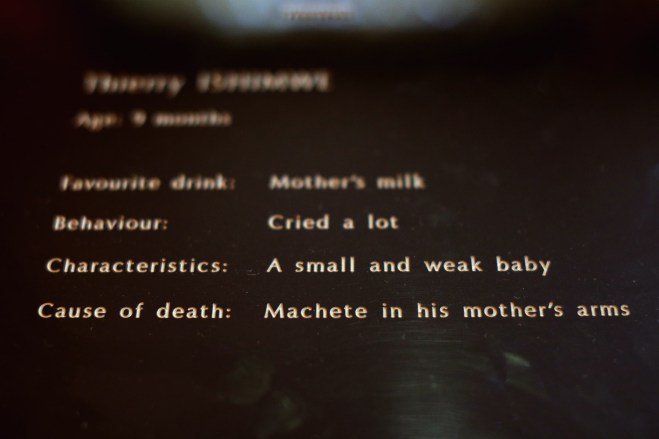
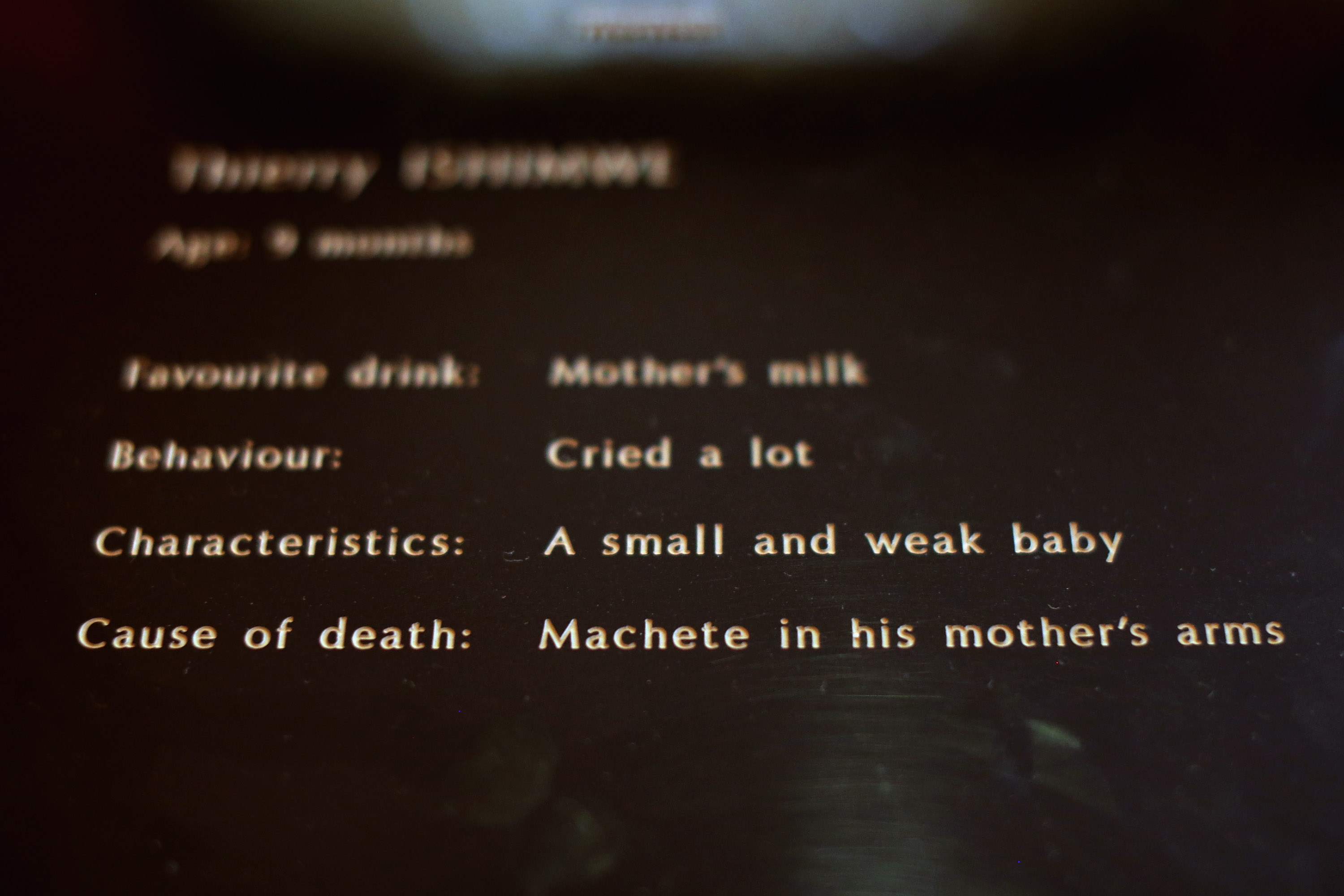
(Photo: The fate of 9-month-old genocide victim Thierry Ishiwme is displayed at the Kigali Genocide Memorial Centre in Kigali, Rwanda on April 5, 2014. Rwanda is commemorating the 20th anniversary of the country’s 1994 genocide, when more than 800,000 ethnic Tutsi and moderate Hutus were slaughtered over a 100 day period. By Chip Somodevilla/Getty Images)

Sex-Selective Abortions In America? Ctd

A reader questions the premise of the South Dakota ban:

Is the argument for the ban on sex-selective abortions seriously to prevent “son-biased sex ratios”? Perhaps the authors of this legislation are unaware that American couples show a distinct preference for baby girls. According to MicroSort fertility technology data, 80 percent of American families who use the MicroSort sperm separation method are requesting a girl. And according to Dr. Ronald Ericsson, who licenses the Ericsson method for pre-pregnancy sex selection, in most of the clinics which offer his services, the ratio of requests for girls over boys is as high as two to one.

In addition, nearly 90 percent of American abortions occur before the 12th week of pregnancy, when gender is highly unlikely to be known (77 percent before week 10, when the gender is impossible to know). And despite there being slightly more boys than girls in the domestic system awaiting adoption, American parents choose to adopt American children at a rate of 64 percent girls/36 percent boys.

That last figure is more than a decade old, but research published just last summer (pdf) shows that American adoptive parents continue to prefer girls to boys. Previous Dish on sex-selective abortions here and here.

The Biggest Election The World Has Ever Seen

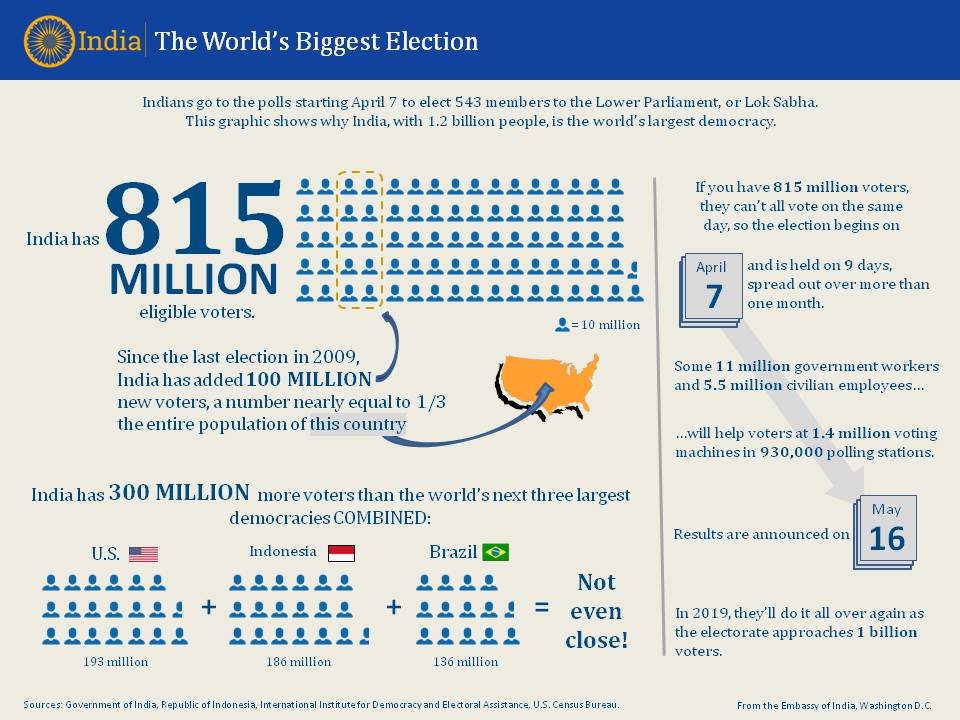
Cillizza passes along an infographic on the Indian election, which began today:

Indian Election

The Economist explains how India manages to run such a massive voting operation:

One answer is that elections are narrowly focused tasks of limited duration that are regularly repeated. Where similar conditions hold, bureaucrats prove similarly successful. One example is the ten-yearly national census; a newer success is a scheme to build the world’s largest biometric database, which has enrolled some 600m people, scanning their eyes, fingerprints and more. (Whether this data will be put to good use is another matter. It is worth noting, too, that much work was done by private contractors overseen by public officials.)

A second answer is that state employees respond well when given tasks of great prestige and put under careful public scrutiny. Thus India’s space agency last year launched a spaceship to Mars which continues on course, for a remarkably small budget. Similarly, public-health officials recently announced that India had eradicated polio. A third answer is that bureaucrats succeed when free from political meddling and corruption. The Election Commission, like the central bank, is independent. And whereas policemen spend much of their time collecting bribes to pay to their superiors, election officials have neither big budgets to divert, nor much opportunity to extract bribes.

Global Voices has a primer on the elections:

The main contest is between the National Democratic Alliance (NDA), United Progressive Alliance (UPA) and the Third Front. However, the main rivalry in this election will be between Narendra Modi, candidate for prime minister from the Bharatiya Janata Party-led National Democratic Alliance, and Rahul Gandhi, the vice president of the Indian National Congress party and the chairperson of the Indian Youth Congress and the National Students Union of India. The Bharatiya Janata Party (BJP), led by Hindu nationalist Modi, and its allies are forecast to win in majority of the constituencies, leaving behind the incumbent Congress party and its allies.

Vaishnavi Chandrashekhar also has a primer. On the current polling:

India’s complex electoral math and the difficulty of accurately polling more than 800 million voters makes it hard to call any election. But recent polls show that voters across the country are tilting toward the BJP and to Mr. Modi, a Hindu nationalist who styles himself as a decisive, economic policymaker with a rags-to-riches backstory. That tilt is being seen not only in urban areas and among upper Hindu castes that are traditional BJP strongholds but also, to a lesser extent, among lower castes and the rural poor. The latter usually favor Congress and regional or caste-based parties. Young voters appear to be lukewarm towards the Congress Party’s reluctant leader Rahul Gandhi.

Indian pre-election polls have been proven wrong several times before. This election is different, say election experts. They argue that the past two elections were driven by local issues and candidates, and thus hard to poll. This year voters appear to be focused on national issues like economic growth, inflation, and corruption – pointing to the possibility of a rare split between local and national party preferences.

Danielle Rajendram looks at Modi’s foreign policy:

From what Modi has said, it is clear that economic development will be his priority, and that this will underpin his foreign policy decision-making. Modi has argued that India’s Ministry of External Affairs should place greater emphasis on trade negotiations and promoting Indian businesses overseas, and supports enhancing the role of individual states in building economic and political relations abroad. This emphasis on economic growth speaks to the pragmatism that will likely drive Modi’s foreign policy, and nowhere is this more evident than in his attitude towards China. … Economic links between China and Gujarat are strong, and Modi will be unlikely to jeopardise the economic opportunities that come from closer engagement with China, regardless of his tough rhetoric on territorial disputes.

Life-Sized Origami

elephant

The dude standing there is the artist, Sipho Mabona:

This life-sized white elephant stands 3m (10 ft) tall and weighs a whopping 250kg (550lbs) – and it was all folded out of a single 15m x 15m (50ft x 50ft) sheet of paper. The epic piece of paper art took a team of up to ten people four weeks to complete. They financed the project through an Indiegogo campaign, which raised $26,000. The money allowed the team to work on the project continuously for an entire month and to capture the entire process on film.

In a 2011 interview, Mabona talked about his passion for paper art and when it began:

When I was a kid, I always used to throw paper airplanes out of our kitchen window into our neighbor’s garden but I couldn’t pick them up because their garden wasn’t accessible and, on top of that, they had this vicious dog. The landlord wrote letters to my parents saying that I should quit throwing those planes. The planes kept flying and the letters kept coming. I only quit throwing airplanes when the landlord threatened to kick us out of our apartment.

Watch a video of the construction process here. See more of Mabona’s work here.

(Photo by Philipp Schmidli)

Why Herzog Endures

As the Saul Bellow novel turns 50, Nicholas Mills explains its continuing power:

What made the appeal of Herzog so wide ranging were in no small measure Herzog’s insights into ’60s culture during the period between the assassination of John Kennedy and the nation’s full-scale involvement in the Vietnam War. Herzog’s descriptions are mini-critiques of his times.

In the New York City courthouse, while waiting to meet with his own lawyer, Herzog sees one poor defendant after another railroaded by the justice system. During a visit with his daughter, who now lives far away from him in Chicago, he experiences the price sexual freedom exacts on the children of divorce, and noting the growing impact of money on politics, he realizes with great sadness how intellectuals like himself are increasingly “lost in the arms of industrial chiefs and billionaire brass.”

The result is the kind of overview of the country missing in so many novels that revolve around a vulnerable, central figure absorbed by his own troubles. In this case the overview of the novel reflects Herzog’s desire to reach beyond himself. “He must live. Complete his assignment, whatever that was,” Herzog tells himself as he starts to get over the depression into which he has fallen.

Herzog belongs to a long line of American intellectual heroes who come to look down on the purely intellectual life. Like Ishmael in Moby Dick, who asserts that a whale ship was his Harvard and his Yale, and Thoreau in Walden, who finds his bean field endlessly fascinating, Herzog opts for a life built on contact with the everyday. He is not satisfied to end up as a recluse.

Fight Club For Freedom

Matthew Shaer investigates the convicts of Klong Prem prison in Thailand:

In 2012, Kirill Sokur, a 35-year-old Estonian émigré and fight promoter, helped devise a new breed of behind-bars event: one that would match up, for the first time, Thai inmates and Western pros. He called his event Prison Fight and came up with the suitably catchy Battle for Freedom slogan. Sokur offered prison officials a deal: He’d provide the ring and the Western fighters and drum up attention from local newspapers and TV stations. The matches would be dubbed “charity events” – a nod to the fact that rehabilitated prisoners could earn their freedom through battle – which would make the prison brass look good. In return, Sokur would film the fights with an eye toward eventually selling DVDs or perhaps producing some kind of reality show.

… [T]he international market for fight videos has soared in recent years to become an annual multimillion-dollar industry. “I thought, You could have a murderer on one side and a professional on the other,” Sokur explains. “I knew it would be exciting for people. If a man is a killer outside the ring – if he’s learned to kill – think about what might happen inside the ring!”

Above is a Vice documentary on the disturbing sport.

Russian Exceptionalism

Bershidsky examines a leaked draft of the Russian culture ministry’s forthcoming “Foundations of the State Cultural Policy”:

“Russia must be viewed as a unique and original civilization that cannot be reduced to ‘East’ or ‘West,’” reads the document, signed by Deputy Culture Minister Vladimir Aristarkhov. “A concise way of formulating this stand would be, ‘Russia is not Europe,’ and that is confirmed by the entire history of the country and the people.”

Russia’s non-European path should be marked by “the rejection of such principles as multiculturalism and tolerance,” according to the draft. “No references to ‘creative freedom’ and ‘national originality’ can justify behavior considered unacceptable from the point of view of Russia’s traditional value system.” That, the document stresses, is not an infringement on basic freedoms but merely the withdrawal of government support from “projects imposing alien values on society.”

The draft goes on to explain that certain forms of modern art and liberal Western values in general are unacceptable and harmful to society’s moral health.

Angus Roxburgh fears what may come of the country’s burgeoning chauvinism:

The question is, where will it end, this new-found Russian confidence? The concept of the Russian World (“Russkiy Mir”) has been gaining strength, especially since 2006, when Putin exhorted young people to “use this phrase more often.” Now there is a Russian World Foundation, which aims to promote Russian language and culture, as well as something more amorphous—a sense of “Russianness” and a community that covers the entire Russian-speaking world. That includes territory in Ukraine, Moldova, Kazakhstan and elsewhere. Is that where Kremlin eyes are gazing?

It is only a small step from nationalism to chauvinism. In the wake of the Ukraine crisis, it is rampant—and it already ran deep in Russian veins. I recall hearing a very senior member of Putin’s circle (one of those whom foreign journalists describe as sophisticated and westernised) privately describing the Ukrainians as a nation of devious, untrustworthy crooks.

Related Dish here.

Face Of The Day

Andy Cush captions:

The latest work in street artist JR‘s “Inside Out” series aims to remind military drone pilots that their victims are not faceless, anonymous specks, but people with lives and families. Often, they are children. This particular child, whose name was not released, lost two siblings and both of her parents in a Predator drone strike. A group of artists, using the printing technology behind JR’s work, placed a massive portrait of the girl in Pakistan’s Pukhtoonkhwa region, where drones have killed over 200 people. Now, they hope, pilots flying overhead might see her face and be reminded of their victims’ humanity.

Mike Pearl pushes back a bit:

Far be it for me to tamp down our collective moral outrage over the use of predator drones, but I also hope we won’t turn the military personnel who work as drone pilots into bogeymen.

Granted, drones are a weapon that takes the attacker even further out of harm’s way than if he or she was using a rifle and, before that, a sword. And even more than rifles, drones do seem to take down a shit ton of civilians. But the pilots with the joysticks are also people with names and faces. While I’d much rather be the pilot than the villager dodging a rain of bullets, drone pilots aren’t just playing Space Invaders. They have to monitor the comings and goings of a place for hours or even days, staring at the people they’re eventually going to target as they take smoke breaks and stand around chatting.

Nancy Cooke, cognitive science professor at Arizona State University’s College of Technology and Innovation told Livescience.com a few months ago that the emotional drain on drone pilots comes from close monitoring. The Air Force reports that PTSD in drone pilots is one-third the rate seen in those who saw actual combat overseas, but they are still getting PTSD, and it’s probably because they aren’t psychopaths.

Previous Dish on drones and PTSD here and here. A reader deepens the critique of the public art piece:

Isn’t the responsible thing to reply with an image of the thousands of faces that would be killed in the kind of massive ground invasion this country pursued before we had drone technology? Without acknowledging the results of the military alternatives to drones, the drone hysteria doesn’t translate to much more than “violence is bad”, which no one disagrees with and does not advance a useful discussion about these technologies.

Leading Ladies

Attention Michael Hayden: Here’s a thorough debunking of the notion that women are too “emotional” to be effective leaders:

study recently published in the Journal of International Affairs suggested that female leadership may be advantageous in some conditions. The authors found that, in ethnically diverse countries, female leaders outperform their male counterparts in growing the gross domestic product, a measure of national economic progress. On average, having a female leader was associated with a 6% higher GDP growth rate than having a male leader.

A separate study described at the Harvard Business Review and MIT News found that teams perform better when they include more women. Author Thomas Malone commented:

“The standard argument is that diversity is good and you should have both men and women in a group. But so far, the data show, the more women, the better.” Coauthor Anita Woolley added, “We have early evidence that performance may flatten out at the extreme end—that there should be a little gender diversity rather than all women.”

Not only is female gender not incompatible with effective leadership, it appears that female representation may be advantageous. It should concern us then that Western countries have relatively low female representation in government. Out of 189 countries, the US ranks 83rd, with women comprising less than 20% of government. The UK is ranked 64th and Canada is 54th. Myths and stereotypes about females in leadership may contribute to this imbalanced representation and prevent government from functioning optimally.