Did It Just Get Easier To Buy A Congressman?

Yesterday, the Supreme Court issued its first major campaign finance ruling since Citizens United, striking down aggregate donation limits on First Amendment grounds:

At issue was the $123,200 cap on overall spending—$48,600 to all candidates and $74,600 to all political action committees and parties—imposed by Congress and the Federal Election Commission, which was designed to limit the overall amount of money an individual could give directly to candidates. But the court ruled that these caps limited the number of campaigns a donor could support. Donation limits to campaigns, set at $2,600 for individuals and $5,000 for parties and most PACs, were not the subject of the case.

Seth Masket explains why this might not be as terrible as liberals would tend to believe:

I have no doubt many will disagree on this front, but this is not going to undermine American democracy. In fact, in some ways, this will be an improvement. Here’s why:

Donation caps are notoriously bad at limiting the involvement of wealthy people in elections. Donors want to donate. Candidates want to receive. If you erect a wall in between them, money will typically find a way around it. In the vast majority of cases, this is not a criminal enterprise. It simply means that once a donor reaches her contribution limit, she will find another way to get the money to candidates who need it. That could mean contributing to a Super PAC, a 503(c)(4), an independent expenditure committee, etc. That money can still be put to use helping out candidates, but the flow of the money is much less direct and much less transparent.

Drum’s not so sure:

The effect of this decision is unclear. Will billionaires start giving enormous sums of soft money to political parties? That would presumably require parties to set up lots of different committees that are putatively for different purposes, which in turn would probably give rise to yet more legal challenges. But if the past is any indication, the bright boys and girls who run these things will figure out a way.

I suppose it might even be a good thing, if you believe that parties have gotten too weak compared to billionaire donors these days. This could give them a way of rebuilding their influence and providing more central control over messaging and candidate selection. But I doubt that. The cringe-inducing spectacle of Republicans trekking to Las Vegas this weekend to kiss Sheldon Adelson’s ring in hopes of becoming his fair-haired child and sole recipient of his millions, shows that the horse is truly out of the barn on the role of the super-rich in political campaigns.

Bradley A. Smith is pleased with the ruling:

The practical results of this decision will be to make fundraising easier for party committees and candidates. That is almost certainly a good thing and should help ease concerns that “super PACS” are too influential with parties. Don’t expect a landslide in new giving, however, as the old aggregates did not affect most donors, who contribute to only a few candidates.

Ultimately, this decision is a significant victory for the First Amendment. Perhaps more important than the immediate result is the insistence that the government must have an actual, rather than conjectural, theory of corruption to be prevented. The “monsters under the bed” theory of constitutional jurisprudence seems headed for the dustbin.

As Justice Roberts wrote, “If the First Amendment protects flag burning, funeral protests, and Nazi parades — despite the profound offense such spectacles cause — it surely protects political campaign speech despite popular opposition.

Allahpundit spins it as good for transparency:

The upshot here is that you’re going to hear even more screeching about the Koch brothers buying elections from Harry Reid and the rest of the Democrats, even as lefty billionaires like Soros and Tom Steyer start maxing out donations to every Democratic candidate for Congress in America. The other takeaway, ironically, is that this might produce more accountability in campaign finance compared to what we have now. One of the big knocks on Super PACs is that their donors can legally conceal their names; donors to candidates’ campaigns can’t. In the past, if you were rich and wanted to donate more than the aggregate limit on campaign donations, Super PACs were your main option. Now that wealthy donors no longer have to worry about the aggregate limit and can give directly to as many candidates as they want, their donations will be reported under disclosure rules.

Weigel questions this claim:

Some of the largest donors in politics have hundreds of millions of dollars to throw around. Are the managers of super PACs truly worried about losing out if those donors can also max out to candidates and parties? The network of super PACs and 501s can still promise the ultrawealthy something that the parties never can. They can keep their donations and their identities secret.

As does Waldman:

It’s true that the contributions we’re talking about here will be easier to track than 503(c)(4) contributions, which don’t have to be disclosed. But disclosure—not just how it works, but whether it works in stopping corruption—is something we’re going to have to do a lot more thinking about in the coming years. Because as I said, if the Roberts Court takes the final step and declares even the limits on direct contributions to candidates to be unconstitutional, they will almost certainly justify it by saying that disclosure is sufficient to forestall corruption. It’s OK if the Koch brothers write Mitch McConnell a check for $20 million for his next campaign, because we’ll all know about it, and we’ll keep our eagle eyes on McConnell to make sure he isn’t doing the Kochs’ bidding.

Justin Levitt thinks McCutcheon will put pressure on big donors to go even bigger:

Now, after [yesterday’s] decision, a demonstration of true commitment to the party has no real ceiling at all. “Maxing out” across the board has lost its meaning. Just taking care of the official bearers of the party brand will cost at least $3.9 million, every two years.

Four million bucks is a rather sharp uptick from $123,200. And while most of the attention has focused on the impact of that quantum of money flowing directly to party coffers, it is also worth noting that if maxing out used to be the cost of doing business, the cost of doing business just got a lot more expensive.

Some of the maxed-out donors from the 2012 cycle will have the means and desire to join the new biennial multi-million club. But many will likely balk. The plutocracy just got smaller.

Michael Scherer takes the same view:

In practice, the new rules could give monied interests a bigger say in politics, and those writing the checks can expect to pay higher prices for access to leading politicians. Now there is nothing to stop Obama from asking donors to give $500,000 or even $1 million to attend a sit-down dinner, so long as the money is distributed among dozens of Democratic Party committees and candidates. The question for historians will be whether this new freedom leads to an increase in the sort of quid pro quo dealmaking between donors and politicians that Roberts says Congress still has a right to discourage.

In light of this ruling, Jonathan Rauch contends that the best solution to dark money in politics is to dramatically increase contribution limits:

If the burgeoning gray market in political money is to be countered, a few things need to happen. First, political money needs to be made easier, not harder, for politicians to raise. Second, the money needs to be encouraged to flow through channels that are ultimately accountable to voters and the national interest. Third, candidate and party donations need to flow in straightforward, observable ways rather than being routed circuitously, so that everyone can see what’s going on and vote or campaign accordingly. Fourth, disclosure needs to be improved for the nonprofits and other black holes.

Greatly raising contribution limits and simultaneously improving disclosure would achieve those goals. High limits would affect only the most stratospheric contributions, the ones that raise the most serious questions about corruption; other donors could bring their money back into the mainstream system in an above-board way. Voters might not like it, but at least they could see it and, if they chose, vote against it. With money inside the political system, candidates and parties would have more control over their own campaigns and destinies.

Yes, big donations buy access and influence. Yes, high limits tempt politicians to squeeze donors mercilessly for money. But if you think the existing system puts a stop to that, I refer you to the Adelson Primary the other day in Las Vegas, where Republican hopefuls lined up to curry favor with the gambling magnate.

The Fervor Around Flash Boys

Michael Lewis explains what led him to write his new book on the abuses in high frequency trading:

This NYT Magazine excerpt from the book gives you a general sense of its arguments:

Technology had collided with Wall Street in a peculiar way. It had been used to increase efficiency. But it had also been used to introduce a peculiar sort of market inefficiency. Taking advantage of loopholes in some well-meaning regulation introduced in the mid-2000s, some large amount of what Wall Street had been doing with technology was simply so someone inside the financial markets would know something that the outside world did not. The same system that once gave us subprime-mortgage collateralized debt obligations no investor could possibly truly understand now gave us stock-market trades involving fractions of a penny that occurred at unsafe speeds using order types that no investor could possibly truly understand. That is why Brad Katsuyama’s desire to explain things so that others would understand was so seditious. He attacked the newly automated financial system at its core, where the money was made from its incomprehensibility.

In an NPR interview, Michael makes his core case:

There is this perception that Wall Street insiders understand how Wall Street works — and it’s false. It’s especially false right now. Here you have this young man, this kid [Katsuyama] at the Royal Bank of Canada who’s engaged in this kind of science experiment in the market. He figures out at least one angle the predators are taking ,and he goes and talks to not just ordinary investors … the biggest investors, the smartest investors in the world, and their jaws are on the floor. … Even these people have no idea what’s going on in the market and are being educated by this Canadian who has basically just arrived on the scene and has decided to make understanding [this] his business.

It’s a riveting book, but it has its critics. Matthew Philips claims that Lewis gets much wrong about high frequency trading (HFT):

HFT doesn’t prey on small mom-and-pop investors. In his first two TV appearances, Lewis stuck to a simple pitch: Speed traders have rigged the stock market, and the biggest losers are average, middle-class retail investors-exactly the kind of people who watch 60 Minutes and the Today show. It’s “the guy sitting at his ETrade account,” Lewis told Matt Lauer. The way Lewis sees it, speed traders prey on retail investors by “trading against people who don’t know the market.”

The idea that retail investors are losing out to sophisticated speed traders is an old claim in the debate over HFT, and it’s pretty much been discredited. Speed traders aren’t competing against the ETrade guy, they’re competing with each other to fill the ETrade guy’s order.

Felix Salmon agrees that “Lewis goes to great lengths to elide the distinction between small investors and big investors” and argues that it’s “big investors who get hurt by HFT.” Another criticism:

This vagueness about time is one of the weaknesses of the book: it’s hard to keep track of time, and a lot of it seems to be an exposé not of high-frequency trading as it exists today, but rather of high-frequency trading as it existed during its brief heyday circa 2008. Lewis takes pains to tell us what happened to the number of trades per day between 2006 and 2009, for instance, but doesn’t feel the need to mention what has happened since then. (It is falling, quite dramatically.) The scale of the HFT problem — and the amount of money being made by the HFT industry — is in sharp decline: there was big money to be made once upon a time, but nowadays it’s not really there anymore. Because that fact doesn’t fit Lewis’s narrative, however, I doubt I’m going to find it anywhere in his book.

Mark Gorton, who “makes his living running a high-frequency trading firm,” criticizes the book for “conflating what high-frequency trading firms do with what exchanges and brokers do”:

The biggest conflicts of interest and problems in the market have to do with how brokers treat orders. Have you heard of payment for order flow? If you order through eTrade or TD Ameritrade, that order doesn’t get sent to one of the stock markets. There are firms out there that pay eTrade and the other firms to have their orders routed to them, and then they execute the orders. This payment obviously creates incentives for brokers to do things that aren’t in the customer’s interest.

The problem that exists is small. The amount you’re talking about in any of these cases is fractions of a penny. So even if you do have this payment for order flow, it’s a fairly small amount. And again, I think it’s a practice that should be banned. But it’s not a giant amount of money. And it’s a broker practice.

Matt Levine thinks that there “are two ways of characterizing high frequency trading”:

In one, HFTs are front-running big investors, rigging the game against them and making the stock market illusory. In the other, HFTs are reacting instantly to demand, avoiding being picked off by informed investors and making the stock market more efficient.

In my alternative Michael Lewis story, the smart young whippersnappers build high-frequency trading firms that undercut big banks’ gut-instinct-driven market making with tighter spreads and cheaper trading costs. Big HFTs like Knight/Getco and Virtu trade vast volumes of stock while still taking in much less money than the traditional market makers: $688 million and $623 million in 2013 market-making revenue, respectively, for Knight and Virtu, versus $2.6 billion in equities revenue for Goldman Sachs and $4.8 billion for J.P. Morgan. Even RBC made 594 million Canadian dollars trading equities last year. The high-frequency traders make money more consistently than the old-school traders, but they also make less of it.

You don’t have to be absolutist about this either way. Whether or not HFTs’ behavior of quickly adjusting quotes to market conditions is “predatory” in some moral sense — and whether or not it ultimately makes markets more or less efficient on balance — it is clearly annoying to a lot of institutional investors. So those investors like having the option of trading on IEX. And there’s no obvious reason to think that the current market structures and rules are the “right” rules, or that high-frequency traders aren’t sometimes gaming those rules in not-so-socially-optimal ways.

What Levine sees as the real danger of HFT:

There are two competing forces:

  1. High-frequency trading quickly propagates information across markets, reducing the need for fundamental investors to do research and make capital allocation decisions.
  2. High-frequency trading drives down the rewards to fundamental investors, by making prices react instantly to their activity so that they can never make a profit by buying (selling) undervalued (overvalued) stocks.

If force 1 outweighs force 2 then markets will be more efficient: The David Einhorns of the world will make less money finding undervalued companies, but their work will have more effect on market prices and capital allocation. If force 2 outweighs force 1, then … well, you could imagine a world where high-frequency trading is so speedy and efficient that there’s no way for fundamental investors to make any money: As soon as David Einhorn even thinks about buying a stock, its price snaps up to what he’d consider a fair price, so he can’t profit from buying it.

In this world, where high-frequency trading firms could instantly capture all of David Einhorn’s profits, he’d just quit investing and go play poker. And so would everyone: No one would invest in investment research, because any information advantage you could obtain by research would disappear instantly the minute you tried to buy stock. The market would be left to no one but the hobbyists and the high frequency traders, neither of whom are much good at the fundamental analysis that in theory should go into allocating capital.

Back in 2012, Felix Salmon identified another problem with HFT:

The more obvious problem with exchanges run by computers is that computers don’t have any common sense. We saw this on the 6th of May, 2010 — the day of the so-called “flash crash”, when in a matter of a couple of minutes the US stock market plunged hundreds of points for no particular reason, and some stocks traded at a price of just one cent. It was sheer luck that the crash happened just before 3pm, rather than just before 4pm, and that as a result there was time for the market to recover before the closing bell. If there hadn’t been, then Asian markets would have sold off as well, and then European markets, and hundreds of billions of pounds of value would have been destroyed, just because of a trading glitch which started on something called the e-mini contract in Chicago.

In a more recent post, Salmon wonders about HFT regulation:

Brad Katsuyama, the founder of IEX and the hero of Lewis’s book, is no white-hat absolutist: he doesn’t like the way in which the term “HFT” is used to cover a multiplicity of different behaviors, and in fact he is all in favor of computerized trading. (Which makes sense, seeing as how he runs a dark pool.) And BATS president Bill O’Brien is happy to concede that the market has become too complex. He said only that the complexity needs to be “managed”, rather than simplified, but in reality simplification is by far the most effective way to manage complexity. A market with only three or four order types, for instance, is a lot simpler and easier to manage than a market with hundreds.

Can the market be fixed? Michael Lewis says he would like to see that — but at the same time he says that he welcomes the way in which the FBI and the New York attorney general are launching investigations into HFT, to see whether anything in that world can be considered criminal insider trading or market manipulation. My feeling is that if you want prosecutions, then law-enforcement should launch investigations — but that if you really want to fix things, then creating a highly adversarial relationship between HFT shops and the government is not going to help and is in fact almost certain to hurt.

Zachary Karabell makes a related argument:

We should welcome the current debate and the negative spotlight cast on high-frequency trading. But that doesn’t mean that behavior that was previously deemed acceptable should be suddenly criminalized just because the pendulum shifts. The behavior can be unacceptable and be curtailed without the attendant use of state power to prosecute, fine, and potentially incarcerate. Let’s end this system of high-frequency trading that makes it possible for a few firms to profit unfairly and at times distort markets, but let’s do it in a way that avoids the bread-and-circuses spectacle of hunting for villains.

Our regulatory framework in general, whether in finance or any other aspect of life, has become too focused on punishment, often at the expense of meaningful societal reform. Since change and reform are what benefits us all, that is where our energies should go. Trials and scalps may garner media attention and act as proxies for reform, but they are a pallid alternative to the structural changes we actually need.

Finally, Justin Fox looks at the debate from 10,000 feet:

Yes, “the stock market is rigged,” as Lewis said on 60 Minutes. But it’s always been rigged, and that hasn’t prevented it from delivering pretty impressive returns to long-run investors. Yes, we should strive toward a market that’s rigged in the least expensive, most transparent, most efficient, most stable way possible. I don’t think we’ll ever get rid of the people (or computers) in the middle making money off the customers, though. And there may even be something to be said for letting them do it the old way, out in the open, with cartels and fixed fees and Cadillacs to drive home to Long Island.

I find this world-wear capitulation to rigging to be a little like the journalism pundits who say of fake articles: “nothing new here, walk on by.” The fact that some traders operated in a market milliseconds ahead of everyone else, and did so by subterfuge and flying below the radar is a reminder, once again, that Wall Street’s insiders simply cannot be trusted. They have one goal: to make as much money as possible by whatever means possible. They have close to zero interest in the integrity of your investments or mine. That they felt able to do this after all but destroying the lives of countless human beings through their addiction to complexity they didn’t fully understand makes it all the more shocking to me. Almost as shocking as the blase attitude of so many toward these unrepentant, greednik vandals.

The Rise And Rise Of The European Far Right

At some point, the relentlessness of the austerity, the hopelessness of the job market and the frustrations of thwarted sovereignty were bound to provoke some kind of backlash. We just witnessed the extraordinary success of the French Front National in local elections in France. But in Britain, there is also a political earthquake. In the looming European elections, the UK Independence Party, or UKIP, may even beat the Tories and Labour and the Liberal Democrats in a low turnout vote. And the leader of UKIP – once described by some Tory leaders as a “swivel-eyed loon” – Nigel Farage just debated deputy prime minister Nick Clegg on the issue and, by all accounts, knocked the stuffing out of him. Two post-debate polls showed him beating Clegg by more than a 2 – 1 margin. YouGov found that 57 percent of Labour voters thought he won the second debate with Clegg. Telegraph Tory, Daniel Hannan, rejoices:

Clegg, remember, was defending the position taken by every party represented in the House of Commons and by every newspaper except the Daily Express. Yet he lost by more than two to one. More than two to one, for Heaven’s sake.

Euro-enthusiasts will no doubt be trying to console themselves with the thought that it was a clash between two politicians, not the In/Out referendum itself. But why should that campaign play out significantly differently? What we saw over the two televised clashes is what we usually see when the EU is debated. Euro-enthusiasts almost always argue as Clegg did, calling their opponents names, flaunting their supposed expertise, implying that anyone who disagrees with them is a bigot. It didn’t work for Clegg, and it won’t work during the referendum.

And what was Labour leader Ed Miliband’s response? He wants to ban Farage from the general election debates scheduled next year:

“No. Look, I think the format we had last time with parties that have representation in parliament is a good format. In the end it is for the broadcasters to decide who they invite. They have got their own rules and they have got to follow their rules. I look forward to debating David Cameron. I am not that interested in Nigel Farage. I care about debating David Cameron.”

Talk about playing into populism’s hands. Farage, meanwhile, is not just intent on withdrawing Britain from the EU. He’s also an admirer of Vladimir Putin, an opponent of all immigration (especially from “Mediterranean” countries), a ferocious opponent of any military intervention in, say, Syria or Ukraine, deeply opposed to marriage equality, and a backer of a flat tax for Britain. What we’re seeing across the continent is a rejection of the political class that defends the EU and represents EU austerity and cosmopolitanism. It’s not terribly pretty – but in too many ways, the European establishment has played its hand with the usual deftness of the arrogant and the cocooned.

A Nation Defined By White Supremacy? Ctd

Jesse_Washington_hanging

A reader dissents:

It is hard to know where to respond to TNC.  His essays and rebuttal were powerful in so many ways, talking about the values and strengths of African Americans, white American hypocrisy, the way pathology becomes the dominant narrative over the factual evidence of strong values.  Yet traps abound.  Words like any angry, gloomy, unbalanced come to mind, but he is entitled to his gloom and anger, and who says balance in history or journalism is somehow more accurate.  What is a balanced story on slavery, tobacco, or creationism for that matter?

Yet something is off.  His claim to the “unvarnished truth” gives away the game for me.  It is very hard to respond when someone lays sole claim to the Truth.  For all the complexity and nuance in his writing, at moments he sounds like a college freshman after his first consciousness raising social history class quoting and listing his favorite authors.  I don’t quibble with his facts or even many of his conclusions.  I find the cleansing of our history and the triumphal happy talk despicable at best.  By laying claim to the Truth, however, he’s not offering an interpretation to debate but rather challenging readers to decide which side they are on.  Oddly in such vulnerable essays, he wraps his arguments in a security blanket: I know the Truth – if you disagree that exposes the real you.  He may dislike Ryan, but he’s really mad at progressives.

To challenge his interpretation feels like being a fraternity brother pointing to all his community service and high GPA to justify his drunkenness and general harm to the quality of life of other students.  His subtext is that challenges makes one an apologist.  Just look at you. How cautious you were in your last response to his essays!

Andrew, if you had grown up in this county, you would have had this experience at university in black-white encounter session and maybe have been less shaken.  So I was surprised how much he put you off you guard.  Look, I liked and agreed with so many of his points, and he made me think about issues in a new way.  But his framing is the kind of bullshit you wouldn’t have put up with from anybody else – but he now has you “needing to re-visit a huge amount of my previous convictions and understandings.”  Wow.  I’m looking forward to your recanting the Reagan years in the Deep Dish next!

Lord knows we need more civility and receptiveness to other views in our politics, but cautiousness and a false politeness is poison for discussions of this import.  Otherwise everyone starts posturing and pulling their punches.  I loved the way he showed the continuities for elements of racist thought and practice through the time, but calling American a White Supremacy is bullshit.  The word tilts the debate.  Our world is categorically different from 50, 100 years ago, despite all the real problems and remaining racism.  This is more than some insipid argument about “progress.”  Our capacity for change – and for good and ill – is astounding.  We are a great country in the Greek sense of the hero with great flaws. His important points on the politics of “pathology” get weakened by his posturing. He hates blaming culture (which he underappreciates), but he sure likes historical determinism (which his oversells).

If someone made the same kinds of factual arguments about the Catholic Church’s manifold sins and wickednesses over the millennia culminating with the recent child molestation scandals, and then said that history defines the core of your religion, you would say no, that’s not right, even while acknowledging all the sordid facts.  You might talk about meaning of the Eucharist to you, the transcendence of faith in your life made possible by the Church and its history. There’s a broader, also legitimate perspective that’s lacking. A writer of TNC’s thoughtfulness and insight deserves stronger engagement from you to enrichen the debate.  I’m looking for you to get back on the horse.

As I said, I’m not done.

(Photo: the lynching of Jesse Washington. Taken by Fred Gildersleeve on May 15, 1916.)

Dissent Of The Day

A reader writes:

I have a feeling this might be a bit of a tough sell for you, but I’m going to take a shot anyway. Is this really about craven people making immoral decisions? It seems to me that what’s going on is that market conditions are pushing journalists to sponsored content. I’m sure there’s a spectrum of feelings about the morality of sponsored content – that some folks are more ok with it than others. But I’m certain lots of people at the very institutions you’re criticizing feel more or less as you do.

Companies that do sponsored content aren’t doing it to fatten an already-wide profit margin. It’s not about buying yachts and champagne. Here’s the problem: the market has moved into a place in which lots of publications have to use sponsored content in order to survive. I don’t know, but I have to think that choices are being made between firing people and taking the sponsored content.

This is the thing about markets. No one has any control over them. And sometimes, the numbers just don’t line up. And it’s like we have this panglossian idea that if the market says it, it’s for the best. Sometimes it’s not. Sponsored content is a pure product of the market, and it sucks. I guess I’d urge you to try to be a little bit more compassionate about the pressures your colleagues face, even as you speak out against the trend. And also to please try to continue to hold the line yourself, if you can.

This is an absolutely fair point. In my defense, I’ve tried not to cast absolute moral aspersions on those running fake articles for money. It’s possible for well-intentioned people to be swimming in market forces they have no option but to co-opt. I doubt Jill Abramson is thrilled to be doing what the NYT is doing with sponsored content. But Mark Thompson has over-ruled her, and for understandable reasons. Yes, of course, the media economy is currently brutal. Serious journalism used to be subsidized by many things – classifieds, comics, and sports coverage bundled in with foreign policy; lucrative advertising in scarce paper sources, etc – that have disappeared entirely. Something has to replace them for journalism to survive this technological onslaught. At the Dish, we do not have the resources (yet) to invest in the kind of deep reporting that requires big budgets that require big revenue. I get that. I also get the fact that some people are doing their best to manage this balancing act while not throwing out every ethical guideline we ever had in this business.

But it is still a terrible precedent to attempt to pass off ad copy as editorial with phony words and crafty design. Go check out TPM’s home-page today. A third of it is taken up with a huge chunk of space for a fake article by Phrma above the fold; a Phrma ad below it; and a big section on the side as a vehicle for Phrma’s propaganda, with some token TPM copy and AP stories as filler. At some point, you might be forgiven for wondering where TPM’s coverage ends and where Phrma’s propaganda begins. As I said at Buzzfeed more than a year ago, there is a real danger that you could be destroying the village in order to save it.

And the consequences of letting down the drawbridge so completely have yet to be seen. I suspect that online, in a relatively short time, branded journalism will be more plentiful and more lucrative than actual journalism, that readers online will get used to there being no real difference between corporate messaging and editorial writing, that the blurred lines will become fuzzier. I suspect that, having used the media in this fashion, the propaganda industry will soon move on to create their own media products – videos, listicles, fake articles, etc. – without the help of journalism at all. And when they do that, there will be so little left to distinguish it from what used to be clearly definable places for editorial content that the very idea of the fourth estate – independent and able to challenge all concentrations of power, economic and governmental – will disappear.

I’m not writing these critiques to demonize my fellow journalists – least of all, Josh, who is a dear friend – but to take a stand because so many others are now compromised by the very fake journalism I oppose. I do it because I have a rare platform to air this issue, which is flying way below the radar of most readers. I know it won’t make me friends – I love Ben Smith, for example, and don’t exactly love railing against his enterprise – but I feel it’s a duty to raise these concerns. If I come off as a bit moralizing and pious, I apologize. But I will not apologize for defending the principle of an independent press. It’s what having a blog of your own is for.

Married 10 Years

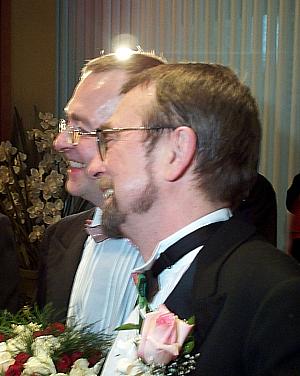
Tuesday was the 10th wedding anniversary of Michael Hendricks and René Leboeuf, the first gay couple to be legally married in Quebec, about a month before marriage equality came to Massachusetts. In a recent interview, the couple reflected on the fight to the altar:

POP TART: Your court case began on Nov 8, 2001. Over the next few years, what was the most difficult part about this legal battle and journey?

Hendricks: Putting up with the “know-it-all” lawyers we had at first who tried dish_hendricks-leboeuf to dictate to us what we should do and say – very politically ill-informed people, with wacky ideas and enormous egos. But we were really lucky once we got rid of them and built a legal team that respected us and, in the end, carried the day in the Quebec Appeals Court. They attended our wedding as honoured guests. … As for the myth that “the gay community” is rich and paid for everything – they paid around $7,000 out of the $300,000 [in lawyer fees]. There was a lack of support from the LGBT community in general until we started to win. Then they were all over us like a cheap suit. We quickly learned what the term “Success has many parents while failure is an orphan” means. For example, one “community” lawyer pleaded for civil unions in court which led the Chief Justice of the Quebec Appeals Court, Michel Robert, to ask him during the hearing for which side was he arguing.

POP TART: How did you guys feel when you finally won?

Leboeuf: Thank god, it’s over!

Hendricks: We were tired after 6 years of constant hostility, constant fundraising, putting up with whacky lawyers and with sniping by members of the community – many of whom, incidentally, now take credit for having won the marriage battle and have gotten legally married after telling us for years how they rejected it in favour of civil unions. …

POP TART: How important do feel your 10th wedding anniversary is, both personally and publicly?

Hendricks: Personally, after our first 30 years together, 10 years is nothing. Nothing really changed in our everyday lives except our legal affairs which, as a couple, are now straightened out. Publicly? At the time we were talking about moving a mountain. But today, 10 years later, SSM is accepted – trivial in fact – and forgotten. That’s perfect, exactly what we hoped would happen. Today, gay and lesbian adolescents generally think that marriage always existed for them, which is exactly what we wanted to achieve back in 1998.

(Image: Hendricks and Leboeuf at their wedding on April 1, 2004, via Wikimedia Commons)

How Will Francis Handle Uganda?

Michael O’Loughlin challenges the Pope to stand up to bishops supporting anti-gay laws in Africa:

Violence and discrimination against gays and lesbians around the world is very real and, in places, growing. From Nigeria to Uganda to Russia, efforts to codify rampant homophobia and lend legitimacy to the mobs that torment sexual minorities have widespread backing. That some Catholic bishops support these laws seems anathema to the Gospel that they are supposed to uphold, their critics argue, in particular to the central tenets of acceptance and kindness — a stance to which the pope seemed to lend his support in much-lauded comments last year.

Why, then, won’t Pope Francis speak out more directly against political leaders like [Nigerian President Goodluck] Jonathan and against his own bishops who support draconian treatment of gay people? Some say failing to do so threatens to derail his conciliatory image, hinged on engaging in dialogue with a changing world. As Bob Shine of New Ways Ministry, which advocates for LGBT Catholics, wrote in late March, “It is time for Pope Francis to speak out clearly and forcefully against Uganda’s law, and other similar anti-gay laws around the globe. He can save lives.”

Matt Ford argues that “the pope may have to confront growing homophobia in Uganda, whether or not he travels there”:

The pontiff’s tenure, now in its second year, has so far been characterized by two themes: greater compassion on social issues in the developed world, and greater outreach to and inclusion of the developing world. Until now, these goals have rarely clashed. How he bridges the divide between the two in Uganda, if he chooses to try, will be one of the great challenges of his papacy.

Reefer Sanity Watch

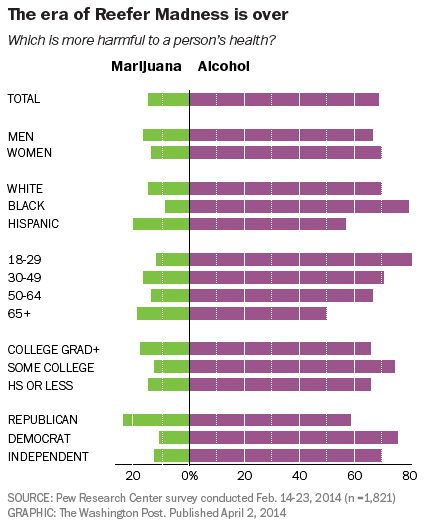
Pew found that the public is finally getting it right about the relative harms of marijuana and alcohol:

alcohol-marijuana-harm

Christopher Ingraham summarizes the poll and provides the above chart:

The elderly, Republicans and Hispanics are the least likely to agree that booze is more harmful than weed, but even among these groups respondents said that alcohol was more harmful by more than a two-to-one margin. At the other end of the spectrum, blacks say alcohol is more harmful by an eight-to-one margin, while those under thirty agree by nearly seven-to-one.

Now compare this with the formal stance of the DEA: that marijuana is as dangerous as the hardest drugs and completely useless as medicine, while alcohol is perfectly fine. The federal government, in other words, officially holds a view that is empirically untrue, intuitively absurd, contrary to any serious scientific judgment and an insult to the opinion of a hefty majority of Americans. Why are we not demanding it change and change now?

A Treacherous Climb Up The Social Ladder

While studying the causes and motivations of high school bullying, UC Davis sociologist Robert Faris found that kids who ascend the social hierarchy, especially girls, run a high risk of being victimized:

Faris was interested in understanding bullying at a deeper level, to identify “hotspots” of conflict and aggression in school-based hierarchies. He and his colleague Diane Felmlee, professor of sociology at Pennsylvania State University, investigated whether there were other reasons for students’ aggression toward one another, such as using it as a tool for social climbing.

Their results, published in American Sociological Review, suggest that kids get bullied not only when they don’t fit in, but also when they are simply trying to avoid being victims by moving up the social ladder. “As social status increases, the involvement in aggression–both as perpetrator and now as victims–also tends to go up until they get to the very top, when things start to reverse,” says Faris.

Emily Bazelon explains what this means for how we approach the problem of bullying:

Faris and Felmlee come out with one clear proposal for schools: Bullying-prevention programs should try to de-emphasize hierarchy. The more that students feel there are multiple routes to social success—the choir as well as sports, chess champion as well as class president—the better. That sounds right to me, but also hard for adults to construct. Teenagers have to have their own ways of taking each other’s measure separate from adult wishes and meddling. That’s part of growing up. The trick is for them to lead each other to social rewards that come from building other people up rather than tearing them down. This study is an important reminder that all kinds of kids benefit from making that shift, from all points in the high school universe.

Press Not Censored, Say Readers Of Censored Press

Screen Shot 2014-04-02 at 12.53.57 PM

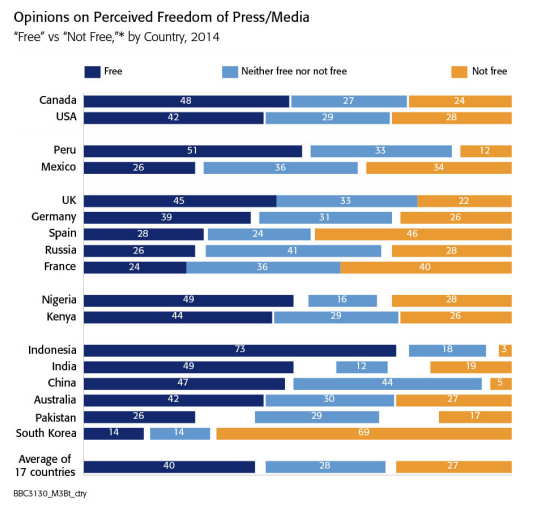
That’s one finding from a recent survey showing how people in 17 countries perceive their level of freedom:

Some of the results of the poll will not surprise anyone who has heard of Edward Snowden: a majority of Americans and Germans feel they are not free from government surveillance or monitoring, and only a third of Americans and Canadians, 38 percent of Britons and 27 percent of Germans feel the Internet is a safe place to express their opinions. But the eye-catching figure is that 76 percent of respondents in China said they do feel free from government surveillance and monitoring – the highest proportion among the 17 countries polled (Australia came in second with 72 percent). And 45 percent of Chinese respondents said the Internet was a safe place to express their opinions, more than in most countries polled (France rated worst on this score, at 22 percent).

Another surprise was the proportion of respondents in China – 47 percent – who said their press, which is in fact rigidly censored, is free. This was higher than the result for France (24 percent), Spain (28 percent), Germany (39 percent), America (42 percent), Australia (42 percent) and Britain (45 percent).

Over at Quartz, Lily Kuo notes that China is easing off its “more Orwellian approaches” to information control in favor of “allowing a certain degree of open debate on the Internet”:

How does this work in practice? Since 2005, dozens of local governments have been hiring Internet commentators – known as wumao for the supposed ¢50-a-post state-backed bloggers receive for interjecting pro-government sentiment into online discussions and for defusing anti-Communist Party sentiment. This is consistent with government directives, advising officials to focus less on controlling online discussion, Yang says. For instance, in 2010, a local public security department in Fujian province published a document saying Internet management should combine “damming with channeling, with more focus on channeling.”

Another way the government attempts to influence public opinion via the internet is through actual government engagement. In the city of Ji’an, in Jiangxi province, Yang explains that rather than blocking bloggers’ comments or accounts, officials have been contacting bloggers, explaining the harm of their posts and encouraging them to delete or modify them of their own accord.