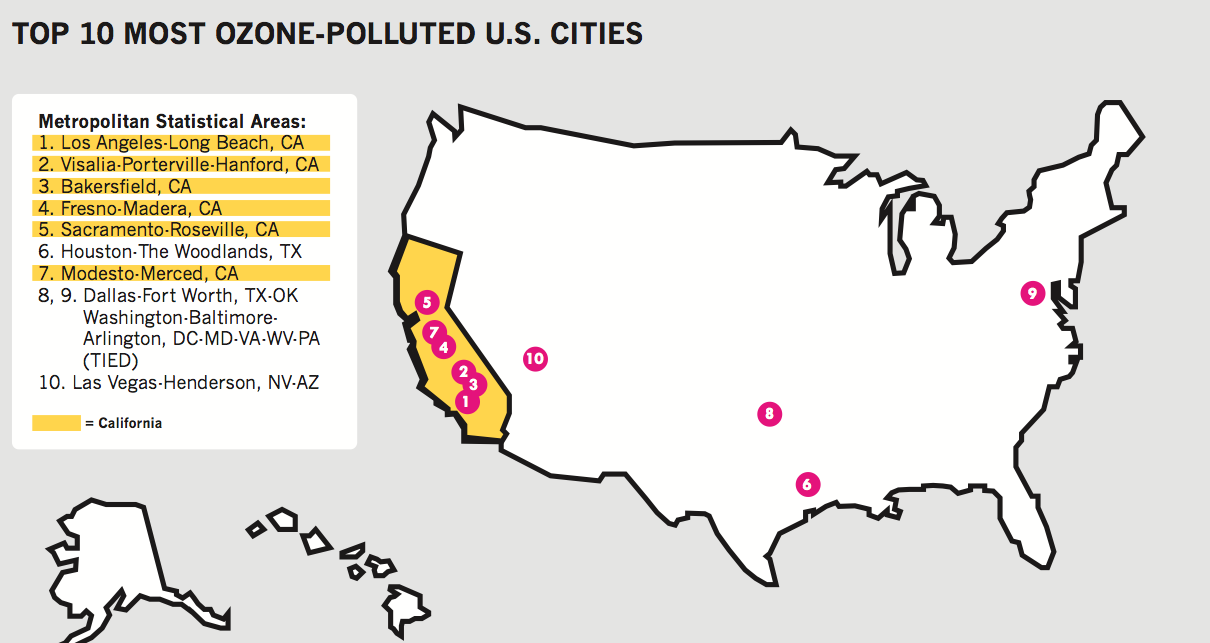
The American Lung Association’s annual “State of the Air” report shows that much of the country is still suffering from “dismal levels of pollution”:
More than 147 million people, or roughly half the nation, live in places with unhealthy concentrations of ozone or particulate pollution. Fifty-three million others reside in areas that the association has slapped with a most troublesome “F” grade for pollution. The health implications of this coast-to-coast blanketing of foulness are hard to overstate.
Suzanne Goldenberg notes that ozone levels are rising across the country:
The report, which is based on data collected between 2010 and 2012, found smog, or ozone, had worsened in 22 of the 25 biggest US metropolitan areas, including Los Angeles, Houston, Washington-Baltimore, New York City and Chicago – and said there was a high risk of more high-ozone days because of climate change. … Smog, or ozone, which is the most widespread air pollutant, forms more readily in hotter temperatures, and is expected to increase under climate change. “It’s going to make it harder to clean up air pollution,” said Janice Nolen of the American Lung Association. “Days that wouldn’t ordinarily have high ozone levels are going to have them.” She added: “It’s going to be much harder to keep ozone pollution down to the levels that we should be breathing.”
Meanwhile, Brad Plumer explains why more than half of the 10 most polluted US cities are in the Golden State:
Why does southern California dominate the list? One reason is that tailpipe emissions from all those cars and trucks interact with high heat and bright sunlight to create ozone pollution. An especially hot summer made things worse. So did the geography of the Central Valley, whose weather patterns tend to trap pollutants in the region.
He adds that not all the news is grim:
That all said, it’s worth putting this in historical perspective. … [S]ix major air pollutants have all fallen 72 percent since 1970 – due, in large part, to the Clean Air Act. Over that same period, the economy has grown 219 percent, the number of miles we drive has grown 165 percent, and the amount of energy we use has grown 47 percent. So it’s certainly possible to drive down air pollution and still get much, much richer.
(Map by Mark Byrnes)

