Global Gentrification?

ifj67sQ

Surowiecki sees something like that in action:

The globalization of real estate upends some of our basic assumptions about housing prices. We expect them to reflect local fundamentals – above all, how much people earn. In a truly global market, that may not be the case. If there are enough rich people in China who want property in Vancouver, prices can float out of reach of the people who actually live and work there. So just because prices look out of whack doesn’t necessarily mean there’s a bubble. Instead, wealthy foreigners are rationally overpaying, in order to protect themselves against risk at home. And the possibility of losing a little money if prices subside won’t deter them, [urban planner Andy] Yan says, “If the choice is between losing 10 to 20 per cent in Vancouver versus potentially losing 100 percent in Beijing or Tehran, then people are still going to be buying in Vancouver.”

The challenge for Vancouver and cities like it is that foreign investment isn’t an unalloyed good. It’s great for existing homeowners, who see the value of their homes rise, and for the city’s tax revenues. But it also makes owning a home impossible for much of the city’s population.

Emily Badger wonders whether taxing foreign investors could be an answer:

Taxing them for the privilege – beyond existing property taxes – probably won’t deter foreigners who have a lot of money to shell out in the first place … But maybe that revenue could be spent mitigating some of the consequences of international investment. What if cities used that money to create new affordable or moderate-income housing, as communities in London are considering? Or to help pay for a proposal like Mayor Bill de Blasio’s $41 billion plan to ensure 200,000 affordable-housing units in New York? Or to support programs and infrastructure that benefit the residents who do live in town?

Cities already require such concessions of real estate developers, who have to fund public parks, affordable housing or new school construction in exchange for the right to develop a project. What would happen if we thought in similar terms about the investors who later come in to buy that finished real estate?

Update from a reader:

That graphic is pretty obviously wrong. It suggests that real estate in the most expensive market in the world, Monaco, costs $400 a square foot, which is considerably less than what it costs in suburban Boston, from whence I write. It also claims that real estate in New York will cost you $58 per square foot, and that real estate in London is almost three times as expensive as in New York. I looked at the original source, and it looks like the person who made the chart converted from square meters to feet squared (i.e. the original source says $1m will buy you 15 square meters, and 15 meters is 50 feet, so the graphic presents that as $1m will buy you 50 feet squared, whereas 15 square meters is in fact about 160 square feet, and the conversion error becomes much bigger as the sizes get bigger). So, in fact, the original data say that real estate in Monaco is about $6,200 a square foot, New York is a little over $2,300 (presumably they’re talking about relatively prime real estate), and London is just over 50% more expensive than New York.

(Graphic by Simran Khosla/GlobalPost)

Coloring Our Perception

Maria Konnikova reviews research on how misinformation affects our judgment:

Even when we think we’ve properly corrected a false belief, the original exposure often continues to influence our memory and thoughts. In a series of studies, [psychologist Stephan] Lewandowsky and his colleagues at the University of Western Australia asked university students to read the report of a liquor robbery that had ostensibly taken place in Australia’s Northern Territory. Everyone read the same report, but in some cases racial information about the perpetrators was included and in others it wasn’t.

In one scenario, the students were led to believe that the suspects were Caucasian, and in another that they were Aboriginal. At the end of the report, the racial information either was or wasn’t retracted. Participants were then asked to take part in an unrelated computer task for half an hour. After that, they were asked a number of factual questions (“What sort of car was found abandoned?”) and inference questions (“Who do you think the attackers were?”). After the students answered all of the questions, they were given a scale to assess their racial attitudes toward Aboriginals.

Everyone’s memory worked correctly: the students could all recall the details of the crime and could report precisely what information was or wasn’t retracted. But the students who scored highest on racial prejudice continued to rely on the racial misinformation that identified the perpetrators as Aboriginals, even though they knew it had been corrected. They answered the factual questions accurately, stating that the information about race was false, and yet they still relied on race in their inference responses, saying that the attackers were likely Aboriginal or that the store owner likely had trouble understanding them because they were Aboriginal. This was, in other words, a laboratory case of the very dynamic that [political science professor Brendan] Nyhan identified: strongly held beliefs continued to influence judgment, despite correction attempts—even with a supposedly conscious awareness of what was happening.

The Gender Gap In Retirement

dish_genderwage

Jonnelle Marte details it:

Men had an average of $139,467 in their individual retirement accounts as of 2012, compared with the average of $81,700 that women had stashed in their IRAs, according to a report released Wednesday by the Employee Benefit Research Institute, a Washington-based research institute that focuses on health, savings and retirement issues.

As the chart [above] shows, women moved money to their IRAs just as often as men did. This was true for IRAs overall, which saw contributions for 10.9 percent of accounts held by women and 10.8 percent of accounts held by men; for Roth IRAs, which require people to contribute with after-tax dollars; and for traditional IRAs, which can include tax-deductible contributions.

Melanie Hicken considers some of the reasons for the disparity:

[F]emale workers make up about two-thirds of all part-time employees. And the majority of those jobs don’t come with employer-sponsored retirement benefits. That makes it harder to save for retirement at all, let alone to accumulate a nest egg large enough to last decades. Proposals to help workers who do not receive workplace retirement benefits, such as Obama’s new myRA plan, are a start but unlikely to make any major improvements.

Getting Away With Murder

There’s a place where it’s possible, apparently:

Let’s imagine Daniel and Henry are vacationing in Yellowstone National Park, and set up camp in the 50 square miles of the park that are in Idaho (unlike most of the park, which is in Wyoming). They get into a fight and Daniel winds up killing Henry.

But rather than bury the body and try to cover up the crime, Daniel freely admits to it and surrenders himself to the authorities.

At his trial, he invokes his right, under the Sixth Amendment, to a jury composed of people from the state where the murder was committed (Idaho) and from the federal district where it was committed. But here’s the thing — the District of Wyoming has purview over all of Yellowstone, even the parts in Montana or Idaho. So Daniel has the right to a jury composed entirely of people living in both Idaho and the District of Wyoming — that is, people living in the Idaho part of Yellowstone. No one lives in the Idaho part of Yellowstone. A jury cannot be formed, and Daniel walks free.

That scenario is fiction, but all the legal maneuvers Daniel employs are completely legitimate, and someone in a similar situation could quite possibly get off scot free. That got a lot of attention when it was first pointed out by Michigan State law professor Brian Kalt in his 2005 Georgetown Law Journal article, “The Perfect Crime.” After all, it implied that there was a 50 square mile “Zone of Death” of the United States where you can commit crimes with impunity, like in The Purge or something. The scenario even got featured in a best-selling mystery novel, Free Fire by CJ Box, who consulted Kalt when writing the book.

Update from a reader:

I served as a chaplain in a trauma hospital in Alabama, and I observed that criminal investigators from rural counties rarely bothered to investigate apparent suicides as possible murders. One case in particular stood out, where a man was brought in who had initially survived a gunshot wound to the head. The story being told by his common-law wife was that the gunshot wound was self-inflicted, but she seemed to be in a big hurry to have his life support removed. Others in the family were concerned that the wife was somehow responsible. When it was all said and done, the county law enforcement spent about 20 minutes investigating the incident and ruled it a suicide. The county didn’t do an autopsy because of funding issues and the man was cremated expeditiously.

I learned at that moment that if you wanted to get away with murder, stage a suicide in a rural county in Alabama.

Off-Roading With Google Street View

dish_canyonview

While praising Google for bringing Street View to the Grand Canyon – “the company has captured the canyon with tremendous accuracy” – Jeremy Miller describes the limitations of virtual tourism:

[Street View Grand Canyon] feels conspicuously inadequate in critical ways.

On the virtual river you can fast-forward downstream, avoiding the soaking rapids and searing sun, putting in and taking out as you please. But part of the Grand Canyon experience is surrendering to the flow of the river and committing to the journey. Anyone who has traveled in canyon country knows how much the terrain can change in a matter of seconds during an afternoon rainstorm, or in the hours between noon and dusk, as sunlight glistens and fades upon the canyon walls. To these subtle but vital gradations, Google’s roving digital eye remains conspicuously blind.

I’d heard these shortcomings voiced by proud river runners and backpackers, often delivered with mild condescension (“I guess I can cancel my rafting permit for this summer”) or outright indignation (“Is nothing sacred?”). Jonathan Thompson, an editor at High Country News, invoked the cantankerous author Edward Abbey, who in the 1970s wrote, “The utopian technologists foresee a future for us in which distance is annihilated and anyone can transport himself anywhere, instantly. . . . To be everywhere at once is to be nowhere forever, if you ask me. That’s God’s job, not ours.” [Project leader for Google’s Grand Canyon mapping effort Karin] Tuxen-Bettman made a similar concession, pointing out that the map and its imagery were no substitute for the canyon itself. “It reflects what’s there at one moment of time,” she said, “but it does not replace it.”

Explain Yourself

It might make you more open-minded:

Recruiting a sample of Americans via the internet, [researchers] polled participants on a set of contentious US policy issues, such as imposing sanctions on Iran, healthcare and approaches to carbon emissions. One group was asked to give their opinion and then provide reasons for why they held that view. This group got the opportunity to put their side of the issue, in the same way anyone in an argument or debate has a chance to argue their case.

Those in the second group did something subtly different. Rather that provide reasons, they were asked to explain how the policy they were advocating would work. They were asked to trace, step by step, from start to finish, the causal path from the policy to the effects it was supposed to have.

The results were clear. People who provided reasons remained as convinced of their positions as they had been before the experiment. Those who were asked to provide explanations softened their views, and reported a correspondingly larger drop in how they rated their understanding of the issues.

Face Of The Day

by Andrew Sullivan

EU Election Count In Southampton

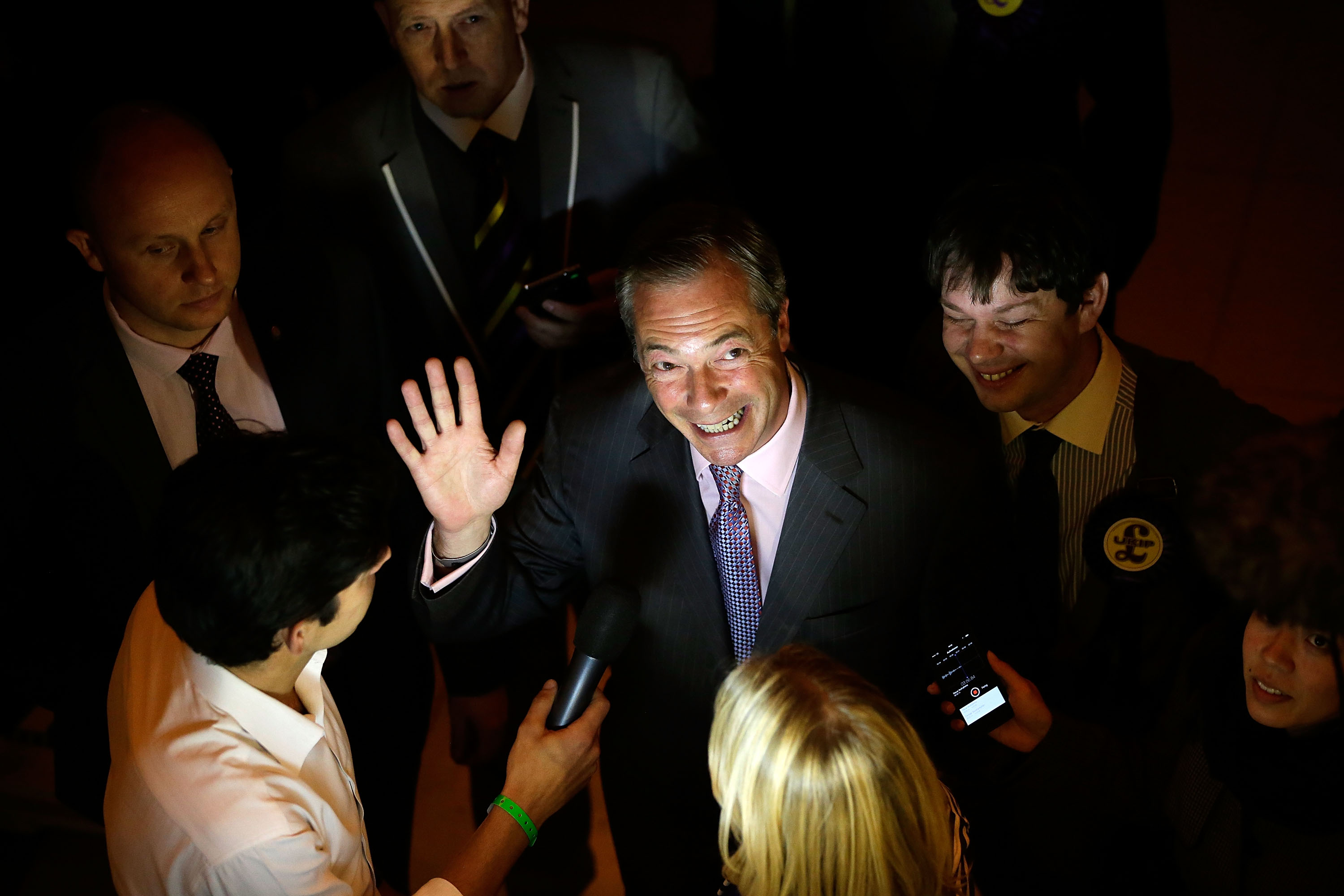
UK Independence Party (UKIP) leader Nigel Farage is interviewed by media as he arrives at the Guildhall for the results of the South East election count on May 25, 2014 in Southampton, England. UKIP, which advocates withdrawal from the European Union, was the top vote-getter in Britain’s European elections, beating both the Tories and Labour. By Matthew Lloyd/Getty Images.

Why Take Vacations?

by Jonah Shepp

Pointing to the abundance of research showing that “people who take vacations aren’t any happier, or are only barely so, than those who [don’t],” Jennifer Senior asks the obvious question:

Several reasons: First of all, our happiness often increases before vacations too, and that’s no small thing—never underestimate the hedonic power of anticipation. The positive memories from vacation also seem to occupy disproportionately large tracts of real estate in our minds, even if we weren’t enjoying our holidays at every moment in real time—and who are we, if not the sum of our most cherished memories?

But perhaps more to the point, our bodies appear to crave a respite from real life. While on vacation, we sleep more (about three quarters of an hour extra per night) and better; there’s also good evidence that they reduce our risk of cardiovascular disease and generally improve our long-term health. As de Bloom and her co-authors say in their 2013 paper, “Asking why we should keep going on vacations is therefore comparable to asking why we should go to sleep considering the fact that we get tired again.” Our bodies need them, simple as that.

More Than Pulling Strings

by Matthew Sitman

8620870455_d7bf611145_b

Eric Bass, a puppeteer, explains why the assumptions behind phrases like “puppet government” or “played him like a puppet” misunderstand what the art is all about:

As puppeteers, it is, surprisingly, not our job to impose our intent on the puppet. It is our job to discover what the puppet can do and what it seems to want to do. It has propensities. We want to find out what they are, and support them. We are, in this sense, less like tyrants, and more like nurses to these objects. How can we help them? They are built for a purpose. They seem to have destinies. We want to help them arrive at those destinies.

A simple example: What are the properties of a ball? It rolls, and sometimes it bounces. To put a ball onstage and have it never bounce or roll is a denial of what that ball is. Even if the ball does nothing, it can be said to be waiting to roll or bounce. A figurative puppet’s properties may not be quite so obvious, but they are there, and so is its character.

Analyzing the character will not get us very far. We have to discover who our performing partner is. This is true of its actions, its gestures, and its voice. Our cleverness in thinking of great things for the puppet to do or say will not help the puppet live. They will only draw attention to ourselves. If we try to impose them on the puppet, the piece we are performing will not be about the puppet at all. It will be about us, the manipulator. Or it will be about the conflict between us and our puppet.

The practice of our art, then, requires that we be the exact opposite of a controller. In fact, it requires that we step back and allow our puppets to perform their roles, their actions, their moments of life on the stage. It requires from us a generosity. If we try to dominate them, we will take from them the life we are trying to give them.

(Hat tip: Prufrock. Photo by Wolfgang Lonien)