The Gridlockpocalypse

by Patrick Appel

Cassidy heralds its coming. He contends that “the G.O.P. is likely to gain the six seats it needs to capture the Senate, which could well usher in a two-year standoff with the White House that would make the current gridlock look like a model of benign administration”:

It’s not just that nothing would get done about things like climate change, gun control, and long-term budget reform. With the Republicans exercising a legislative veto through their majority in the House of Representatives, we have already been stuck on these issues, and many others, for three-and-a-half years. If the G.O.P. takes over the Senate, it will also gain the power to block Presidential appointees much more easily than it can do as the minority party—and a good deal of day-to-governance will probably grind to a halt. Judgeships and ambassadorships will remain vacant for want of candidates acceptable to both parties. Cabinet members and other nominees to the executive branch will have an even harder time getting appointed than they do now—and the situation is already so dire that it’s an international embarrassment to the United States.

But John Dickerson wants the GOP to take the Senate and be forced to govern:

For the moment, partisanship provides an excuse and impediment to action. House Republicans pass legislation, but their views never have to be sharpened or reconciled with those of their Senate colleagues. Control of both houses could force clarity in the GOP on issues like immigration, which leaders have ducked so far, claiming they didn’t have a trusted partner in the president. That is a dodge to keep from starting a fight in the party over a contentious issue.

When you control both houses, this kind of inaction can’t be allowed if the goal is to be taken seriously as a governing party. Republicans would also have to provide more concrete votes on issues like health care, tax reform, and implementing portions of Rep. Paul Ryan’s budget. Republican strategists know the GOP has to shake the “Party of No” label, which means producing actual accomplishments—that is, unless you want the governors in the GOP 2016 field using you as a foil. (Of course they’re already doing that anyway).

Burning Problems

by Tracy R. Walsh

fire-costs-dishedit

According to Brian Mockenhaupt, decades of aggressive fire-fighting efforts have left the West more prone to blazes than before:

During [the Great Depression], the Forest Service decided that every wildfire in the country should be put out by the morning after it was reported. The country had the manpower to try. This new approach coincided with the onset of several cool, wet decades, which aided the effort: forests weren’t as dry, so they grew more and didn’t burn as often. Smoke jumpers joined the fight, first parachuting into a fire in 1940, and after World War II their ranks swelled with veterans who had made combat jumps across Europe. After the war ended, firefighters also had surplus military trucks and bulldozers at their disposal, and by the mid-’50s they were using helicopters and retired military airplanes to drop water and flame retardant on fires. …

It seemed like a great success story:

Americans were fighting fire, just as they had fought their military enemies, and they were winning. But when wildfires don’t burn regularly, fuels simply accumulate, and bigger fires become inevitable—something policy makers took decades to recognize. “What they didn’t see at the time,” says Don Falk, a forest-and-fire ecologist at the University of Arizona, “is that fire is inevitable. You can defer it, but it’s a pay-me-now-or-pay-me-later scenario. There’s no fire-free scenario.” We’re paying for that blindness now. Across the West, enormous swaths of forest and shrubland are loaded with decades’ worth of built-up fuel.

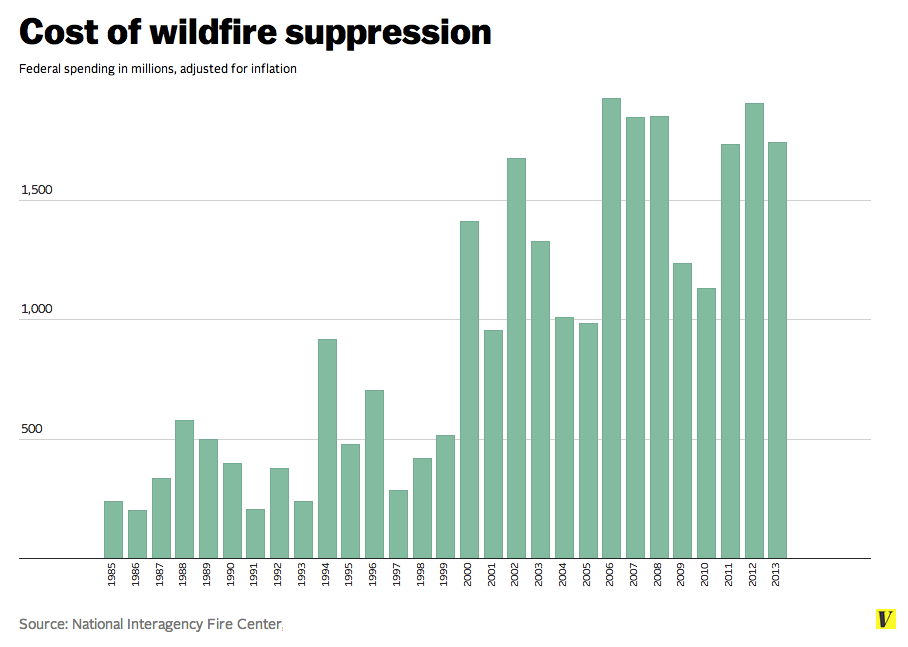
Plumer passes along the above chart:

Costs are going up partly because the wildfires themselves are getting bigger. But it’s also a function of the fact that more and more people are living in fire-prone areas. In Colorado, for example, some 250,000 new residents have settled into the fire-prone “red zone” over the past two decades. … Right now, Congress gives agencies like the US Forest Service a budget for fire suppression that’s based on the average cost of wildfires over the previous 10 years. Of course, if wildfires are getting bigger over time, that’s going to create constant shortfalls.

An Accounting Of American Racism, Ctd

by Patrick Appel

Dan Savage has effusive praise for TNC’s reparations article:

Gay marriage went from inconceivable to laughable to an existential threat to obviously just in a few short decades. I expect that reparations for slavery (and Jim Crow and redlining) will do the same—and I epxect that we will one day look back at Ta-Nehisi Coates’ 2014 piece in The Atlantic the same way we look back at Andrew Sullivan’s 1989 piece in the New Republic (“Here Comes The Groom: A (Conservative) Case For Gay Marriage”). This is an essay that could jumpstart a movement. It’s certainly a piece that everyone is going be talking about.

John McWhorter is more critical:

Despite frequent claims that America “doesn’t want to talk about race,” we talk about it 24/7 amidst ringing declamations against racism on all forms. Over the past year’s time, I need only mention Trayvon Martin, Paula Deen, Cliven Bundy, and Donald Sterling. Over the past few years, three of the best-selling and most-discussed nonfiction books have been Isabel Wilkerson’s chronicle of the Great Migration, The Warmth of Other Suns, Rebecca Skloot’s book about the harvesting of a black woman’s cancer cells (The Immortal Life of Henrietta Lacks), and Michelle Alexander’s invaluable The New Jim Crow. And let’s not forget recent major release films such as The Help, 12 Years a Slave, and The Butler.

Can we really say that these are signs of a nation in denial about race, racism, and its history?

Yet for writers like Coates, somehow none of this is enough. A shoe has yet to drop. We remain an “America that looks away,” “ignoring not just the sins of the past but the sins of the present and the certain sins of the future.” But what, exactly, is the suggestion here? Surely not that no racism exist anywhere in the country—but what, then? In exactly what fashion could 317 million people “reckon” or come to certain eternally elusive “terms” with racism? Especially in a way that would satisfy people who see even America’s current atonements as insufficient?

William Jacobson points out that “Coates never gives the answer as to who gets what and how”:

And that’s ultimately the problem with reparations arguments that are not based upon the people causing the harm paying the people directly harmed by specific conduct soon after the conduct is remedied.

If you can’t answer the question of why a Vietnamese boat person has to pay reparations for the conduct of white plantation owners more than a century earlier, then you can’t make the argument. If you can’t answer the question of why two successful black doctors living in a fashionable suburb should get reparations paid for by the white children of Appalachia, then you can’t make the argument. If you can’t answer the question of why the adult black recent immigrant from Paris should be pay or be paid reparations based on the color of his skin for crimes committed in a land he did not grow up in, then you can’t make the argument.

And what about the increasing number of children of mixed race?

Bouie sees the purpose of the article differently:

Wisely, Coates doesn’t try to build a proposal for reparations. At most, he endorses a bill—HR 40—that would authorize a government study of reparations. Instead, his goal is to demonstrate the recent origins of racial inequality, the role of the federal government, the role of private actors, and the extent to which the nation—as a whole—is implicated. Even if your Irish immigrant grandparents never owned slaves, or even lived around black people, they still reaped the fruits of state-sanctioned—and state-directed—theft, through cheap loans, cheap education, and an unequal playing field. If anything, what Coates wants is truth and reconciliation for white supremacy—a national reckoning with our history.

Ezra weighs in:

“The popular mocking of reparations as a harebrained scheme authored by wild-eyed lefties and intellectually unserious black nationalists is fear masquerading as laughter,” Coates writes. It’s also the intellectually unserious response of people who believe that because they never owned slaves or drank from a whites-only water fountain and so they weren’t the beneficiaries of American racism. They may not be the villains of American racism, but they are the beneficiaries of it. The average white southerner in 1832 was far poorer than the average white southerner today, and part of that vast increase in wealth and income and knowledge and social networks is the result of compound interest working its magic on what the slaveowners and the segregationists stole.

It’s as simple and clear as a child’s math problem. The people who benefitted most from American racism weren’t the white men who stole the penny. It’s the people who held onto the penny while it doubled and doubled and doubled and doubled.

Emily Badger considers the impact of the discriminatory housing practices TNC focuses on:

Schemes like this illustrate why homeownership has been a much more precarious prize for blacks. They also explain why the racial wealth gap remains so wide today. Wealth in America, as it’s passed from one generation to the next, is intimately tied up in housing. And blacks have systematically been denied the chance the build that wealth. Just earlier this week, the Center for Global Policy Solutions released a report looking at the racial wealth gap in America today. It found that the average black household in America owns 6 cents for every dollar in wealth held by a typical white family. It found in the Washington, D.C., metropolitan area that whites have a homeownership rate that’s still 20 percentage points higher than blacks.

Lastly, PM Carpenter declares, “I’m all for Coates’ cause, but as a part-Native American and citizen of the Cherokee Nation, I want what’s mine and my brothers’ and my mother’s, too”:

I also want American women to be compensated for their years of unpaid grueling toil as they raised the next generation. And I want compensation for the millions of Jews, Irishmen, Italians and all other minorities who suffered from systematic discrimination in both civil society and the workplace. In fact I want reparations paid to every American who sprang from the loins of oppressed proletarians, for the slavery of class hierarchy is, historically, very real.

I’m not trying to make light of Coates’ pain, or to conflate black slavery with “Irish need not apply.” But the world doesn’t work in the way Mr. Coates believes it should. And almost everybody has a history of major hurt, against which endless cases for reparations could be made.


This Is Like So Totally A Coup

by Jonah Shepp

Francis Wade updates us on the situation in Thailand, where the military finally admitted yesterday that it had, in fact, carried out a coup d’etat:

Thais awoke this morning to their first full day of military rule, with top political leaders detained and television stations taken off air following a coup yesterday led by the powerful army chief, General Prayuth Chan-ocha.

More politicians are expected to report to the army headquarters in Bangkok today, with the recently deposed Prime Minister Yingluck Shinawatra having already turned herself in, according to the BBC. They face possible arrest, while scores of politicians and activists have been banned from leaving the country. Commentators questioned the grounds for the coup in light of the fact that the ongoing political turmoil had been limited mainly to Bangkok. The U.S., a strong ally of Thailand, sharply criticized the army’s intervention, with Secretary of State John Kerry asserting that “there is no justification for this military coup.”

Lennox Samuels takes the pulse of Bangkok under curfew:

TV screens were dark or adorned with royal and military symbols, with military and patriotic music playing on a loop and “National Peace and Order Maintaining Council”—the euphemistic name the generals have assigned to the coup administration—prominently displayed in Thai and English. Local stations, from Thairath to Voice TV, Nation TV, TNN24 and THV, are shut down. The government is blocking CNN, BBC, Bloomberg and other foreign networks; Al Jazeera English, curiously, remains on the air.

Even normally eager-to-talk sources have gone to ground, unsure how punitive the military might be in its actions against critics. No sources answered their phones. One sent a terse text message in response to voicemails: “Really sorry can’t talk right now.”

Keating examines why Thailand is “as prone to coups as some of the world’s most unstable failed states”:

Thailand’s coup culture preceded the red-yellow divide, and may have its roots in the unique role the monarchy plays in Thai politics. While Thai politics are bitterly divided, both sides venerate King Bhumibol with an ardor that’s a little difficult for foreigners to grasp, and has on a number of occasions landed them in jail. In comparison with the monarchy, electoral institutions in Thailand tend to be viewed as a bit more transitory.

The king has personally intervened to end Thai political crises in the past, and the fact that his intervention is often sought as a kid of deus ex machina when the country’s political forces are at a loggerheads likely doesn’t really help the legitimacy of civilian political institutions. The Australian scholar Nicholas Farrelly argues that “Thailand has largely accommodated military interventionism, especially by accepting the defence of the monarchy as a justification for toppling elected government.”

William Pesek doubts this will end well:

With no exit strategy visible for the generals, this coup could easily prove to be an unmitigated disaster, even a prelude to full-blown civil war. The odds of a credible election that heals Thailand’s wounds over the next few years are in the single digits right now. Yet there is no other means of establishing a stable government that both the international community and the Red Shirts will accept. The 0.6 percent drop in gross domestic product in the three months through March is only the beginning of economic fallout to come.

Asian markets are largely ignoring this week’s events in Bangkok, figuring we’ve seen this before. They’re being complacent. Thursday’s coup demonstrates a debilitating level of political dysfunction that’s gradually pulling Thailand in the direction of Egypt and Tunisia, not South Korea. Rather than end Thailand’s political nightmare, this coup could drive the country toward whole new levels of chaos.

But Heather Timmons takes the market’s reaction at face value:

Thailand’s twelfth military coup has ushered in a news blackout and a nationwide curfew, but some investors are actually cheering the move, which they say could bring much-needed stability to the divided country, and lift the stock market and currency after months of protests. Seasoned Thai investors have plenty of experience with coups—there has been one every 4.5 years, on average, since 1932. “We view the current military coup as likely overall positive as it creates a more stable environment,” Mark Mobius of Templeton Emerging Markets Group, told Bloomberg. “The prognosis for Thailand is good.”

How the US has responded:

In a stark contrast to its handling of the military takeover in Egypt earlier this year, the U.S. government swiftly ruled the Thai action a coup, beginning a review of U.S. aid to Thailand. At least $10 million in American funding may be withdrawn under federal laws that prohibit American aid to countries where democratic governments have been overthrown. State Department spokeswoman Jen Psaki wouldn’t elaborate on why the U.S. government did not rule the Egyptian takeover a coup after weeks of review but could make the Thailand decision within hours of the takeover.

Adam Taylor finds that distinction suspicious:

So what exactly is different about Thailand and Egypt? According to Jay Ulfelder, an American political scientist who focuses on political instability, not as much as the State Department hopes. “State is assiduously resisting efforts to draw it into explicitly comparing the two cases, and with good reason,” Ulfelder explains. “Under all the major definitions used by political scientists, both today’s events in Thailand and last summer’s events in Cairo qualify as successful coups. So based on the facts alone, there’s no coherent way to conclude that the two cases wind up in different categories.”

Coup is dirty word, as Thailand’s military are well aware (“This is definitely not a coup,” one army official told the AP on Tuesday). But while academics don’t totally agree on the details, Ulfelder points out that most academic definitions of a coup have three main points: 1) The use or threat of force 2) by people inside the government or security forces 3) with the aim of seizing control over national political authority. Sometimes a fourth point is added to these: 4) by illegal or extra-constitutional means. After the attempts of Thursday, Thailand meets at least three of the categories, and the events in Egypt last year meet all.

And Elias Groll adds that what happened in Bangkok definitely doesn’t qualify as a “democratic coup”:

[Ozan] Varol defines a “democratic coup” according to the following criteria:

(1) the coup is staged against an authoritarian or totalitarian regime; (2) the military responds to persistent popular opposition against that regime; (3) the authoritarian or totalitarian regime refuses to step down in response to the popular uprising; (4) the coup is staged by a military that is highly respected within the nation, ordinarily because of mandatory conscription; (5) the military stages the coup to overthrow the authoritarian or totalitarian regime; (6) the military facilitates free and fair elections within a short span of time; and (7) the coup ends with the transfer of power to democratically elected leaders

On point one, it fails for Thailand: The ousted government was democratically elected and had taken steps to reconcile with the protest movement by promising new elections. And while the military certainly responded to popular opposition, the governing coalition’s ability to consistently win popular elections would point to their support among the people. On point three, the government had called for new elections in response to the protests. On point four, it depends on whom you ask. On the fifth criteria, the answer is an obvious no. And on points six and seven, it remains to be seen — and the country’s long history of coups certainly doesn’t point toward an answer in the affirmative.
Love At A Distance, Ctd

by Chris Bodenner

The popular thread continues:

I call bullshit on the long-distance, living-apart marriage. My husband and I were in a long-distance relationship before we were married. During that time, things were always fabulous. But that is because I got to experience only a fraction of my spouse – the part that shows off well in short increments. Marriage is intimacy – the hardest form (at least it’s supposed to be, but in the age of “me, me, me” it’s hard to sustain that concept). Marriage is being completely emotionally available to another person. It’s allowing another soul to see yours, including the beauty and the undeniable “you make we want to strangle you sometimes” warts. Had I never lived with my spouse, I never would have experienced the true closeness that has come from driving each other batty, but eventually learning to accept each other as we are (and not the versions of ourselves that manage to present well in 3-4 day periods). I don’t see how you can ever accomplish this if at the end of the day you can simply turn to your partner and say “go home until we get along again.”

Another is miffed by such criticism:

I don’t understand why people feel the need to be so judgmental of other peoples’ living arrangements. My partner and I have been together about 13 years. We bought a duplex together 11 years ago … he lives on one side, I live on the other.

The reasons we chose to go this route in the beginning, vs. purchasing a house, aren’t relevant here … but I have to say that the arrangement has worked out a lot better than I think a house would have. We have different approaches to all kinds of things (orderliness, pack-ratting, daily routines, what kind of food is ok to keep around, etc.) that would cause tremendous conflict if we didn’t have our own space and a certain level of autonomy.

Seven years ago, we brought a child into the world. He “lives” with me (his room and toys are on my side), but he happily bounces back and forth between the units as needed. We function just like any other family – we cook and eat together, watch TV together, play and work around the house together … but Dad typically sleeps next door, with his stuff and his cats. Big deal.

Want to sleep under the same roof? Fine, do it. Don’t want to? Then don’t. Want to sleep under the same roof, but with a big dividing wall down the middle? Buy a duplex. But PLEASE stop judging people – or their commitment level to their partner – when they make different decisions than you would.

Another reader:

I am finding this LAT discussion so timely that I wanted to chime in. The SO [significant other] and I just celebrated our seventh anniversary. We have never lived together. He has a condo that is too small for me. I have a tiny overpriced apartment 30 minutes away I’m not attached to, but my commute to work is two minutes. To move in together we would have to buy a place to have the comfort and space we have now.

We spend every weekend together and a nights a week when we can. We talk on the phone most nights. We work in similar industries so we also collaborate on projects. There is no question we are head-over-heels in love, monogamous and enjoy every second of our time spent together (even when we’re being homebodies).

In seven years we have rarely fought. We run errands for each other. We help and support each other. I’d also add the pressure of having regular sex when you live with someone (at least in my past hetero experience) can turn into conflict. With the SO, sex is a great motivation for a 30-minute drive on a work night and mostly guaranteed when we’re together. The fact that we both look forward to sex and really enjoy it allows for a great deal of intimacy, without any pressure about one partner feeling the relationship is lacking in that regard.

We have conversations about how it would be nice to live together, but neither one of us feels that if it doesn’t happen we’re walking away. Sure, we would save money on mortgage/rent, but that’s not a real reason to do it. The friends and family who ask about our living situation have goals to get married and have kids (or have already done so), but the SO and I do not.

LAT is wonderful for me because neither of us even have the option of taking each other for granted or falling into co-dependency if we want to keep this relationship going another seven years and beyond (and we do!). I think we could live together and be perfectly happy. Still, our current living situation dictates we must respect each other as independent individuals and I find that very rewarding too. Some of the friends and family seem flabbergasted that the LAT situation works at all, but it does. It is the most loving, fulfilling and easiest relationship I have ever been in.

Map Of The Day

by Patrick Appel

Marriage Map

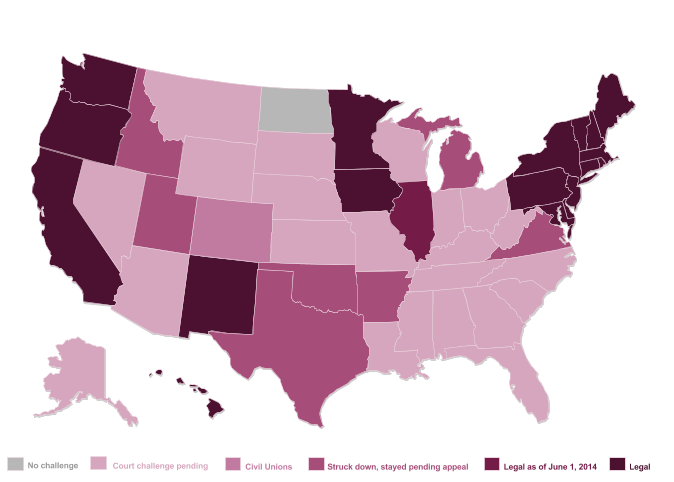
Only one state hasn’t had its marriage ban contested:

Six couples filed a federal lawsuit against South Dakota’s gay marriage ban [yesterday], leaving North Dakota as the only state in the country with an unchallenged same-sex marriage ban. … This is, of course, subject to change, possibly very soon. Josh Newville, the lawyer representing the South Dakota couples, told the AP that he’s been approached by several gay couples from North Dakota and is “seriously considering” taking their case on.

India’s Gun Control

by Jonah Shepp

Vivekananda Nemana and Ankita Rao explore the gun rights movement in India, where the law requires gun owners to temporarily surrender their firearms before every election:

Even outside election season, it’s difficult and expensive to buy a gun in India. To procure a license, regular citizens must give evidence that their lives are threatened and require extra security, as legislated in the 1959 Arms Act and the 1962 Arms Rules. In 1986, the central government banned all imports of firearms in response to a violent insurgency in the northwestern state of Punjab. Today, most Indians looking to buy legal guns must choose between arms imported before the law went into effect and the basic handguns and rifles manufactured by the state-run Indian Ordnance Factories, which [secretary-general of the National Association for Gun Rights India Rakshit] Sharma says are low quality and overpriced. A used Walther PPK — James Bond’s weapon of choice, which costs around $300 in the United States — can fetch as much as $15,000 in India, Sharma said. His Smith & Wesson revolver cost him half a million rupees, or about $10,000 at the current exchange rate — about nine times what it would cost in the United States. “The owner’s nightmare is to see them rust at a police station for two months,” he said.

How many guns are there in India, anyway? Nobody really knows:

The best estimate, from a 2011 survey by the India Armed Violence Assessment, a New Delhi-based research organization, says the country has 40 million privately owned guns — the second most in the world, after the United States — with only 6 million of them legal. That’s why Sonal Marwah, a researcher with the India Armed Violence Assessment, which works to measure and analyze the arms industry, thinks taking guns away from licensed holders could be counterproductive. Marwah said that during elections — especially in thinly policed rural areas — politically connected gangs buy up cheap, often makeshift, guns from illegal workshops. The guns are then used to intimidate voters into supporting a certain candidate — though rarely, she added, for injuring or killing people. “It is the old rationale: criminal behavior,” she said, pointing to police reports of gun seizures. “It enforces demand, and you would expect it to peak during election season.”

Reihan Salam’s War On Public School Spending

by Jonah Shepp

Here, he floats the idea that private schools improve the public education system by keeping costs down:

By foregoing a public education for their children, private school parents relieve a financial burden on taxpayers. Without private schools, [economist Andrew] Samwick estimates that U.S. public K-12 schools would have to spend $660 billion rather than $600 billion per annum. If this positive externality interpretation is correct, Samwick suggests that parents could be underutilizing private schools because they fail to appreciate the benefit they provide others by making use of them.

To address this problem, he proposes treating the decision on the part of parents to send their children to private schools and to forego a public education as, in effect, a charitable contribution equivalent to the per pupil expenditure in their local public schools. The idea is that today’s school districts offer a “voucher” that can only be redeemed at local public schools, and private school parents are effectively donating these vouchers to their school districts so that the money can be spread among public school enrollees.

And in another piece, he argues that public schools have an obligation to improve their efficiency:

If you really care about public education, calling for more spending is exactly the wrong thing to do.

Pouring more money into dysfunctional schools gives incompetent administrators the excuse they need to avoid trimming bureaucratic fat and shedding underutilized facilities and underperforming personnel. It spares them the need to focus on the essentials, or to rethink familiar models. The promise of constant spending increases is what keeps lousy schools lousy. When private businesses keep failing their customers year after year, they eventually go out of business. When public schools do the same, they dupe taxpayers, and the occasional tech billionaire, into forking over more money. If you really, really care about The Children, call for a system in which the most cost-effective schools expand while the least cost-effective schools shrink, and school leaders are given the freedom to figure out what works best for their teachers and their students.

In response, Freddie deBoer loses it, calling the above “an awful piece that marries broad ignorance about its subject matter to the condescending Slate house style”:

Now it happens that there is no such thing as private school pedagogy that’s distinct from public school pedagogy. Private school teachers often attend the same college programs as public school teachers, teach from the same collection of textbooks, give the same sort of tests. They are often exempt from the manic standardized testing that public school teachers have to participate in, freeing up class time, so there’s that, I guess. But it’s not like there’s some secret lesson plans that get passed around only between private schools. And here’s another dirty secret: there frequently isn’t a big difference in the day-to-day administrations of private schools, either. Oh, you can fire a teacher easier in your average private school. But there’s absolutely no reputable evidence to suggest that this is why private schools seem to have better educational outcomes than public schools. There is, on the other hand, an argument that has been supported by decades of responsible studies from thousands of responsible researchers: student demographics are more powerful determinants of educational outcomes than teachers or schools. And private schools systematically exclude the hardest-to-educate students, through high tuitions, entrance exams, and opaque selection processes. For these schools, the fact that the hardest-to-educate kids can’t attend is a feature, not a bug.

Why Pull The Trigger? Ctd

by Chris Bodenner

First, a Dan Savage reader underscores a key distinction:

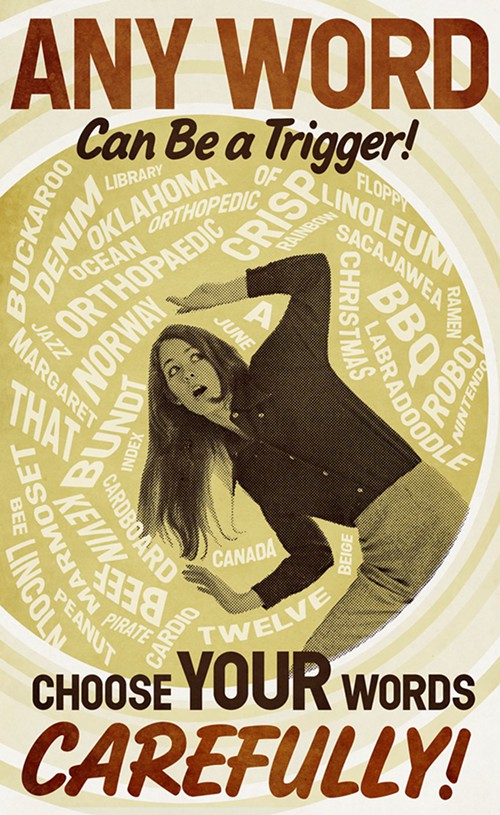
Thank you, thank you, thank you from a survivor of three separate T’s, triply diagnosed with1400614339-tumblr_n2juhvk9xv1s71q1zo1_1280 PTSD—severe child abuse (sexual, physical, verbal), rape at age 18, and a gunpoint robbery while delivering pizza in college. I had to deal with several legitimate triggers in college, all of which I managed to handle. People calling for trigger warnings on every damn thing are essentially using “triggered” to mean “made mildly uncomfortable,” and that infuriates me. “Triggered” needs to actually mean “triggered” or else my life and the life of other survivors will be made significantly more difficult. People self-diagnosing PTSD because (gasp) something shitty happened to them once and then claiming to be triggered because something reminds them of the shitty thing are adding new obstacles to what PTSD survivors already have to cope with, and it sucks.

Meanwhile, Dish readers continue their discussion:

As a clinical psychologist who has studied PTSD and treated patients suffering with post-traumatic symptoms, I’m pleased to see the extended discussion of trigger warnings on the Dish. One of your readers wrote:

I find it amusing that so many people are getting their knickers in a twist over trigger warnings on books. Has it not occurred to anyone that there have been warnings on content for decades? Hello, movie ratings system!

Well, no, it’s not the same as the movie rating system. That system is intended to indicate age appropriateness of content and possible morally offensive or disturbing material without making assumptions about psychopathology in the viewer. Trigger warnings represent a clinical judgment that erroneously assumes that serious symptomatic reactions may occur if a reader reads about a criminal or tragic event. This represents a gross misunderstanding of PTSD triggers, and it condescendingly assumes pathology so disabling that the reader can’t even hear mention of anything related to the trauma they experienced without tumbling into a symptomatic spiral. That’s nonsense.

Not according to this PTSD sufferer:

I’ve been watching the recent trigger warning debate with incredulity. I have post-traumatic stress disorder.  I have triggers.  I am fortunately not in a field where they’re likely to come up in class, but being triggered in other contexts has caused me to have panic attacks and thrown off my emotional balance and ability to focus for hours.

But, if I know that something is coming that might trigger me – i.e. if I get a warning – I can steel myself.  I’m more likely to be successful in modulating my reaction appropriately.  I’m a lot more likely to be able to continue engaging with the material in a productive way.  And if this is helpful for me, it’s probably helpful for other people in similar situations, some of whom are more likely to be exposed to their triggers in class.

After following the last few days of debate, I’ve learned that this means I want to censor or ban books, that I’m a whiny oversheltered millennial who has never had to feel uncomfortable before (how, exactly, do these people think one gets PTSD or any other trauma-related psychological problem in the first place?), that I should toughen up, that my position is the triumph of the student-customer model that’s ruining American universities, that I’m ignoring the healing transformative power of literature and am trying to create a society where nobody feels pain, that trying to influence my environment to make it more friendly to my mental health is privilege run amok, and that, since exposure therapy and systematic desensitization can be helpful for PTSD, my desire to avoid panic attacks in public places with a quick heads-up is counterproductive (because being exposed to a trigger randomly in a space of untrained laypeople is clearly comparable to a therapeutic technique being used in a planned treatment program by a mental health professional? I have a therapist, a seasoned trauma specialist, and I’m pretty sure I’d rather work with her in a coherent recovery process than have misguided random people trying to tough-love me out of my symptoms).

The discussion has left me standing in my kitchen, bewilderedly telling my husband, “All I wanted was for someone to give me a heads up if they’re about to show something with [the kind of violence that caused my trauma]! And for other people to be able to get one too if they needed!”

She proposes a good idea:

Increasingly, I’m thinking that a good implementation for trigger warnings in a university setting would be as accommodations through the disability office.  This would allow more tailoring to individuals’ needs than blanket warnings – people with really random idiosyncratic triggers could be accommodated just the same as people with common ones.  It would mean that professors didn’t have to worry about making judgments that they don’t think should be their responsibility or about students filing complaints, as long as they cooperated with the disability office the way they would for other disabilities.  It might also allow students to take care of their mental health without a bunch of people yelling about censorship and kids these days’ lack of fortitude.

Another reader who suffered trauma views it differently:

I get putting a “trigger-warning” on things like movies that can cause epileptic seizures due to flickering lighting. I even get basic rating systems for movies – it’s entertainment, and broad guides to let the audience pick what they want to expose themselves to seems not that unfair. But it’s getting carried to such horrible, idiotic extremes.

I’ve run into trigger-material that hit my own triggers hard enough to make me walk away from material I would otherwise have liked. I lost one fetus to an ectopic pregnancy and spent nine-months in fear of losing a child to SIDS (Sudden Infant Death). I did not respond well to a book that included a villain who killed infants silently without a mark and left them for their parents to discover. The villain was SIDS and miscarriage personified – walking evil. And, yeah, it was a trigger for me.

You know what I did? Closed the book and gave it away … with no hard feelings toward the author. And if I’d had to study the material for a grade? I’d have bloody-well soldiered up.

Education is by its nature threatening, forcing us out of our comfort zones. Those who can’t cope with that should give some serious thought to their presence in an educational setting … or at the very least to their areas of study.

Another:

Your reader who says that trigger warnings are no big deal because we have content ratings on movies has, inadvertently, expressed my biggest concern about this subject. Take a look at the movie landscape and you’ll notice that producers now go out of their way to ensure that every movie they make, with few exceptions, have a PG-13 rating. The reason for this is that producers are perfectly aware that this is the rating with the largest audience cross section. The direct consequence of this is that subject matter that pushes boundaries gets automatically marginalized as a type of soft-censorship sets in, and this isn’t even without considering the power that the (unregulated and unaccountable) MPAA has over the industry.

The thought that literature could go this way send chills down my spine.  One of the points of literature is to push at convention and to challenge us by periodically shocking and, yes, upsetting us. Do we really want to give publishers a reason to actively start cutting content out of books for fear that a trigger warning label will drive down sales?

Another:

I think the idea of providing detailed keywords for content (especially movies) is a good one, but there’s no need to call them “triggers.” Clearly that word is hotly debated. “Tags” would be a fine word. Therefore when people are looking to relax with a movie, they can see at a glance if it includes mutilation, dead babies, or incest. And no, doing a google search is not practical for everything you want to see. I want it listed on the case/Netflix summary like you get ingredients for food.

One more reader:

Why can’t there be a middle ground in the trigger warning debate? There’s an easy one for teachers: They can make it clear to their students that if asked, they’ll provide a list of assignments that could be a trigger for them. That way people who don’t want spoilers don’t get them. People only get warnings about triggers that affect them. Works aren’t labeled in scary ways. And, important to my mind, no judgment is passed on what is or is not enough of a trigger to merit a warning.