A Debate Over A Troublesome Book

by Patrick Appel

Nicholas Wade’s A Troublesome Inheritance: Genes, Race and Human History, which I finished reading last night, is a deeply flawed examination of human genetic difference. Andrew, who is more sympathetic to the notion of race as a biological construct than I am, often does not see eye-to-eye with me on matters of race and genetics. But he encouraged me to critically examine Wade’s book during this guest-blogging stint in order to move the conversation forward. Andrew will likely respond to the debate when he returns next week.

The best refutation of the book I’ve seen is comes from Agustín Fuentes, a professor of anthropology at Notre Dame. In an hour-long webinar hosted by the American Anthropological Association, Fuentes debates Wade and takes a jack-hammer to the factual foundation of Wade’s book. Alex Golub summarizes the Fuentes-Wade exchange for those who don’t have time to watch it. A key part:

Fuentes pointed out that “genes matter” but that “they’re just a small part of a whole evolutionary picture” which results in behavior. He also argued that Wade was imprecise in his terminology. “Wade uses cluster, population, group, race, sub-race, Wadeethnicity in a range of ways with few concrete definitions, and occasionally interchangeably throughout the book” he said.

Fuentes then went on to deal with the topic of human genetic variation. Humans share all of their genes and 99.9 percent of variation, he said, so what was being discussed in the webinar was just “0.1 variation of all the variation in the genome.” He emphasized that “most variation in human genetics is due to gene flow and genetic drift, which basically mean that the further apart two populations are, the more differences there are going to be between them.” Wade relied on a study which showed differences between people in Nigeria, Western Europe, Beijing, and Tokyo which showed differences between these groups but, Fuentes claimed, if you studied people from Liberia, Somalia, and South Africa you would get similar variation. “So for zoologists,” Fuentes concluded, “no human populations are different enough from one another to be called subspecies.”

Fuentes argued that the color-coded clusters of genetic data that Wade used in his book were a product of arbitrary choices made by Wade and scientists, and did not emerge automatically in the data themselves. In one study, the computer program Structure was asked to cluster data into 3, 4, 5, and 6 groups. Fuentes claimed that Wade noticed the arbitrariness of this scheme in his book and decided on a five-race scheme because it was “practical for most purposes” and not because it was naturally there in the data.

Another important point:

[Debate host Ed] Liebow asked Fuentes to talk about how biological evolution is linked with social evolution. Fuentes stresssed that “rather than just the environment shaping organisms and their gene pool, we know there’s interaction between organisms and the environment, which actually changes the way natural selection works. Evolution is ongoing over time and complex, it’s not just the environment targeting genes.”

For Fuentes complexity was clearly important. “The representation of little teeny minor differences in some areas of the DNA and connecting that to large sociopolitical and historical differences as Nicholas Wade did in his book, it’s misleading because it’s not giving true credit to the complexity of evolutionary biology and the complexity of understanding how things evolve.”

Pete Shanks comments on the webinar:

It was not so much a discussion as a debate, and in my view Fuentes defeated Wade thoroughly, though it was all very polite (too polite). Fuentes was well prepared, and able to identify, cite and comment on every study that Wade brought up to support his thesis. More important, he kept hammering away at the definition of “race” — as in, Mr. Wade, can you tell us, what is it? If you are going to claim that certain kinds of genetic variation between populations constitute a racial grouping, how do you define it?

Mostly Wade ignored the question. To the extent that he addressed it, he dismissed it as unimportant. Whether there are three or five races, or more, and where the boundaries are drawn: these are mere details until we admit the possibility of discussing race. (I’m being a little kind to him here myself; he burbled.)

Wade is full of factoids; the impressive thing about Fuentes’ performance was that he was familiar with all of them. That inevitably led to some points of agreement. For instance, at one point, Wade started to speculate about what percentage of genetic divergence would constitute a sub-species, and zoologically, they were in broad theoretical agreement. However, Wade seemed to be edging towards very dangerous waters when it came to the concept of human sub-species. Unfortunately, Fuentes and moderator Liebow were too polite to shove him in.

Over at his blog, Fuentes writes that “dialogue on such an important topic should be encouraged and as open minded as possible, but it must also be accurately informed by the science of human biology.” He provides a “mini-primer on what we what we know about human genetics to help such a discussion”:

1) Genes matter, but they are only a small part of the whole evolutionary picture and focusing on DNA segments won’t get you very far in understanding human evolution. The roundworm C. elegans has about 20,000 genes and humans have about 23,000 genes—it is pretty obvious that humans are more than 15% more complex than roundworms.

2) When making scientific argument about genetic variation you need to focus on populations–and be clear about your definitions (a common one for “population” is a geographical cluster of people who mate more within the cluster than outside of it). Many people talking about this subject use the words cluster, population, group, race, subrace and ethnicity in a range of ways, with few concrete definitions and occasionally interchangeably.  If you do not define something then you cannot measure it, test for it, or try to construct and refute or support hypotheses for it—in short you can’t do science.

3) Humans all share 100% same genes and 99.9% of the variation in the DNA. So the variation we are interested in is .1% of the entire genome. And yes, understanding that variation is important

4) Most genetic variation is due to gene flow and genetic drift so the further apart two populations are the more likely they are to have more differences

5) Nearly all the genetic variation in our entire species is found in populations just in Africa, with most of the variation found in all populations outside of Africa making up a small subset of that variation.

He ends his post with these words:

We do need to talk about Race without fear and with clarity. We certainly need more public discussions on Race, not less. But in doing so we need to accurately represent what the social and biological sciences actually tell us about genetic variation, about race, and about evolution.

That is exactly the kind of discussion I hope to engage in over the course of this week’s guest-blogging. Readers are invited to help me deconstruct Wade’s book. Even though A Troublesome Inheritance is hugely problematic, the reviews and debate surrounding it are worth examining in detail. I will follow up on this post with a series of posts focused on individual fault-lines within the larger debate.
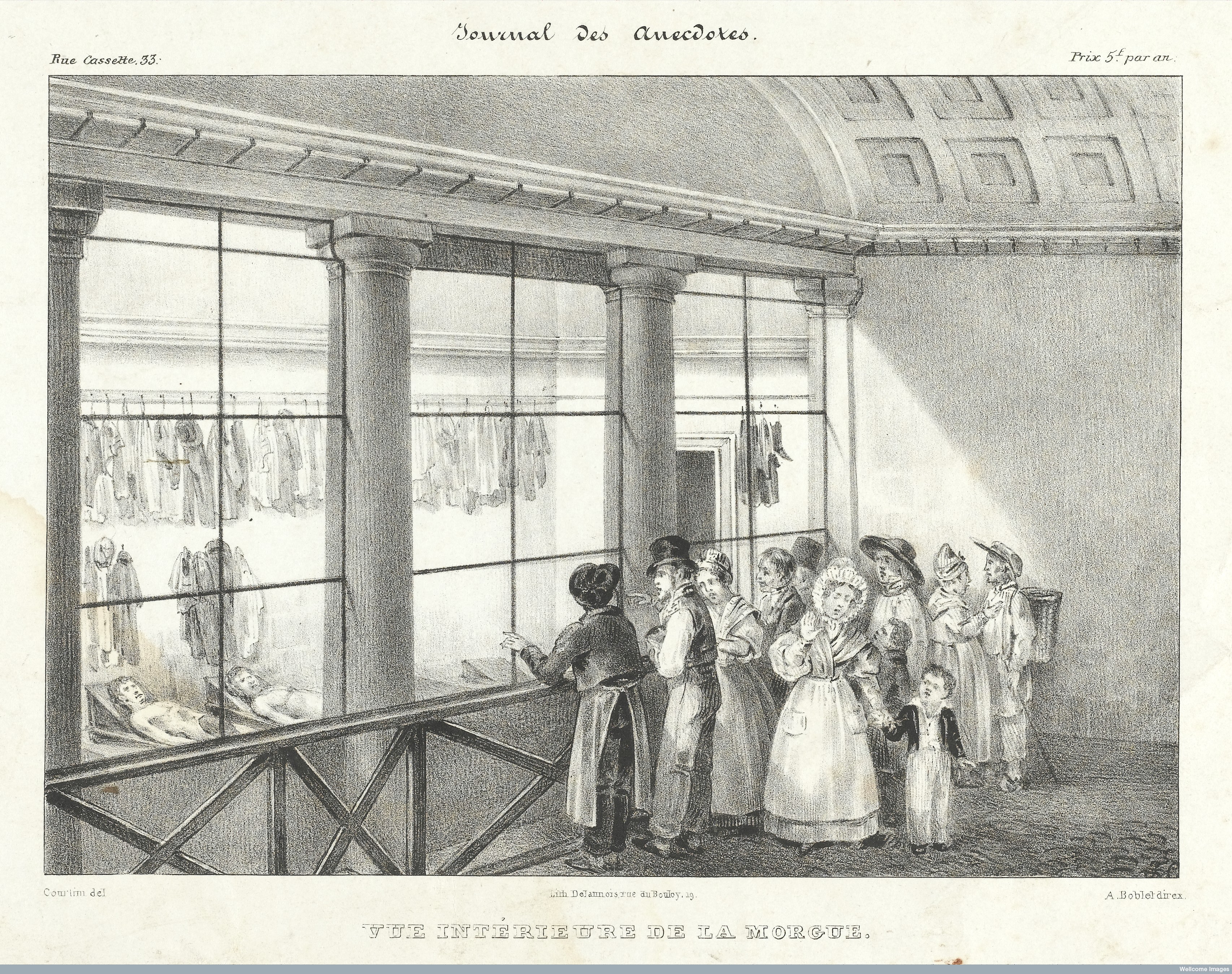
The Biggest Tourist Draw In Paris

by Tracy R. Walsh

L0042495 People visiting the morgue in Paris to view the cadavers.

It used to be the city morgue:

There aren’t many other ways to describe the Paris Morgue during the 19th century other than as a place of entertainment, for Parisians and tourists alike. Conveniently located behind the Notre Dame on the southern tip of the Ile de la Cité, built in 1864, the original purpose of the morgue was of course not to attract tourism but to identify unknown bodies found in the city; many that had been fished out of the Seine or suicides that no one had reported missing. Their unfortunate remains were displayed on slanted marble tables behind glass, inviting friends and families to claim the deceased. Word of the morbid (and free) exhibition of dead bodies quickly spread, and soon the morgue became a fixture on the Parisian social circuit, enticing the curiosity of men, women, even children from all social backgrounds, who would visit regularly, filing past the grisly display, providing themselves with at least a week’s worth of fresh gossip on the possible identities of the corpses and causes of death.

Update from a reader:

I want to point out that MessyNessy’s blog post to which you link today is drawn entirely from the scholarship of the historian Vanessa Schwartz, from her book Spectacular Realities: Early Mass Culture in Fin-de-Siecle Paris. Shouldn’t Dr. Schwartz be mentioned in your post? Historians work hard to dig this stuff up, and they deserve credit.

(Image: A crowd, including a mother and her young son, gathers to view the grisly sight of the bodies at the Paris Morgue circa 1820. Credit: Wellcome Images, Wellcome Library, London.)

Love At A Distance, Ctd

by Chris Bodenner

A reader can relate to Croydon’s reporting on LAT couples:

Let me start a thread!  My GF, love of my life, and I have been together 12.5 years.  We have never lived together and have no intention of ever doing so, except for old-age caretaking plans (which, with luck, might be two decades or more away).  I spend weekends at her place, she spends one night during the week at mine.  I don’t have to have cats (though I’ve come to like hers); she gets to have a small house (in a neighborhood I’d never live in); I get to have my small apartment with a view (in a neighborhood she’d never live in).  She does my laundry; I do her yard work.  The commute is occasionally a pain, but there are many train and biking options.

We call it Permanent Romance.  Every time we are together, it’s special, because we are not together all the time.  It never gets “Oh, you again!”  We’re actually pretty compatible in many small ways (both kind of sloppy, laundry-on-the-floor types), but she’s an introvert who needs lots of time alone to recharge, and I’m an extrovert who likes dive bars full of my friends.  She likes watching TV; I listen to baseball on the radio.  No conflicts, since we’re 25 miles apart 4 nights a week.

Even when we vacation together – usually 10-day trips to Europe – we build in a few hours apart each afternoon.  She has a nap and a bath; I go find a café for a drink and the crossword puzzle. We’re also non-monogamous, so not living together is logistically helpful for that, but it’s the very least of our reasons.  Mostly, we love each other but also love our privacy and time apart. More people should try it.  Eliminating the little daily bullshit battles makes everything else sweeter.

The Big Winners Of Climate Change

by Jessie Roberts

Insurers:

Outside of government agencies, the insurance industry is the primary funder of climate-change research.

A trade group is sponsoring studies on how climate change affects tornadoes and hail. Another is backing university research on land ecosystems in a warming world, especially forests and crops. A British company is focusing on hurricane intensity and temperature rise while an insurer in Bermuda researches cloud seeding to see whether the storms can be stopped before making landfall. A.I.G., for example, just released a climate report of its own, noting “a disproportionate increase in the number of extreme weather events” in North America. [Berkshire Hathaway CEO Warren] Buffett is right: in ten years, if not sooner, calculations are bound to change. Those paying for the best research will get it first and, when they see an immediate risk, they’ll immediately price it in. For their own survival and for the sake of their shareholders, they will have to. Insurance rates will go up. And, if the risk is deemed too high or regulators block massive rate increases, as took place in coastal Florida some years ago, insurers will exit the market.

If profits equal progress, however, the insurance industry is on the right track. While researching a book that I wrote on the topic, I found that, when Hurricane Andrew landed in Florida and Louisiana, in 1992, insurers were caught unprepared, disbursing $1.27 in claims for every dollar of premium earned, for a total of twenty-three billion dollars. Those insurers started paying attention, and raised rates accordingly. Total claims were almost twice that when Hurricane Katrina hit Louisiana thirteen years later—but insurers still came out ahead, losing just 71.5 cents per dollar of premium. Industry profits were forty-nine billion dollars that year. We continue to gamble with our environmental policies. But the insurance industry, year after year, keeps winning.

Finding New Antibiotics Isn’t Easy

by Patrick Appel

The past few decades have lacked major antibiotics discoveries. Derek Lowe shifts blame away from the drug companies:

There’s a persistent explanation for the state of antibiotic therapy that blames drug companies for supposedly walking away from the field. This has the cause and effect turned around. It’s true that some of them have given up working in the area (along with quite a few other areas), but they left because nothing was working. The companies that stayed the course have explored, in great detail and at great expense, the problem that nothing much is working. If there ever was a field of drug discovery where the low-hanging fruit has been picked clean, it is antibiotic research. You have to use binoculars to convince yourself that there’s any more fruit up there at all. I wish that weren’t so, very much. But it is. Bacteria are hard to kill.

How McArdle sees the issue:

Antibiotic resistance is one of the few policy areas where everyone agrees that something should be done. Well, maybe except for some nutcases in the Voluntary Human Extinction Movement. Even more rarely, it is an area where we all agree on what we would like to see done. Unfortunately, the folks who actually have to do it seem to have no idea how to make it happen.

And you know what? That’s not an accident. If we knew how to find lots of great new antibiotics, this wouldn’t be a policy argument; we’d have lots of great new antibiotics, and we wouldn’t need to worry about resistance. The very existence of a policy issue tells you that it is difficult to solve, either politically or technically.

Iran’s Lifesaving Drone Program

by Jonah Shepp

Eat your heart out, John McCain. Motherboard takes a look at what these Iranian scientists are up to:

We’ve seen how drones can be a crucial asset to search and rescue operations, but Iran’s RTS Lab has taken an entirely new angle. RTS’s Pars drone carries a payload of life preservers that can be delivered to a drowning swimmer far faster than a lifeguard. As we saw in testing in the Caspian Sea, the drone can also work at night, using bright lights, thermal sensors, and a built-in camera to stream video to rescuers on shore.

The concept works well, and it’s an excellent example of how powerful drones—which are cheaper and easier to use than just about any other aerial delivery vehicle—can actually be.

Commencement Speakers Are Dropping Like Flies, Ctd

by Chris Bodenner

Several readers dissent:

Your selection of commentary on the rash of protests against commencement speakers seemed really one-sided and off base to me. Some of it was also dripping with contempt for the millennial generation. As a Rutgers alum who is currently an assistant professor at a large state university, I followed the Condi Rice story with interest and think the criticism of protesting students misses the boat.

Protest is a form of speech that is often the only available method of expressing dissent to those in power. As a college instructor, I’m thrilled to see politically engaged students speaking out against awarding honorary degrees and, in some cases, massive speaking fees (Rice was set to be paid $35K) to individuals who they believe do not represent their values. We can’t wag our fingers at millennials for being self-absorbed and then simultaneously criticize them for protesting powerful political figures, which is an inherently social and political act.

Also, at Rutgers, they protested and Rice decided to bow out. That’s a crucial distinction to me.

RU did not rescind its invitation; Rice decided not to attend. Myself, I’ll take vocal dissent over apathy every day of the week. And the likes of Condi Rice and Christine Lagarde should have thicker skin, show up to the event, and directly engage the substance of the dissenters’ point of view. Those dissenters are less powerful, less wealthy, and yes, maybe could learn something new from the engagement. But my sense is the Rices and Lagardes of the world are too privileged and too insulated to seriously entertain the notion of taking a little criticism. They’ll do the event only if everyone kisses their butt on their way to and from the podium.

Another reader makes another key distinction:

Commencement is unique. There is no opportunity for dialogue with a commencement speaker, no debating issues, no public forum where you can criticize them for their errors and try to get them to respond. Their very role of commencement speaker implies that an honor is being bestowed on them by the college, by that graduating class, for their accomplishments in the world outside the campus. And their role on the dais is to shed the value of their status on those about to graduate.

I applaud these students for making their voices heard. They have done the work and paid the price. It is not a false sense of entitlement to believe they do not have to put up with someone as commencement speaker they don’t believe is worth the honor. They are truly entitled to that. They have earned it. I nearly boycotted my own commencement in 1981 because the speaker was George Will. I wish I had had the courage of my convictions to do so at the time, and I salute these students for standing up and making their voices heard on this.

Another suggests that the would-be commencement speakers are the entitled ones:

I’m headed to my 40th Smith College reunion this weekend. I am disappointed that Christine Lagarde has withdrawn as speaker simply because some 400 or so people signed an online petition. Is that really all it takes? I fault Lagarde and the other withdrawing speakers more than the students who signed the petition. I mean really, I get asked to sign online petitions every day, and sometimes I actually do. It doesn’t take much effort, nor does it necessarily mean I’m going to take some further action, like, heaven forfend, hold up a protest sign at a speech or throw rotten tomatoes.

Lagarde’s excuse for withdrawing was that she wanted to “preserve the celebratory experience” of the commencement. There is no indication that there were any threats by petition signers to take any actions that would hamper the celebrations. A few protest signs, if there were going to be any, wouldn’t have done any harm. I feel that these last-minute withdrawals by Lagarde and the other speakers doing so are going to have a chilling effect on the exercise of future student protesters’ first amendment rights to voice their protests. They are in effect saying, “If you complain about me or the institution I represent, I’m going to pack up my marbles and refuse to play.”

If the college and the speaker feel the speaker has something useful to say to the students, they ought to be willing to say it and take a little flak if necessary. I think she’s a coward.

The Very Slow Death Of The Death Penalty

by Patrick Appel

Death Penalty Polling

Enten examines public opinion on capital punishment:

Overall, support for the death penalty is dropping in the U.S., but at a slow rate. When we look at the 70 polls on capital punishment in PollingReport.com’s database taken since 2000, we see that the drop has averaged only 0.4 percentage points per year. The trend suggests that, at this point, about 61 percent of Americans support the death penalty. Some polls (such as a 2013 Pew Research Center survey) put support lower, and some (such as the YouGov survey) put it higher.

If the trend continues, a majority of Americans will support the death penalty for an additional 30 years.

And there isn’t much reason to expect the trend to pick up speed anytime soon. Unlike issues such as same-sex marriage and marijuana, where a large age gap favors the more progressive position, young Americans aren’t all that more likely than older Americans to oppose the death penalty.

Meanwhile, David R. Dow explains why Texas leads the nation in executions:

As a law professor in Texas who, along with my team, has represented well over 100 death row inmates over the past 20 years, I am often asked why Texas executes so many people. This is what I say: Texas executes so many people because it executes so many people. I’m not being flip. What I mean is simply that killing people is like most anything else; the more you do it, the better you get. If killing people were like playing the violin, Texas would have been selling out Carnegie Hall years ago.

To understand how the adage that practice makes perfect applies to the execution of a prisoner, it is helpful to understand the stages and legal intricacies of a death penalty case. The law surrounding the death penalty is complex and often must be dealt with swiftly, as court deadlines and execution dates loom. The more familiar lawyers, government administrators, prison wardens, executioners and the many other relevant actors are with the process, the better they are at seeing it all the way through until its lethal end.

What Made Camus Great?

by Matthew Sitman

Reviewing Robert Zaretsky’s A Life Worth Living: Albert Camus and the Quest for Meaning, Ian Marcus Corbin attributes it to the writer’s “singular commitment to concrete reality” and “determination to not just think, but also to look“:

There is no way for a thinker—or indeed, a user of language—to eschew abstraction entirely, of course, but Camus was deeply attuned to the dangers of excessive abstraction. This may not sound particularly heroic, but it can be, and it certainly was in Camus’s day. Camus’s peers, mid-century French intellectuals, were all too susceptible to the raptures of abstraction. The Left Bank bien pensants were, with few exceptions, stalwart armchair Marxists, obliquely aware that the divine dream of the worker’s paradise was exacting a brutal toll on the actual humans of the Soviet bloc, but blissfully unmoved by this fact. Camus publicly, angrily, charged that their fixation on beautiful ideas made them insensate to the ugly cost such ideas imposed on the much-beloved proletariat. And indeed, it is now difficult—impossible—to think Camus wrong.

Zaretsky quotes the French philosopher Maurice Merleau-Ponty, who writes of the Stalinist horrors with chilling coolness, explaining that only the unfolding of history will “give us the final word as to the legitimacy of a particular form of violence.” Camus righteously fumes in response that “man has been delivered entirely into the hands of history … because we live in a world of abstraction, a world of bureaucracy and machinery, of absolute ideas and of messianism without subtlety.” Camus’s rejection of blood-draining Stalinist abstraction put him far out of favor with his peers, most notably his once-close friend Jean Paul Sartre, who publicly denounced him for his political apostasy.

Claire Messud picks up on another aspect of Camus’s thought – his complicated relationship to Christianity. She praises Sandra Smith’s recent translation of The Stranger for realizing the subtly religious aspects of his prose:

Camus, of course, was more complex in his atheism than we might commonly expect: he was an atheist in reaction to, and in the shadow of, a Catholicism osmotically imbued in the culture (of the French certainly, but of the pieds noirs in particular). The inescapable result is that his atheism is in constant dialogue with religion; in L’Étranger no less than in, say, La Peste.

Sandra Smith has, in her admirable translation, plucked carefully upon this thread in the novel, so that Anglophone readers might better grasp Camus’s allusions. Here is but one key example: the novel’s last line, in French, begins “Pour que tout soit consommé,...” which [Matthew] Ward translates, literally, as “For everything to be consummated.” But as Smith points out, the French carries “an echo of the last words of Jesus on the Cross: ‘Tout est consommé.’” Her chosen rendition, then, is “So that it might be finished,” a formulation that echoes Christ’s last words in the King James translation of the Bible.

Previous Dish on Camus here, here, here, and here.