Lane Florsheim explains how they get away with it despite a 2002 Supreme Court ruling, which found “that executing intellectually disabled individuals violated the Eighth Amendment’s ban on cruel and unusual punishment.” She writes that most “states have opted to use the clinical definition of intellectual disability” but “a number of states have established their own definitions, so that prisoners who test as intellectually disabled in one state could be eligible for execution in another”:
Texas, for example, uses a set of guidelines known as the Briseño factors, which consider whether people who knew the individual as a child think he was intellectually disabled and “act in accordance with that determination”; whether the individual carried out formulated plans or conducted himself impulsively; whether the individual can lie effectively; and whether his offense required forethought, planning, and complex execution, among other considerations. The Briseño factors, which were written by the Texas Court of Criminal Appeals, ask Texas citizens to compare the inmate to the character of Lennie from Of Mice and Men. “Most Texas citizens might agree that Steinbeck’s Lennie should, by virtue of his lack of reasoning ability and adaptive skills, be exempt [from execution],” they read. By implication, an individual who seems less impaired than the fictional character would not be exempt. The Briseño factors are not recognized by a single clinical or scientific body.
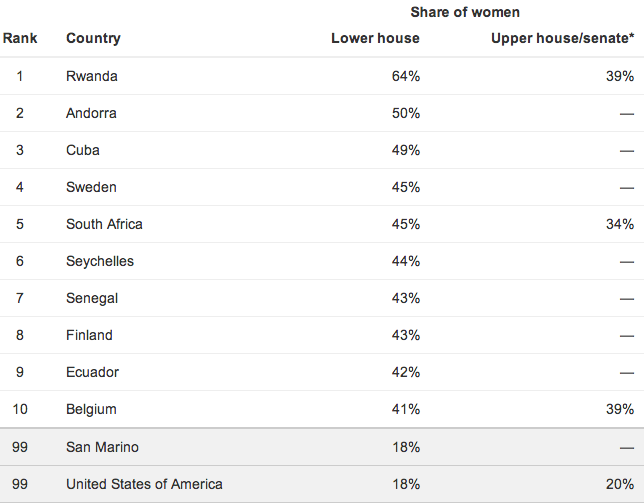
But Leonardo Arriola and Martha Johnson find that the “growth of women in African governance has not necessarily translated into real influence”:
Previous scholarship has shown that women around the world typically receive appointments to less prestigious, more “feminine,” ministerial portfolios like women’s affairs, which are rarely launching pads for greater authority. This remains true in much of Africa. Based on data from 43 African countries between 1980 and 2005, we find that women are significantly less likely than men to receive high prestige appointments in areas such as finance or defense. Women are more likely to be found in medium prestige portfolios like education, which may have sizable personnel and resources but little influence, or low prestige portfolios like culture with small budgets and narrow constituencies.
Update from a reader:
Thanks to your post, I am led to the full list and find where China stands. China’s ranking (61st with 23.4% women in the “single house”), while low, masks the true disparity that is appalling. The people’s congress is known to be the rubber-stamp chamber anyway. Two other statistics could be more telling. Among the officials at or above the provincial and ministry ranks, 11% are women. There are two women in the current politburo of 25, or 8%.
This year, farmers have to make important decisions—and it often comes down to money. If given a choice between keeping fruit trees alive (which take years to mature and can bring 10 times more money per acre), or planting rows of vegetables that live only a few months, that’s a no-brainer if you’re trying to maximize profit. This year, farmers are fallowing vegetable fields and scrambling to save high-dollar fruit and nut orchards. The result is counterintuitive: In the midst of the worst drought in half a millennium, the most water-intensive crops are getting priority.
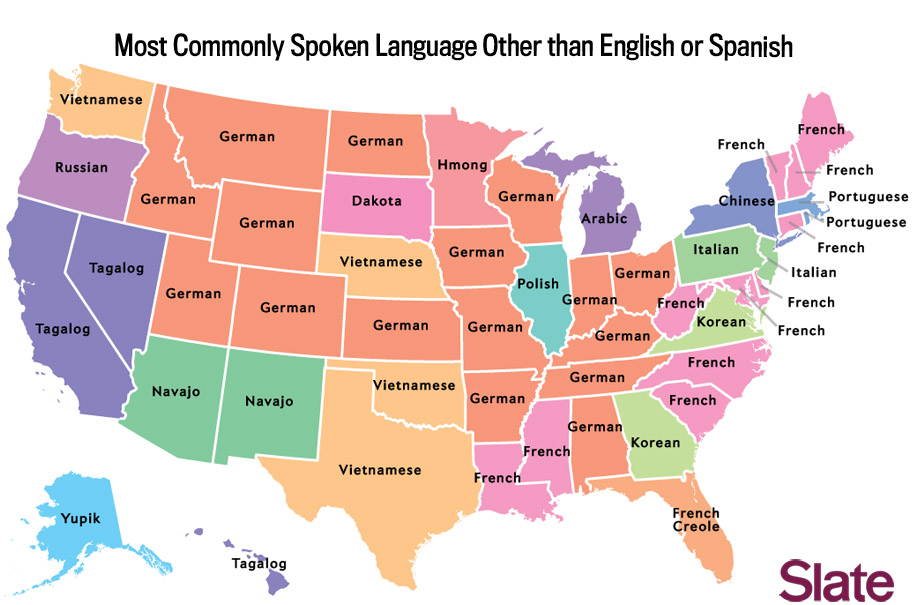
Ben Blatt illustrates the country’s linguistic diversity with a map of the second- and third-most spoken tongues in across America (Spanish is the second-most common language in 43 of the 50 states):
Olga Khazan traces the American tendency to view sleep deprivation as a badge of professional dedication back to Thomas Edison:
Early newspaper accounts touted Edison’s willingness to work “at all hours, night or day,” to frequently rack up more than a hundred hours of work in a week, and his tendency to select his subordinates based largely on their physical endurance. In an 1889 interview with Scientific American, Edison claimed he slept no more than four hours a day, and he apparently enforced the same vigilance among his employees. …
Over time, children’s books and magazines began to promote this type of Edisonian asceticism. “One juvenile motivational text featured a photo of Edison with a group of workers identified as his Insomnia Squad,” [historian Alan] Derickson writes. Early 20th century biographies of Edison featured him interviewing job candidates at 4 a.m. and cat-napping on lab benches between marathon work sessions.
Some short-sleepers might have shrugged and said they were simply biologically lucky. But Edison encouraged all Americans to follow his lead, claiming that sleeping eight hours a night was a waste and even harmful. “There is really no reason why men should go to bed at all,” he said in 1914.
That’s from the Idaho governor’s primary debate – and that biker dude is pretty rad.
Meanwhile, Fox News has a new poll out, and some of the questions deserve this tart riposte from Steve Benen. But it has, for me at least, some interesting data. On the economy, Obama is rebounding in the Fox poll – with an approval rating on that subject higher than at any point since October 2009. On healthcare, support for the ACA is also now the highest Fox has ever found since it became law in 2010. Then these two findings: 63 percent believe that the continuing Republican inquiry into Benghazi is for political gain, rather than seeking the truth; and a whopping 65 percent oppose intervention in the Ukraine.
On another front, a friend forwarded me an old Los Angeles Times story about the debate about marriage equality in the gay community in the mid-1990s. The first two paragraphs tell you a lot:
Elizabeth Birch, head of the Human Rights Campaign Fund in Washington, the nation’s foremost gay lobbying group, believes that the struggle to legalize gay marriage is “one whose time has not yet come. There is no reason that this battle is being played out right now, other than it fits into Republican election strategy.”
On the other hand, Andrew Sullivan, until recently editor and now senior editor at the New Republic and author of the best-selling “Virtually Normal: An Argument About Homosexuality”, says he has “really been surprised by the ferocity of support on this issue. It’s mobilizing the gay community like no other act has done.”
Just a reminder of the history HRC is busy now trying to bury.
Today, we explored the possible ramifications of the abrupt firing of Jill Abramson at the NYT. I didn’t really weigh in much on my long personal experience with Jill, so let me say this: she’s always been an inspiration to me, not least because she never tolerates bullshit, and always tells you what she thinks in that bored-as-hell drone of an accent she has. Whatever the reasons for her departure, she deserved a lot better than this shoddy kicking out the door.
Our new Book Club selection is Alexandra Horowitz’s fascinating insights into the world around us, On Looking, and Maria Popova will be hosting the discussion after Memorial Day. Full details here. You can support the Dish by buying the book through this link. The public library link is here. It’s a great read as summer approaches.
Many posts today were updated with your emails – read all of them here. And you can always leave your unfiltered comments at our Facebook page and @sullydish.
Almost 200 more readers became subscribers over the last couple of days – a surge that came after I sent out a nudging email to those of you who hadn’t gotten around to renewing yet. Yes, you’re still out there. Thanks to everyone who re-upped. Though at least one Founding Member is still procrastinating:
I fucking love your site, I’m just a lazy ass. : ) I promise I’ll get around to renewing, fear not.
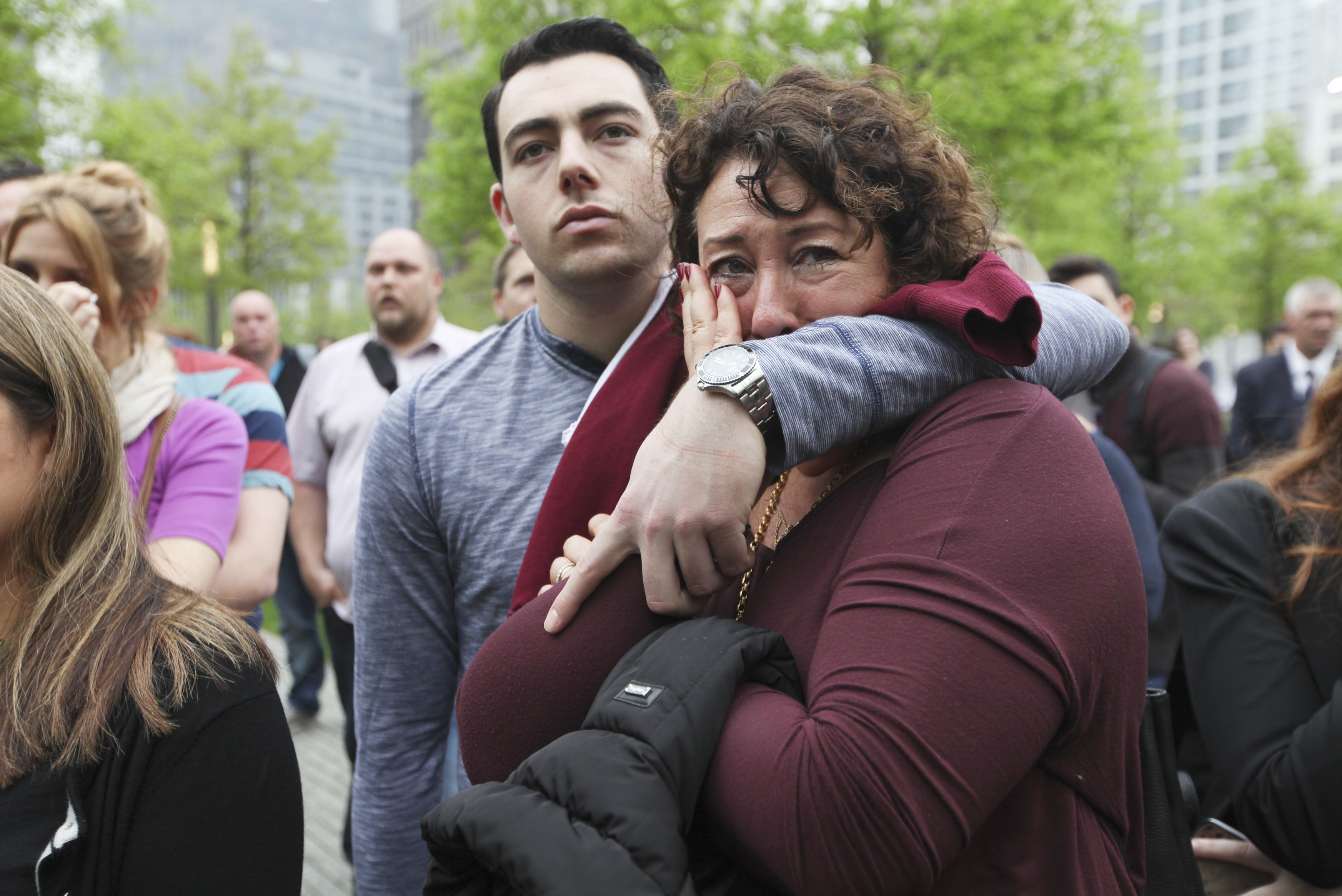
People on the memorial plaza watch a video feed of the opening ceremony for the National September 11 Memorial Museum at Ground Zero on May 15, 2014. The museum spans seven stories, mostly underground, and contains artifacts from the attack on the World Trade Center Towers that include the 80 ft high tridents, the so-called ‘Ground Zero Cross,’ the destroyed remains of Company 21’s New York Fire Department Engine as well as smaller items such as letter that fell from the hijacked plane and posters of missing loved ones projected onto the wall of the museum. The museum will open to the public on May 21. By Allan Tannenbaum-Pool/Getty Images.
Transcendence may be the “most persuasive evidence of God,” but this is not how it operates in the lives of most religious men and women. They do not require evidence of God; their concern is not to defend His existence, but simply to serve Him. Some of them may never even have a “highly personal transcendent experience,” but for those who do, it is less a great and strong wind or an earthquake or fire than a kol d’mamah dakah summoning the believer to go and return to her way.
In Christopher Beha’s astonishing debut novel What Happened to Sophie Wilder (reviewed here), the title character is attending mass at a small parish church when she is invaded by the Holy Spirit—she is taken over by “something outside of herself, something real, not an idea or a conceit or a metaphor”—but rather than pursuing a repetition of the experience, she dedicates herself to caring for her father-in-law as he dies painfully from cancer.
The ordinary religious duties (or what she, as a Catholic, would call humility) are what gives permanence to the moment of transcendence. Neglecting them she might have managed to “hook up” with God, but only briefly and without meaning.
In a follow-up post, Myers turns to a passage from Beha’s second novel, Arts & Entertainment, to warn of what happens when such “ordinary religious duties” aren’t cultivated:
As a ten-year-old altar boy at his family’s parish in Queens, Eddie had experienced a single unforgettable moment of what adults might call transcendence, when his whole body buzzed with the presence of something other than himself, a moment he had never talked about to anyone and didn’t like to think about now, because it still seemed unmistakably real to Eddie and didn’t make any sense to him.
Instead, Eddie tries to find substitutes for the experience in acting (“Something like that feeling had sometimes visited him while he was onstage”), and it remains without religious significance for him: “If asked, he would have said he was Catholic, just as he would have said he was Irish—it was a matter of birth, not of action or belief.”
Everything that happens to Eddie in the sequel is a consequence of his failure to make “that feeling” the basis of action or belief. Like so many of his contemporaries, he prefers the fever to the habit.
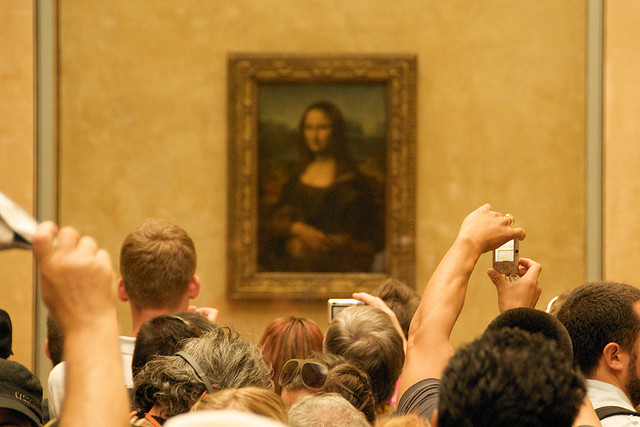
In an essay that explores why some works of art achieve legendary status while others languish in obscurity, Ian Leslie investigates why, exactly, the Mona Lisa became so famous only in the 20th century. It “wasn’t a scholarly re-evaluation,” he explains, “but a burglary”:
In 1911 a maintenance worker at the Louvre walked out of the museum with the “Mona Lisa” hidden under his smock. Parisians were aghast at the theft of a painting to which, until then, they had paid little attention. When the museum reopened, people queued to see the gap where the “Mona Lisa” had once hung in a way they had never done for the painting itself. The police were stumped. At one point, a terrified Pablo Picasso was called in for questioning. But the “Mona Lisa” wasn’t recovered until two years later when the thief, an Italian carpenter called Vincenzo Peruggia, was caught trying to sell it to the Uffizi Gallery in Florence.
The French public was electrified. The Italians hailed Peruggia as a patriot who wanted to return the painting home. Newspapers around the world reproduced it, making it the first work of art to achieve global fame.
From then on, the “Mona Lisa” came to represent Western culture itself. In 1919, when Marcel Duchamp wanted to perform a symbolic defacing of high art, he put a goatee on the “Mona Lisa”, which only reinforced its status in the popular mind as the epitome of great art (or as the critic Kenneth Clark later put it, “the supreme example of perfection”). Throughout the 20th century, musicians, advertisers and film-makers used the painting’s fame for their own purposes, while the painting, in Watts’s words, “used them back”. Peruggia failed to repatriate the “Mona Lisa”, but he succeeded in making it an icon.
Although many have tried, it does seem improbable that the painting’s unique status can be attributed entirely to the quality of its brushstrokes. It has been said that the subject’s eyes follow the viewer around the room. But as the painting’s biographer, Donald Sassoon, drily notes, “In reality the effect can be obtained from any portrait.” [Sociologist] Duncan Watts proposes that the “Mona Lisa” is merely an extreme example of a general rule. Paintings, poems and pop songs are buoyed or sunk by random events or preferences that turn into waves of influence, rippling down the generations.
(Photo of the Mona Lisa in the Louvre by Thomas Ricker)
Reihan Salam wants the vertically challenged to stick up for one another:
As I go through life, I will occasionally say, “well, as a short person …” before making some observation. And I’ve found that my interlocutor will often interject something to the effect of, “Hey, you’re not that short,” as if to reassure me. But why would this be reassuring if there were nothing wrong with being short? This is the root of the problem. I come from a long line of fierce and proud short people, who proved resilient in the face of all manner of natural calamity. My ancestors had small bodies that were tailor-made for sweating, which allowed them to work long hours in sweltering heat in South Asia’s swampy marshlands. The notion that being short is something to be ashamed of strikes me as deeply wrongheaded.
His call for unity:
To the short men among you, I’d like to ask:
Have you ever poked fun at someone for their size? Have you done so to delight your taller friends, and to establish that you are truly one of them? If so, I’d like you to think hard about the place in hell that is reserved for your ilk. If you have no fear of hell, consider this: Do you think that your chums respect you more or less for selling out one of your own?
It is those men who hover within spitting distance of the average height who have a special obligation to stick up for short men as a whole. When other short men are getting pushed around, it is these men who must speak up. Is someone making fun of “midgets”? Now is the time to get in their face. When presented with the opportunity to seamlessly blend in with average-sized or tall people, it is these men who must reject it, and to assert the importance of treating all people fairly and humanely, regardless of their size. And if the time comes when discrimination against short people intensifies, it is these men who must join the general strike that will bring the entire architecture of anti-short-people oppression to its knees. My credo is simple: Stay short. Stay strong. And when you see a short brother in need, do something about it.

 The Dish